
Executive launches Civic Campus initiative in State of the County address


King County Executive Dow Constantine delivered his 2023 State of the County address to the King County Council Tuesday that highlighted progress in the last year and continued work ahead, including the need for action in the state Legislature to avoid budget cuts this fall.
In his address, Executive Constantine launched the Civic Campus initiative, a proposal to reimagine the courthouse neighborhood, and with Sound Transit considering the shuttered Administration Building as the site for a new Link Light Rail station, Executive Constantine urged making the most of the opportunity if selected. He also urged the legislature to remove the 1% cap on the county’s primary funding source, and build statewide solutions to behavioral health.
“This historic area can remain a center of local government, but it can also be so much more: a neighborhood with residents of all incomes, with shops and restaurants and gathering spaces, a place that enlivens and supports the surrounding neighborhoods,” Executive Constantine said. “Public and private workplaces that reflect the way people work in this new era. It’s clear that we’re not simply going back to how things were — so let’s use this moment to go forward.”
You can learn more in the press release and full transcript, and the video of his remarks.
Share this:

Watch 2023 State of the County address today at 1 p.m.

King County Executive Dow Constantine will deliver his 2023 State of the County address at 1 p.m. on Tuesday, March 7, and employees are invited to watch the address live from their workstations.
You can watch Executive Constantine’s address streaming live on this webpage and on KCTV Channels 22 and 322 (HD). The Executive’s remarks will begin a little after 1 p.m.
Every year, during the State of the County address, Executive Constantine discusses the condition of our County and outlines his legislative agenda and priorities to the people of King County.
Video and the text of the Executive’s address will be available soon after the event.
The State of the County address is a County-sponsored event and King County directors, managers, and supervisors are encouraged to permit employees to join, if possible. Employees should speak with their manager about HR policies regarding employee attendance at County-sponsored events.
Share this:

Contribute sick or vacation time to help coworkers in need


King County’s leave donation programs allow you to help colleagues affected by catastrophic health conditions or injuries, or those who are caring for family members, by donating sick or vacation hours.
The Emergency Medical Leave Fund allows you to donate accrued leave to a central fund that can be distributed to other employees who have a qualifying need. You can donate up to 80 hours of accrued vacation and 25 hours of accrued sick leave each calendar year.
The Employee-to-Employee Medical Leave Donation Program allows you to donate any amount of your accrued vacation time directly to another employee, and up to 25 hours of your sick leave per year, as long as you have 100 hours or more of sick leave remaining.
Donated leave can only be used for a qualifying family or medical reason—such as your own serious health condition or the serious health condition of an eligible family member, or to bond with a new child—and can only be used after you’ve exhausted all of your own accrued leaves.
For more information, including forms and an FAQ, go to the Taking leave webpage. If you have questions about donating leave, contact the Benefits Team 206-684-1556 or KC Benefits.
Share this:

Salvation Army and Sheriff’s Office collaborate to help family living in vehicle
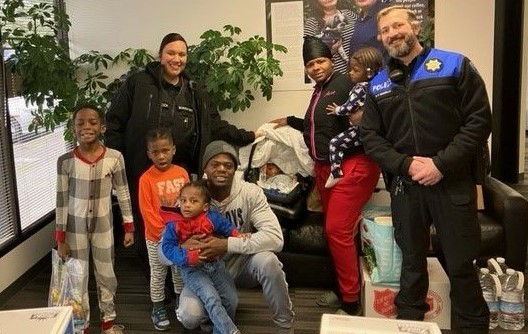
From the Sheriff’s Newsletter

In the early morning hours of Feb. 16, Master Police Officer (MPO) Omar Jackson contacted the occupants of a vehicle parked outside a gas station-car wash- laundromat. He learned that a family of seven was living in that car.
In speaking with the father, MPO Jackson was told that recently the entire family had moved to the area from the southeast and the father had also lost his job. As an experienced tradesman, he was willing and able to work.
The five kids ranged in age from two months to eight years. MPO Jackson and Mental Health Professional (MHP) Daisy Espinoza reached out to the Salvation Army Street Level team to assist the family. The Salvation Army coordinated a hotel stay for them until they move into their new home.
MHP Espinoza and MPO Jackson later met with the family of seven at the Salvation Army Street Level office in Tukwila. They provided them with a week’s worth of food, baby formula, and diapers. Initially, the father was hesitant, but MPO Jackson let the man know that he would try to connect them with the services they so badly needed. Eventually, he was accepting of the combined efforts and follow-through. The Salvation Army even coordinated a job interview for the father.
The Sheriff’s Office would like to thank everyone involved. This collaborative effort shows the effectiveness of working with the Salvation Army’s Street Level team to help those needing services.
Share this:

Use your 2022 FSA funds

If you still have funds remaining in last year’s Health Care or Day Care Flexible Spending Account (FSA), be sure to get reimbursed for expenses incurred in 2022. There are a variety of ways to submit claims and the deadline is March 31, 2023.
Click here for details and information on how to submit claims.
If you have questions about your FSA, contact Navia at 800-669-3539 or Navia Customer Service.
Share this:

Dog adoption for $50 in March

Cross-posted from Tails from RASKC
Regional Animal Services of King County (RASKC) has a full house – all aces, no jokers – and that means a dog-gone good deal for you. During the month of March, you can ante up just $50 to adopt an adult dog – a savings of 50% or more off the regular adoption fee. Read more.
Share this:

Animal Control Officers juggle many responsibilities

Cross-posted from Executive Services Express
Being an Animal Control Officer (ACO) involves much more than chasing loose animals.
“There’s a lot more that we do and that we’re exposed to that the average citizen does not think about,” said Sam Moore, an ACO at Regional Animal Services of King County. Read more.
Share this:

Local Services program welcomes Jacques Imperial

From the Department of Local Services blog
Local Services’ goal of empowering residents to determine how money is spent in their neighborhoods just got a valuable addition.
Jacques Imperial recenlty joined Local Services as the Participatory Budgeting program’s new Administrator. In her new position, Jacques will help Program Manager Gloria Briggs, who is currently seeking applicants to serve on the program’s Steering Committee for 2023-24.
“My passion for public service stems from helping those whose voices are often unheard and ensuring that when communities seek government assistance, they get the best customer service possible,” Jacques says. “I am excited to be a part of the Local Services team that shares these same values.” Read more.
Share this:

Washington State Spring Fair discounts

The Washington State Spring Fair features all the usual carnival favorites like great entertainment, yummy food, wild rides, adorable animals, and more. The Fair will take place April 13-16 and April 20-23 in Puyallup
Click here for more information and discounted tickets, or go to TheFair.com/corporate.
See all available discounts on the Employee Discount webpage.
Share this:

March 13–19 is Neurodiversity Celebration Week

Neurodiversity Celebration Week is a worldwide initiative that challenges stereotypes and misconceptions about neurological differences. It aims to transform how neurodivergent individuals are perceived and supported by providing schools, universities, and organizations with the opportunity to recognize the many talents and advantages of being neurodivergent, while creating more inclusive and equitable cultures that celebrate differences and empower every individual.
To learn about how you can support people with neurodiverse conditions at home, at work, and in your community, visit https://www.neurodiversityweek.com.






 Employee News