
Kudos! to the King County Medic One team
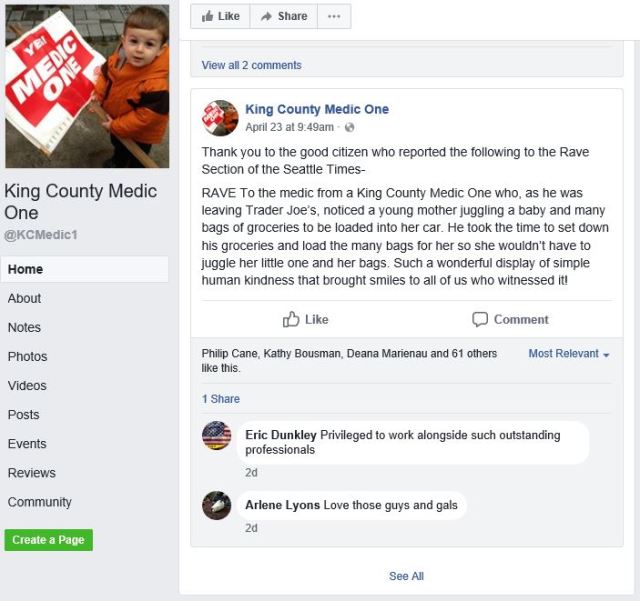
The King County Medic One team gave a Facebook tip-of-the-hat to “the good citizen” who reported a good deed by the team to the Seattle Times RAVE section. Good citizenship all around, including by our King County team members!
From Medic One’s post on Facebook: “Thank you to the good citizen who reported the following to the Rave Section of the Seattle Times RAVE: ‘To the medic from a King County Medic One who, as he was leaving Trader Joe’s, noticed a young mother juggling a baby and many bags of groceries to be loaded into her car. He took the time to set down his groceries and load the many bags for her so she wouldn’t have to juggle her little one and her bags. Such a wonderful display of simple human kindness that brought smiles to all of us who witnessed it!’”
Share this:

Featured Job: Ballot Collection & Logistics Supervisor

Closing: 05/13/18 11:59 PM (GMT -8:00)
Salary: $31.49 – $39.91 Hourly
Location: King County Elections – 919 SW Grady Way, Renton, WA 98057-2906
Job Type: Career Service, Full Time, 40 hrs/week
Department: Department of Elections
Job Number: 2018-08063
Description: This is an amazing opportunity to be engaged in the election process! The Department of Elections is recruiting a Ballot Collection & Logistics Supervisor. Under the direction of the Elections Services Manager, this position will provide logistical support for ballot collection and the necessary fleet and warehouse tasks aligned with this work. Duties include the supervision of ballot drop box collection program including: planning and logistics for the operations and support of ballot collection, training of short-term temporary staff, dispatching of driving teams and closers, oversee procedures for securely receiving and processing of ballots, and customer relations with vendors and external customers.
Contact: For more information, contact Queniya Lassiter at 206-477-3773 or Queniya.Lassiter@KingCounty.gov.
Learn more about this position or all available jobs.
Share this:

Social Media Spotlight: EcoConsumer on YouTube

 Green spring fashion, sustainable communities and indoor air quality are just three of the topics you can enjoy learning more about on EcoConsumer’s YouTube channel! KOMO4 News features the team discussing a number of topics; most recently, Earth Day. EcoConsumer is a public outreach program of DNRP’s Solid Waste Division.
Follow King County EcoConsumer on YouTube today.
Click here to view all King County social media pages.
Share this:

Japanese-American Remembrance Trail Map
Crossposted from GIS & You
By Patrick Jankanish, GIS Specialist and Senior Cartographer with KCIT
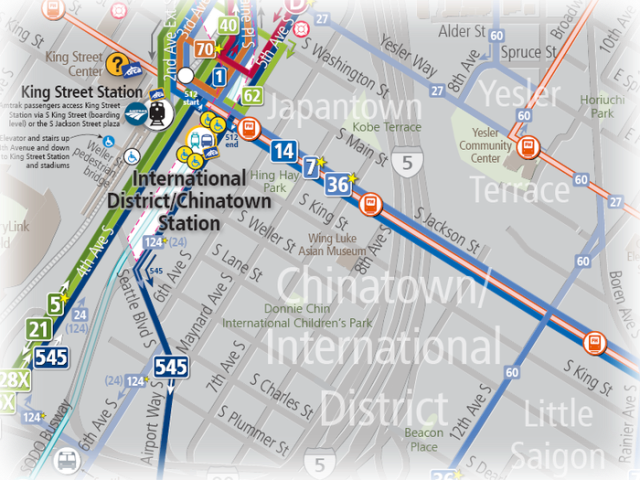
One of the most satisfying things that a well-made map can do is convey a sense of place. And an especially well-made map may convey a sense of a past place that both infuses and transcends a present location. I came across such a map yesterday just a few blocks from our own King County GIS Center location, where Seattle’s Pioneer Square transitions to the International District, specifically the historic Japantown.
The “Japanese-American Remembrance Trail Map” somehow seems larger than its modest tabloid print size, due in no small part to the numerous delightful and intriguing hand-drawn illustrations of people and places throughout the ID that are spread across the map, fusing past and present. For us in the present, the map serves as a walking tour of current sights, sounds, tastes, and touch, which can all be gateways to the rich Japanese American legacy in Seattle, a cultural story that continues into our city’s future. (Coincidentally, as I write this I am hearing a radio announcement for this weekend’s—April 20-22—Seattle Cherry Blossom & Japanese Cultural Festival, which two of my KCGIS Center colleagues will be participating in.)
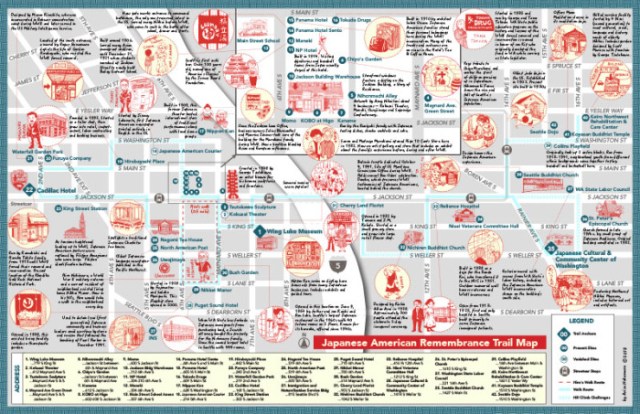
Japanese American Remembrance Trail Map by Arisa Nakamura ©2018
The trail map—as useful as it is a great piece of art—was designed and illustrated by Seattle’s Arisa Nakamura. Read more about her work on the map in this article in The North American Post. The map is available in separate English- and Japanese-language versions at locations throughout the Chinatown/International District, including the Wing Luke Museum of the Asian Pacific American Experience, which is one of the anchors of the Japanese American Remembrance Trail. The Wing Luke Museum website has a section about the trail tour and links to PDF files of both versions of the map.
As the late winter, early spring chill finally relinquishes its grip on Seattle, it’s the perfect time to put on your walking shoes and let a wonderful map lead you through and teach you about a special part of our city.
Patrick Jankanish is Senior Cartographer in the King County GIS Center and is a member of its Spatial Services group.
Read more at GIS & You.
Share this:

Tech Tip: Conference Room Smartboard Training

King County Information Technology is installing more smartboards in Department Conference Rooms. These tools allow unprecedented collaboration for departments, employees, external partners and customers. If you aren’t sure how to maximize these new tools, join us for a drop-in training session in Chinook.
Smartboard Training
Smartboards are in 50+ county conference rooms. To make the best use of the new technology, KCIT is offering three training sessions in May. Drop-in for 10 minutes or stay for 30. No signups required.
What: Open house! A Surface Hub Tour and Live Demo: The Future of Online Collaboration
Who: Jeremy Birney and Alex Patrut
May 7, 2018, anytime from 9:30 a.m. until 4:30 p.m., Chinook 714 “Reboot” Conference Room & Chinook 931 “Compiler” Conference Room
May 11, 2018, anytime from 9:30 a.m. until 4:30 p.m., Chinook 616 “Avatar” Conference Room & Chinook 714 “Reboot” Conference Room
Share this:

Listen to Executive Constantine on KUOW’s “The Record”

 King County Executive Dow Constantine joined KUOW host Bill Radke on Tuesday, April 17, to discuss a range of issues, including the new Children and Family Justice Center, which is being built to replace the failing Youth Services Center.
“King County has long had a goal of reducing the number of kids involved in the justice system, including the number detained,” Executive Constantine said during the interview. “Over the course of the last 20 years we’ve reduced the number of kids in detention from around 200 on an average day to, on this last Friday there were 34.”
Radke and Executive Constantine also discussed options for reforming the state tax system and ways that King County is tackling homelessness, among other issues. You can listen to the full interview here.
(Featured Image: Megan Farmer / KUOW)
Share this:

Local cases of E. coli linked to romaine lettuce outbreak
 Crossposted from Public Health Insider
Two King County siblings, both under age 5, have been diagnosed with E. coliromaine-lettuce-medium 0157:H7 infections that genetically match the ongoing national outbreak linked to romaine lettuce. One child was hospitalized and has since been discharged. Both children have recovered and neither child developed hemolytic uremic syndrome (HUS), a type of kidney failure that can result from an E. coli infection.
Public Health’s disease investigators are currently working to identify the exact source of the E. coli exposure and suspect romaine lettuce as a potential source but it is not yet confirmed. Other members of the family ate romaine lettuce and were also ill but were not tested for E. coli. It is possible that the children contracted the illness from other ill family members rather than from eating romaine lettuce. The family reported that they have not traveled out of state recently, suggesting that the family’s exposure to E. coli was local.
An additional case of E. coli linked to the national outbreak was found in a King County resident in her 50s who had eaten romaine lettuce while traveling out of state.
Connection to national outbreak
The national outbreak related to romaine lettuce has been ongoing since mid-March. The infections in these two siblings appear to be the first locally acquired cases. As of April 26, 98 people ill from a matching E. coli 0157:H7 infection have been reported from 22 states. The Centers for Disease Control and Prevention (CDC) and the Food Drug Administration (FDA) have been looking into these cases and so far, the information indicates that romaine lettuce from the Yuma, Arizona growing region could be contaminated and make people sick.
Consumer advice about romaine lettuce
The CDC has issued advice to protect consumers:
- Avoid all romaine lettuce from the Yuma, Arizona growing region, including whole heads and hearts of romaine lettuce, chopped romaine, and salads and salad mixes containing romaine lettuce.
- Do not eat or buy romaine lettuce unless you can confirm it is not from the Yuma, Arizona, growing region.
- Product labels often do not identify growing regions, so don’t eat or buy it if you don’t know where it was grown. If you do not know if the lettuce is romaine, do not eat it.
Symptoms of E. coli
Talk to your healthcare provider if you have symptoms of an E. coli infection: diarrhea that can be bloody, severe stomach cramps, and vomiting. Anyone who is ill with suspected E. coli should not work in food handling, patient care, or child care settings. Ill children with suspected E. coli should not attend daycare until they have seen a healthcare provider and been tested for E. coli infection even if their illness is mild.
What do restaurants and retailers need to do?
Retailers, restaurants, and other food service operators should not sell or serve any romaine lettuce from the winter growing areas in Yuma, Arizona. This includes whole heads and hearts of romaine, chopped romaine, baby romaine, organic romaine, and salads and salad mixes containing romaine lettuce. If you cannot verify the source of your romaine lettuce, do not sell or serve it.
Food workers should always take steps to avoid the cross contamination of cutting surfaces and utensils through contact with potentially contaminated products. As a reminder, follow these precautions:
- Regularly wash, rinse and sanitize display cases, cutting boards, refrigerators, and other food contact surfaces where potentially contaminated products were stored in order to avoid cross contamination of surfaces.
- Wash hands with hot water and soap following the cleaning and sanitation process.
- Always wash all leafy greens (e.g., romaine lettuce) with water thoroughly with water before use.
- Always store cut leafy greens in refrigerator under temperature control 41ºF or below.
If you have questions please call the Public Health – Seattle & King County at 206-263-9566. Learn more about recommendations for restaurants and retailers.
For more about the national outbreak, visit the CDC’s webpage.
For more on E.coli, visit Public Health’s webpage on shiga-toxin producing E. coli.
Share this:

Wastewater employee’s hard work saves ratepayers $32 million

On April 19, the U.S. Environmental Protection Agency issued its first-ever loan from the Water Infrastructure Finance and Innovation Act (WIFIA) for $134.5 million to the King County Wastewater Treatment Division to help finance the Georgetown Wet Weather Treatment Station.

Dan Kaplan, Wastewater Treatment Division Financial Services Administrator
Organizations have to be invited to submit an application, and the deadline is tight. Dan Kaplan, WTD financial services administrator, devoted one year to the pursuit of the low-interest loan, which will save ratepayers $32 million in interest payments over the life of the loan.
Dan had to first analyze and determine this was a good source of funding for WTD, and then had the tough task of convincing the EPA that the project was what they were looking for – that we could deliver it on time, and that we were able to engage in the challenging application process.
The WIFIA program supports spending on water and wastewater infrastructure. The Georgetown Wet Weather Treatment Station is designed to significantly reduce the amount of untreated wastewater and stormwater entering the Duwamish River, and will create approximately 1,400 direct and indirect jobs.
Of 44 national projects, only 12 were selected to proceed to the application stage.

Wet weather treatment stations clean overflows locally on-site during heavy rain storms.
It took three months to complete the application package, which required legal, engineering, and financial information from attorneys, project managers, permitting managers and finance staff. The process involved producing 32 pages of narrative, 70 exhibits, a preliminary rating letter from bond rating agencies, and a two-hour video conference presentation.
As this was the first loan ever awarded from the WIFIA program, the draft loan agreement included more than 100 pages of technical and legal requirements, which were reviewed in detail. Then the final loan language was negotiated. Dan managed a team of experts, including bond counsel, bond advisor, debt manager, prosecuting attorneys and project managers in developing an agreement that will provide the template for similar loans in the future.
For more information on the project, visit the Georgetown Wet Weather Treatment Station site.
Share this:

EcoConsumer Tom Watson on KOMO4 News

In observance of Earth Day, KOMO4 News hosted King County EcoConsumer’s Tom Watson and four of his special guests to showcase youth innovators and leaders who are working on great projects and making a difference in our communities.
“Earth Day is all about the future” said Watson, “and our guests today are the future.”
Two of Tom’s guests were University of Washington students Maika Bui and Kaitlin Tighe, from the team that won the 2018 Alaska Airlines Environmental Innovation Challenge Grand Prize with their BioPots – biodegradable planting pots that are an earth-friendly alternative to the plastic containers typically used for the seedlings and flowers we buy.
Watch the KOMO4 coverage of Tom and his fantastic guests below:
Maika Bui explained, “It is a biodegradable pot that is plantable, that is made of wood fiber and spent beer grain. Over 1.6 billion pounds of plastic end up in landfills every year because of plastic pots. With BioPots, we hope displace that.” Kaitlin Tighe then demonstrated how the pulp and spent grain – a waste product from the beer industry – combine to form a slurry that is poured into a mold, producing the BioPots.
“That is so, so functional, and helpful for the environment as well,” said KOMO4 Anchor Mary Nam. “Alright, very cool.”
Tom’s other two guests were Duwamish Valley Youth Corps’ Daniella Cortez and Director Carmen Martinez. Daniella shared with KOMO4’s Mary Nam how youth corps members are learning about environmental issues in our communities and spending usually one day a week taking action to make the Duwamish Valley community a better place, emphasizing the love the community has for Seattle’s only river, saying, “… it’s really important to the people here in South Park and Georgetown, because we do live right there and it is a big part of our community. We love our river, and it’s a beautiful thing to have. But, if we don’t take care of it, we’re not going to have it for much longer.” Director Martinez shared details about the youth corps’ tree planting program.
King County EcoConsumer is a DNRP Solid Waste Division program. Tom and the rest of the EcoConsumer team share the stories of many of their impactful efforts on their King County EcoConsumer Twitter feed, Pinterest board and YouTube channel. The KOMO4 coverage of Tom and his fantastic guests can be viewed here on their YouTube channel. Past KOMO4 features are available on EcoConsumer’s King County site.
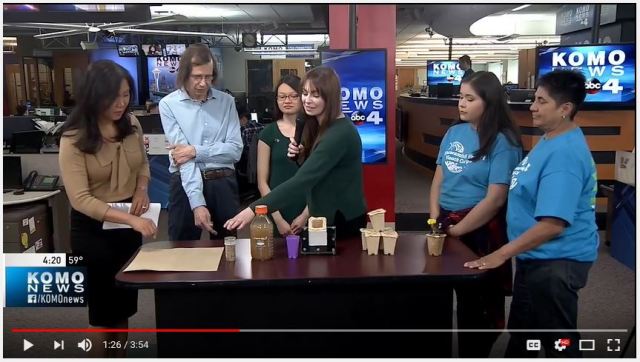
From left to right, KOMO4’s Mary Nam, King County EcoConsumer’s Tom Watson, University of Washington students Maika Bui and Kaitlin Tighe, and Duwamish Valley Youth Corp’s Daniella Cortez and Director Carmen Martinez.
Share this:

Buy small and local through Amazon? Yes you can!

This is National Small Business Week. We know that small businesses are the backbone of our regional economy, contributing billions of dollars and thousands of jobs. King County has a long tradition of supporting local small businesses through our Small Contractors and Suppliers (SCS) certification program, as well as other efforts, and we want to do even more to support these entrepreneurs.
 Last year, King County purchased nearly $1 million from thousands of sellers through Amazon Business – and we want to direct more of that spending toward small businesses.
If you use Amazon Business to purchase goods for the county, you’ll see that Amazon Business highlights SCS-certified small businesses as “preferred King County sellers.” If available, you’ll see their products first in your Amazon Business search results.
For purchases less than $10,000, you may use your discretion to purchase from these preferred sellers and support SCS-certified small businesses (even if it’s not the lowest price available). In September, we’ll evaluate how this approach benefits local small businesses, and the overall impact on King County spending. Our goal is to direct at least half of our purchases under $10,000 to small businesses.
Learn more about the Amazon Business Pilot program at here on the King County website or contact Procurement and Payables at Procurement.Web@kingcounty.gov.
View this video to learn more about the pilot.






 Employee News