
Employee safety reminders as the fall season begins

Fall officially arrived on Sunday, Sept. 22 so it’s time to get ready for changes in the weather and less daylight. Daylight saving time ends on Sunday, Nov. 3 at 2 a.m. which means turning your clocks back one hour on Saturday, Nov. 2 before you go to bed. It is important to prepare for these seasonal changes. If you drive, you should have an emergency kit in your vehicle, including extra clothing, food, water, and a flashlight. If you work on site, have a plan for your commute, dress warmly, and let safety be your guide when making commute decisions. King County cares about the safety of our employees so please familiarize yourself with the safety programs listed below:
Walking Bus: King County’s employee “Walking Bus” pilot program offers five afternoon departures from the King County Courthouse to King Street Station and Colman Dock via the Pioneer Square light rail station. In this pilot phase, which started last November, King County employees can join their colleagues and a Facilities Management Division (FMD) Security Escort each weekday evening walking from the Third Avenue entrance of the King County Courthouse to the King Street Station and Colman Dock via a stop at the Pioneer Square light rail station entrance at Jefferson Street and Yesler Way. Download this flyer for routes and departure times and learn more here.
Escort Program: Upon request, King County provides security escorts in downtown Seattle for individuals moving between their workplace and their commute. Please contact the Emergency Dispatch Center (EDC) at 206-296-5000 to arrange for a security escort whether coming in to work or leaving work. Escorts are limited by available staff.
Walkpool: Walkpool is a program where you can walk to and from work with a buddy. Visit the Employee Transportation Program website for more information.
Home Free Guarantee: King County employees who come to work via bus, rail, streetcar, carpool, vanpool, biking, or walking are eligible for eight free taxi rides home each year in cases of personal emergency or unexpected requests to work overtime. Visit the Home Free Guarantee website to learn about who is eligible and how to arrange a ride.
Stay informed about county emergencies
- Sign up for KCInform, King County’s employee alert and warning system. KCInform is used to reach County employees during an emergency with timely information about infrastructure disruptions, facility impacts, changes in your department’s business operations, and other critical impacts. Your King County desk phone and @kingcounty.gov email are already in the system. It is important to register your County-issued cell phone (if applicable), personal cell phone, and personal email address to ensure you receive time-sensitive messages. This service is free, and your personal contact information is secure and protected. To sign up, please contact kcinform@kingcounty.gov anytime or 206-296-3830 between 8:30 a.m. – 4:30 p.m. Monday – Friday to request your unique registration link. Visit the KCInform website to learn more or watch our short video.
- Call the Employee Hotline—206-205-8600 (save it to your phone now).
- Check your King County email for information on business operations, delays, and closures. Some agencies may send additional instructions directly to their staff.
- Contact your supervisor for specific instructions.
- Visit the Emergency News page at KCEmergency.com for regional impacts.
Resources for travelers
- Metro, Water Taxi, Streetcar: Sign up to receive transit alerts (via text and email) for routes you use regularly or during inclement weather. Visit MetroWinter.com to learn about snow routes, and review bus route changes before traveling on Metro’s service advisories web page. Recent transit alerts can be viewed in Metro’s RSS feed via desktop or mobile RSS reader.
- Sound Transit: If you travel on Link light rail, Sounder or ST Express buses, Sound Transit keeps riders informed of disruptions at their Service Alerts web page, where you also can sign up to receive alerts via text and email.
- Roads: Visit Roads’ Snow and Ice resources and sign up for King County Road Alerts (text, email, tweets via @kcroads)
To report a non-emergency incident, use our online form, call 206-296-5000, or email FMD.Security@kingcounty.gov. In case of emergency, call 911. See additional resources and programs for personal safety at work.
Share this:

Test of KCInform employee alert and warning system on Oct. 17

King County will conduct a test of KCInform, King County’s employee alert and warning system, on Thursday, Oct. 17 between 9 and 10 a.m. as part of the annual Great Washington ShakeOut drill to test earthquake preparedness.
KCInform is used to notify County employees of emergency situations, infrastructure disruptions, facility closures, changes in department business operations, and other critical impacts. Your King County desk phone and @kingcounty.gov email address are already in the KCInform system. However, please register your County provided cell phone (if applicable) and personal cell phone and email address to ensure you don’t miss important, time-sensitive messages. The service is free and your personal contact information is secure and protected.
If you are not currently registered with KCInform, please contact kcinform@kingcounty.gov to request your unique registration link. Visit the KCInform website and watch this short video to learn more.
And remember, at 10:17 a.m. on Oct. 17, Drop, Cover, and Hold On as if there were a major earthquake occurring at that very moment, and stay in this position for at least 60 seconds as part of the Great Washington ShakeOut drill.
Other preparedness steps you can take right now include:
- Create an Emergency Plan: Discuss with your family how you’ll stay in touch and what steps to take if evacuation becomes necessary, especially if you spend time in or near a tsunami area.
- Build an Emergency Kit: Stock up on two weeks of essential supplies so you’re ready for any situation that arises.
- Stay informed: Sign up for regional emergency alerts by visiting gov/Alert.
Share this:

Wellness Hero Skyler Bridges

Balanced You Wellness Heroes highlights employees doing things to better their lives, the lives of their colleagues, and our community.
For Suicide Prevention Month, Balanced You is excited to introduce you to Wellness Hero Skyler Bridges, Executive Assistant to the King County Assessor. In this video Skyler talks about breaking down the stigma of suicide, shares a personal story on how he has been impacted by suicide, the importance of community and connection, a podcast that he started, and more.
We want to hear your stories! If you have a wellness story or want to nominate a fellow co-worker you know to be a Wellness Hero, please send an email to BalancedYou@kingcounty.gov. Wellness Heroes can be anyone who has used a King County or Balanced You resource to nurture their well-being.
Check out the video of Skyler below.
Share this:

Balanced You Conversations: Veterans mental health

Balanced You Conversations is a series of talks about important topics related to overall health and well-being. Karla Clark, Employee Health & Wellness Educator with the Balanced You team talks with Taylor Nguyen, a Licensed Clinical Social Worker Associate with Wellness x Design. They discuss veterans’ mental health including suicide prevention, signs, and treatment for post-traumatic stress disorder, how to support loved ones, and more.
Read more, and view resources and links here. View the video below.
Share this:

Earn rewards when you bike or scoot to transit!

Crossposted from Metro Matters
As we step into fall, King County Metro, in partnership with the Seattle Department of Transportation (SDOT), Sound Transit and Lime, is offering a new exciting promotion for those connecting their rides on shared bikes or scooters with public transit. Whether you’re hopping on a bus or catching the Link light rail, you can now earn rewards just by riding and parking at certain transit hubs.
What’s new this year?
Launched on Sept. 16, the Bike and Scoot to Transit pilot now makes it even easier to ride transit and get rewarded. Read more.
Share this:

How King County is reducing waste generated by building demolition and creating more equitable access to green jobs

A new training program offered by King County is helping the local construction industry transition from demolition to deconstruction, a modern approach that dramatically decreases the amount a material the ends up in the regional landfill while creating more equitable access to green jobs.
Unlike traditional demolition that relies on heavy machinery to turn buildings into piles of mixed debris, deconstruction carefully dismantles structures so materials can be salvaged and put back into the economy or, in some cases, completely rebuilt or relocated. The approach taught by King County can reduce the amount of valuable material that ends up in a landfill by up to 90%.
Read more in the official press release and watch the video below.
Share this:

Committed to public service: Honoring the Ruth Woo Emerging Leaders Fellows

Crossposted from Metro Matters
Join us in celebrating King County Metro’s Pauline Estrella, recently honored by the King County Council as one of several prestigious Ruth Woo Fellows.
Estrella worked with Metro staff on World Cup transportation planning and other efforts during her 2023-2024 fellowship.
Their dedication throughout this fellowship exemplifies a commitment to public service and advocacy for underserved communities.
Diversity in leadership
Civic leader Ruth Woo recruited diverse leaders to serve in local government. King County’s Ruth Woo Fellowship continues to recruit the leaders of tomorrow. Read more.
Share this:

Executive Constantine announces proposal to preserve the county’s public health clinics, further sustain Harborview Medical Center’s operations and maintenance
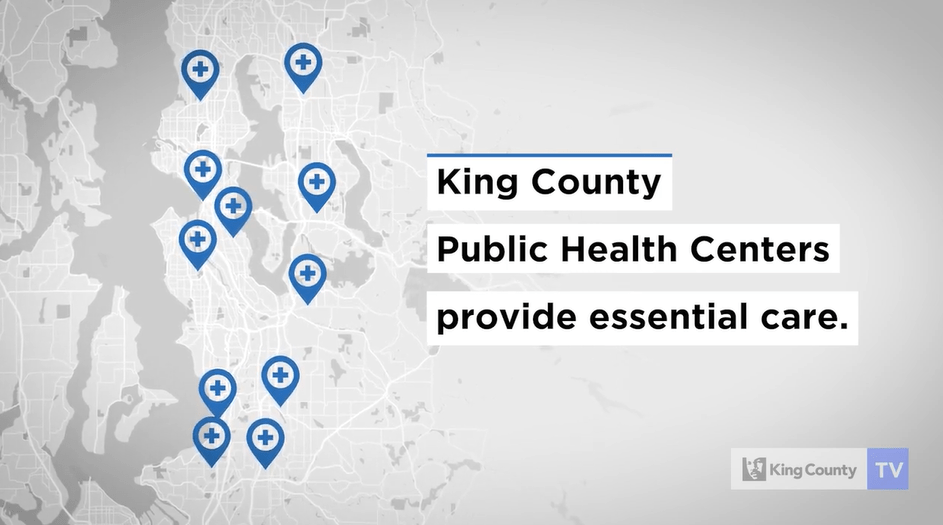
King County Executive Dow Constantine announced on Sept. 19 a proposal to preserve and fund the county’s public health clinics and further maintain operations and maintenance for the county hospital, Harborview Medical Center. The proposal is part of Executive Constantine’s 2025 budget and, if approved by the King County Council, would utilize a modified county hospital property tax authority approved by the state Legislature earlier this year.
The proposal would levy an 8.5 cent tax that would raise $74.6 million for the 2025 budget, eliminating the need for public health clinic services to be covered by the county’s General Fund and increasing funding to maintain operations, maintenance, and capital projects at HMC.
Read more in the official press release and view the video below.
Share this:

Executive Constantine announces his 2025 budget proposal, highlighting key investments in housing, health, safety, transportation, climate, and the environment

King County Executive Dow Constantine yesterday announced his 2025 budget proposal totaling $10.2 billion. The budget prioritizes key investments in housing, health, safety, transportation, climate action, and the environment, and demonstrates a commitment to making King County a welcoming community where every person can thrive.
The budget proposal is a road map to King County’s vision and values based on transforming the way government operates, solving problems effectively and efficiently, with equity and accountability, to best deliver services to all residents.
“This 2025 budget reflects King County’s commitment to creating innovative solutions to our most pressing challenges. We’ve balanced the budget, making careful cuts while strategically investing in key areas to deliver essential services for our residents,” said Executive Constantine. Read more.
Share this:

Airport fire trucks get cleaned of “forever chemicals”

Crossposted from the DES Express
In a partnership with the Port of Seattle, King County International Airport’s fire engines are being cleaned of PFAS, or per- and polyfluoroakyl substances, found in firefighting foam. These chemicals stick around for a long time, possibly thousands of years, and can build up in the environment and people’s bodies, causing harmful effects. Among the health effects are developmental problems, immune system issues, and links to certain cancers.
PFAS are man-made chemicals used in things like non-stick cookware and fire-retardant materials. The presence of PFAS is pervasive in products we use every day. From food packaging to cosmetics, cookware, upholstery cleaners, rain-resistant clothing, and even firefighting foam, these chemicals find their way into our environment and into our bodies when these products are produced, consumed, and thrown away.
King County is committed to protecting the environment and public health and this means reducing sources of PFAS pollution. King County is addressing PFAS contamination through a comprehensive approach, focusing on upstream interventions to prevent these harmful chemicals from entering waterways and our environment.
“The King County International Airport ARFF unit is excited to be among the first departments in the country to utilize an advanced PFAS cleaning and remediation technology,” said Sgt. Clint Herman with Aircraft Rescue and Fire Fighting (ARFF). “With a common goal and shared vision for health, welfare and safety, the partnership with the Port of Seattle is a true testament that when we work together there are no limits to what we can accomplish.”
The FAA has approved fluorine-free foams (F3) for use and KCIA is planning to convert to the new fluorine-free foams this year. Before converting to the new foams, existing fire engines must be cleaned and decontaminated. Fire engines used by KCIA’s ARFF unit are being cleaned at the Port of Seattle. The cleaning efforts started in August and will be complete this month. See more in a new video from KCTV.
The technology, called PerfluorAd, is used to remove the chemicals from the trucks’ parts. The recovered PFAS are then disposed of off-site, and the rinse water is treated on-site to remove any remaining traces before being recycled or sent to the sanitary sewer.
King County Airport is investing in new organic, biodegradable fluorine-free foams to use in a new plug-in hybrid electric crash rescue truck that will only be used with the PFAS-free firefighting foam. Once existing equipment is cleaned, those trucks will also use the new foam.
KCIA is preparing an investigation plan to determine the presence of PFAS, its extent in identified areas and a remedial/feasibility study to determine alternatives, costs and preferred solutions. The process will take about two years and will be performed in accordance with the Washington State Department of Ecology PFAS Sampling and Remediation Guidance.
The impacts from PFAS can be minimized through collective action to control the sources and limit exposure. Together, we can address PFAS challenges for a healthier, safer future. Get more information about what you can do from the Washington State Department of Health.
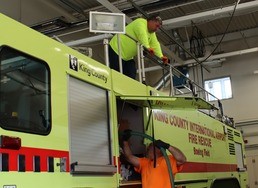
Pictured: Steve Pistoll, Field Service Manager, TRS Group, in orange shirt, works to clean an ARFF engine of PFAS, a man-made chemical in firefighting foam.






 Employee News
