
Payroll deductions for Washington Paid Family and Medical Leave program start Jan. 1, 2019

In 2017, the Washington state legislature passed a bill to create a mandatory statewide Paid Family and Medical Leave (PFML) insurance program that will provide almost every Washington worker with partial wage replacement while on leave beginning January 1, 2020, to:
- Recover from a serious illness or injury;
- Bond with a new child (through birth, adoption, or foster placement);
- Take care of a seriously ill or injured family member; or
- Participate in certain military-connected events.
Under the state PFML, eligible employees are entitled to up to 12 weeks of family or medical leave, or a combination of the two up to 16 weeks annually. While on leave, you are entitled to partial wage replacement. This will be a percentage of your average weekly wage. It is up to 90% of your weekly wage, with a maximum benefit of $1,000/week. King County employees will also continue to have their existing benefits, which you may choose to utilize instead of PFML.
Starting January 1, 2020, eligible employees who have worked 820 hours for a Washington employer during the previous year will be able to apply for benefits (i.e., leave and partial wage replacement). The PFML program will be administered by the Employment Security Department, the same agency that manages unemployment benefits.
The program will be funded by premium payments beginning January 1, 2019. The premium is 0.4% of an employee’s wages. Under the PFML employees are responsible for 63% of the premium deduction, and the county is responsible for the remaining 37%. For example, if you make $50,000 annually, the total annual employee cost would be $200, of which $126 would be deducted from your paycheck per year, or about $2.42 per week.
Beginning January 1, 2019, the County is required to start making payroll deductions for non-represented employees and a majority of the bargaining units. This deduction will appear on your first paycheck of 2019. Click here for a listing of collective bargaining units that have completed bargaining on PFML.
For more information, please visit paidleave.wa.gov/workers or email paidleave@esd.wa.gov, and refer to this infographic. You can also contact your Human Resources Manager.
Share this:

Plan ahead, expect delays during SR 99 closure beginning Jan. 11, 2019
Dear fellow King County employee,
King County Executive Dow Constantine
Starting January 11, 2019, after the evening commute, the Washington State Department of Transportation (WSDOT) will close SR 99 through downtown Seattle for approximately three weeks, and permanently close the SR 99 Viaduct. Additional ramp closures mean this work could create up to six weeks of traffic disruption.
No matter how you commute, or where from, you should expect significant delays during these closures and be prepared for crowded buses, trains, water taxis, and light rail. All buses coming into or through downtown Seattle will face delays. Twelve southwest routes and five northern routes will be directly affected by the closure.
Metro has been working with regional partners to provide travel options and alternatives to help you get around during the closure. Visit kingcounty.gov/getready to review your options and find out which routes are affected.
King County is always committed to delivering high quality services to our customers and we will continue to do so during this period. Please allow plenty of extra travel time to get to work and expect rush hour congestion to start earlier and end later.
You may wish to take vacation for some of this period, or consider adjusting your schedule, working at an alternative location, or teleworking if these are options for your job. If you wish to make alternative work arrangements for any of this period, please discuss these beforehand with your supervisor. We have existing policies that address attendance and work schedules, and a website with our telework policy, forms and templates that can assist your planning.
Also, as getting to and from meetings will be very difficult, try to limit meetings with external partners and people coming from outside Seattle during this period, or conduct meetings using Skype for Business (formerly Lync).
Thank you for helping us continue to meet and exceed the expectations of the people we serve during this construction work.
Sincerely,

Dow Constantine
King County Executive

This is a map of the SR 99 closure through downtown Seattle. For more information visit http://www.wsdot.wa.gov/Projects/Viaduct/realign99.
Share this:

Pet of the Week: Kingston

Crossposted from Tails from RASKC
 This regal-looking fellow is Kingston, our Pet of the Week!
Kingston is a German Shepherd/Australian Shepherd mix who is smart, playful, and protective of his people. Since he’s so spirited and fun-loving, he’s one of our “Rambunctious Red” pets.
Read more at Tails from RASKC
Share this:

Featured Job: Chief Legal Counsel

Salary: $155,783.00 – $209,511.00 Annually
Location: Seattle, WA
Job Type: Appointed
Department: King County Council
Job Number: 2018-08997
Closing: 1/1/2019 11:59 PM Pacific
The Metropolitan King County Council is seeking an experienced, enthusiastic attorney with a passion for Public Policy, Leadership and Professionalism to join our team. The Chief Legal Counsel serves as a legal advisor to the Council and staff on a variety of matters dealing with public policy, legislation, and Council actions. The ideal candidate will be adept at municipal law, and the powers and duties of public officials and agencies. The Chief Legal Counsel is a senior level professional position and supervises the work of the Council’s Deputy Chief Legal Counsel. This position operates with considerable latitude in providing legal advice and proposed solutions for consideration by decision makers to support the Council in fulfilling its mission. The most competitive candidates will have an in-depth knowledge of County government and the theories and practices of civil and administrative law as they relate to local government. This is an exciting opportunity to join the King County Council staff and help provide excellent regional services to county residents. The position requires effective collaboration with Councilmembers, staff, the Office of the Prosecuting Attorney, the King County Executive and County departments, other units of governments, and members of the public.
Learn more about this position or view all available positions.
Share this:

Training Spotlight: How to Navigate Amidst Overwhelming Times, Lean Basics and Introduction to Career Development

How to Navigate Amidst Overwhelming Times, Dec. 11: The King County Office of Equity and Social Justice is hosting a workshop that centers on the lived experiences of native employees and employees of color. This session will pay special attention to the intersection of trauma and oppression especially that of indigenous and people of color lived experience and background. This will be a large a cross disciplinary gathering that works towards building a critical mass of those striving for sustainability. Register and learn more, use password affinitygroup.
Lean Basics, Jan. 8: Have you heard about Lean before? Have you wondered if Lean could be applied on your job? Come and join us in the Lean Basics course where you will become familiar with the fundamental principles of Lean; such as Waste Identification, Visual Management, and Continuous Improvement. Students will engage the materials through instructor lead classroom discussions, and interactive hands-on learning. Read more and register.
Introduction to Career Development, Jan. 15: In this workshop you will learn the key elements of career development, identify your individual interests and values as they relate to career options, explore similar job classifications, learn the importance of competencies when identifying career options, leverage tips for engaging in conversations with your leadership, and gain the knowledge of how to research and seize career opportunities. You will choose a partner and participate in various exercises together. Read more and register.
Share this:

Kudos! King County Archives welcomes UK film crew

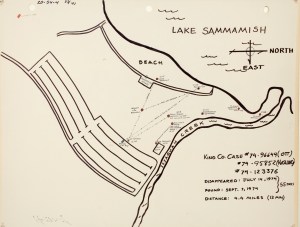
Pictured: A hand drawn map used in the case provided by King County archives.
On November 13, three representatives of London-based Arrow Media came to the King County Archives to see the Ted Bundy collection. Assistant Archivist Amanda Demeter laid out a selection of maps, photographs, and documents from the collection, and the crew also got footage of the collection in the vault. A documentary about Bundy is in production and slated for release some time next year. Arrow Media is expected to return to Archives soon for footage on a documentary about Gary Ridgway.
Kudos to King County Archives for being a valuable international resource on Pacific Northwest history!
Share this:

Did you know you had this benefit? Volunteer sick days
King County will pay you to volunteer: Eligible employees may use up to three days of sick leave each year to volunteer at any local school or any nonprofit organization participating in the King County Employee Giving Program. Learn more here.
Share this:

Inmate program provides opportunity and education

The Maleng Regional Justice Center’s Janitorial Certificate Program was recently featured on KING5 News. A story highlighting the program aired on Nov. 2 that featured how the custodial program sparks positive change for inmates.
Through an interview with Renton Technical College instructor Martin Douthit and current students, the video shows how programs like this provide people a second chance.
View the below or at this link.

Share this:

Looking to reduce stress? Try a mindfulness class

Balanced You offers a variety of health and well-being options to support employees so you can feel good, get the most out of life, and do your best work for the people of King County. If you’re looking to reduce stress, give one of our popular mindfulness classes a try. Practice mindfulness at County worksites, online, or in the community. There are still spots available in many upcoming classes. Contact Balanced You with questions at BalancedYou@kingcounty.gov or 206-263-9626.
Share this:
Radio shop star: Ric Myers

KCIT Electronics Communications Specialist Ric Myers was assigned the task of finding a vendor to install a bi-directional Amplifier system (BDA) in the Shoreline Police Department’s new building, located at Shoreline City Hall. After he received the bids, Ric declared he would do the work himself. Ric, along with coworkers Aaron Oestmann and Sean Bachler, ran cable and installed antenna systems throughout the Shoreline Police headquarters, saving thousands of dollars and completing the project three months ahead of schedule. Because of Ric’s great attitude and great customer service, Shoreline Police have made him their “go-to guy” for all communications needs explained Ric’s coworker, William (Rich) Richardson Jr., King County System Manager.
But that’s not the end of the story. The King County Sheriff’s Office in Burien Precinct 4 was also scheduled to have a BDA installed by a private vendor. Ric went there to survey the facility and discovered a broken, pre-existing BDA System. His skills allowed him fix the broken BDA, saving King County more than $52,000 in replacement and installation costs.
“Regional Services, KCIT and King County are blessed to have Ric Myers on their team,” Rich said.






 Employee News