
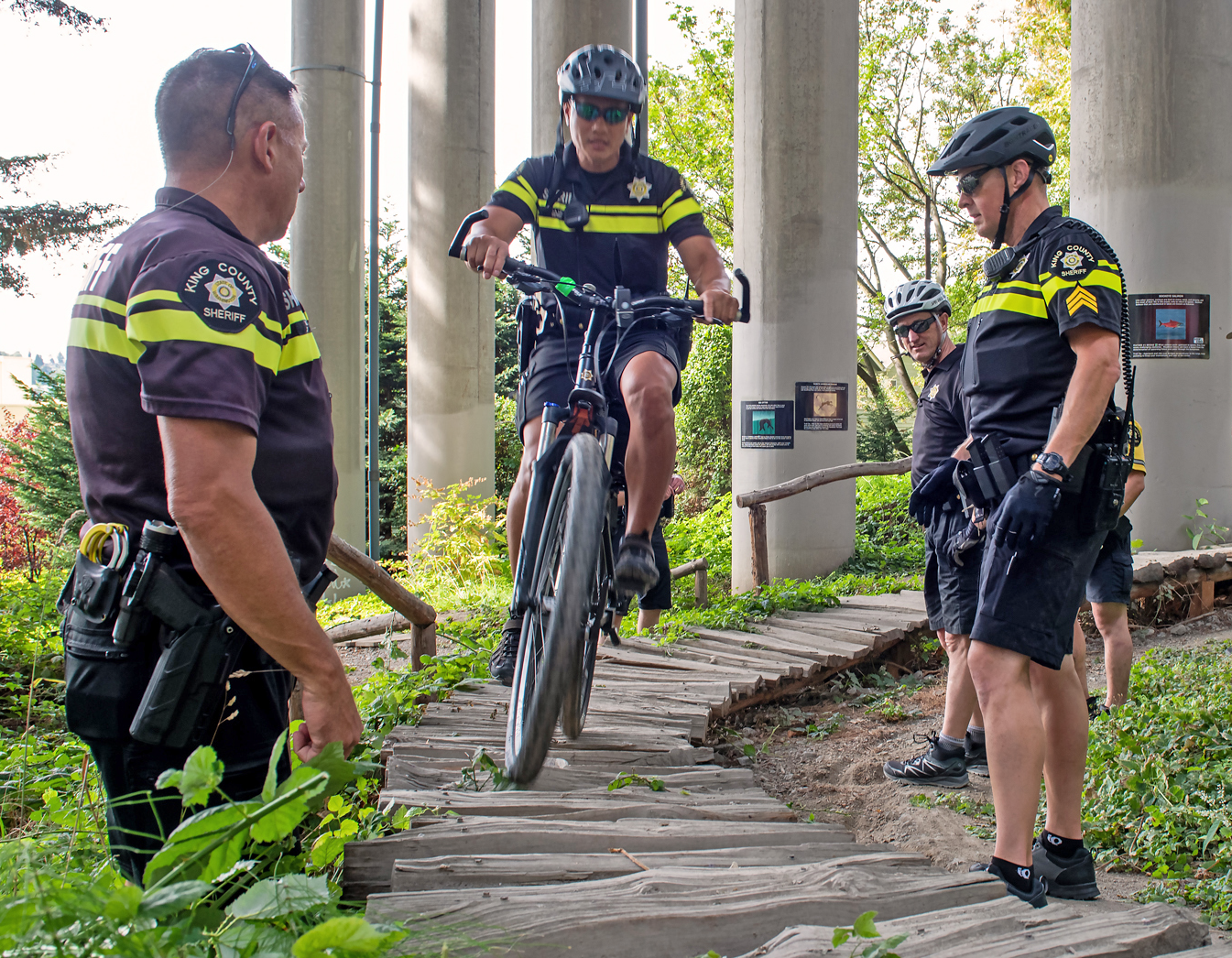
BEES patrol flies at street level
Updated April 23, 2024
“The BEES are easy to spot and quick to offer help,” said King County Metro General Manager Michelle Allison. “Their presence maintains safety, deters crime, and brightens the day of our riders, employees and community members.”
For nearly 20 years, there has been a King County Sheriff Patrol that focuses on Metro transit stops and the surrounding areas. Unlike the typical deputy in a vehicle driving around a specific district, responding to calls sometimes miles away, the Bicycle Emphasis and Enforcement Squad – known as BEES – can be found pedaling between the central business district and the International District (ID).
“The flexibility of the BEES is invaluable to the METRO Transit Police. By deploying on bicycles as opposed to vehicles, they can move and respond quickly throughout the busy downtown corridor,” said Police Chief Todd Morrell. “They are also inherently accessible to the public and are an integral part of the transit landscape. Whether providing directions to customers, engaging with tourists, or educating people about the transit system and our code of conduct, the BEES are the embodiment of the caliber of people we want working in our agency.”

The BEES patrol’s primary function is monitoring Metro transit stops, which is technically not part of the Seattle Police Department’s (SPD) jurisdiction. They have the same authority as any deputy, but their presence also serves as a deterrent to activity that might create an unsafe atmosphere for Metro riders and operators.
“We try to be nice about conveying a message to move along and educate what’s accepted behavior at bus stops,” said Sergeant Tom Liu. “Most people are pretty cooperative and move along.”
According to Sgt. Liu, being on the bike allows the patrol to get up close and personal, be more approachable. “The bike might even be a starting point for conversation,” he added. “People going to and from work who start talking about biking, asking questions. Lots of tourists ask for directions.” These interactions make the public feel safer and more at ease, which is not something that happens as easily from a inside a vehicle.
“We take action by having a progressive approach, educating people on acceptable behavior,” Sgt. Liu said. They do not intervene or make charges unless they see repeat behavior.
Being on patrol at such a level allows the BEES to develop relationships with those in need. The BEES are not there to harass or bother people that are just hanging out. They’re able to get to know people by name and become more friendly, building a decent relationship, due to their accessibility on the bicycles. “People that we know, we’ve visited in the hospital,” Sgt. Liu said of regulars that they talk to daily. “We care about their well-being.”
But their work in that district has a very serious side. Deputies carry Narcan with them to deal with the high number of drug overdoses that have plagued the area. Sgt. Liu said that Deputy Nix, a member of the BEES, has administered it over 20 times.
“When we’re downtown, we listen to the SPD radio,” said Deputy Bob Nix. He told of an attempted child kidnapping that took place where “private security, local cyclists, and the Seattle Police Department chased down the criminal.” While his grandmother gave a statement, the BEES patrol helped distract the child from the incident by taking him to a police car and letting him play with the siren. They then escorted the shaken couple to Chinatown for lunch.
“The grandmother wrote a very nice letter of thanks,” Deputy Nix added, “Explaining that she brought the child back downtown a few days later to help him not be afraid of going there.”
With their frontline viewpoint, the BEEs also serve as a source of information for Metro when it comes to issues and policies for policing trouble spots. Areas in Seattle like Third Avenue and Pike Street, Union Station, and 12th Avenue and Jackson Street in the International District have seen increases in illegal activity over the last several years. The BEES have accompanied Metro and City of Seattle representatives when assessing these areas in person, and their experience allows them to provide consultative ideas in how to help alleviate the issues, making the Metro stops safer for riders while treating the non-riders there with respect and concern.
The deputies on the BEES also develop a strong presence with businesses in those areas. Business owners know they can reach out to for direct support when they need it. When command staff meet with business associations, they always get praise for the BEES patrol.
“The Bicycle Emphasis and Enforcement Squad (BEES) have established ongoing relationships within the neighborhoods they patrol,” said King County Metro Chief Safety Officer Rebecca Frankhouser. “Knowing the businesses, residents and riders allows the BEES to build trust, to prevent and identify issues, and to provide an appropriate response when needed. We’re grateful for their thoughtful service to the community.”
This method of patrolling is so successful that Metro has asked for a presence in other areas. BEES patrols can also be found in Federal Way, Kent, Des Moines, along the Pacific Highway, Shoreline, and north Seattle along A and E Metro lines.
“The BEES can do ethos, focus on service, and their commitment to safety of our transit community is unparalleled,” Chief Morrell said. “They are the backbone of the METRO Transit Police.”






 Employee News