
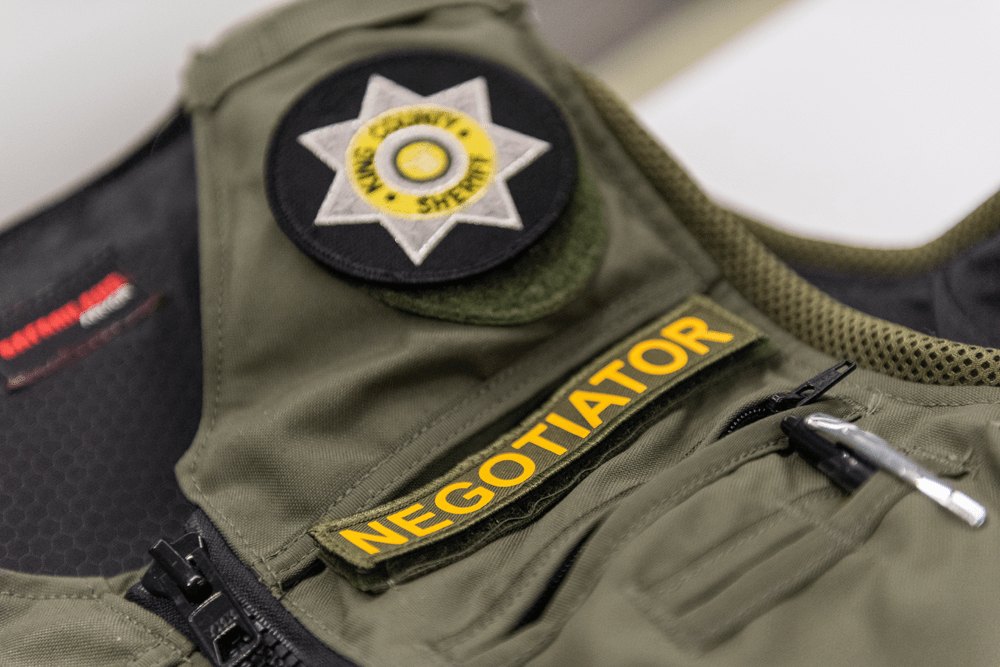
KCSO Crisis Negotiation Team, Part III
Part I explored the evolution of the King County Sheriff’s Office Crisis Negotiation Team (CNT). Part II told the story of how a mental health professional became an official part of the team after years of volunteering. The final segment illustrates how they put it all together.
An incredible partnership

Over the last several years, there have been many improvements implemented in the partnership between TAC 30 and the Crisis Negotiation Team that have made KCSO into a leader in the crisis field.
“We’re ahead of our peers in having a mental health professional work with the team and will be the standard going forward,” said Master Police Officer (MPO) George Ireland.
Ongoing training is essential for maintaining and enhancing the level of professionalism these teams strive to achieve. MPO Ireland was instrumental in the team getting monthly training, such as mock scenes and recognition of mental health signs. Both he and Mental Health Professional Susie Kroll also serve as instructors for the Crisis Systems Management training school.
“The goal with CNT was to get that program more up to speed in working with TAC 30,” said Sgt. Chad Mulligan. They have joint trainings with TAC 30 to give them insight on CNT processes and send CNT people to TAC 30 training to learn how they operate and what equipment they use.
“There’s less mystery on how each side works,” Mulligan continued. “There’s more respect now that both teams understand each other’s methods, why and how they’re doing things.”
Technology is also a part of their evolution. The CNT is deploying a new system that allows the command post to watch and listen to negotiations in real time. And CNT personnel are getting trained in using drones that safely get the team near a crisis situation where they can see and communicate with someone without putting the negotiator in danger.
“It takes a team with varied skill sets,” said Kroll. “I couldn’t do what I do without their support, and I know from the flip side they do a good job because they get an extra tool as a resource. It’s an incredible partnership that pulls it all together.”






 Employee News