
Supporting people living with disabilities through the 2022 Annual Giving Drive
As part of the 2022 Annual Giving Drive, we are highlighting nonprofits whose work supports people living with disabilities. These and hundreds of nonprofits are participating in this year’s Annual Giving Drive.
- Hearing, Speech and Deaf Center (HSDC) (9267): Working together with people who are deaf, hard of hearing, or have speech differences through advocacy, early education, audiology, speech therapy, and ASL interpreting.
- Canine Partners for Life (5085): Service & companion dogs are professionally & custom trained to enable persons with physical, developmental, & cognitive disabilities to become more independent.
- Autism Speaks, Pacific Northwest (4083): Promotes solutions for needs of individuals with autism and families; increasing ASD acceptance and research into causes and better interventions.
- Community Homes, Inc (5720): Creating rich, full lives for adults with developmental disabilities by providing and promoting quality, community-based housing and services.
- Outdoors for All Foundation (2797): Enriches the lives of 3,000 children and adults with disabilities through outdoor recreation thanks to the support of over 800 volunteers.
You can go online or use a paper form by Friday, Nov. 18, to make a pledge to your favorite Employee Giving Program nonprofits by:
- Payroll donation: One-time, once–per-month, or twice-per-month.
- Time donation: Eligible vacation or comp time. See your department Lead Ambassador for details in your office.
- Check or credit card: Made out directly to the nonprofit.
- Volunteering: Up to three sick days per calendar year at a nonprofit in the EGP (for non-represented and employees whose union has approved this benefit, including those covered by the Master Labor Agreement).
For more information, contact your Employee Giving Program Ambassador, visit www.kingcounty.gov/giving, email EmployeeGiving@KingCounty.gov, call 206-263-9372, or attend an online Nonprofit Expo.
Share this:

Stay home when you’re sick or have symptoms this flu season

We’re heading back indoors, children are back in schools, and sure enough, the cold and flu season has arrived. At the same time, COVID-19 remains with us, and as we spend more time indoors, we could expect to see the number of COVID illnesses rise again. Please do what you can to prevent the spread of illness in our workplaces and community.

If you get sick, please follow your agency’s sick leave request and approval protocols and stay home. We value your work here, but it won’t help anyone if you spread your illness to your co-workers.
COVID-19 and the flu virus will both likely be spreading this fall and winter. You may think you have the flu, but actually have COVID-19— or vice versa. Anyone who has symptoms of the flu or COVID-19 should avoid contact with others and test for COVID-19 immediately. This can help prevent you from accidentally spreading COVID-19 or the flu.
If you have the flu, it’s important to stay home until at least 24 hours after your fever is gone. If you have symptoms of COVID or test positive, follow this guidance: Isolation and quarantine – King County.
Get vaccinated for flu and an updated COVID-19 booster
Even if you’re young and healthy, both the flu and COVID-19 can lead to serious complications that require hospitalization. Getting vaccinated not only helps prevent you from getting ill, it also decreases the severity of illness if you do get infected and helps protect those around you who cannot receive the shot because of their age or underlying conditions.
The county makes it free for employees and anyone covered by your benefits to get a flu shot at one of our onsite clinics, or at your doctor’s office or local pharmacy. Get it at a worksite clinic or from your health care provider or local pharmacy.
There’s now an updated booster vaccine for COVID-19. It’s important to get the updated booster shot, even if you’ve gotten COVID-19 or had a booster shot previously, to prevent severe illness and long COVID. The coronavirus changes over time and the updated booster targets the Omicron variants that are circulating now, in addition to the original COVID-19 strain.
Everyone 5 years and older is eligible if it has been at least two months since completing the primary series of vaccine or receiving the last booster dose. You can get the updated boosters from your healthcare provider, many pharmacies, and at King County’s vaccination clinic at the Auburn Outlet Collection Mall (appointments and drop-ins welcome) and the Eastgate Public Health Center. Updated boosters are free, and no insurance or proof of citizenship is required. More information about locations and appointments: kingcounty.gov/vaccine.
Our colleagues at Public Health also have answers to common questions about the updated booster: Should I get an updated booster? We asked an expert. – PUBLIC HEALTH INSIDER.
If you have questions about sick leave, please talk to your supervisor or HR Manager (employee access only). Thank you for helping to stop germs and stay healthy!
Share this:

7 Mental Health Benefits of Volunteering

The Annual Giving Drive is underway and King County employees have until Nov. 18 to fundraise for causes they are passionate about. But did you know that you can give back all year? You can use up to three sick days per calendar year to volunteer at a nonprofit in the Employee Giving Program.
Besides providing necessary support to an organization, volunteering for a cause you are passionate about can improve your own mental health and help you feel good. Read through the 7 Mental Health Benefits of Volunteering, including stress reduction, confidence building, and preventing isolation.
Share this:

King County named among top 10 Green Fleets
Cross-posted from Executive Services Express
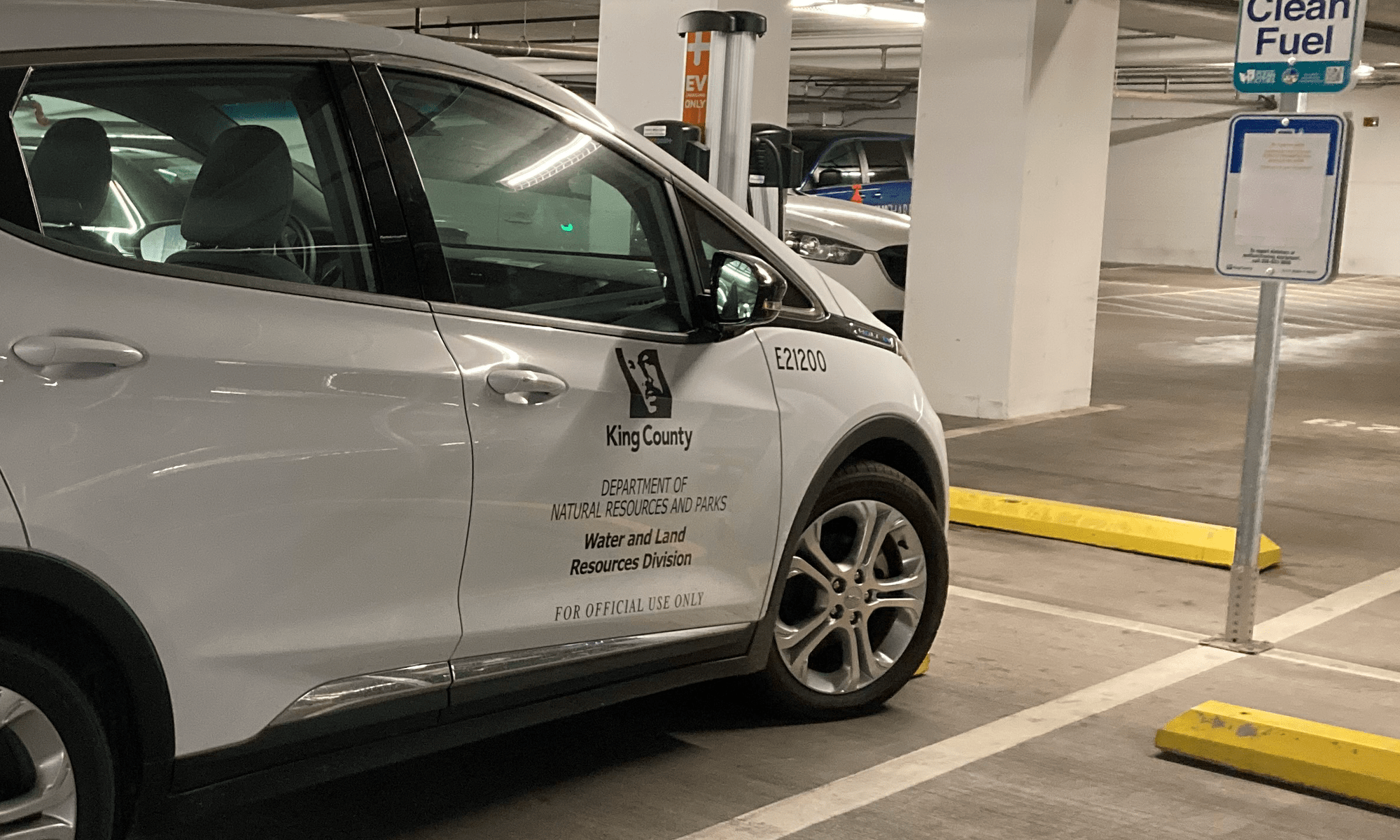
King County placed sixth in the 2022 NAFA Fleet Management Association’s Green Fleet Awards Competition. NAFA is the industry’s largest membership association for those who manage the vehicular fleet and mobility responsibilities for their employers.
The Green Fleet Awards recognizes government and commercial fleets in North America that implement innovative programs designed to minimize the negative environmental impacts of their fleet operations. Read more.
Share this:

Annual Cybersecurity Training required for all King County employees

Cybersecurity Training is an important safeguard that protects King County systems, and the number of employees who complete training each year impacts our insurance rates.
When your training is assigned, you will receive an email from kc-knowbe4@kingcounty.gov with a direct link to your required training modules. If you can’t find the email, check your Junk folder or login with your work email here.
All employees must complete annual Cybersecurity Training by Dec. 31, 2022 unless your agency has specified a different deadline. Thank you for doing your part to protect King County. Read more.
Share this:

Executive announces new actions to rapidly reduce countywide greenhouse gas emissions

King County Executive Dow Constantine’s proposed budget includes actions to decrease countywide greenhouse gas emissions at a faster pace as an analysis of the Puget Sound region shows an urgent need for collective action to avoid the worst impacts of climate change.
A first-of-its-kind analysis led by King County found that greenhouse gas emissions per person have decreased as the result of more energy efficient vehicles and buildings, but total emissions have increased as the population has grown. Read more.
Share this:

King County Affinity Group celebrates National LGBTQ+ History Month by highlighting activist Heather Purser

This week, for National LGBTQ+ History Month, the LGBTQ+ Affinity Group celebrates Heather Purser. Purser is a Suquamish activist that successfully advocated for her tribe to legally recognize same-sex marriages in 2011, before they were recognized in Washington. Learn more about Purser and other LGBTQ+ individuals throughout history by visiting this calendar celebrating LGBTQ+ History.
If you are interested in getting connected to the LGBTQ+ community at King County, consider reaching out to the LGBTQ+ Affinity Group at LGBTQ@kingcounty.gov.
Learn more about King County Affinity groups at www.kingcounty.gov/AffinityGroups.
Share this:

Get emergency alerts with KCInform
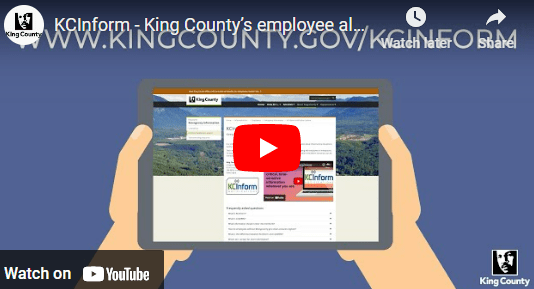
During an emergency having timely information on what is happening is critical. King County employees can sign-up for KCInform, the employee alert and warning system, to receive information about infrastructure disruptions, facility impacts, changes in your department’s business operations, and other critical impacts.
Your King County desk phone and @kingcounty.gov email are already in the system. It is important to register your County-issued cell phone (if applicable) and personal cell phone and email address to ensure you receive time-sensitive messages. This service is free and your personal contact information is secure and protected. On Thursday, Oct. 20 at 9 a.m. we will test KCInform as part of the annual Great Washington ShakeOut drill to test earthquake preparedness.
Watch this short video to learn more and visit the KCInform website for more information.
Share this:

Commute Trip Reduction Survey begins Oct. 17

On October 17, the Commute Trip Reduction survey will be distributed to all County worksites with over 100 employees. The Washington State Commute Trip Reduction law requires these surveys of employers every two years.
When you complete the confidential survey, you will have a chance to win prizes provided by the King County Employee Transportation Program and Commute Seattle.
The survey results assist the state and county to design and implement transportation programs that address the diverse needs of employees, while also working to reduce traffic congestion, improve air quality, and decrease energy consumption.
To learn more about the 2022 survey and your employee transportation benefits, visit: www.kingcounty.gov/ETP, call Hossein Barahimi, ETP Manager, at 206-477-5853, or email ETP@kingcounty.gov.
Share this:

Ben Malmstadt, Metro’s 2022 Facilities Employee of the Year
Cross-posted from Metro Matters
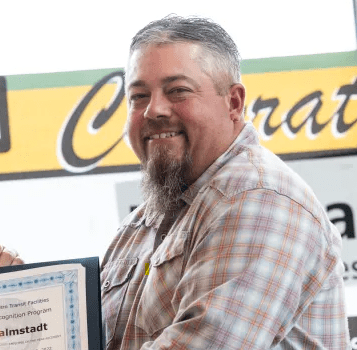
Ben Malmstadt’s devotion to ensuring clean, safe spaces for riders and the communities has earned him top honors as Metro’s Facilities Employee of the Year for 2022.
Malmstadt was honored at a ceremony at Metro’s Atlantic base attended by his family and teammates as well as King County Executive Dow Constantine and Metro Deputy General Manager Michelle Allison. Read more.






 Employee News