
New emergency location feature in Microsoft Teams

Starting Sept. 21, the Microsoft Teams desktop app will include a new emergency location field that automatically detects the physical location of employees who are logged on to the King County network onsite at any King County facility. The emergency location field will automatically update when an employee brings their laptop to a different floor, or to a different King County facility. This new feature allows 911 emergency services to locate callers faster and more efficiently.
For employees working offsite or remotely (not in County facilities), the emergency location field will not automatically detect or update your physical location. Instead, employees may choose to manually enter a physical location in the emergency location field; however, any changes must be updated manually.
If you are working offsite or remotely, using the Teams app on your laptop to call 911 is NOT recommended; for your safety, please use a cell phone or landline.
Emergency location information cannot be used to track employees and will not be visible to anyone but 911 responders. Additionally, emergency location information is not discoverable, searchable, or retained for public records disclosure. Microsoft has added this feature to support compliance with the United States FCC requirements for Ray Baum’s Act.
Share this:

Sept. 29 is the third payday of the month

All King County employees get paid on a biweekly basis, every other Thursday, resulting in 26 pay periods per year. You usually receive two paychecks per month; however, Sept. 29 will be your third payday of the month.
The net dollar amount of these “third” paychecks may be larger because not all deductions are taken out. For example, Deferred Compensation, supplemental insurance premiums, Benefit Access Fees, and Employee Giving donations are not deducted from these checks.
For more information about your paycheck, go to Payroll or speak with your department Payroll representative or timekeeper.
Share this:

Making a more welcoming downtown civic campus
Updated Sept. 22, 2022
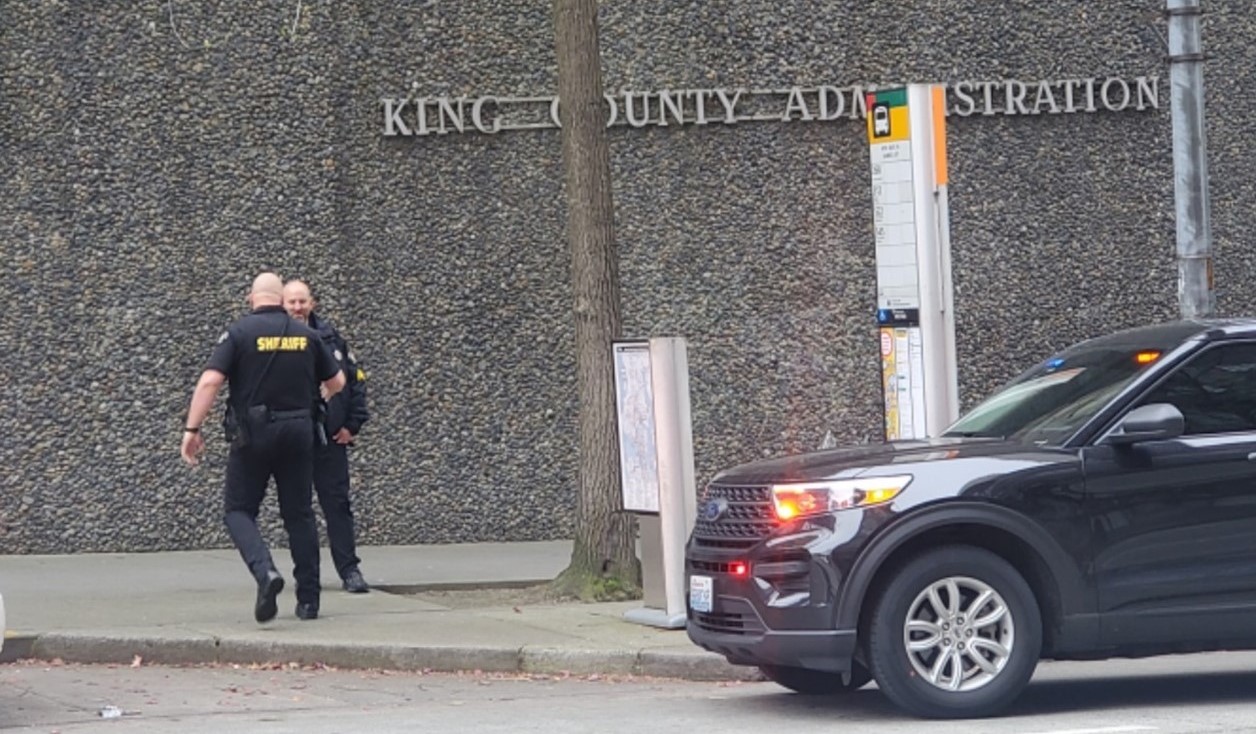
As more employees return to downtown workspaces, additional patrols by King County Sheriff’s Office (KCSO) deputies around the downtown civic campus are making the area a more welcoming space for employees and community members.
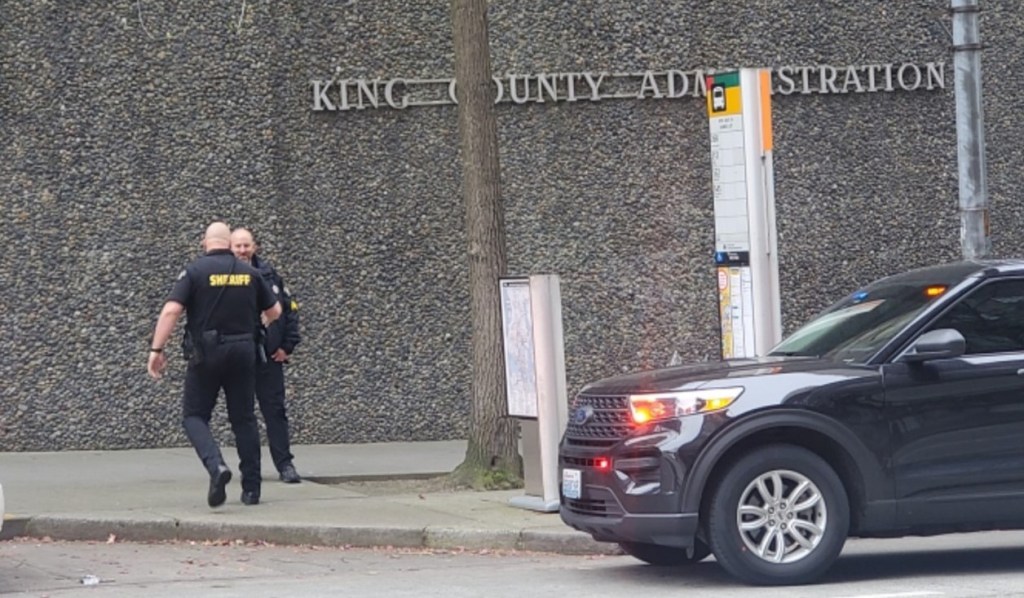
Sheriff’s deputies are providing regular patrols on foot and bicycle between 7 a.m. and 5 p.m. Monday to Friday.
The three priorities for these patrols are:
- Keep all people safe
- Ensure clear access to buildings and sidewalks for all
- Assist any person in crisis.
In addition to public safety, these deputies and sergeants have also helped people who are returning downtown for work and visiting with things like directions to local businesses and landmarks, and where to find parking. Members of the community and County employees have expressed their appreciation for the hard work and presence of these deputies.
The KCSO patrols are part of a number of safety and custodial enhancements across King County worksites, including:
- Facilities Management Division (FMD) Security Officers conducting exterior perimeter patrols of the downtown campus
- Trash and general clean-up each morning, with pressure washing three times per week. Custodial staff are also on-call during normal hours to respond to cleaning incidents as needed
- Three security officers now assigned to the King Street Center, with exterior clean-up conducted daily, and pressure washing three times per week.
- Additional security enhancements to be implemented at the Downtown Public Health Clinic in the coming weeks.
In addition, the City Hall Park Neighborhood Outreach Team, a one-of-a-kind program funded through the Behavioral Health and Recovery Division (BHRD) within the Department of Community and Human Services (DCHS), is assisting unsheltered neighbors around City Hall Park. The eight-person team was created to support unsheltered people around City Hall Park with access to shelter and housing, as well as helping people in crisis.
For more information on employee safety programs and resources, check out the Future of Work Personal Safety at Work intranet page (employee access only).
Share this:

Executive Constantine proclaims Latinx/Hispanic Heritage Month

In recognition of the historical, cultural, and economic contributions of the Latinx and Hispanic residents of King County, and the firm commitment by the administration to addressing critical issues for the the Latinx and Hispanic community in the county, Executive Dow Constantine has proclaimed September 15 through October 15 as Latinx/Hispanic Heritage Month.
Read the full proclamation below.

Share this:

Professional Development Scholarship Program: Individual Development Plan

By Travis Gershaneck, Veteran Fellow, Department of Human Resources
The first application period for the Coalition Labor Agreement Professional Development Scholarship Program is quickly approaching. The first period opens on Jan. 9, 2023, but it is recommended to have information for your application materials prepared well ahead of time.

The completion of an Individual Development Plan (IDP) is not required to apply for this scholarship, but it is strongly recommended. The IDP is a roadmap that you create to identify your career goals, how to achieve them and how you will apply your training towards your career goals in a way that aligns with King County’s commitment to equity and social justice, any of King County’s True North values and to better serve your customer. It is this information that will be used to evaluate your scholarship application.
Not only will the IDP prepare you to apply for a scholarship, but it is a powerful tool to help keep you on track to reach your career goals. The IDP includes an option to tie in your supervisor, manager, and others to offer ideas, provide support to you in your development activities, and open networking and training opportunities to assist you.
Your IDP should be treated as a “living document” that adapts and evolves with you on your professional journey. Consider involving others as you develop your IDP. Career Support Services offers individual career coaching sessions to assist you, and has provided the following IDP samples to guide your plan creation:
As part of the King County Investing in YOU and True North and Values initiatives, the Professional Development Scholarship is designed to provide eligible employees represented by a union in the Coalition of Unions up to $3,000 in financial resources to continue pursuing professional goals.
Important 2023 dates:
- Jan. 9 to Feb. 5, 2023: First application period
- March 20 to 24, 2023: First period award notifications
- May 8 to June 4, 2023: Second application period
- July 31 to Aug. 4, 2023: Second period award notifications
For more information:
Visit the program website: www.kingcounty.gov/scholarships or register for a scholarship information session.
Questions? Please email us at scholarshipfund@kingcounty.gov.
Share this:

Tech Tip: Manage IT tickets with KCIT’s new omni-channel chatbot, capable of voice or text responses

KCIT and Amazon are now piloting an exciting new automated chatbot option that lets you quickly and easily manage your IT Helpdesk tickets – without waiting to speak with a live technician.
Watch this 5-minute video to see how Executive Branch employees can ask the chatbot to check the status of their open tickets, close a ticket, request a priority escalation, add a note for the technician, or transfer to a live agent. The chatbot will even answer frequently asked questions!
The new chatbot is now available to serve you 24 hours a day. Simply follow the voice prompts when you call the IT Helpdesk at 206-263-HELP (4357) from your Teams desktop app or county-assigned mobile phone, or utilize the chat option in the Cherwell IT Helpdesk Portal.
Share this:

Discounted tickets for Seattle Thunderbirds Hockey Club opening night, Oct. 1

King County employees are invited to join the Seattle Thunderbirds as they open their defense of the Western Conference Championship at the Accesso ShoWare Center, in Kent.
King County employees receive a $30 ticket for only $20, plus a small service fee. Purchase discounted tickets here. Enter the discount password: county. For more information, contact Cory Howerton at 253-856-6844.
See all available King County employee discounts on the Employee Discount webpage.
Share this:

988 Suicide and Crisis Lifeline

September is National Suicide Prevention Awareness Month, and it’s a reminder for all of us of the importance of checking in on each other and seeking support in times of crisis.
This year, the new 988 number for the National Suicide Prevention Lifeline went into effect. Too many people are experiencing suicidal crisis or mental health-related distress without the support and care they need, and sadly, the COVID-19 pandemic only increased the mental health challenges we face. 988 offers 24/7 access to trained crisis counselors who can help people experiencing mental health-related distress. That could be:
- Thoughts of suicide
- Mental health or substance use crisis
- Any other kind of emotion distress.
988 is confidential, free, and available 24/7/365, connecting those experiencing a mental health, or suicidal crisis with trained crisis counselors. Those who are worried about a loved one who may need crisis support can also dial 988. Services are available in Spanish, along with interpretation services in over 250 languages. To learn more about how to recognize warning signs and risk factors for suicide, visit the Balanced You blog.
Share this:

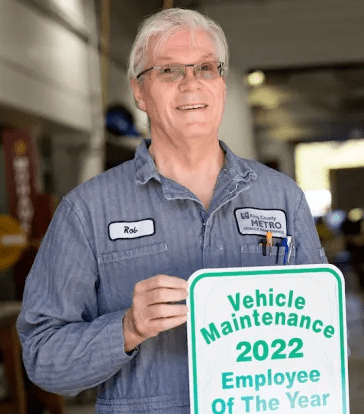
Robert Dargan, Metro’s 2022 Vehicle Maintenance Employee of the Year
Cross-posted from Metro Matters
King County Metro recently announced Robert Dargan as the 2022 Vehicle Maintenance Employee of the Year. He began his career with King County in May 1999 as Transit Mechanic and has been providing excellent service at King County Metro in this position.
Dargan was surprised with the honor at a ceremony at Metro’s East Base by King County Executive Dow Constantine, Metro General Manager Terry White, and Vehicle Maintenance leadership staff. Read more.
Share this:

Is your information correct in PeopleSoft?

Benefits Open Enrollment is Nov. 1-15 and it’s important that you review and update your personal information in PeopleSoft to ensure you receive announcements.
You can also update your emergency contact information, receive important updates, and select the email address where you prefer to receive information.
Got to ess.kingcounty.gov and select Personal Details to make sure all items are up to date. For login help, call the IT Service Center at 206-263-4357.






 Employee News