
What to know about getting the COVID-19 vaccine

Our state is now in Phase 1a and Phase 1b, Tier 1 and Tier 2 for vaccine distribution and many King County employees who have been on the front lines during the pandemic are now eligible, including staff working in congregate settings in public transit, corrections, courts, and first responders not covered under earlier phases.

If you are eligible for a vaccine, you are encouraged to look for open appointments across all current options available to you, and not wait:
- Call your doctor’s office or health care provider to see if they have available vaccination appointments.
- Washington State’s Phase Finder online tool can confirm your eligibility and provide you with a list of possible vaccination locations. Phase Finder is available in multiple languages here.
- Visit Washington State Department of Health’s list of vaccination locations, organized by county.
- If you need language interpretation or can’t use the online Phase Finder tool, call the Washington state’s COVID-19 Assistance Hotline: Dial 1-800-525-0127 or 1-888-856-5816, then press #. Available Monday 6 a.m. to 10 p.m., and Tuesday-Sunday and observed state holidays 6 a.m. to 6 p.m. For language interpretation, state your preferred language when you are connected. Phone support is also available from the Public Health COVID-19 Call Center at 206-477-3977, 8 a.m. – 7 p.m.
- WA COVID Vaccine Finder is a volunteer-driven effort to help Washingtonians find appointments for the COVID-19 vaccine. www.covidwa.com
- Community vaccination site at Lumen Field. If you live or work in King County and are eligible under Phase 1A through Phase 1B, Tier 2, you can sign up for this notification list and will be notified via email when appointments become available at any of the three City of Seattle fixed vaccination sites, including the Lumen Field Event Center.
How to Get Vaccinated With Kaiser Permanente
Whether you’re a Kaiser Permanente member or not, King County employees can follow these steps if you’d like to get your COVID-19 vaccine with Kaiser Permanente.
Regardless of where you get a COVID-19 vaccination — the doctor’s office, a pharmacy, a community event, or other location — you should not have to pay anything. Checking with your health care provider is the best place to start, but if they do not have vaccine availability you should check other vaccine locations.
If you are covered under a King County employee health plan, you may be asked to provide your Regence BlueShield, CVS, or Kaiser Permanente insurance card.
Getting vaccinated is an eligible use of sick leave, and starting March 10, King County will approve employees using Paid Administrative Leave when taking time off to get a COVID-19 vaccine. Employees will need to follow workplace procedures for requesting the time off.
All COVID-19 vaccines currently available in the United States have been shown to be highly effective at preventing COVID-19. These vaccines have been studied in clinical trials with large and diverse groups of people, of various ages, races, and ethnicities.
We have built an employee vaccines webpage where you can learn how to find out when you are eligible, how to schedule a vaccine, information about your benefits, and much more. You’ll also find the latest vaccine information from Public Health at kingcounty.gov/vaccine.
Remember that the virus is still spreading in our community and we are under the threat from more contagious new variants. It remains more important than ever to continue to wear masks, stay at least six feet apart, and avoid gatherings with people you don’t live with.
Share this:

Standing against racism, discrimination, and violence

by Dow Constantine, King County Executive
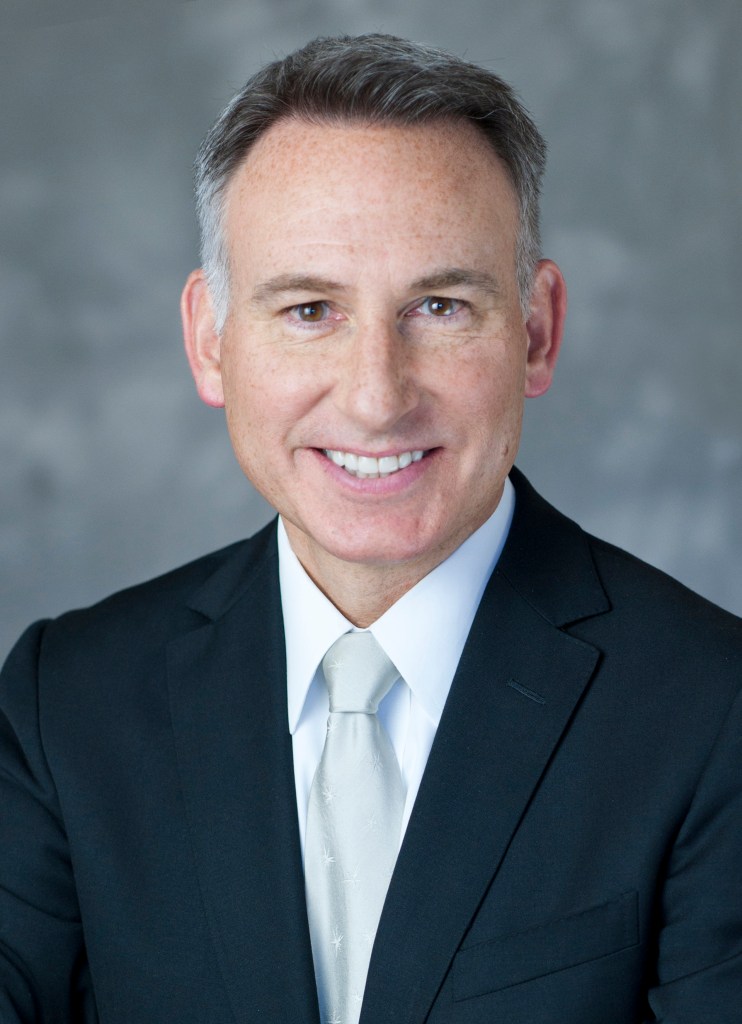
As we work to fight the spread of COVID-19 in our community, we stand together against the spread of misinformation about COVID-19 and the rise of aggression, racism, and violence aimed at Asian and Pacific Islander Americans.
We are always stronger together. That is the promise of our diversity and shared future.
We are again witnessing how racist rhetoric locally and nationally is fueling fear, separation, and blame, and harming individuals, children, and communities. These incidents of hate and bias are unacceptable and cannot be tolerated. We condemn all acts of hate and violence and stand against anti-Asian hate and violence.
We stand with the truth that Asian and Pacific Islander Americans are in no way responsible for the coronavirus. Yet they have been targeted and blamed during this crisis and have been the focus of hate crimes that, until recently, have largely been left out of mainstream media. Although this has been the case nationally as hate crimes have increased over the last year, King County, through its Office of Equity and Social Justice, has supported the Coalition Against Hate and Bias, which works closely with Community Based Organizations (CBOs) to support King County’s Asian American communities and others that continually experience hate and bias incidents.
In these times of uncertainty, we must stay true to our values. Two of King County’s core values are to be racially just and to respect all people. We must do everything in our power to stay true to these values, stand together, and reject racism and discrimination. Racism is a public health crisis. If we are to heal ourselves and our communities, we must oppose this harm and truly model how communities can live and thrive together.
King County offers resources about how to work together to decrease stigma and the harm it causes. Learn more with these anti-stigma resources. Understand your workplace rights and responsibilities in King County’s Nondiscrimination, Anti-Harassment & Inappropriate Conduct Policy. Find out how to report harassment and discrimination and also access COVID-19 and anti-racism resources here.
If you would like to speak with someone about how these incidents are affecting you, King County provides two free services to employees that offer professional support and advice: the Employee Assistance Program and Making Life Easier. Both resources are free and confidential. You can also reach out to one of our Employee Resource/Affinity Groups for support and community.
By standing together and working together we can build a shared future free of racism, violence, and hate.
Share this:

Updates on COVID-19 vaccines


by Whitney Abrams, Chief People Officer
Starting March 17, eligibility for COVID-19 vaccine will expand to include residents eligible under Phase 1B2, including critical workers in certain industries and people 16+ who are pregnant or have a disability that puts them at high risk.
I am delighted that so many more of our King County employees who have been on the front lines during the pandemic will now become eligible, including staff working in congregate settings in public transit, corrections, courts, and first responders not covered under earlier phases.
While this is great news, the vaccine supply is still far lower than demand. Public Health-Seattle & King County estimates that we currently have one first dose for every eight eligible people. Vaccine supply and appointment availability may go up and down for another month, and not everyone who is eligible for a vaccine will be able to find an appointment. I know this is frustrating, but vaccine supply will increase significantly over the next few months. I will provide another update with new information soon.
Below you’ll find information about how to check your eligibility, and options for where to access a COVID-19 vaccine. King County will be working to help our high-risk staff eligible under Phase 1B2 understand your options. As supply improves next month, we also look forward to providing additional convenient options and will share details as they become available.
Once Phase 1B2 launches on March 17, I encourage eligible employees to go ahead and look for open appointments across all current options available to you, and not wait. You’ll find the latest information at kingcounty.gov/vaccine.
- Confirm vaccine eligibility: Learn more about who is eligible at www.CovidVaccineWA.org and check your eligibility by using the Phase Finder: findyourphasewa.org
- Schedule an appointment
- Call your doctor’s office or health care provider to see if they have available vaccination appointments.
- Washington State’s Phase Finder online tool can confirm your eligibility and provide you with a list of possible vaccination locations. Phase Finder is available in multiple languages here.
- Visit Washington State Department of Health’s list of vaccination locations, organized by county.
- If you need language interpretation or can’t use the online Phase Finder tool, call the Washington state’s COVID-19 Assistance Hotline: Dial 1-800-525-0127 or 1-888-856-5816, then press #. Available Monday 6 a.m. to 10 p.m., and Tuesday-Sunday and observed state holidays 6 a.m. to 6 p.m. For language interpretation, state your preferred language when you are connected. Phone support is also available from the Public Health COVID-19 Call Center at 206-477-3977, 8 a.m. to 7 p.m.
- WA COVID Vaccine Finder is a volunteer-driven effort to help Washingtonians find appointments for the COVID-19 vaccine: www.covidwa.com
- Community vaccination site at Lumen Field. If you live or work in King County and are eligible under Phase 1A through Phase 1B, Tier 2, you can sign up for this notification list and will be notified via email when appointments become available at any of the three City of Seattle fixed vaccination sites, including the Lumen Field Event Center.
- Leave time: If your COVID-19 vaccine appointment occurs during a time you are scheduled to work, please follow regular procedures for requesting leave. Sick leave and COVID-19 Paid Administrative Leave may be used for COVID-19 vaccine appointments as well as recovering from side effects.
- After COVID-19 Vaccination: Thank you for getting vaccinated and helping our communities get one step closer to overcoming this pandemic. After vaccination, it’s important to continue COVID-19 precautions to protect co-workers, friends, and family. Please follow Public Health’s guidance at www.kingcounty.gov/vaccine.
Please take care of yourself and continue to take measures to keep yourself, your family, and your community as safe as possible.
Share this:

Have your say in the 2021 Employee Survey
As of Thursday morning, March 25, about 60% of all eligible employees have completed the 2021 Employee Engagement Survey and let County leaders know about their experiences at King County.
The deadline to participate is Friday, March 26.
You can see a complete breakdown of participation rates here.
If you haven’t completed the survey, look in your King County inbox for an email from KC Employee Survey (kcemployeesurvey@us.confirmit.com) with the subject line “Welcome to the King County 2021 Employee Survey.”
All employees are eligible for the employee survey, except the following:
- Employees in Superior Court, District Court, Prosecuting Attorney’s Office and the Sheriff’s Office
- Employees who are interns or short term temporary (STT)
- Employees who have not worked at the county for at least 3 months prior to the survey period (for 2021, employees must have started before December 8, 2020 to be eligible).
The survey, which runs through Friday, March 26, should take no more than 15 minutes and can be done during work time. Your responses are 100% anonymous and cannot be traced back to you. For FAQs and more information about the survey visit www.kingcounty.gov/employeesurvey.
Share this:

Ways to Increase Mask Protection: Improve Fit and Filtration
From the Centers for Disease Control and Prevention
- Improve fit to help prevent air (potentially with respiratory droplets containing the virus) from flowing freely around the edges of the mask and instead forcing air to flow through the mask.
- Improve filtration to cause more respiratory droplets containing the virus to be captured by the mask.
How to Improve Fit
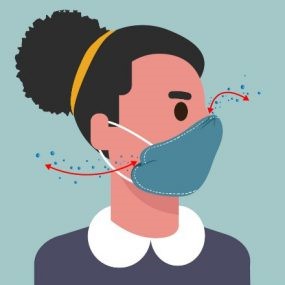
COVID-19 spreads mainly from person to person through respiratory droplets that come out of the nose and mouth when people breathe, cough, sneeze, talk, shout, or sing. These respiratory droplets travel in the air and can then land in the noses and mouths of others, which spreads COVID-19. Therefore, in order to be effective, masks must always be worn over the nose and mouth.
Ensuring that masks fit well on the face is very important to help prevent getting and spreading COVID-19. A common problem with some masks is that there can sometimes be gaps between the mask and the mask wearer’s face. When there are gaps, air with respiratory droplets containing the virus can leak in and out around the edges of the mask (on the top or the sides). To help prevent air leakage, masks should fit snugly against the sides of the face and not have gaps.
Options to Improve Mask Fit

Nose Wires: Use cloth or medical procedure masks that have a nose wire (a metal strip along the top of the mask) to help prevent air leakage at the top of the mask. Nose wires can also help to prevent fogging of eyeglasses. To get a good fit, make sure to bend the nose wire over your nose to conform to your face.
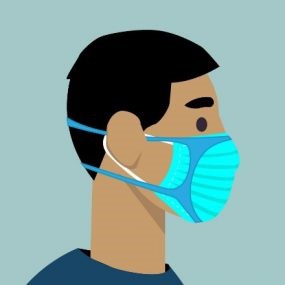
Mask Fitters and Braces: These devices can be used over a medical procedure mask or a cloth mask to improve the fit by helping to reduce air leakage from around the edges of the mask.
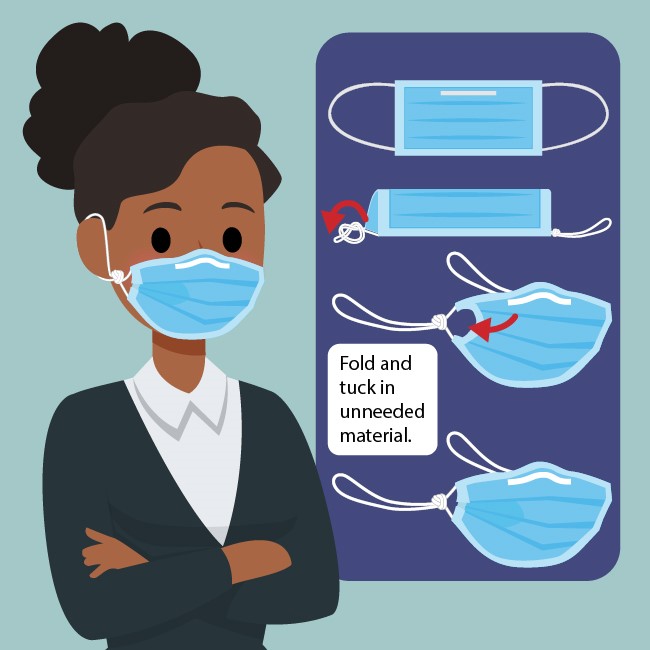
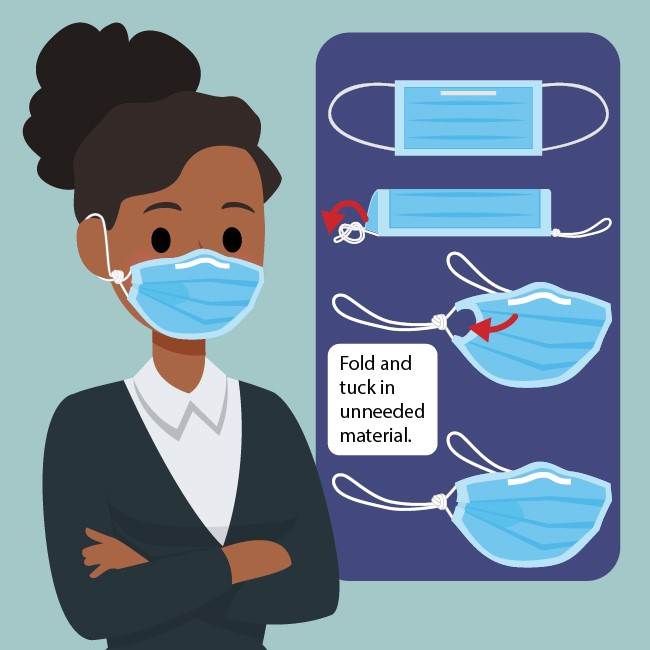
Knotting and Tucking: This technique can be used to improve the fit of a medical procedure mask. Knot the ear loops of the mask where they join the edge of the mask, then fold and tuck the unneeded material under the edges. (For instructions, see the following video)
How to check mask fit
- Check for gaps by cupping your hands around the outside edges of the mask. Make sure no air is flowing from the area near your eyes or from the sides of the mask.
- If the mask has a good fit, you will feel warm air come through the front of the mask and may be able to see the mask material move in and out with each breath.
How to Improve Filtration
Another important step to increase the protection offered by your mask is to improve filtration. Masks capture respiratory droplets containing the virus when the wearer breathes out, blocking them from reaching the outside air and protecting others. They also serve as a barrier to protect the wearer by capturing respiratory droplets containing the virus breathed out by others, so that the wearer does not breathe them in. A mask with improved filtration will stop more respiratory droplets containing the virus from getting inside your mask if others are sick or escaping from your mask if you are sick.
Layering
Adding more layers of material to a mask (layering) is a good way to reduce the number of respiratory droplets containing the virus that come through the mask. One layering strategy is to use a cloth mask that has multiple layers of fabric. Another strategy is to wear two masks.
Improve Mask Fit and Filtration by Wearing Two Masks
Wearing a second mask on top of a first mask can
- Improve fit by pressing the inner mask closer to the face, thereby reducing the amount of air that leaks around the edges of the masks.
- Improve filtration by adding more layers of material to reduce the number of respiratory droplets containing the virus that come through the masks.
One way to do this is to wear a medical procedure mask underneath a cloth mask. A recent study conducted in a laboratory found that this combination provided much better protection to the wearer and to others as compared with a cloth mask by itself or a medical procedure mask by itself.
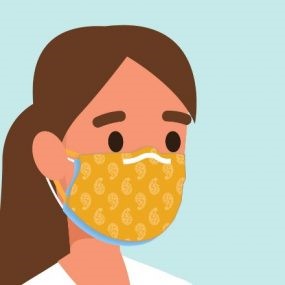
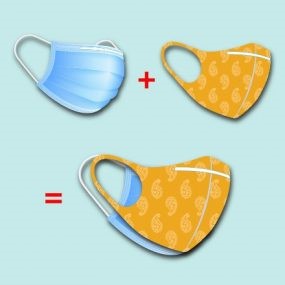
However, there are some mask combinations that should not be used
- Do not combine two medical procedure masks. Medical procedure masks are not designed to fit tightly and wearing a second medical procedure mask on top of the first medical procedure mask does not help to improve the fit.
- Do not combine a KN95 mask with any other masks. You should only use one KN95 mask at a time, and you should not use any type of second mask on top of or underneath a KN95 mask.
Share this:

Executive Constantine’s proclamation recognizes March as Women’s History Month
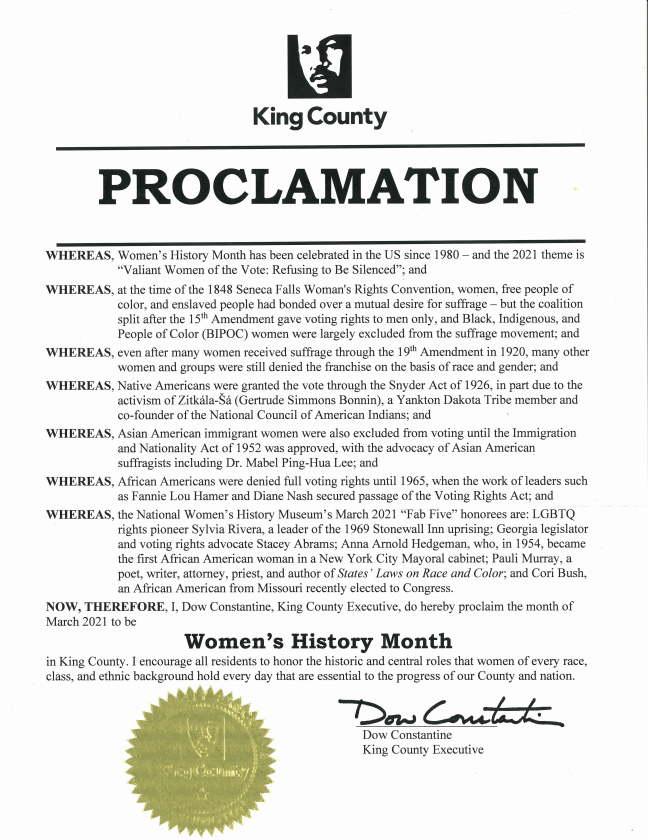
In recognition of the 41st year of Women’s History Month, King County Executive Dow Constantine has proclaimed March 2021 to be Women’s History Month. The proclamation states “Whereas Women’s History Month has been celebrated in the U.S. since 1980 – and the 2021 theme is “Valiant Women of the Vote: Refusing to Be Silenced” and “even after many women received suffrage through the 19th Amendment in 1920, many other women and groups were still denied the franchise on the basis of race and gender,” Executive Constantine encourages all King County residents to honor the “historic and central roles that women of every race, class, and ethnic background hold every day that are essential to the progress of our County and nation.”
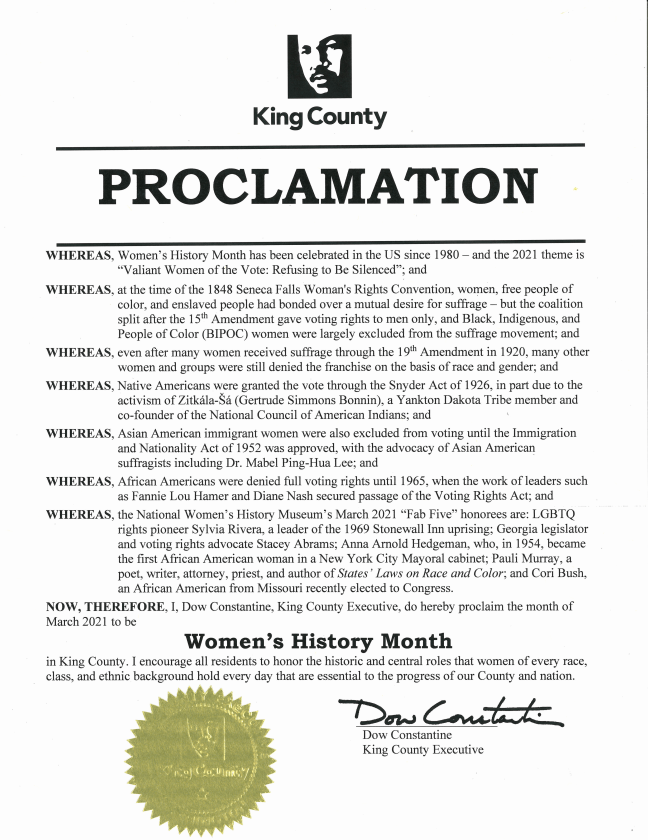
Read the full proclamation below.
Share this:

Phase 1 Future of Work plans submitted for review

King County departments have submitted the first phase of their “Future of Work” plans as part of efforts to look ahead to the needs of operations, employees, and customers once the risk of the COVID-19 pandemic has ended.
The plans draw on the experiences and lessons learned from the last year operating amid COVID-19 and incorporate input from employees using a variety of mechanisms, including surveys, all-hands meetings, and focused breakout discussions, with a particular emphasis on equity and employee health and safety.

The Future of Work plans are being developed in two phases by departments that report to the Executive and consider impacts to eight key areas:
Phase I (submitted February 26)
- Equity
- Employee health, safety, wellbeing, engagement, and labor relations
- Customer service, business needs, and operational needs
- Change management and communication plans
- Worksite changes
Phase II (due March 26)
- Budget planning and cost avoidance
- Climate change, sustainability, and efficiency
- Legal advice and regulatory compliance.
Some of the issues being considered by departments are how remote and on-site work affects equity for employees and customers, potential impacts to carbon emissions, and the maintenance of employee health, safety, and wellbeing.
“COVID-19 forced many changes on the way we work but it has also given us the opportunity to rethink the way we work,” Chief People Officer Whitney Abrams said. “We want to take this opportunity to look at how we deliver services, the way we work, and what we can do differently to better serve our region, our employees, and the environment.”
Approximately two-thirds of King County’s 15,000 employees are currently required to work on-site, delivering essential in-person services to residents. Many other public facing services have shifted online, and various buildings are closed to the public and most employees. In addition, the Administration Building will close some time in 2021, with staff in that building relocating to Chinook, KSC, and other County-owned or -leased facilities.
Departments are meeting with the Guidance Team to learn from other departments’ strengths and improve their plans. Final plans will be submitted to the Future of Work Planning Committee for review and final plans will need to be approved by King County Executive Dow Constantine and his Senior Leadership Team.
Share this:

County leadership wants to hear from you
The 2021 Employee Engagement Survey is now underway, and King County leaders want to hear from you about what is going well and where we need to improve.
King County Executive Dow Constantine, King County Council Chair Claudia Balducci, Assessor John Wilson, and Elections Director Julie Wise recorded a short video about why participating in the Employee Engagement Survey is so important. Watch the video.
Most employees will receive an email in their King County inbox between Monday, March 8, and Tuesday, March 9, from KC Employee Survey (kcemployeesurvey@us.confirmit.com) inviting them to have their say in this year’s survey, which runs from March 8-26.
The survey — which can be taken on your work computer or a mobile device — will take no more than 15 minutes and can be done during work time. Your responses are 100% anonymous and cannot be traced back to you.
Translations available
This year, the survey will feature a dropdown menu with language translations in Amharic, Chinese (traditional and simplified), Somali, Spanish and Vietnamese.
All employees are eligible for the employee survey, except the following:
- Employees in Superior Court, District Court, Prosecuting Attorney’s Office and the Sheriff’s Office
- Employees who are interns or short term temporary (STT)
- Employees who have not worked at the county for at least 3 months prior to the survey period (for 2021, employees must have started before December 8, 2020 to be eligible).
For FAQs and more information about the survey visit www.kingcounty.gov/employeesurvey.
Share this:

Email to participate in 2021 Employee Survey

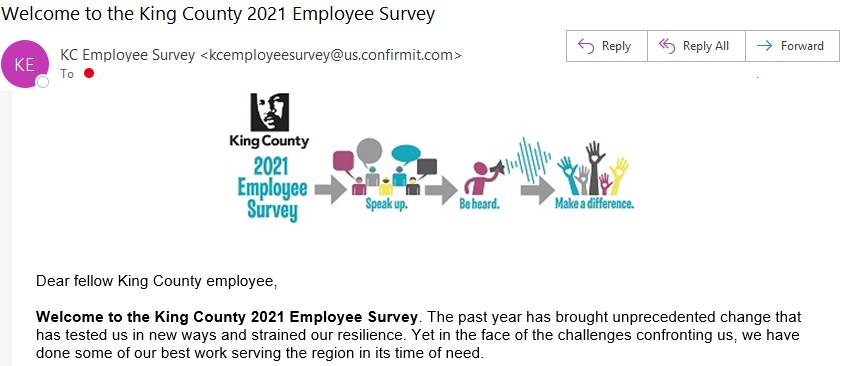
Between Monday, March 8, and Tuesday, March 9, most employees will receive an email in their King County inbox from KC Employee Survey (kcemployeesurvey@us.confirmit.com) with the subject line “Welcome to the King County 2021 Employee Survey” inviting them to have their say in this year’s Employee Engagement Survey.
Here is what the email will look like:
The 2021 Employee Engagement Survey will take place from March 8-26, and it is a great opportunity to let County leaders what is going well and where we need to improve. Remember that changes happen from your suggestions.
The survey — which can be taken on your work computer or a mobile device — will take no more than 15 minutes and can be done during work time. Your responses are 100% anonymous and cannot be traced back to you.
All employees are eligible for the employee survey, except the following:
- Employees in Superior Court, District Court, Prosecuting Attorney’s Office and the Sheriff’s Office
- Employees who are interns or short term temporary (STT)
- Employees who have not worked at the county for at least 3 months prior to the survey period (for 2021, employees must have started before December 8, 2020 to be eligible).
For FAQs and more information about the survey visit www.kingcounty.gov/employeesurvey.
Share this:

Updates on COVID-19 vaccines

by Whitney Abrams, Chief People Officer

King County Executive Office
Marking one year
This week marks one year since the first cases of COVID-19 were identified in King County. I want to acknowledge what a challenging, stressful, and exhausting year this has been. The COVID-19 pandemic together with the public health crisis of racism have had—and continue to have—a profound impact on you, your families, and our community.
I am grateful for the many ways you have taken care of yourself and of one another during this past year. Together, our sustained strength, courage, and resilience has enabled us to provide exceptional service to the people of King County. Together, we’re helping to slow the spread of COVID-19 in our community and we look forward to brighter days ahead.
COVID-19 cases has been on a downward trend in King County, but over the past week, that has flattened out. The virus is still spreading in our community and we are under the threat from more contagious new variants. It remains more important than ever to continue to wear masks, stay at least six feet apart, and avoid gatherings with people you don’t live with. Complacency now would be a major mistake.
COVID-19 vaccine update
King County continues to work closely with our state colleagues as well as partners in the community and at all levels of government to ensure COVID-19 vaccines are distributed quickly, safely, and equitably in King County and across the state. We are heartened by the recent approval of the single shot Johnson & Johnson vaccine, which joins Pfizer and Moderna as authorized vaccines.
This is exciting news, but I know that you may have questions and concerns about vaccines. King County is committed to sharing trusted information about COVID-19 vaccines with you. All COVID-19 vaccines currently available in the United States have been shown to be highly effective at preventing COVID-19, and have been studied in clinical trials with large and diverse groups of people, of various ages, races, and ethnicities.
Vaccine supply is still low right now, so those of you who are currently eligible to be vaccinated may still experience frustrating delays. Please know that this will improve over time as vaccine supply increases.
Certain groups of higher risk King County employees are expected to become eligible for vaccination in upcoming phases. Washington State sets the priorities, which you can learn more about here. We are committed to helping eligible employees understand their options for how to access the vaccine when their turn comes. This includes actively working to facilitate access for front-line employees who would become eligible under Phase 1B Tiers 2 and 4 as defined by the state, due to the nature of their work at King County.
Now is a good time to learn more about COVID-19 vaccines and get your questions answered so you’re prepared when it’s your turn to get vaccinated:
- www.kingcounty.gov/covid/vaccine can help you understand when and where to get the vaccine. You’ll also find FAQs about the vaccine
- FindYourPhaseWA.org - Washington State’s Phase Finder online tool can confirm your eligibility and provide you with a list of possible vaccination locations
- www.preventcovidwa.org can help you learn more about COVID-19 vaccines and the science behind them, and to separate myth from fact.
Regardless of where you get a COVID-19 vaccination — the doctor’s office, a pharmacy, a community event, or other location — you should not have to pay anything. Checking with your health care provider is the best place to start, but if they do not have vaccine availability you should check other vaccine locations.
If you are covered under a King County employee health plan, you may be asked to provide your Regence BlueShield, CVS, or Kaiser Permanente insurance card. And remember, getting vaccinated is an eligible use of sick leave.
We all want to get back to our lives and vaccinations can help us get back to many of the things we miss most and keep all of us as healthy and safe as possible.
I will continue to share more information over the coming weeks and months as we work to end this pandemic.






 Employee News