
Metro GM Rob Gannon stepping down, Deputy Terry White named interim GM


Rob Gannon
King County Executive Dow Constantine yesterday announced that King County Metro General Manager Rob Gannon is stepping down to take a position as chief financial officer for the city of Missoula, Mont.
“I want to thank Rob Gannon for leading King Country Metro with his steadfast service, his core commitment to providing transit where needs are greatest, and his vision for an agency devoted to overall mobility,” said Executive Constantine. “When Metro won Best Large Transit Agency in North America during Rob’s tenure, it recognized what King County residents already knew: that one of the great advantages of living here is a safe, equitable, and sustainable mobility agency that connects all our residents to community and opportunity.”
 Gannon oversaw the transformation and restructure of Metro from a transit division to a full King County department. Under his leadership, Metro outlined a path for operating and growing transit to reduce congestion, tackle the climate crisis, and make mobility accessible and affordable for everyone—especially communities of color, people with lower incomes, and customers with disabilities.
Executive Constantine has appointed Deputy General Manager Terry White to become Interim General Manager when Gannon steps down at the end of July. Chief of Staff Michelle Allison has agreed to serve as interim Deputy General Manager.
White began his Metro career in 1987 and possesses both an unparalleled knowledge of the agency, and a heartfelt and highly personal connection to its employees and customers. White oversees all of Metro Operations, which includes bus, rail, and marine service, facilities, and vehicle maintenance. White also has served at Metro as a transportation planner, customer service administrator, communications superintendent, and managing director of bus operations.
Share this:

We’re listening to employees to support employees

The King County value “We respect all people,” encourages us to actively seek to learn and understand all perspectives, beliefs, and values, engage people in decisions affecting them, and recognize all people for their contributions and accomplishments. This has never been more important than during our COVID-19 response.
With this in mind, and to more fully understand the impacts of COVID-19 on employees, more than 1,000 randomly selected Executive branch employees participated in a survey or listening session in May 2020 to share their experiences and opinions.
This opportunity allowed employees from a range of departments to openly discuss the challenges they are facing, as well as provide feedback on how King County can more fully support them during this difficult time. Topics such as equity and social justice (ESJ), safety, well-being, communication, and accessibility came up repeatedly during the discussions.
“Safety should come first, and consideration for the whole person. Also, flexibility for mixing up telework and on-site work should be a long-term outcome,” one participant shared.
This also allowed managers and supervisors to learn from employees, and how King County can better address their need. Hearing directly from employees about their experiences is essential for moving forward in developing a healthy workplace and community. Leadership across the County is invested in responding to these survey findings and enacting policies and procedures to make lasting change.
“The Executive and his senior leadership team are committed to listening and acting on what we hear from you,” said Whitney Abrams, Chief People Officer. “We will continue to conduct regular surveys and listening sessions to better support you throughout this pandemic and beyond.”
To learn more about this survey, view the video below to see the key findings, or view the full survey results here (SharePoint).
Share this:

Boost your Microsoft Teams skills: Take a free King County webinar, multiple dates

KCIT Training is offering a series of free webinars all about Microsoft Teams. Select the free King County webinar that best fits your interests or skill level or attend them all.
Webinars are available multiple dates from Wednesday, July 15 through Wednesday, Sept. 9. Register here.
Courses include:
- Getting Started with Teams— gain confidence in navigation, search and managing your profile/settings.
- Teams for Intermediate Users —featuring collaboration and co-authoring tools and managing member roles.
- Teams for Advanced Users —add to your toolkit with the addition of tabs and file recovery.
- Collaboration Across Office 365 —includes OneNote and Outlook integration and sharing files/folders in OneDrive.
Share this:

Brain-based Time Management online training, July 30
 Do you procrastinate, get distracted, have a hard time prioritizing, or feel overwhelmed? What we do and how we do it are driven by how our brains are wired. Neuroscience tells us we have 10 brain skills and each one of us has skills that are strong (and skills that are not strong).
In this class, you’ll hear about each of these skills so you can identify where the weak areas are for you and most importantly, learn what you can do about it. Imagine finishing your workday with confidence that you remembered and handled everything you needed to!
- Thursday, July 30, 2020, from 9 a.m. to noon. Register here.
The webinar is $50 and space is limited. For more information, contact the Learning and Development Team at KCTraining@kingcounty.gov or visit www.kingcounty.gov/learning.
Share this:

PeopleSoft HCM outage this weekend, July 17-19
To allow for system maintenance, the PeopleSoft system will not be available this weekend, July 17 through July 19. During this planned outage, the Business Resource Center (BRC) will apply vendor updates and maintenance.
This work will begin on Friday, July 17 at 3 p.m. and is scheduled to be completed by 6:30 a.m. on Monday, July 20.
The system will not be available for access by any County staff during this outage window. There will be a communication sent out to all County staff when the system becomes available.
We realize that this outage impacts all PeopleSoft users and we appreciate your understanding and support.
Share this:

PBS NewsHour program “Let the Shameful Wall of Exclusion Come Down,” July 21

 On Tuesday July 21, the George and Barbara Bush Foundation will convene key activists, advocates and policymakers who helped make the Americans with Disabilities Act a reality for a bipartisan celebration of that landmark civil rights legislation – and, equally important, focus on the challenges that will shape the future of the disability movement. The 90-minute online program, titled “Let the Shameful Wall of Exclusion Come Down,” taken from President Bush’s remarks on July 26, 1990 as he signed the ADA, starts on July 21 at 1:30 p.m. Eastern Time and will be moderated by Judy Woodruff, the managing editor and anchor of PBS’ NewsHour. Register and view the program here.
Share this:

What we heard from employees

Dear King County employee,
Over the past few months, I’ve been thinking a lot about one of our King County values—We respect all people. At King County, we show respect by actively seeking to learn and understand all perspectives and engaging people in decisions that affect them.
As we seek to stabilize during the pandemic and adapt to change, we surveyed more than 1,000 Executive Branch employees to better understand their current challenges, fears, and hopes for the future. We also held listening sessions with frontline employees and King County affinity groups to get an even deeper perspective of their experiences. You can view the survey results here (SharePoint).
Here’s what we learned:
- You want King County to center equity and racial justice in the recovery effort.
- Remote workers see many benefits in working remotely, and report feeling more productive and engaged with their work. Most want to continue working remotely at least some of the time after the pandemic subsides; their challenges include ergonomics and screen fatigue.
- Frontline staff and emergency responders working onsite report feeling less valued and engaged than teleworkers. Their challenges include workplace safety, mental health and well-being, and communication with their managers and supervisors.
- Your interest in growth and development opportunities remains strong, and you don’t want to stagnate during the pandemic.
- The pandemic has created communication challenges, especially with the loss of onsite interaction.
Here’s what we will do:
- Lead with Racial Justice from the top of the organization.
- Continue to make ESJ training and tools available so you have the knowledge and tools to center Racial Justice in your work.
- Establish employee well-being advisory groups for employees working onsite and those working remotely.
- Continue to work on communication and support for employees working onsite – and check how this is working, and adjust where needed.
- Continue our commitment to employee well-being with Balanced You programs that support your mental health, financial well-being, and physical health.
- Update our Learning Management System by the end of this year so we can better support eLearning throughout the County.
The Executive and all of us on his Senior Leadership Team are committed to listening and acting on what we hear from you. We will continue to conduct regular surveys and listening sessions to better support you throughout this pandemic and beyond.
This is challenging time. We will get through it by listening to and supporting one another, acting on what we learn, and adjusting as we go. I am so grateful for everything you do for our customers and community, and for one another. I hope you can take some time this summer to rest, relax, and recharge. Your well-being is important!
Sending you my best (virtually) –

Whitney Abrams,
Chief People Officer
Share this:

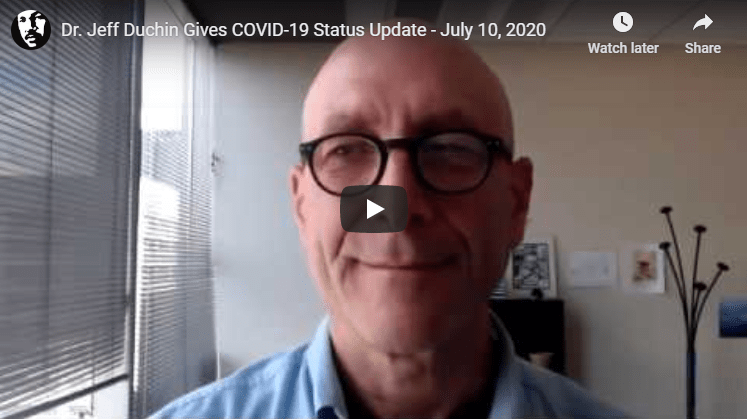
Video: July 10, 2020 Update on COVID-19 in King County with Dr. Jeff Duchin
Crossposted from Public Health Insider
On July 10th, Dr. Jeff Duchin gave an update on the COVID-19 outbreak in King County and expressed urgency for our community to help prevent a further surge in cases. View the update below.
“It is critical as a community we understand the long-term nature of this COVID-19 mess. None of us asked for this, none of us wanted this, but if we don’t deal with it, it will deal with us… We need long-term behavior change with respect to how close we get to one another, institutionalizing distancing, wearing of masks anytime we are in public and in close contact with one another (especially indoors), paying attention to ventilation and duration and frequency of contact, and good hand hygiene.
We need to reconfigure our workplaces and other places we spend time to allow the space that is necessary to decrease the risk of transmission.
For a healthy economy, we need a healthy community. Understanding how interconnected and interdependent we are and the steps we need to take for the long-haul are the most important things right now.”
Share this:

Welcome people of all abilities to your remote meetings and events!

 Crossposted from Clean Water Stories
Are you hosting remote meetings? King County Wastewater Treatment Division (WTD) would like to share some advice that will make your meetings more accessible.
Not too long ago, a pandemic might mean intense social isolation for some. Today, technology lets us stay connected in real time, if not in person.
Remote interactions are a lifeline in this challenging time. Telework, remote visits with family, virtual tours, and online community engagement connect us with others while protecting our health.
Share this:

Doing the right thing: Restaurants and COVID-19

 Crossposted from Public Health Insider
In response to rising COVID-19 cases county wide, Public Health – Seattle & King County is expanding efforts to educate and enforce compliance of Governor Inslee’s Safe Start COVID-19 reopening requirements in food establishments.
The governor’s Safe Start business reopening requirements include that food establishments:
- Set up customer flow that allows for social distancing of 6 feet or more;
- Assure that employees and customers wear face coverings;
- Limit restaurant indoor and outdoor seating occupancy; and
- Take other important protective measures such as surface cleaning and employee health screening.






 Employee News