
Fireworks safety in a pandemic


Pictured: Last year’s fireworks show over the Space Needle.
Every year in the U.S., about 9,000 people are injured using fireworks at home, according to the U.S. Consumer Product Safety Commission (CPSC). Most of these injuries take place around the July Fourth holiday. This year, we have been dealing with the dual pandemics of COVID and racial injustice. Most public fireworks displays have been cancelled. If you decide to use consumer fireworks, please do so with caution and follow local rules and regulations. In addition, remember that social distancing, wearing a face covering and hand-washing are still very important.
- Fireworks are banned in many cities
- Fireworks purchased from approved firework stands are only allowed to be discharged in unincorporated King County on July 4, and they should be sold only by reliable Washington State- and King County Fire Marshal-licensed retailers
- Fireworks not purchased from a state-licensed fireworks retailors are not approved to be discharged in unincorporated King County. They may be considered explosive material.
- Fireworks are not allowed in King County Parks, per King County Code.
If you choose to discharge fireworks on the 4th follow these rules and safety tips:
- You must be at least 16 years old, with photo identification, to purchase fireworks.
- Always have a responsible adult light all fireworks.
- Have a garden hose or a fire extinguisher handy.
- Use fireworks outdoors only—away from buildings, houses with wood exteriors, trees, and dry fields.
- Avoid aerial fireworks.
- Light one item at a time, move away quickly, and have everyone keep a safe distance.
- If a device does not light or fire, an adult should wait at least five minutes before approaching it.
- Soak used fireworks in water before disposing of them.
- Keep pets safe. Use eye protection. Clean up all debris. (Regional Animal Services of King County provides information about fireworks safety for pets)
- If it has a stick or fins and it goes up, or if it explodes, it is illegal in Washington State.
Share this:

Routine dental care again allowed

 Dentists began seeing patients for routine visits again on May 19. Prior to reopening, dental offices have implemented new protocols, including additional Personal Protective Equipment (PPE), to further protect the health and safety of you and your family members.
Some employees have reported that their dentists are charging them for the additional PPE needed to prevent the transmission of COVID 19. Delta Dental is now paying dentists an additional amount for each visit to cover the cost of PPE. Covered members are not required to pay any additional charges for PPE. Delta Dental contracts with network dentists do not allow for dentists to charge members anything additional for supplies.
You may wish to check with your dentist before your next dental appointment to see if they are going to charge you an extra fee for PPE. You can share the information above with your dentist, but if your dentist insists on charging you extra for PPE, you are not obligated to pay it.
As a reminder, the dental plans for those in the Regular and Transit ATU 587 employee benefit groups covers preventive and diagnostic services at 100% with no deductible. That includes cleanings, exams, and x-rays, plus sealants and fluoride for children through age 18.
If you have questions about your dental benefits, please contact the Benefits Team at 206-684-1556 or KC Benefits.
Share this:

Featured Job: COVID Homeless Testing Program Manager (Project / Program Manager III)

Salary: $87,640.80 – $111,089.89 Annually
Location: Seattle, WA
Job Type: Special Duty Assignment or Term Limited Temp (TLT)
Department: DPH – Public Health
Job Number: 2020NH11771
Division: Community Health Services
Closing: 7/8/2020 11:59 PM Pacific
Learn more about this position or view all available positions.
Share this:

COVID-19 update: Increased ridership, restored trips, required masks and face coverings
 Crossposted from Metro Matters
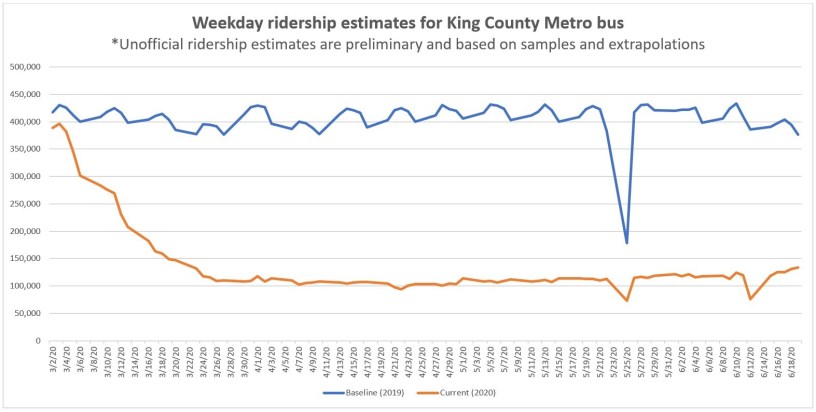
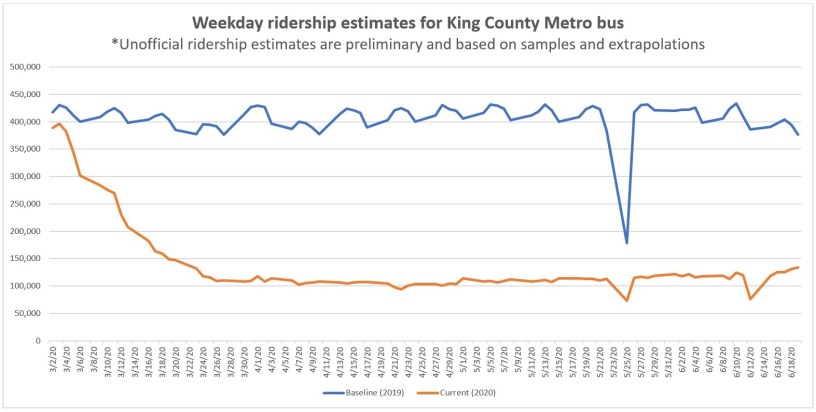
Ridership on King County Metro has increased in recent weeks as more people choose to ride public transportation and the state allows more activities under its “Safe Start” plan. Metro continues to require masks or face coverings be worn on transit. Buses currently have reduced passenger limits to support social distancing and limit the spread of COVID-19.
Metro analyzed preliminary extrapolations to create an unofficial estimate of weekly ridership, which remains lower compared to a year ago but shows early signs of recovery.
Share this:

July and August Mindfulness Class Schedule now available

 As we continue to maneuver through this very difficult time in our society, it is important that we manage our mental health and stress levels. Balanced You heard from employees that mindfulness classes have helped alleviate some of the anxiety many are experiencing, so we are continuing to provide these classes through August.
What is mindfulness?
Mindfulness is a practice that uses breath work, visualization, and other skills to support you in reducing stress at work and at home. Mindfulness techniques are especially useful now, as we move through the uncertainty of the political climate and coronavirus pandemic.
Balanced You continues to partner with Mindfulness Northwest to offer free mindfulness classes and workshops to King County employees, via both employee-specific and community classes. In alignment with social distancing recommendations, all in-person classes have temporarily shifted to online platforms. Visit the Balanced You blog for a class calendar, registration links, and more information.
Share this:

Road to Retirement classes offered online, July 8, multiple times

Are you planning to retire in the next six months? In honor of National Retirement Planning Month and to better fit your schedule, the Road to Retirement class will be offered online at four different times on Wednesday, July 8, being offered at 7 a.m., 10 a.m., 2 p.m., and 7 p.m.
Join your Retirement Team for this informative 90-minute online class. We’ll discuss procedures and forms, medical coverage options, and pension plans—so you’ll be on a smooth road toward a happy retirement.
Please register for a session that works best for you. You will then receive a separate email with a Zoom link for the class you selected. To learn more before the class, go the Retirement page and read the Retirement Guide. For more information, contact KC Orientations or Carmen Johnson, retirement navigator. Please note, attendance is strictly voluntary, on your own time, and non-work related.
Share this:

Volunteer to be a Ballot Drop Box Closer for August 4
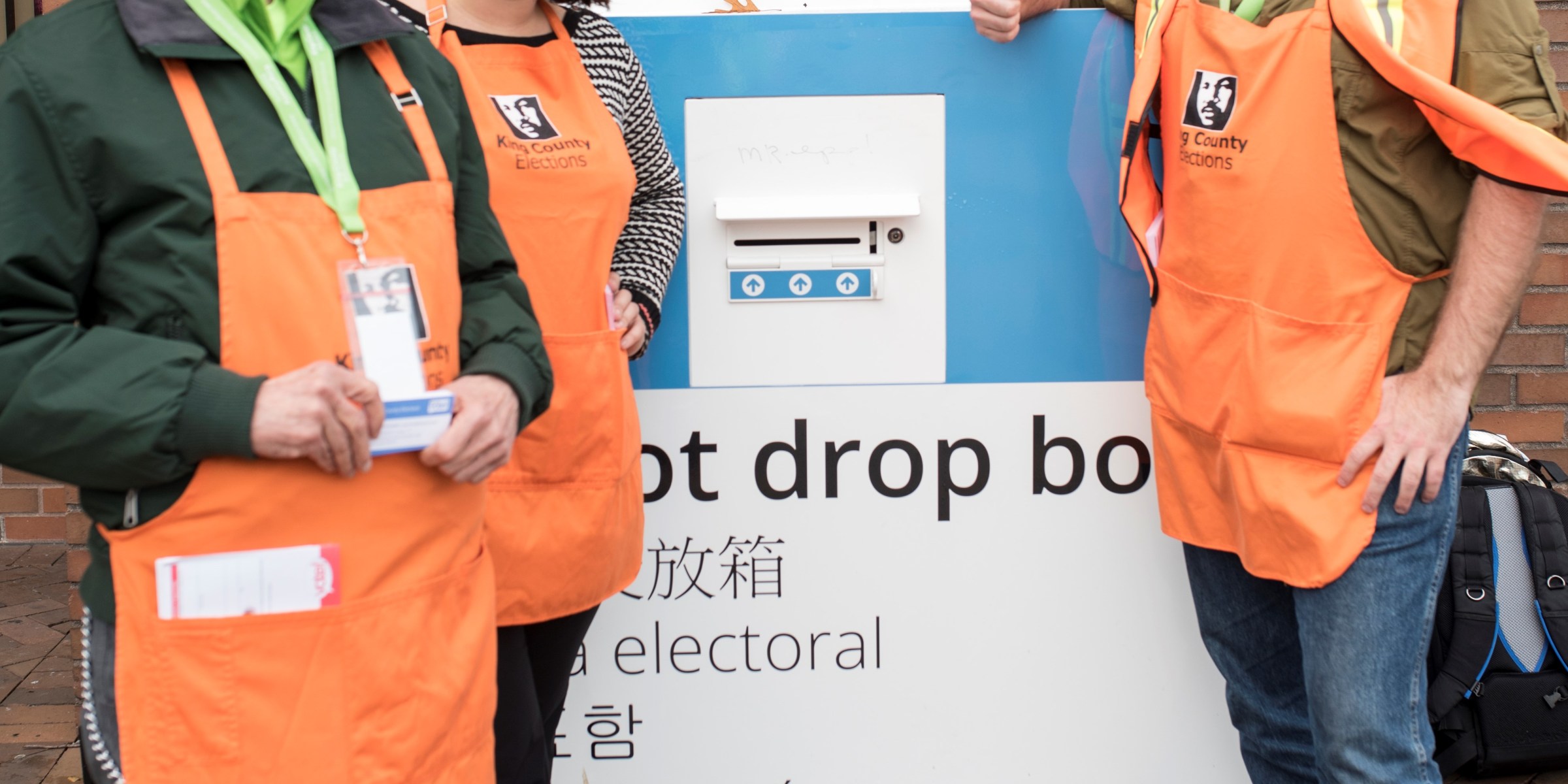
 Looking for some Election Day excitement? Meet your neighbors and continue your commitment to public service by volunteering as a drop box closer. Drop box closers are the friendly face the public sees on Election Day, ensuring that every vote is counted, and every voice is heard.
Who: You and your co-workers
What: Closing ballot drop boxes across King County
When: Election Night – August 4 from 6:30-8:30 p.m.
Where: A drop box location near you
Most voters wait until Election Day to return their ballots and drop boxes are often busiest in the last few hours of voting. We need your help to provide customer service and assistance to voters using this last opportunity to return their ballots. Sign up and join us for a fun and fulfilling experience helping your neighbors experience the excitement and community of casting their ballots.
You’ll be partnered with Elections staff and no experience is necessary – we provide all the training you need! All locations are outside and we ask that volunteers wear masks to help prevent the spread of COVID-19. If you do not have a mask, we can provide one for you. More information about precautions being taken will be provided to all volunteers ahead of Election Day.
Our colleagues who volunteered in November described their experiences as rewarding, fun, and inspiring! Join us by signing up to help with the Primary election on August 4th, 2020 from 6:30-8:30 pm.
Have questions? Learn more here.
Share this:

Emergency Operation Center experiences dual activation


Pictured: A volunteer from Team Rubicon at the Emergency Operations Center earlier this year.
Already activated in February for COVID-19, King County had a dual activation of the Emergency Operations Center (EOC) from May 30 through June 7 in response to protests over the murder of George Floyd in Minneapolis.
“Dual activations are very rare anywhere, and they’re tough,” said Brendan McCluskey, Emergency Management Director. “Staff rose to the challenge. We had to keep track of both situations, including resources and costs. We had more people in the EOC and had the need for physical distancing with COVID-19.”
On a few occasions, the King County EOC has activated in response to more than one emergency at the same time, typically for weather-related events. A dual activation occurred during the Howard Hanson Dam emergency of 2009-2010, when the county was battling the compromised dam structure that threatened downstream communities of the Green River Valley, and severe weather events.
During the most recent dual activation, staff at the EOC helped coordinate National Guard staffing throughout the county, beyond Seattle. In addition, the EOC supported county departments and local jurisdictions (fire departments, transit, cities, etc.) with public information, resource management, planning, and operational coordination. The EOC also helped collect information about the extent of financial losses from affected businesses, submitting this information to the Small Business Administration for potential funding.
Share this:

King County GreenTools Program “sheroes” honored by the US Green Building Council for equity and social justice work

 The US Green Building Council honors King County “Women in Green Sheroes” for advancing equity and social justice through sustainable development, green building, and community empowerment.
For their efforts to advance equity and social justice through the sustainable development work carried out under King County’s GreenTools Program, Solid Waste Division employees Patti Southard and Nori Catabay were honored as “Women in Green Sheroes for Economic Empowerment in the Pacific Region” by the US Green Building Council.
“Everyone in King County deserves access to a healthy community where people, businesses and the environment can thrive,” said Department of Natural Resources and Parks Director Christie True. “The program created by these two incredible women is centered on the concept that sustainable development and its benefits are an equity issue, and we’re proud so many others around the nation are looking to emulate this model.”
Read more in the official press release.
Share this:

Featured Job: Administrative Project Coordinator
Salary: $32.92 Hourly
Location: Seattle, WA
Job Type: Short Term Temporary, Part Time, Std Wkly Hrs Vary
Department: KCC – King County Council
Job Number: 2020-11772
Division: Office of Indep Oversight
Closing: 6/30/2020 11:59 PM Pacific
Learn more about this position or view all available positions.






 Employee News