
PeopleSoft HCM outage this weekend, June 12-14

To allow for KCIT infrastructure maintenance, the PeopleSoft system will not be available this weekend, June 12 through June 14.
During this planned outage, KCIT will upgrade infrastructure including server maintenance that impacts the PeopleSoft system. As a precautionary measure, the PeopleSoft system will be taken offline and not available during this time.
This work will begin on Friday, June 12 at 6 p.m. and is scheduled to be completed by 6:30 a.m. on Monday, June 15.
The system will not be available for access by any County staff during this outage window. There will be a communication sent out to all County staff when the system becomes available.
We realize that this outage impacts all PeopleSoft users and we appreciate your understanding and support.
Share this:

Black Lives Matter silent march and general strike Friday, June 12

 Dear employee,
Black Lives Matter Seattle-King County (BLMSKC) has called for a statewide silent march and general strike across Washington on Friday, June 12.
King County remains steadfast in our fight against racism, hatred, and violence, and in our commitment to our “We are racially just” value. We respect, value, and support people peacefully expressing their views and exercising their First Amendment rights.
Employees who are scheduled to work and wish to attend any of the strike events on June 12 must follow their department’s appropriate leave policies. For more information on your department’s leave policies, please refer to your Human Resources Manager.
Employees should check with their supervisor for specific information or instructions for their work unit, or requests for alternative work arrangements. Any alternative work arrangements must be approved by an employee’s supervisor. Supervisors are encouraged to exercise flexibility and creativity wherever possible.
All Executive Branch employees who are currently telecommuting should continue to do so, except where there is an operational need to physically be in the workplace. Employees designated as first responders and mission-critical employees should continue to report to work per current operations, unless advised otherwise by their supervisor.
You can find more details about Friday’s strike and events here.
Public Health officials advise that attending a large gathering such as a protest carries a risk of a person acquiring COVID-19 and bringing it back to their home, workplace and community.
Larger outdoor gatherings represent larger risk, especially if distancing is not possible. Steps to prevent potential exposure include:
- Stay home if you have symptoms
- Stay 6 feet or more away from others
- Wear a cloth mask or face covering. This helps protects those around you, and others wear face coverings to help protect you.
- Carry hand sanitizer and use it often. Avoid touching objects and surfaces that others have touched.
- Do your best to avoid situations where people are shouting or singing, as these activities can spread more virus into the air. Use noisemakers instead of shouting.
Following an event, be on the lookout for any of the symptoms in the 14 days after attending a large group gathering and seek testing promptly if symptoms develop, even if mild. Symptoms include fever or chills, cough, shortness of breath or difficulty breathing, fatigue, muscle or body aches, headache, new loss of taste or smell, sore throat, congestion or runny nose, nausea or vomiting, and, diarrhea. If you can’t access testing through your healthcare provider, Public Health has a listing of free testing sites at www.kingcounty.gov/covid/testing.
Share this:

Use new W-4 to change your tax withholding

 Form W-4 is used to let your employer know how much federal income tax to withhold from your pay. The IRS recommends completing a new Form W-4 when your personal or financial situation changes. This year, the IRS redesigned Form W-4 to reduce complexity and improve accuracy. Go to the IRS website for information about Tax Withholding, FAQs on the 2020 Form W-4, and a Tax Withholding Estimator.
If you would like to adjust the amount withheld from your King County paycheck for tax purposes, please use PeopleSoft to update your W-4:
- Sign in to PeopleSoft. Must be logged into VPN to access this PeopleSoft feature.
- Select the Payroll tile
- Select W-4 Tax Information
- Enter your choices and make note of your selections
- Review and Submit
For additional instructions, check out the W-4 Withholding Certificate video or the Updating Your W-4 training document, both available in the PeopleSoft Knowledge Center.
If you prefer to use paper, go to the IRS website and print a 2020 Form W-4. Complete the form and mail to: Benefits, Payroll and Retirement Operations, Chinook Building, CNK-ES-0230, 401 Fifth Ave., Seattle, WA 98104. Please remember to never use interoffice mail to send items containing a Social Security number.
If you have payroll-related questions, please call Benefits, Payroll and Retirement Operations at 206-684-1556, Option 2, or email KC.Benefits@kingcounty.gov.
Share this:

PRIDE rides on

 Crossposted from Metro Matters
June 28, 2020 marks the 50th anniversary of the first Pride parade. Started in New York City, the event was originally known as Christopher Street Liberation Day. This activist-created march bloomed in reaction to the police raid against LGBTQ patrons of the Stonewall Inn, and the five days of community protests and riots a year earlier. The first Pride parade brought together thousands of participants. Today, millions participate in Pride events around the world.
In 1977, Mayor Charles Royer made the first official declaration of Gay Pride Week in Seattle. That year, the parade started at Occidental Park in Pioneer Square, with more than 2,000 participants marching up First Avenue. As of 2020, organizations like Seattle Pride, the South King County PRIDE Alliance, and the Renton LGBTQIA+ Community plan Pride events throughout our region.
During this intense and somber time – as we endure a pandemic, and mourn and rally in opposition to racism and police brutality against Black people – we also honor and celebrate our LGBTQ+ community. We create space. We recognize the sacrifices made, and the isolation and violence endured. Pride amplifies the voices, visibility, love, and support of LGBTQ+ individuals and their families.
At King County, we strive to be a place where all people have equitable opportunities to thrive. Though in-person Pride events have been canceled or postponed across King County to maintain social distancing, Pride must ride on. We’re celebrating safely with our employees and our community:
- Pride flags were raised at Metro’s King Street Center and 28 Metro work sites, beginning with King Street Center on June 1.
- Starting on June 10, you’re invited to play virtual Pride Bingo – with activity squares like Dance Pride and Throwback Pride-day.
- Our soon-to-be-released Ride with Pride tribute video will feature the voices of Metro riders, community-based organizations, and Metro employees and their family members.
- You’ll also see Metro’s Ride with Pride bus and other colorful, celebratory transit signs rolling around town from June through October.
- Finally, Metro’s own Equal Employment Opportunity / Equity & Inclusion Office will engage staff with thought-provoking materials.
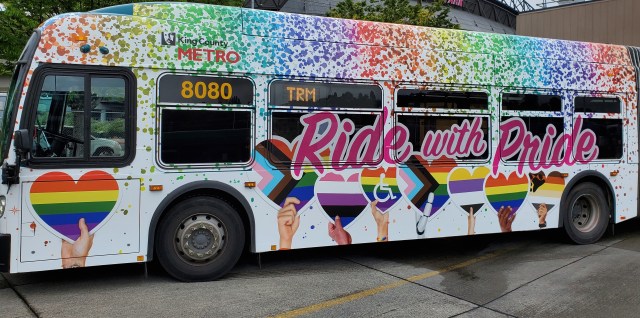
Pictured: Metro’s 2020 Pride bus makes its outdoor debut at Ryerson base. With social distancing, this year’s Pride may look and feel different compared to the past. But as Metro employee Jennifer Mayer recently said, “We’re out, even though we’re staying in!”
Subscribe to our social media channels for the latest ways to show your Pride this month and to stay connected with Metro all year long:


Let’s all “Ride with Pride” in 2020!
Share this:

King County submits plan to re-open limited business activity in COVID-19 recovery

King County Executive Dow Constantine, King County Council Chair Claudia Balducci, and King County Board of Health Chair Joe McDermott today submitted a plan to the state Department of Health that would allow limited and modified openings for a wide range of businesses and personal activities.
The county’s application includes recommendations from King County local health officer Dr. Jeff Duchin that would:
- allow all outdoor recreation permitted in Phase 2 in Gov. Inslee’s Safe Start plan
- expand opening indoor fitness studios for one-on-one activities
- allow restaurants to begin opening indoor seating at 25% of normal capacity
- allow hair stylists and other personal services at 25% capacity
“Our plan to safely reopen our region’s economy is based on the latest data, recommendations by Public Health experts, and insight from communities and businesses,” said Executive Constantine. “We are ready to take the next careful step toward an equitable recovery that benefits everyone who calls King County home.”
Read more in the official press release.
Share this:

COVID-19 and unrecognized realities experienced by black people
Crossposted from Public Health Insider
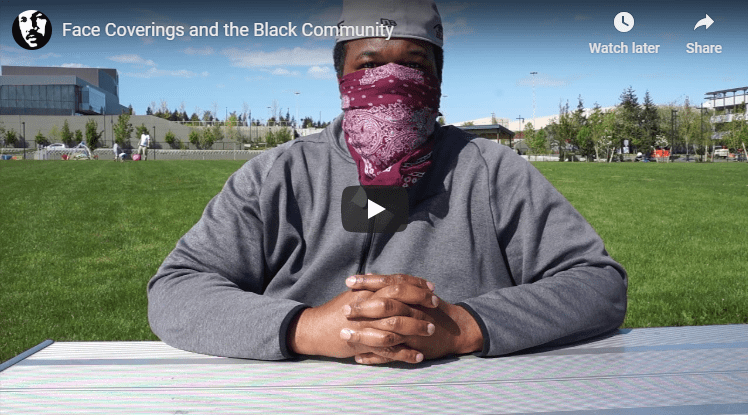
Face coverings help protect our community from COVID-19. Unfortunately many members of the Black community are concerned that wearing face coverings may lead to dangerous and harmful encounters with law enforcement or other community members. Racism influences perceptions of face coverings and those wearing or not wearing them.
After rounds of engagement and feedback from community partners, the decision was made to roll out the face covering policy as as a directive, not an order, so as to prevent further policing of black and brown communities or perpetuate further acts of racism.
However, in recent days and weeks, Black men and women wearing or not wearing a face covering have experienced racial profiling, and racist and violent behavior. Wearing a face covering or not wearing one is no justification for attacking or brutalizing people of color in King County.
Read more from Public Health Insider
Share this:

Featured Job: Disease Research & Intervention Specialist – Hepatitis A

Salary: $30.67 – $38.88 Hourly
Location: Seattle, WA
Job Type: Special Duty Assignment or Term Limited Temp (TLT)
Department: DPH – Public Health
Job Number: 2020AB11705
Division: Prevention
Closing: 6/17/2020 11:59 PM Pacific
Learn more about this position or view all available positions.
Share this:

Tech Tip: Reminder about regular emails from KCIT vendor KnowBe4.com

Each Wednesday all King County email users will receive an email from authorized King County vendor KnowBe4.com about phishing scams. King County Information Technology (KCIT) has partnered with KnowBe4.com to regularly provide information and training to employees about phishing scams and other email red flags. KnowBe4.com is a leading industry expert in security awareness training. Its mission is to help employees to make smarter security decisions, every day, and keep the County’s and employees’ information secure.
Employees are encouraged to read through the helpful information in each email and review the security tips presented. Employees can also rest assured the email comes from a verified source, and is not spam, as it does not feature the external email notice.
For questions or more information, contact the KCIT Helpdesk or call 206-263-4357 (3-HELP).
Share this:

MOS and MTA Certifications available online

 Through a partnership with the Washington Library System, Career Support Services and the Administrative Professionals Committee now offer employees the opportunity to connect with the King County Library and Seattle Public Library for MOS and MTA certification exams, as well as online study guides. Employees can earn their Microsoft Office Specialist (MOS) and Microsoft Technology Associate (MTA) certifications from home at no cost, as well as access study guides and practice tests to help earn the certification. As a reminder, employees may also use the online learning website www.Lynda.com at no cost with their library card.
- For the King County Library System, visit www.kcls.org/getcertified.
- For the Seattle Library, visit the MOS Exam Calendar.
For questions about the certifications, please contact the King County Library at www.kcls.org or the Seattle Public Library at www.spl.org. For additional questions, please email AdministrativeProfessionals@kingcounty.gov.
Share this:

Reminder: PeopleSoft outage starting Friday, June 5, at 3 p.m.

To allow for system maintenance, the PeopleSoft system will not be available this weekend, starting today, Friday, June 5, at 3 p.m.
During this planned outage, the Business Resource Center (BRC) will apply vendor updates and maintenance.
This work will begin on Friday, June 5, at 3 p.m., and is scheduled to be completed by 6:30 a.m. on Monday, June 8.
The system will not be available for access by any County staff during this outage window. There will be a communication sent out to all County staff when the system becomes available.
We realize that this outage impacts all PeopleSoft users and we appreciate your understanding and support.






 Employee News