
Health Hero on the spot: Shawna Johnson

Shawna Johnson is a positive force who works to make it easy for you to protect yourself, your family, and your co-workers. Shawna organizes our onsite flu shot events.
Take a look in the video below! And still need to get your flu shot? Click here.
Share this:

King County District Court Judge shares profound impact of county’s Regional Veterans Court

The Seattle Times published an opinion piece from King County District Court Judge Ketu Shah on November 12. The article highlighted how in Regional Veterans Court, those who served in the Armed Forces can participate in the treatment court process with their fellow veterans, affirming that they are not alone in their struggle, and receive the opportunity to succeed.
“Honoring our veterans means ensuring they have stable housing, employment and educational opportunities. It means treating their invisible wounds of war just as earnestly as we treat their physical wounds,” he said. Read the full article here at The Seattle Times.
Share this:

King County 2019-2020 budget approved by Council

King County Executive Dow Constantine’s proposed 2019-20 budget was approved by County Councilmembers Tuesday, Nov. 13.
“I thank members of the King County Council for their careful review of my proposed 2019-2020 budget, and for supporting our shared priorities. For an environment in crisis – I proposed and we are funding real solutions to restore and protect natural habitat. For the homeless – shelter and services that lead to a better life.
“For the hundreds of thousands of commuters – expanding Metro and deploying innovations to make transit work even better. For those who are not sharing in our current prosperity – restructuring training and employment programs. As part of our award-winning continuous improvement efforts – reforming County government and delivering maximum General Fund and Metro reserves. All of this is in service to our commitment that every person in King County will have the opportunity to fulfill their potential, and contribute to the community.”
Read more in the official press release.
Share this:

Complete Open Enrollment by Nov. 15

Don’t miss your opportunity to evaluate your benefit choices and make changes. If you haven’t already done so, make sure the right benefit options are in place for you and your family next year.
If you don’t participate in Open Enrollment, your current elections automatically continue for next year—except your Flexible Spending Accounts and your Benefit Access Fee exemption, which must be selected each year.
Learn: Review the information on the Open Enrollment web pages, including 2019 Key Benefit Changes. If you’re in the Regular employee benefit group, check out the new Short-term Disability Plan.
Choose: Consider changing medical plans. If you cover a spouse or domestic partner on your medical plan, select the appropriate Benefit Access Fee—or exemption—which resets each year. Enroll in a Health Care or Dependent Day Care Flexible Spending Account (FSA) to reduce your taxable income.
Finalize: Sign in to PeopleSoft. Then go to Benefits, then Open Enrollment. When you’re done, use the Final Submit button and sign out.
Get support: Contact Benefits, Payroll and Retirement Operations at 206-684-1556 or KC Benefits. For in-person help, drop by the Chinook Building, 401 Fifth Ave., 2nd Floor, Seattle, 9 a.m.–4 p.m., or go to the computer lab in the Rhododendron Room on Nov. 15, 9–11:30 a.m.
Share this:

U.S. Department of Defense presents awards to King County and DAJD

The Department of Defense’s Employer Support of the Guard and Reserve (ESGR) presented King County, the Department of Adult and Juvenile Detention (DAJD), and several County managers with awards, Nov. 8, in recognition of their support of County employees who currently serve in the Reserve and National Guard. King County was nominated for the “Freedom” Award by Senior Master Sergeant Michelle Helpenstell, a corrections officer with DAJD, who also serves in the Air Force Reserve.

The ceremony opened with the presentation of colors by King County’s Adult and Juvenile Detention Honor Guard followed by remarks by U.S. Army 1st Lt. Erik Campbell with King County Public Health.
“Offering medical coverage to spouses and dependents while I’m deployed, as well as affording me a job when I transition back to civilian life, lessens my anxiety while I’m away and empowers me with the opportunity to focus on the mission and welfare of my soldiers,” said Erik. “I know that I’m fortunate to work at King County and many Guard and Reserve component military members are not afforded the same opportunities.”
Several County managers were presented with the ESGR “Patriot” Award for the direct support they provide to their Guard and Reserve Employees. Among the recipients were Jane Simpson with Public Health, Meagan Condon with Public Health, and Ruoxi Zhang with King County Information Technology.
After, DAJD Deputy Director Hikari Tamura accepted the ESGR’s “Honors” award, which recognizes King County as one of 2,350 employers nominated nationwide for the prestigious Freedom Award – an important achievement. The award was presented to DAJD because it was a DAJD employee who submitted the nomination.
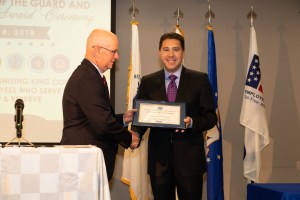
Pictured: Chief Operating Officer Casey Sixkiller accepted the “Above and Beyond” Award on behalf of King County.
Although King County did not receive ESGR’s “Freedom” Award, Chief Operating Officer Casey Sixkiller accepted the “Above and Beyond” Award on behalf of King County. This award recognizes employers at the local level who have gone above and beyond the legal requirements of the Uniformed Services Employment and Reemployment Rights Act (USERRA) by providing their Guard and Reserve employees additional, non-mandated benefits such as differential or full pay to offset lost wages, extended health benefits, and other similar benefits.
“As an employer, one of the largest in the state, we feel it is our duty to look at how we can help those who serve our nation access rewarding careers in our community,” Sixkiller said. “We know that those in the armed forces bring with them unique skills, ideas, and perspectives. Also, we know that these individuals have an overwhelming sense of service, and we want that here at King County.”
Sixkiller then presented challenge coins to Guard and Reserve members who were in attendance. Members who were unable to make it to the event will be awarded coins by their managers.
You can view the ceremony below or at this link.
Share this:

Program offers diverse community opportunities in trades and apprenticeships


Pictured: Graduates from the first PACT cohort, funded by King County in support of the Priority Hire Program.
The King County Priority Hire Program is helping people in economically distressed communities across King County receive the training and skills they need to access rewarding employment and training opportunities in the construction industry. This work is building opportunities and creating a more diverse and trained workforce that will help this region prosper and grow.
“There are opportunities for people in the trades and this program is a great strategy to implement that will help diversify the workforce,” said Samantha Kealoha, Labor Equity Program Manager. “It’s important to help people get into this industry and earn family wage jobs.”
As an important part of the King County Equity and Social Justice Strategic Plan, the program supports greater diversity in the trades, increases the opportunities for community members to access training and improves the retention of a skilled, diverse workforce. Centralized in the Finance and Business Operations Division, it requires contractors to train and hire construction works living in local zip codes with high levels of poverty and unemployment. The program was officially established by the King County Council in March 2018, with support from Executive Dow Constantine and multiple council members.
“We are connecting people in the most economically disadvantaged neighborhoods to family-wage construction jobs that will build the future of our region,” said Executive Constantine. “King County infrastructure projects will now provide opportunities for more people who live in underserved communities to grab that first rung of the economic ladder.”

Pictured: Participants in the YCEP Program at Tahoma High School this summer.
To further this work, the program also collaborates with several organizations, including Apprenticeship and Nontraditional Employment for Women (ANEW). Together they organized the first ever Tahoma High School Youth Career Exploration Program (YCEP). This program offered 20 juniors and seniors the opportunity to learn skills and visit different job sites, including the Georgetown Wet Weather Treatment Station, within the Wastewater Treatment Division of King County’s Department of Natural Resources and Parks. The five-year construction project is one of three King County construction projects that are part of the Priority Hire Program.
Over the course of a week, students received apprenticeship training, reviewed project blueprints, toured the construction site, and heard from King County employees about their work experiences and different paths to construction-related careers. The program was held in summer 2018 and students received a small stipend.
The Priority Hire Program is also working with Seattle Central College for its Pre-Apprenticeship Construction Training (PACT) program. It has funded two cohorts for the program with the first cohort celebrating its graduation in June 2018. Graduates were able to train for their chosen trade apprenticeship and determine how to overcome barriers and challenges in their field. This work aligns with efforts by the Port of Seattle and the City of Seattle, who are also taking action to invest in construction training and worker support services.
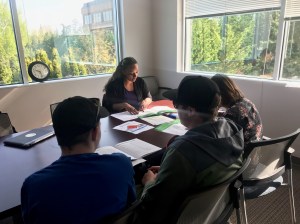
Pictured: Samantha speaking to students about opportunities in the trades industries at Yellow Wood Academy.
On a smaller scale, program staff also attend fairs, community events and conferences to speak about the importance of Priority Hire. Earlier this year, Samantha attended the Yellow Wood Academy’s Career Fair in Mercer Island to speak to middle school and high school students and teaching staff about construction apprenticeship and pre-apprenticeship training. The students were introduced to career pathways in the construction industry and learned about the different opportunities that are available in this sector.
“By focusing on the equity piece and providing an access point for people, we’re able to help economically disadvantaged communities, women and people of color to get into these industries and see the opportunities for themselves,” said Samantha.
The program not only helps provide access to opportunities for diverse candidates but also addresses the reality of a retiring workforce and labor shortage. By keeping new, talented people in the pipeline for these positions, and developing an approach that creates respectful, acceptable worksites, the Priority Hire Program is one more way in which King County is preparing a bright, equitable community for all.
For more information about the Priority Hire Program and to read success stories about how it is making a difference in King County, visit www.kingcounty.gov/PriorityHire. For additional information contact Samantha Kealoha, Labor Equity Program Manager, at 206-263-5856 or SKealoha@kingcounty.gov.
To read the official March 2018 announcement from the King County Council, click here. The Seattle Times also featured the program in an article for its innovative and community focused approach to job creation, which can be read here.
Share this:

Training Spotlight: Report Writing and Document Design and Lominger Competency and Skill Assessment

Report Writing and Document Design, Nov. 14: Want to see immediate improvement in your report writing projects? Learn to write for specific audiences, design documents for readability and clarity, and write concisely using plain English guidelines. Discuss and share ideas in this interactive workshop and learn to produce reports, simple or complex, that grab attention and get results. Register and learn more. Register and learn more.
Lominger Competency and Skill Assessment, Dec. 12: During this class, you will have the opportunity to evaluate your professional skills and generate a list of self-identified competencies that reflect your towering strengths and challenges. Next, based upon the next job you want, you will compare your skills to the Experience, Qualifications, Knowledge and Skills required for your next desired position. We will also discuss possible developmental activities, action steps and resources to help you succeed. Register and learn more. Register and learn more.
Share this:

Superior Court behind the scenes: The Jury Room
Crossposted from King County Superior Court blog
 This is the second in the Walk in the Shoes series with Chief Administrator, Paul Sherfey, Presiding Judge, Laura Inveen and Communications Manager, Jamie Holter.
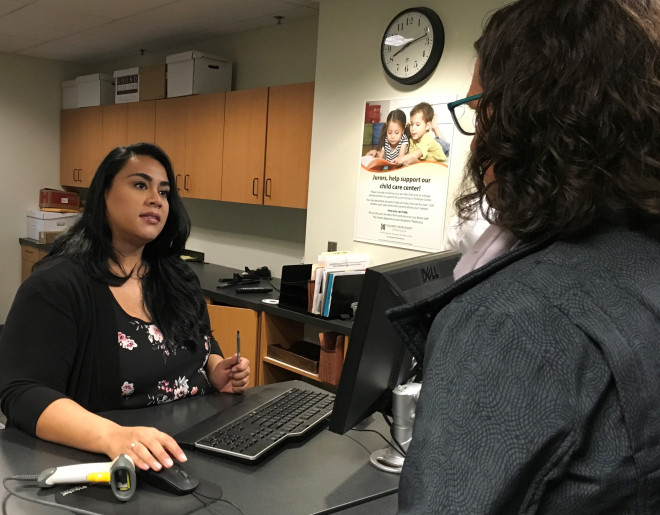
Judge Inveen, Paul Sherfey and I visited the Jury Room Monday, Oct. 22 at 7:30 a.m. as jurors started to trickle in. Over the next hour, Jury Room Court Operations members Daisy Rios and Santiago Villanueva will check in more than 200 people using a barcoded postcard which doubles as a juror badge.
Read more at King County Superior Court blog
Share this:

Anita Khandelwal confirmed as Director of Public Defense
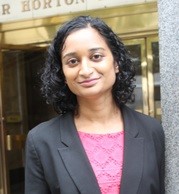
The Metropolitan King County Council removed the interim title from Anita Khandelwal, giving its support to her appointment to a four-year term as the King County Public Defender and Director of the Department of Public Defense.
Khandelwal will be the Department’s second director since voters approved the Charter amendment creating the position in 2013.
Read more in the official press release.
Share this:

Rev Up For Retirement seminar, Nov. 15

Are you too young to think about retirement? Think again! With increasing concern over the future of Social Security and the stability of retirement plans, it’s a good idea to stay informed and prepare in advance. Attendance is strictly voluntary but registration is required. Learn more and sign up here.
Thursday, Nov. 15, 11 a.m.–2 p.m., Eighth Floor Conference Center, King Street Center, 201 S. Jackson St., Seattle






 Employee News