
Pet of the Week: Mark
Crossposted from Tails from RASKC
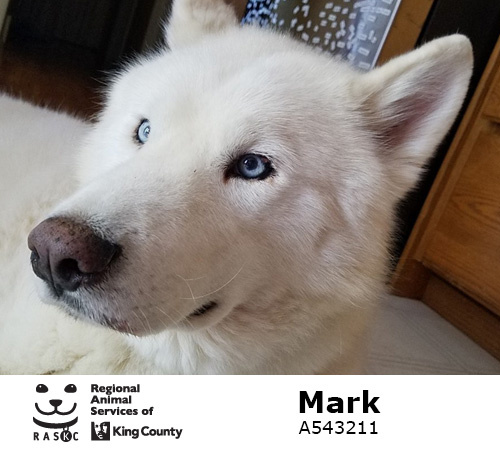
Gentle giant Mark is our Pet of the Week!

This five-year-old Siberian Husky loves to be around people. His personality color is “Bashful Blue,” meaning he can be a little shy at first. But, once he gets comfortable, Mark is a very happy and easy-going boy.
Mark has been in a foster home for a few months while he was recovering from some digestive issues. He lived with two dogs, a cat, and children ages 9 and 15. He got along well with everyone, but did want to play a bit too roughly with the cat, so he may do best in a home with no cats. Since Mark isn’t a big fan of being alone, he would prefer to have a predictable routine if he is home without people for long periods of time.
In addition to hanging out with his people, Mark’s favorite things include playing with stuffed animals and riding in cars. This handsome boy is neutered, current on vaccinations, and microchipped. His adoption fee includes a certificate for a free veterinary exam and 30 days of free pet insurance through Trupanion.
You can learn more about Mark on our website at kingcounty.gov/AdoptAPet. We hope to see you soon!
Share this:

Finding hidden value at the bottom of a sediment tank

Crossposted from Clean Water Stories

A big mechanical job at our West Point Treatment Plant replaced a special part of our sedimentation tanks. The sedimentation tanks are part of how we clean everyone’s sewer water.
What’s the real cost?
Have you ever been undecided when buying an appliance, trying to choose between a standard or select model? You probably wished you had some data to help you make an informed choice. Well, by studying costs and crunching the numbers, maintenance engineers at West Point determined that what looked like a higher priced option for certain replacement parts was actually the best value in the long run.
The cost of equipment isn’t just the cost of buying it. We work on being smart about how we take care of all our “stuff” and look at all of the costs, or “life-cycle” cost. We ask questions like:
- What does it cost to buy it – or design and build it?
- What does it cost to maintain / operate it – including labor and energy costs?
- How long does it last?
- What does it cost to recycle or dispose of it when we eventually replace it?
Investing in performance
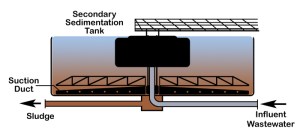
Suction ducts sweep the floor of the tank, scooping up the particles that settle out of the sewer water (sludge) to move it to a different part of the plant for more treatment.
When we clean wastewater, one of the steps is to let it flow slowly through sedimentation tanks, also called a settling tanks or clarifiers. It allows particles in the water to settle to the bottom as the water flows slowly through the tank.
At the bottom of the tanks, where all those particles are collecting, suction ducts sweep the floor, scooping up that settled sludge to move it to a different part of the plant for more treatment.
The now “old” suction ducts were a standard type back when they were installed. But their ‘plain steel’ was rusting and corroding – and the ducts were failing.
Our maintenance teams at West Point helped the ducts last longer by repeatedly applying galvanized and epoxy protective coatings over the years, but eventually they needed to be replaced.
Initially, it seemed that new stainless steel suction ducts might cost too much, but they’re highly resistant to corrosion, eliminating the need for overhauls and coatings every few years. Virtually rustproof, the amount of money we would save in lower maintenance offset the cost of the higher grade steel.
Cultivating mastery

Workers inspect the alignment of the new ducts.
Replacing heavy, crumbling, decades-old ducts requires technical expertise, and West Point maintenance crews were up to the task. Patrick Perrin, industrial maintenance mechanic, devised a method, with a few extra welds, that allowed a two person team to do the work of four. The work also provided valuable service time for industrial maintenance mechanic and project lead Mike Wallace to earn his Master Mechanic certification.
Working on our values
Replacing West Point clarifier suction ducts with cost efficient, stainless steel upgrades shows our employee’s commitment to finding innovative maintenance solutions and being responsible stewards of taxpayer dollars.
Share this:

Teams trying to save ailing orca practice feeding live fish off Lummi Nation boat and SoundGuardian
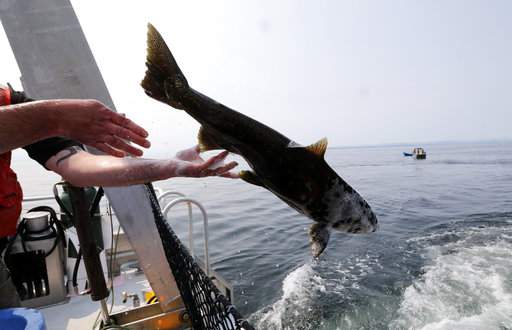
The King County SoundGuardian was featured in a recent article by the Associated Press, highlighting its participation in efforts to save a sick orca whale in Puget Sound.
Teams taking drastic measures to save a young, ailing killer whale loaded up two boats with fat live salmon as the sun rose Friday and rushed to waters off Washington state’s San Juan Island, preparing if needed to test-feed the critically endangered orca a day after injecting it with medicine.

Image courtesy of the Associated Press
By early afternoon, it appeared the 3½-year-old female orca called J50 was too far north in Canadian waters and any trial feeding effort would not happen, Brad Hanson, a wildlife biologist with the National Oceanic and Atmospheric Administration who is leading response efforts in the field, told reporters out on the water.
For now, the unprecedented attempt to feed live salmon to a free-swimming killer whale would have to wait.
The team led by the U.S. agency lacks a permit to feed the whale, which is emaciated and possibly suffering an infection, in Canadian waters, though it had one for medical treatment. NOAA would apply for the feeding permit if conditions are right, said Lynne Barre, NOAA Fisheries’ recovery coordinator for the whales.
The agency wants to see whether it can deliver medication to the whale through live Chinook salmon but first needs to test whether the orca will take its preferred food source.
With the whale far away and a bin full of salmon pulled that morning from a state hatchery, crews did a practice run to work out the logistics of feeding live fish to a whale while staying ahead of it in a boat. One by one, crews aboard a boat belonging to the Lummi Nation, an American Indian tribe, sent the plump salmon into a turquoise tube and then into the water.
Researchers with the Whale Sanctuary Project practiced taking samples of fish scales so they can later genetically track whether the whale consumed that fish. A King County research vessel drove alongside, also carrying fish, to provide support.
Read more at the Associated Press. Image courtesy of The Associate Press.
Share this:

Boogie up the Block with the Archives Saturday!

Archives will be participating in the Boogie up the Block Urban Arts Festival, coordinated by our neighbors at Washington Hall.

Participants in the Boogie up the Block 2017 Graffiti Mural Competition.
The walls of the Archives and Records Center will once again provide a surface for the Graffiti Mural Competition.
Images from last year’s event can be seen on Bytes and Boxes.
Archives will also have a table at the Street Arts Festival, featuring their new “photo booth” that allows people to become part of King County history today!
Share this:

CHOMP! in Your Big Backyard Saturday

Enjoy a full day of activities at CHOMP!, King County’s celebration of local farming, food, and sustainability, Saturday at King County’s Marymoor Park!

King County Parks is has another great music line-up this year! Enjoy free performances by Matisyahu, Caspar Babypants, The True Loves, and more.
For more details about CHOMP!, visit chomplocal.org and follow updates via the event Facebook page.
Eat Well. Live Well. at CHOMP! See you Saturday!
Share this:

Training Spotlight: Lean Basics

Have you heard about Lean? Have you wondered if Lean could be applied on your job? Come and join us in the Lean Basics course, where you will become familiar with the fundamental principles of Lean; such as Waste Identification, Visual Management, and Continuous Improvement. Students will engage the materials through instructor lead classroom discussions, and interactive hands-on learning.
 Objectives:
- Become familiar with the 4 key principles of Lean
- Learn why Lean is important to King County
- Recognize the beliefs and mindset that drive Lean behavior
- Apply Visual Management and Waste Elimination principles
- Learn how to apply these concepts on the job
The training takes place Wednesday, Sept. 5, 1 – 4:30 p.m. at the King County Administration Building.
Learn more and register on Eventbrite before the session fills up, and visit Learning and Development on KingCounty.gov to learn more about trainings and other opportunities to invest in YOU – including a Sept. 7 Building Change Management and Effectiveness training!
Share this:

Internship program breaks barriers for young people most affected by inequities
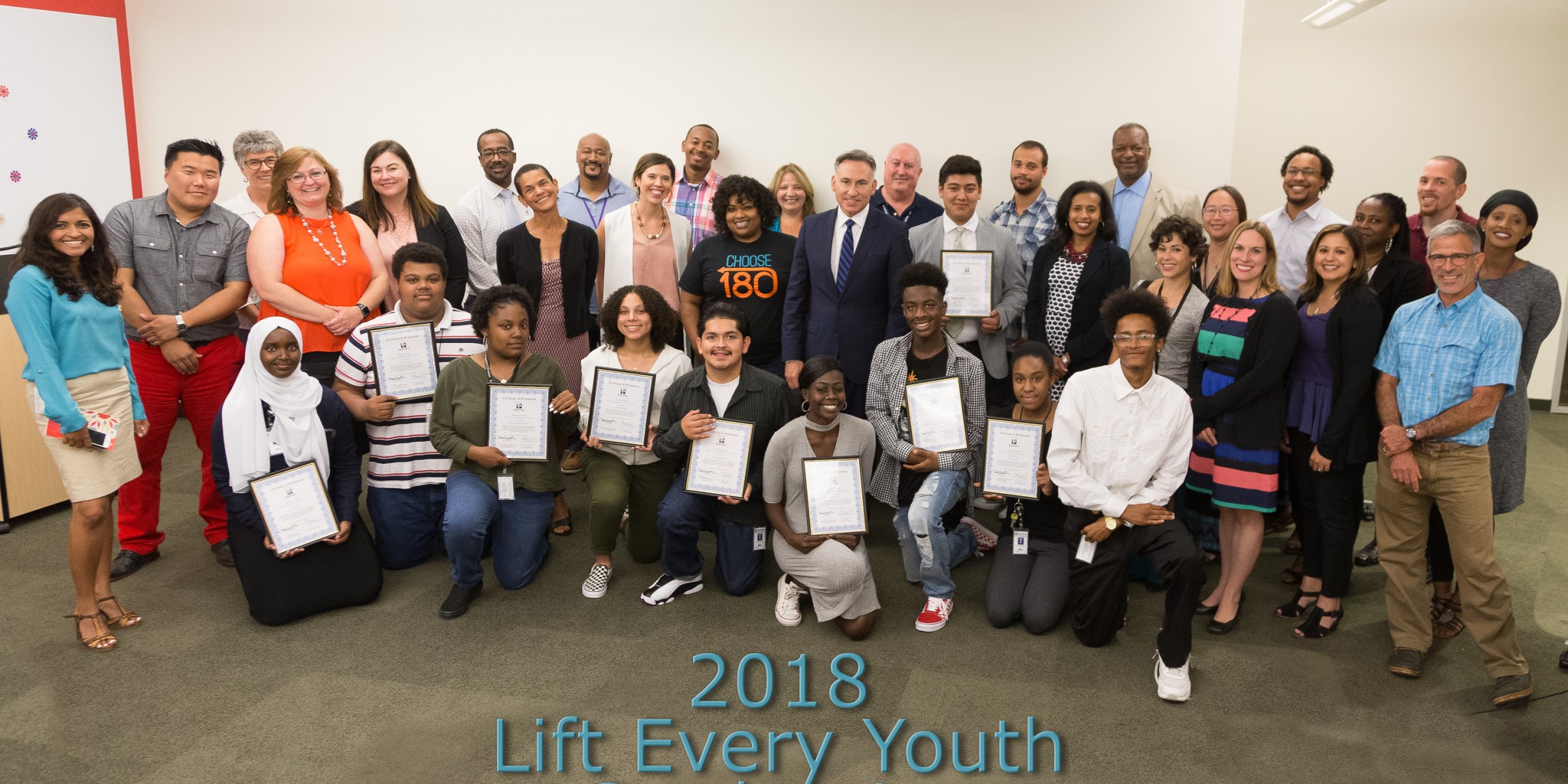
King County is helping to break down barriers to well-paid jobs and career success for young people through an innovative internship and mentorship program that intentionally prioritizes young people with the greatest needs.
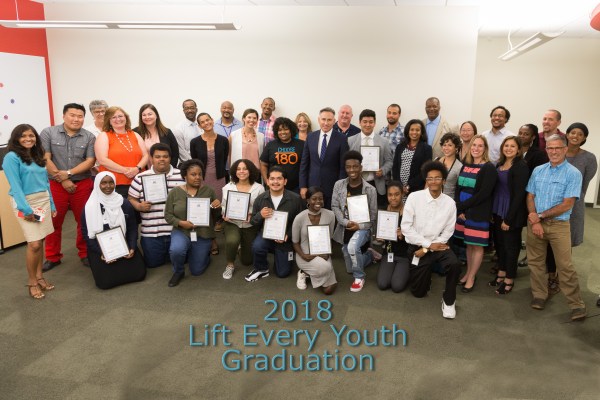
The Lift Every Youth Employment & Mentorship Program aims to help youth and young adults who are disproportionately affected by discrimination, bias and oppression. These conditions lead greater barriers to meaningful employment, post-secondary education opportunities, and impact overall health and life outcomes.
“One of the meta-goals is to ensure the county is playing its role as an employer to help disrupt the school to prison pipeline,” said Arun Sambataro, the Equity Strategies Manager for the Office of Equity and Social Justice in King County. “We specifically partner with organizations that serve youth who are exposed to higher vulnerabilities that range from being out of school, evictions and homelessness, and intergenerational poverty, to domestic violence and juvenile probation and detention.”
Sambataro explained that through paid internships and mentorship to the County can engage young people in public service while helping them see employment as more than a paycheck: as a learning, supportive, and welcoming experience where they can explore a wide range of careers.
“It important they learn about their strengths, their potential, and their capacity to be leaders,” said Sambataro.
The program, which began in 2017, was developed by the very groups that engage in the program, ensuring that groups most affected by the inequities helped design approaches that work for them. Even some of the youth who participated in the first year were involved in focus groups that helped design and enhance the program.
For applicants to be eligible they must be at least 14 years old and participate in one of the following programs: The King County Superior Court’s Education and Employment Training Program, community partner Choose 180, King County YouthSource, King County’s Zero Youth Detention Peacemaking Circle Pilot, or be a returning participant from the year prior.
Applying is the first step for anyone that wants to be involved in the program. King County goes through a competitive application, interview and hiring process facilitated by case managers and King County employee mentors. Once selected for the program by the employee mentors, the interns engage with a team of three mentors, one primary and two supportive, in a field of work that they are interested in pursuing. These mentors help them identify short- and long-term career goals as well as strategies to achieve their goals, which include completing a specific internship project with the employee mentors.
“We intentionally recruit mentors who actively engage in racial equity work and have some fundamental competencies to be able to prepare these young people to navigate our workplaces and institution effectively. From there, mentors go through 12-15 hours of additional skill-building and preparation,” said Sambataro. “The mentorship is the most heavily weighted part of this experience. The trust and relationship that is built between the interns and their mentors is likely stronger than most lessons learned from doing a project.”
The interns also attend job readiness training, complete King County’s Restorative Justice Conflict Mediation Training and Certification for Youth, and attend King County Equity and Social Justice trainings as part of the program.
Lift Every Youth is also changing the way that internships are perceived at King County and other similar institutions.
“When I mention the word “intern”, our organization, our codes, and people have a very consistent stereotype of what that means – and to reframe these stereotypes was at times challenging,” said Sambataro. “Our usual internship opportunities are designed to work really well for white, college-educated, well-connected and well-to-do students, and less well for our youth and young people of color, regardless of education and income. But actually anyone can be an intern and should have the opportunity to be exposed to what an internship offers.”
Sambataro says that she is looking to expand the program next year to allow for 15 interns. Agencies are expected to build in the internship funds within their existing budgets to take part in the program.
“I do this program because I really love connecting with the mentors and the youth,” said Sambataro. “It is one of the highlights of my experience. This is something that is really obvious – it’s directly impacting our communities with the greatest needs, where we are wanting to prioritize our investments, time, and resources to see better, more equitable outcomes.”
Share this:

More food trucks, games, music and more at City Hall Park
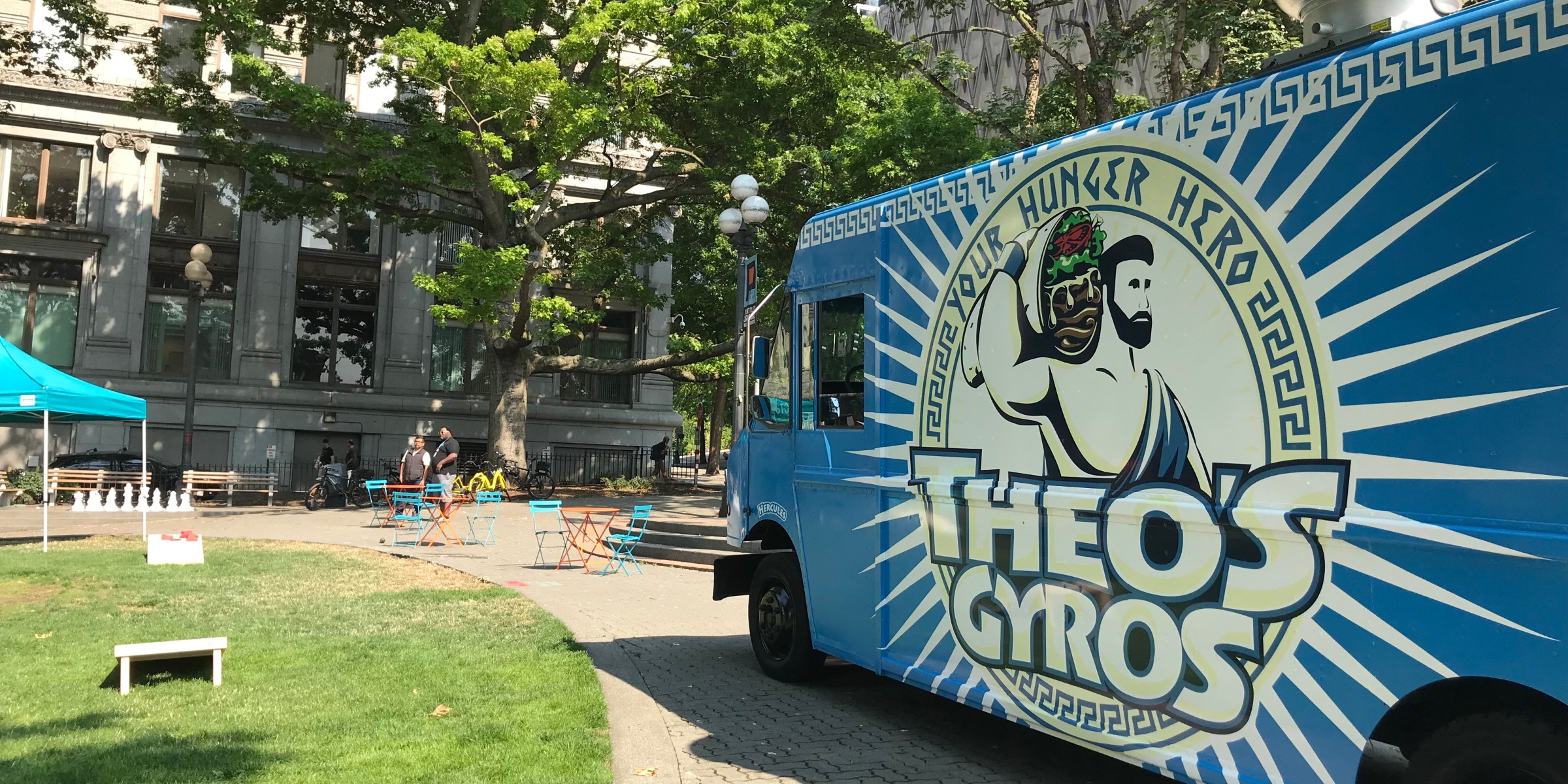
Today from 11 a.m. to 2 p.m. the Paparepas food truck will be out at City Hall Park next to the Courthouse Building serving Venezuelan arepas, empanadas, and its famous quesillo dessert and tequeños. Thursday, the Mobile Mayan will be at the park serving fresh, authentic Mexican food. And Friday, check out Don Lucho’s as they serve traditional Peruvian dishes as sandwiches.

Theo’s Gyros is one of a number of food trucks now coming to City Hall Park.
The trucks will be in City Hall Park from 11 a.m. – 2 p.m. between 3rd and 4th Avenues, just south of the Courthouse Building. You can see the upcoming food truck schedule here.
Today and every day, Monday through Friday, a park concierge will be on-site from 10 a.m. – 4 p.m. There’ll be giant chess, cornhole and other games, bistro furniture and Adirondack chairs, and buskers from noon to 4 p.m.
This effort is part of the Courthouse Vicinity Improvement effort – a partnership between King County, the City of Seattle, Downtown Emergency Service Center at The Morrison, Downtown Seattle Association’s Metropolitan Improvement District, Alliance for Pioneer Square and Sound Transit – to improve the safety and cleanliness around the Courthouse for employees, visitors and residents of the area. So come out and enjoy the park and support these local businesses!
Share this:

Beware of Caller ID spoofing

Caller ID spoofing – the practice where a caller masquerades as someone else by falsifying the number that appears on the recipient’s caller ID display – is on the rise.
 King County phone numbers are randomly being impacted by the robocallers using these spoofed numbers. KCIT is aware of the issue – so there is no need to inform the Help Desk – but they are unable to stop the calls. If you know the call is a spoofed phone number, do not answer the call. Below are some tips from the Federal Communications Commission to avoid spoofing scams.
You may not be able to tell right away if an incoming call is spoofed. Be extremely careful about responding to any request for personal identifying information.
- Don’t answer calls from unknown numbers. If you answer such a call, hang up immediately.
- If you answer the phone and the caller – or a recording – asks you to hit a button to stop getting the calls, you should just hang up. Scammers often use this trick to identify potential targets.
- Do not respond to any questions, especially those that can be answered with “Yes” or “No.”
- Never give out personal information such as account numbers, Social Security numbers, mother’s maiden names, passwords or other identifying information in response to unexpected calls or if you are at all suspicious.
- If you get an inquiry from someone who says they represent a company or a government agency, hang up and call the phone number on your account statement, in the phone book, or on the company’s or government agency’s website to verify the authenticity of the request. You will usually get a written statement in the mail before you get a phone call from a legitimate source, particularly if the caller is asking for a payment.
- Use caution if you are being pressured for information immediately.
- If you have a voice mail account with your phone service, be sure to set a password for it. Some voicemail services are preset to allow access if you call in from your own phone number. A hacker could spoof your home phone number and gain access to your voice mail if you do not set a password.
- Talk to your phone company about call blocking tools they may have and check into apps that you can download to your mobile device to block unwanted calls. Information on available robocall blocking tools is available at fcc.gov/robocalls.
More information is available at this link: https://www.fcc.gov/consumers/guides/spoofing-and-caller-id
Share this:

Monitoring beach water keeps people and animals safe

Before heading out to your favorite swimming hole this summer you may want to check in on King County’s Swim Beach Monitoring Program to see if there is any bacteria or algal lurking in the water that could make you sick.
“There may be multiple bacterial sources for high fecal coliform counts,” states Debra Bouchard, senior limnologist and water quality planner with King County Water and Land Resources Division. “Potential sewage spills are the highest concern because of the increased risk of transferring disease from a human source.”
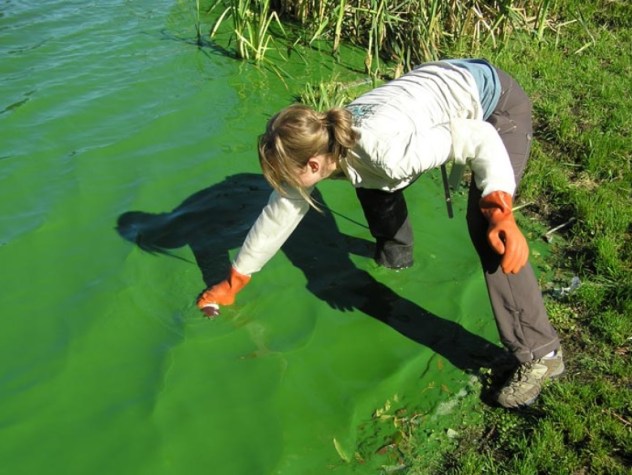
Pond scum at Lake Ketchum.
Other risks include fecal contamination from waterfowl, dogs and cats, surface run-off from poorly drained grassy areas adjacent to the beach, high concentrations from nearby creeks, and poor water circulation in the swimming area may contribute to high bacterial counts. Algal blooms are also a hazard that swimmers need to be aware of before entering the water, as some algal species can present potential health risks to people and animals when in bloom.
“Some beaches are more prone to toxic algae blooms due to high nutrients, wind conditions, shallow water, and poor circulation,” said Bouchard. “Algae and bacteria tend to accumulate in protected coves that are less flushed out by water movement.”
Residents can help prevent bacteria from growing in local swim beaches by not taking dogs to public swimming beaches (there is a fine for having dogs on public beaches in Seattle), properly disposing of pet waste, ensuring children are taken to restroom facilities often, and not feeding geese or ducks in local parks.
“If geese spend less time at the parks, there will be fewer feces and the bacterial load will decrease,” said Bouchard. “Park personnel and the King County Marine Patrol have replaced the practice of washing duck and geese feces off of the walkways and into the swimming area.”
Most swimming beaches have their water quality tested weekly by environmental specialists from the King County Department of Natural Resources and Parks from mid-May to mid-September. The beach monitoring program monitors 27 freshwater beaches, 19 funded by King County and eight funded by the cities of Shoreline, Mercer Island, Sammamish, Kenmore, and Maple Valley via interagency agreements.
While funding restrictions limit the number of beaches that King County’s monitoring program can monitor routinely for bacteria and algal toxin, the state has a Toxic Algae Program that allow anyone to send in a sample for algal toxin testing.






 Employee News