
King County #RiseWithUs highlights

Dear Athletes, Coaches, Family Members, Volunteers, Games Partners, Supporters of the Games, and Greater Seattle Community:
Thank you! The 2018 USA Games said, ‘Rise with Us’ and you did – with open hearts and minds. You were magnificent hosts.
Chairman Tim Shriver, Special Olympics International

Over the first week of this month, we hosted approximately 4,000 athletes and coaches, 15,000 volunteers and 70,000 spectators for the 2018 Special Olympics USA Games.
We at King County also were the athletes, the coaches, the volunteers, and the spectators – and more!
Rama ‘RJT’ Tall is a Parks Specialist with King County.
As part of his responsibilities, he even helps maintain the field and facilities he and his team used to practice for the games.
I’ve been playing soccer since 1987,” RJT told us. “It is important to me to be representing Washington Special Olympics Summer Games. We are trying to bring the trophy home to Washington State!

Rama ‘RJT’ Tall with Team Washington at the opening ceremonies.
RJT’s team placed third in their division during the games.
Read more about RJT in Parks employee competes in 2018 Special Olympics USA Games.
Jonathan Leckband is a Metro HR employee and also a soccer player.
I’m excited! This will be my first time playing at this level. I’m looking forward to the chance to show how good our team is. This will also be a chance to demonstrate sportsmanship, and maybe make new friends.

Jonathan Leckband with Team Washington at the opening ceremonies.
Jonathan’s team brought home gold!
Read more about Jonathan in Metro HR employee athlete competing in 2018 Special Olympics USA Games July 1-6 in Seattle.
Joseph Rivers is one of King County’s 3,000 Metro Transit operators. He is also a former Special Olympics athlete, current volunteer, has coached and refereed for the games, and is the proud father of two of the athletes who competed in the USA Games this month.
A lot of the athletes that come and participate are there to win, but – then again – following the model of ‘let me be brave in the attempt,’ they’re happy to play.
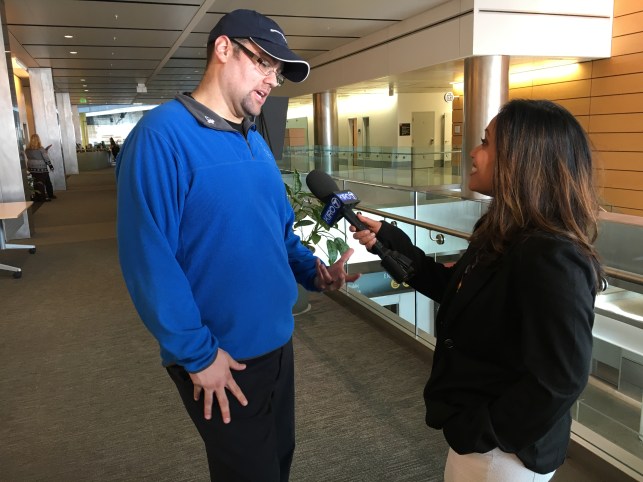
Joseph Rivers talks with KIRO 7 and the Seattle Times prior to the games.
Read more about Joseph in Joseph Rivers: Metro operator and Special Olympics athlete, coach, referee, volunteer and athlete parent.
King County also participated in the first job fair at the Special Olympics with HR and EEO representatives from Human Resources Division, Transit and Parks. Supported Employment Program Manager Christina Davidson was among the group representing King County.
It is truly an honor to showcase King County’s commitment to hiring an inclusive workforce at this historic event.
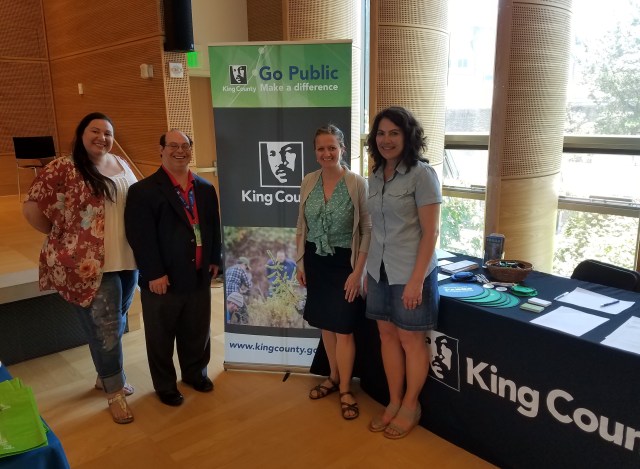
Supported Employment Program Manager Christina Davidson (center right), Patty Jurgens from Parks HR (far right) and Kellie Parker from Metro EEO (far left) join @2018USAGames Job Fair host David Egan during the games in Seattle.
King County’s commitment to supported employment began in 1990, and is the County’s approach used to match qualified job candidates with developmental disabilities to business needs within King County government.
Learn more about Christina’s Supported Employment Program on KingCounty.gov.
King County joined the State of Washington and the City of Federal Way as a Public Partner of the 2018 Special Olympics USA Games, and King County Metro joined Sound Transit, Alaska Airlines, REI Co-op and others as a Bronze Medal Partner. In a joint effort with Sound Transit, King County Metro was an Official Transportation Sponsor of the 2018 USA Games. Metro General Manager Rob Gannon joined Joseph Rivers and others to announce the partnerships prior to the games.
Seattle is a place truly committed to equity and the idea that everyone – every single one – should have equal access to opportunity.
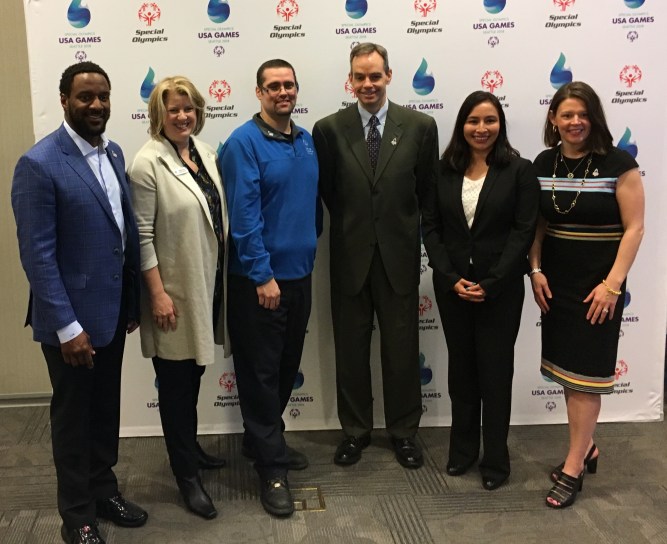
Metro General Manager Rob Gannon (center right) is joined by – from left to right – Seahawks great Jordan Babineaux, USA Games President and CEO Beth Knox, King County Metro Operator Joseph Rivers, Sound Transit EEO Director Jackie Martinez-Vasquez, and Port of Seattle President Courtney Gregoire.
Read more about Metro’s and King County’s support in King County: #RiseWithUs.
Metro also shared parts of their story on Metro Matters, @kcmetrobus, and more, including:
Metro staff competing, volunteering and cheering on athletes at Special Olympics USA Games 2018
Shuttles to help athletes, families, fans reach July 6 Special Olympics closing ceremonies

A volunteer from Metro helps a woman reach her destination during the games.
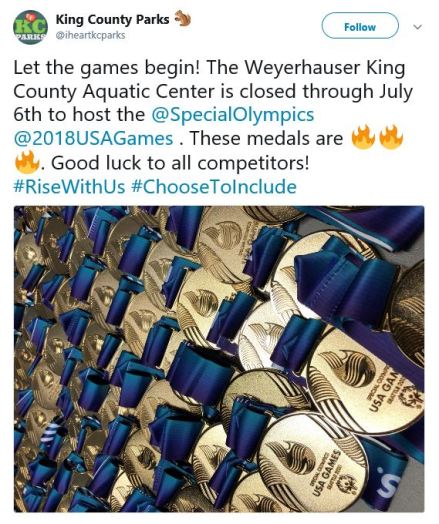
King County Parts shared parts of their story – the Weyerhaeuser King County Aquatic Center’s role – on @iheartkcparks.
We have the opportunity to make that cultural shift that inclusion is the benchmark – that’s where we start. Inclusion for all. If that’s our baseline, then we’re setting an example that the rest of the country – and potentially the world – can follow.
Beth Knox, CEO, 2018 Special Olympics USA Games

#ChooseToInclude
Share this:

Family Treatment Court receives third consecutive National Peer Learning Court designation

King County Family Treatment Court is one of eight courts in the country to receive the 2018 National Peer Learning Court designation by Children and Family Futures.
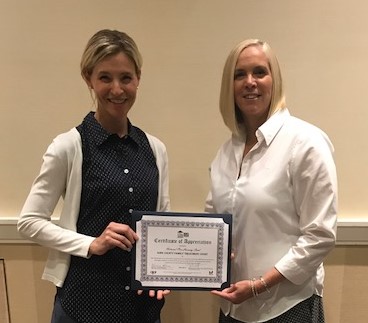
Jill Murphy (left), King County Family Treatment Court Program Manager, receives a National Peer Learning Court Certificate of Appreciation from Kelly Blue, Associate Administrator of the Office of Juvenile Justice and Delinquency Prevention, during the National Association of Drug Court Professionals conference.
Through a rigorous application process, Children and Family Futures designated eight family drug courts to serve as mentors for the National Peer Learning Court program. Having demonstrated commitment to evidence-supported practices, innovative strategies to improve outcomes for children and families, and a strong foundation of collaboration among the court, child welfare, and substance use treatment agencies, the 2018 National Peer Learning Courts will continue helping advance the family drug court movement by furthering the exchange of learning through peer-to-peer technical assistance. Peer Learning Courts host visiting Family Drug Court professionals to experience their court in action and share proven policies, practices and lessons learned. This improves outcomes nationwide for the children – and the parents – of involved families.
For KCFTC, this is its second redesignation. Having been a best-practices leader in the Family Drug Court field, the court received its initial designation as a National Peer Learning Court in 2014 and was first redesignated as a mentor in 2016.

Pictured from left to right: back row; Program Specialist Dajani Winzer, Program Specialist Kandice Trenary, Family Recovery Support Specialist Teresa Anderson-Harper, Program Supervisor Jill Murphy – front row; Treatment Specialist Michelle Szozda, Family Recovery Support Specialist Michelle Thomas, Treatment Specialist April Wilson. (Not pictured: Treatment Specialist Cathy Lehmann.)
Jill Murphy is the KCFTC Parents for Parents Program Supervisor with King County Superior Court, and she leads a team of Family Recovery Support Specialists, Treatment Specialists and Program Specialists. She’s been with King County since 2008, and has been supervising the Parents for Parents Program for 10 years. When asked what it means for King County to be redesignated as a National Peer Learning Court, she said, “It is an opportunity to continue to help serve other community leaders who are working to improve the system both locally and nationally, and it is an opportunity to help child-welfare-involved families be seen, be heard and be valued.”
KCFTC’s mission is to promote the health, safety and welfare of children in the dependency system by actively intervening to address the drug, alcohol and other service needs of families through integrated, culturally competent and judicially managed collaboration that facilitates timely reunification or an alternative permanency plan. Originally implemented in 2004 and supported by a Federal Bureau of Justice Assistance Demonstration Grant, KCFTC was sustained with local County funding. KCFTC then used the County’s Mental Illness and Drug Dependency (MIDD) fund to expand in 2009, and in 2016 used MIDD funds and a Substance Abuse and Mental Health Services Administration (SAMHSA) grant to expand, increasing the number of children served each year from 30 to 140. The program now has six social workers and can carry a caseload of 78 children at any one time between two court locations; a full-day court in Seattle and another in Kent.
“With the SAMHSA grant, we were able to expand our Kent court to a full day calendar, and hire two Family Recovery Support Specialists,” said Murphy. “These specialists are parents who have completed the program successfully, and they are a key factor in the success of our program. They serve as liaisons between program participants, family, team, and treatment organizations to eliminate obstacles to recovery and child well-being. They also help connect participants to community resources, supports, and tools to sustain their recover after exiting the program.”
The University of Washington conducted research about the KCFTC’s process, outcome and disproportionality evaluations, and summarized the statistically significant findings about the KCFTC participants in contrast to comparison groups:
- parents were more likely to be admitted to and use treatment services than comparison group parents.
- parents entered treatment sooner, remained in treatment longer, and were more likely to be successfully discharged.
- children spent less time in out-of-home placements and less time in the child welfare system.
- children were more likely to be permanently reunified with their parent or be on a trial home visit with their parent.
- families of cultural minorities in the KCFTC had more positive outcomes than families of color in the comparison group; comparisons with white families in KCFTC were mixed.


This Peer Learning Court mentorship program has been funded by a grant from the Office of Juvenile Justice and Delinquency Prevention since 2012 and is one component of a variety of technical assistance available through the National Family Drug Court Training and Technical Assistance Program. With this year’s Peer Learning Court designation, KCFTC is joined by Missouri’s Dunklin County Family Treatment Court, Colorado’s Jefferson County Family Integrated Treatment Court, Florida’s Miami-Dade County Dependency Drug Court, California’s Sacramento County Early Identification Family Drug Court, New York’s Tompkins County Family Treatment Court, Oklahoma’s Tulsa County Family Drug Court, and Iowa’s Wapello County Family Treatment Court.
For those interested in visiting KCFTC and receiving mentoring, the program has three hosting availabilities each year, with a capacity for eight people each.
For more information about receiving peer mentoring, contact Jill Murphy, LICSW, at 206-477-2311 or Jill.Murphy@KingCounty.gov. For more information about training and technical assistance available, visit the Center for Children and Family Futures website.

Share this:

Chief Operating Officer visits King County International Airport
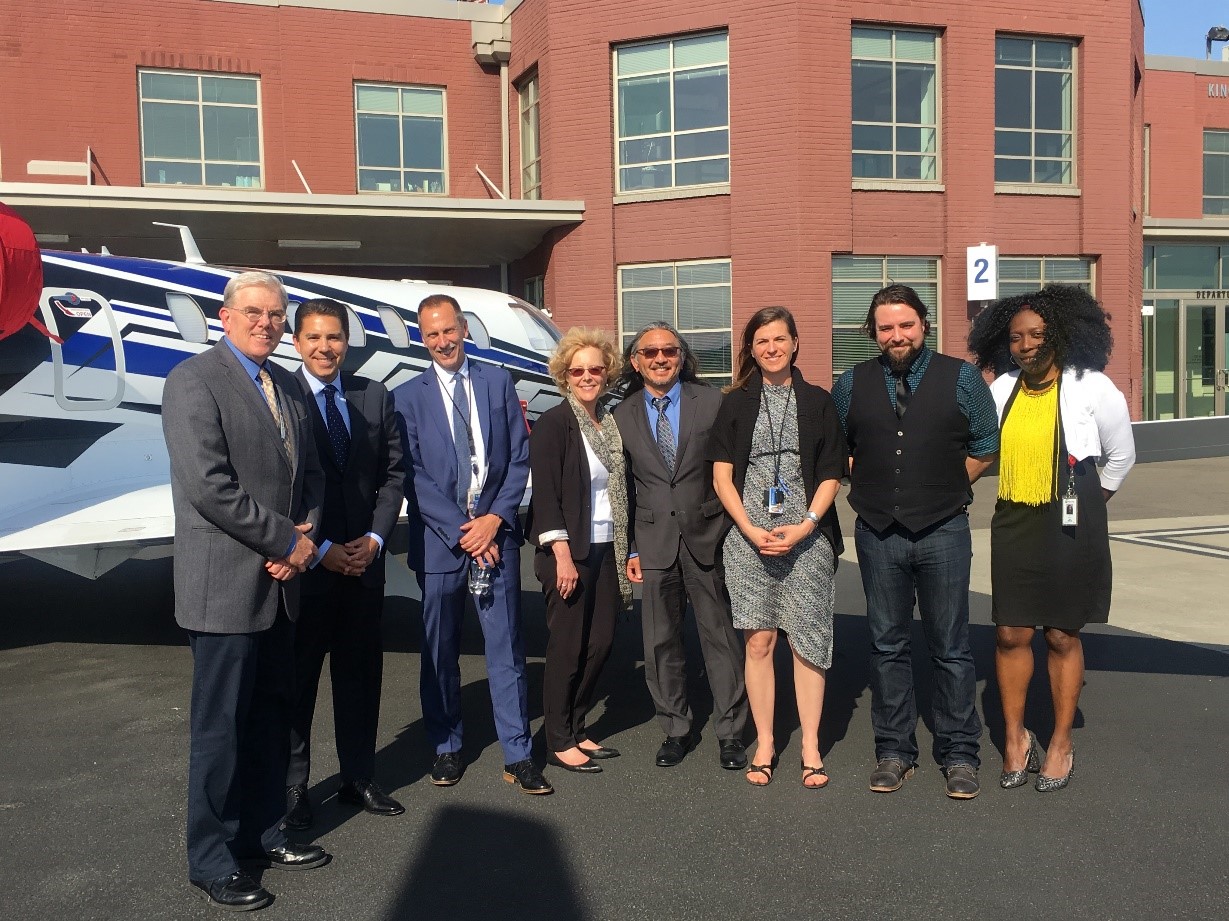
Chief Operating Officer Casey Sixkiller recently visited King County International Airport (KCIA) to meet with employees and learn more about the airport and some of the priorities they are working on.

From left to right: Mark Witsoe, Marketing and Business Development Manager, Casey Sixkiller, Chief Operating Officer, Michael Colmant, Interim Director, Caroline Whalen, County Administrator, Harold Taniguchi, Director of Transportation, Charity Catalfomo, Interim Deputy Director, Ben Pritchard, Continuous Improvement Specialist, and Tricia Diamond, Program Manager
KCIA, also known as Boeing Field, is one of the nation’s busiest primary non-hub airports, averaging around 200,000 operations annually. In turn, 16,336 jobs are directly linked to Boeing Field and $1.8 billion in labor income, and its operations support $3.5 billion in local business sales.
“I was delighted to hear firsthand how our employees are working to provide customers a safe and consistent experience every time they use or visit King County International Airport,” Sixkiller said. “It was also great to learn about their efforts to advance the Executive’s vision for a Best-Run Government by utilizing lean principles to improve business operations and the customer and employee experiences.”
Sixkiller met with Michael Colmant, the Interim Director of King County International Airport, Charity Catalfomo, Interim Deputy Director, and staff who shared some of their department priorities, including facility expansions and local business collaborations. They also discussed new safety projects and their employee engagement efforts through their Investing in YOU work.
Since being named Chief Operating Officer by Executive Constantine in January, Sixkiller has been meeting employees and leaders at different worksites across King County, and he was grateful for the opportunity to meet with staff at KCIA.
“I want to thank the KCIA team for a warm welcome, informative briefing, and tour of the airfield,” Sixkiller said.
Share this:

Free admission: King County Employee Day at the races Sunday, July 15

King County employees and one guest will receive free admission to Emerald Downs Racetrack this Sunday, July 15 for the King County Express Stakes, which includes a Food Truck Day in the park and an Equine Art Show on track level.
Employees must show their King County ID at any of the 12 gates, which will provide the employee and one guest tickets that include free admission, official program and tip sheet, and chips and soda. Children 17 and under get in free.
In addition to this year’s King County Express Stakes, there will be the Boeing Stakes, the Angie C. Stakes, and the Mt. Rainier Stakes – the final prep race for the richest race of the season, The Longacres Mile.
Schedule:
- 12:30 p.m. Newcomers Center open
- 1 p.m. Food trucks open
- 1 p.m. First race
- 7 p.m. Racing concludes
Parking: Free general parking with shuttle service to the building | Valet $15 | Preferred Parking $10
Seating: There are plenty of seats, umbrella tables and benches available on a first-come, first-served basis
- Grandstand seats $2.50
- Box seats (with cocktail and limited menu service) $40 for a 4-seat box; and $60 for a 6-seat box
- Restaurant reservations (full service restaurant with your table reserved for you through the race day)
- Paid seating options. Please call customer service at 253-288-7711
Equine Art Show: The Horse and a Whole Lot More
The purpose of the show is to encourage equine artists and to support the arts, in general, as an integral part of all horse-related sports. The annual art show has garnered recognition since its inception in 1980 at the WTBOA Sales Pavilion at Longacres. In 2018, we celebrate our 19th year of continued growth and success at Emerald Downs.
Food Truck Festival
The tastiest trucks from all over the Pacific Northwest have been invited down to Auburn! As many as 12 food trucks will gather in Paddock Park, competing for the People’s Choice Award and Best in Show.
For more information, visit the Emerald Downs site.

Share this:

Administration Building 5th Avenue entry ADA wheelchair lift replacement begins July 12

The Administration Building ADA wheelchair lift at the 5th Avenue entry is scheduled to be replaced. Construction will begin July 12 and the new lift is scheduled to be in operation by September.
The ADA-accessible route into the Administration Building will be closed during construction. An alternative route is through the Chinook Building at 401 5th Avenue, proceeding through the tunnel to the first floor of the Administration Building.
If you have questions or concerns, please contact the FMD Customer Care Services Team at 206-477-9400 or CustomerCareServices.FMD@KingCounty.gov.
Share this:

Get to know Gary Kurihara, Chief Performance Officer

King County Executive Dow Constantine has launched a new video series introducing the five members of his Senior Leadership Team, starting with Gary Kurihara, Chief Performance Officer.
“Unfortunately, despite considerable effort over the years, I have not yet mastered the ability to be in more than one place at one time,” Executive Constantine said in an email launching the video series. “So I rely on my Senior Leadership Team – which currently includes Budget Director Dwight Dively, Chief of Staff Rachel Smith, Chief People Officer Whitney Abrams, Chief Performance Officer Gary Kurihara and Chief Operating Officer Casey Sixkiller – to also make time to meet with you and keep me informed about the issues, successes and challenges that they learn about.”
Learn more about Kurihara, what brought him to King County and what he’s working on in the video below.
Share this:

Discover savings strategies to create the retirement you want

You and your spouse or significant other are invited to learn more about the King County Deferred Compensation Plan at education sessions offered throughout the year.
In-person sessions are coming up July 17 — 19. Go online for details and registration. For the complete education schedule and list of webinars, go to the Deferred Compensation web site.
If you have any questions, email KCDeferredComp@KingCounty.gov.
Share this:

Kudos! to Public Health’s Dr. Matt Golden

Matthew R. Golden, M.D., M.P.H. Photo courtesy UWMedicine.org.
Public Health HIV/STD Program Director Matt Golden, M.D., M.P.H. received the annual Nettie Award from Beyond AIDS for leading the first successful North American campaign to reach the UNAIDS goal of 90-90-90 by 2020. Dr. Golden is the first in the United States to be granted the award! Read more on our 90-90-90 accomplishment on Public Health Insider.
Thank you, Public Health!
Kudos, Dr. Golden!
Share this:

King County GIS Center Senior GIS Cartographer Patrick Jankanish

Patrick Jankanish creates publication-quality map and graphic products for print and online media. Patrick has practiced innovative cartography for more than thirty years in academic, commercial consulting, freelance, and government settings. Whatever the subject matter—parks and recreation, earth sciences, the environment and natural resources, public policy and information, education, transportation, public infrastructure, and more—Patrick takes a holistic approach to cartography that combines bedrock cartographic theory, modern graphic design principles and techniques, always-evolving GIS and graphic arts technology, and the careful crafting of the written word, both linguistically and visually, to achieve effective and beautiful cartography.
Patrick has a B.A in Geography (cartography emphasis) from the University of Washington in Seattle. He is a URISA Certified Workshop author and instructor.
Patrick has a number of great articles on the GIS & You blog, and we share one of them here.
Patrick has a number of great articles on the GIS & You blog, and we share one of them here.
Cold-War Soviet cartography in our own backyard
Crossposted from GIS & You
The Seattle Times on Saturday, June 2, published an article by staff reporter Erik Lacitis about a “secret, massive program that produced a million maps of cities and places around the world.” The mapping program is fascinating both from a cartographic perspective and a local perspective since Seattle and its environs are among the parts of the United States that were mapped.
At first glance the Soviet maps are reminiscent of many of the USGS topographic maps from the same era, including purple features which on the USGS maps indicated new and revised map items. The Times article ranges from the history of the mapping program, which is detailed in the book, The Red Atlas: How the Soviet Union Secretly Mapped the World, to a number of curious locations identified on the map in Seattle and Bellevue. Shortly after The Times published the article, a reader wrote in with a solution to one head-scratcher—the apparent identification of a nuclear fuel factory in downtown Bellevue!
The article includes a variety of links and illustrations from the Soviet maps, including a swipe-viewer comparison of Soviet and USGS topo maps of downtown Seattle and the Elliott Bay waterfront (see a static comparison below of a smaller portion of that area). The Red Atlas website includes links for viewing individual maps in a simple pan-and-zoom viewer (and for buying prints of the maps). To view USGS topo maps from the same time period, check out the USGS Historical Topographic Map Explorer, a web application that allows the user to pick a location and then view all of the scanned historic USGS topo maps that are available for that location.

USGS 1:25,000 map, 1983.

Soviet 1:25,000 map, 1980.
The map excerpts above show the KCGIS Center’s current backyard as it was before the KCGIS Center, and its current home, King Street Center which opened in 1999 right across the street from the Kingdome’s north parking lot, existed. As you can see, in some ways the Soviet maps are more detailed than comparable USGS topo maps. How accurate they were is a different question. Interestingly, the 1983 USGS map above was produced at a time when the agency, having nearly completed its 1:24,000-scale (1 inch to 2 feet) mapping of the United States and joining in a national trend to switch to the metric system, was in the process of converting to metric-scale mapping,* hence a 1:25,000-scale map instead of the more familiar 1:24,000 scale, but a match for the metric-scale Soviet map.
Share this:

Stormwater mapping in King County: A glimpse into the world of tracking where the rain goes
Crossposted from GIS & You
By Greg Babinski
Can you imagine a city without storm sewers? In 2007 I experienced what it is like to be in a city without storm sewers during a heavy rainfall. I was starting a trip across Russia in Vladivostok, a beautiful city with friendly people. One morning it rained during breakfast and when I left my hotel to explore the city, I found all the streets flooded calf-deep. In the distance I noticed people taking boards and bricks that had been stacked along sidewalks to create little narrow and rickety footbridges.
Fortunately for us in King County, we are well-served by a diverse network of stormwater facilities. King County’s Water and Land Resources Division (WLRD) is responsible for the stormwater system in unincorporated King County. Recently, Alison Sienkiewicz, WLRD stormwater pollution prevention inspector, wrote an article about a team that used GIS tools in the field to map and inventory the King County stormwater system to comply with requirements of the County’s Phase 1 Municipal Stormwater Permit.
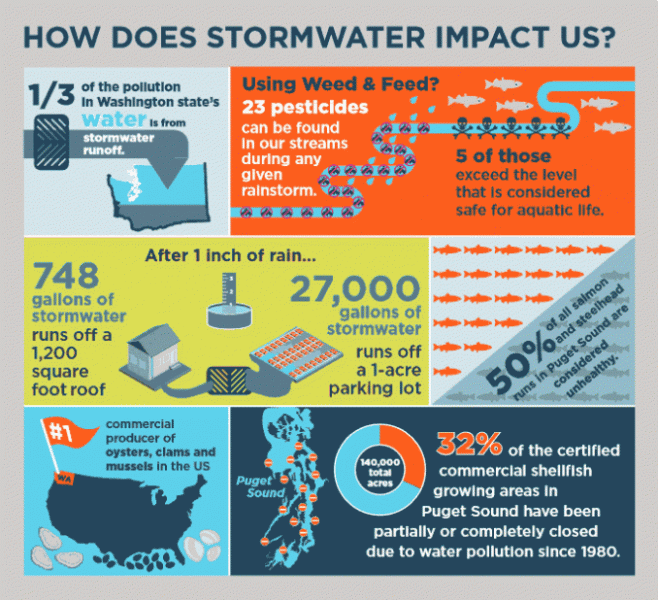
Alison’s article, Stormwater mapping: A glimpse into the world of tracking where the rain goes, was published in WLRD’s The Downstream Blog. The WLRD stormwater GIS mapping team got their feet wet so that you won’t have to next winter.
To learn more about King County stormwater services and information, visit WLRD’s Stormwater website.






 Employee News