
Social Media Spotlight: Regional Animal Services of King County on Instagram

Check out RASKC on Instagram! Regional Animal Services of King County helps pets find forever homes! #KingCountyPets #RASKC http://www.kingcounty.gov/pets
Follow King County Pets on Instagram today.
Click here to view all King County social media pages.
Share this:

Featured Job: 2018 Marine Marketing Intern

Salary: $16.36 – $20.73 Hourly
Location: Seattle, WA
Job Type: Intern
Department: Department of Transportation – Marine Division
Job Number: 2018MCK08010
Closing: 4/28/2018 11:59 PM Pacific
Description: King County Marine Division has a fantastic summer opportunity for two college students who have an interest in marketing. These positions will focus on marketing support and increasing Water Taxi ridership for the King County Marine Division through social media tracking and daily outreach to concierges and the public along the Seattle Waterfront.
Contact: For more information, contact Madeline Canning-Kaplan at 206-477-3721 or Madeline.Canning-Kaplan@KingCounty.gov.
Learn more about this position or all available jobs.
Share this:

ESJ Speaker Series: Impacts of Japanese American Internment during WWII

On Tuesday, May 8, attend the next ESJ Speaker Series for a discussion on the “Impacts of Japanese American Internment during WWII” led by Tom Ikeda, Executive Director of Densho, the Chinook Room 123 from noon – 1 p.m.

Densho means “to leave a legacy”. At Densho, our mission is to educate, preserve, collaborate and inspire action for equity. Densho uses technology to preserve and make accessible primary source materials of World War II incarceration of Japanese Americans; to present materials for historic value and as a means of exploring issues of democracy, intolerance, wartime hysteria, civil rights and the responsibilities of citizenship in our increasingly global society.
Share this:

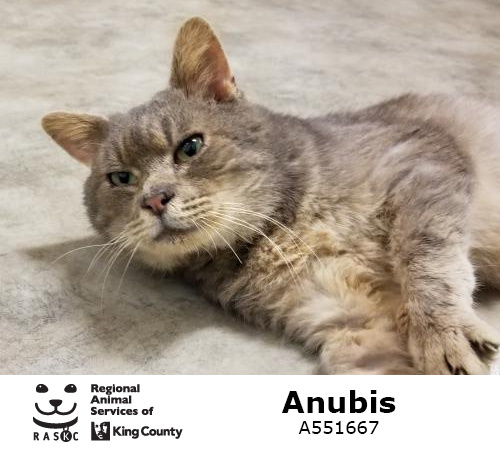
Pet of the Week: Anubis
Crossposted from Tails from RASKC
Can you open your heart and home to Anubis, our Pet of the Week?
This five-year-old gray tabby was brought in by a good Samaritan in early January. His personality color is “Rambunctious Red,” meaning he’s a spirited cat with a fun-loving personality. Anubis loves to be around people and he always wants to get your attention! He loves petting, and if you stop he will nudge your hand for more! He also loves to rub on people and knead their clothes. Though he likes petting, Anubis isn’t always a big fan of being picked up. He can get overstimulated, so keep an eye out for signs that he might need a break.
Anubis has a history of mild discharge from his eyes and possible respiratory inflammation, so a follow-up with your veterinarian is recommended. Our staff and volunteers will be happy to discuss his health care needs with you when you visit.
He comes neutered, microchipped, and up to date on his vaccinations. And like all of our adoptable pets, Anubis’ adoption fee includes a certificate for a free veterinary exam and the option of 30 days of free pet insurance through Trupanion.
You can find out more about Anubis on our website at kingcounty.gov/AdoptAPet or visit him in person at our Pet Adoption Center in Kent.
Share this:

King County’s noxious weed team tackles several high-priority species in April
Crossposted from KCWeeds
King County’s noxious weed specialists have their hands full this month and it isn’t going to get easier anytime soon. Top priority noxious weeds they are focusing on this month include garlic mustard, European coltsfoot, giant hogweed and shiny geranium. Other regulated noxious weeds that are following close behind are spotted knapweed, wild chervil and sulfur cinquefoil. And that’s just the short list of priority species that are regulated under Washington’s state noxious weed law.
King County weed specialists can help homeowners remove their giant hogweed if they aren’t able to do it. Photo by Sarah Baker.
Garlic mustard is probably the most challenging species we are chasing this month. It is a Class A noxious weed so we are trying to find and eliminate every plant, but it is one of the most difficult plants to locate.
This month garlic mustard is producing taller, flowering stems, so it will be easier to find. But it also means the clock is ticking if we are going to control all the plants before they set seed.
In large, forested areas like Coal Creek Natural Area, garlic mustard has a tendency to blend in among look-alike forest plants like nettles and fringe cup. Along waterways such as the Cedar River and Big Soos Creek or steep hillsides like the forests of Golden Gardens and Carkeek Parks, the terrain is another challenge, making it difficult to even get to the plants to control them.
We have contacted property owners and asked for access to survey and control garlic mustard. It will be a big help if anyone receiving a request responds quickly so we have more time to get to all the properties. In King County, anyone who has garlic mustard on their property can contact our office and we will come and control it. Stopping garlic mustard from spreading is just that important!
Another scary plant for us is European coltsfoot (see feature article in this blog), just added to the noxious weed list in 2018. This month is the perfect time to look for the plant because both the leaves and the flowering stems are visible in most cases. The flowers are starting to fade and form seeds though, so we need to act quickly to prevent spread.
This year’s rhizomes will start to grow also, so this is a great month to control European coltsfoot no matter what method you use. Because this plant is so brand new for us, we are still learning the best way to control it. If you have experience with controlling this plant, we’d love to hear from you.
European coltsfoot is often spread by fragments of rhizomes carried by water and soil erosion, but also carried in contaminated rock and gravel materials. We have found it growing in places near construction, in gravel piles and along waterways.
Shiny geranium is also in full force right now. We are finding an alarming number of new locations, some of which are quite large.
Even though this plant doesn’t seem that bad – it’s small and not even poisonous – people who have dealt with it in Oregon have warned us just how invasive and pervasive it can be. Probably we are at the point where we still have an opportunity to keep it from establishing everywhere, but it’s a small window that is closely quickly. Please can help by looking for and reporting shiny geranium whenever they see it.
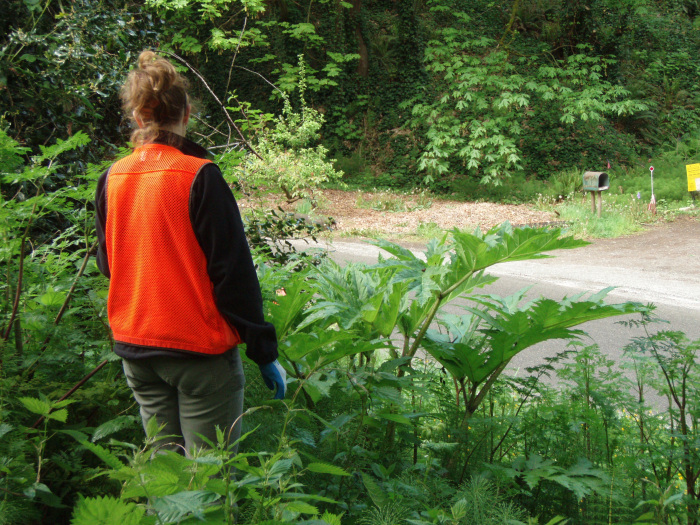
Giant hogweed is still just emerging this month and won’t start flowering for another couple of months, but it is so conspicuous that we can usually spot it even when it’s small.
Hogweed sap makes skin hyper-sensitive to sunlight and often causes burns and blisters to anyone who is unlucky enough to come in contact with it. Gloves, long sleeves and eye protection are highly recommended when controlling hogweed plants. Young plants can be dug up but make sure to get the whole root. Here in King County, please let us know if you see any hogweed so we can work on getting rid of it before anyone gets burned.
Here are a few more regulated noxious weeds King County staff are targeting this month.
The most abundant of the knapweed species on the noxious weed list, spotted knapweed gets taller this month and can be easier to find. The leaves are grayish-green and deeply lobed and old brown flower stems from last year might still be visible. This plant is most common in really gravelly, well-drained soils like you might find on a roadside, railroad edge or along some riverbanks and gravel bars.
This relative of parsley and carrot is not as scary as poison-hemlock or as tall, but it is very invasive and can be tough to get rid of (see feature article in this blog). Most of the large infestations in King County are in the area between Enumclaw and Auburn, but it is possible that other populations have escaped notice. Identification can be difficult, so it’s best to get an expert opinion on this one. Look for small white flowers, stems that are entirely green and ribbed or furrowed, leaves that are highly dissected, and plants that are about two to three feet tall when in flower.
Sulfur cinquefoil is another noxious weed that can escape notice until it completely takes over. The leaves are distinctive with their 5 to 7 toothed lobes that resemble a hand. However, the leaf color blends with the grass it usually grows with and the pale yellow flowers are not that much help either. Once it gets established, sulfur cinquefoil can crowd out even grass as it forms a dense monoculture. We find this plant all over the county, but it is most troublesome in areas with low-nutrient, rocky soils where it has a big advantage over grass and other plants.
For the whole list of noxious weeds we are looking for, check out the King County Noxious Weed List. Species that are regulated are on the top of the list, either Class A, B or C regulated species. Property owners (and that includes public agencies like ours) are required by our state noxious weed law to control these species to prevent them from spreading further.
In many cases, we can help property owners control their regulated species, especially Class A noxious weeds that are the highest priority, so make sure to get in touch if you are having trouble tackling your noxious weeds. Also, King County residents can help us by reporting locations of regulated noxious weeds on our online reporting form or by contacting us.
For more great photos, visit the original post on the KCWeeds blog.
Share this:

Tech Tip: Staying ahead of scams, spam, and phishing emails

Here’s what to look for when you receive an email you aren’t sure about:
- King County and KCIT use the King County logo and/or the “Service Alert” visual in all communication.
- Do not ever click on a link inside a suspicious email. If you need to change your password in any system, go directly to the website or system instead of clicking on a link in an Email.
- If the email seems odd, look for spelling errors and sentences that just don’t sound right.
- Hover over a link in your browser to uncover the real destination, regardless of what the text in the Email says it is.
- If you aren’t sure, don’t click. Contact the HelpDesk at 206.263.HELP or helpticket@kingcounty.gov.
Share this:

King County increased the pet adoption rate by a record 20 percent in a single year

 Regional Animal Services of King County – which has dramatically increased the pet-save rate in recent years – set a new record for adoptions last year, delivering on Executive Constantine’s commitment to transform humane animal care.
Executive Dow Constantine thanked the staff and volunteers at King County’s animal services division for increasing the pet adoption rate by a record 20 percent in a single year, building on the successful transformation of regional animal services.
The latest milestone is the result of several strategies, including partnering with cafes and pet stores to make it easier to adopt cats, starting a new dog playgroup to help staff and volunteers better assess a dog’s behavior, revamping the volunteer program, and significantly increasing the number of pets that are licensed.
“Thanks to outstanding work by our staff and volunteers, we are delivering on the promise I made to the people of King County to set a new standard of excellence in humane animal care,” said Executive Constantine. “Our latest achievement – a record-setting increase in the number of pets that are adopted – demonstrates our unyielding commitment to continuous improvement.”
King County, which had once considered disbanding its animal services division after years of underperformance, has made extraordinary progress in recent years. Delivering on Executive Constantine’s commitment to transform Regional Animal Service of King County, the agency now has a pet-save rate of 92 percent, up from 51 percent in 2003.

Creative partnerships + innovative strategies = more pet adoptions
Regional Animal Services of King County connected 2,992 animals to new families in 2017, up from 2,467 the previous year. The 20-percent increase required innovative work by the staff and volunteers, such as partnering with local cafes and pet stores to make it more convenient for people to adopt cats:
- Covington: Petco
- Kent: Reber Ranch and RASKC
- Kirkland: The Whole Cat & Kaboodle and RASKC’s Eastside Pet Adoption Center located inside the Kirkland Petco
- Redmond: Café Cocoa
- Seattle: Meowtropolitan Cat Café in Wallingford and Neko Cat Café in Capitol Hill
- Tukwila: Petco and PetSmart
After earning a $75,000 grant from Petco Foundation, the agency replaced the stainless steel cat kennels in adoption rooms with more spacious, welcoming cat condos. The staff is now working with professional trainers to create a new behavioral modification program for dogs.
Foster Coordinator Lori Mason worked with volunteers to organize a 3-day garage sale to create cat colony rooms, spaces where people can now interact with cats in a fun, low-stress environment.
The staff transformed the dog behavioral assessment room into a brighter, more welcoming multi-use space where the dog feels more at ease during their intake session, and where potential adopters can become acquainted with an adoptable dog in the warm setting of the dog meet-and-greet rooms.
The staff started a dog playgroup so dogs can burn off excess energy before meeting potential adopters. It also helps the staff and volunteers better assess a dog’s personal and behavior in order to provide helpful background information to the potential adopter.
The agency significantly increasing the number of pets that are licensed – selling a record 111,000 licenses in 2017 – which increased the number of pets that are quickly and safely returned home.
The staff redesigned the agency’s website to provide a resource hub for volunteers, with video trainings that engage both current and prospective volunteers. With the leadership of Volunteer Program Coordinator Sarah Luthens, more than 750 volunteers donated a total of 120,523 hours, helping animals adjust to the shelter, washing laundry, and taking dogs for a walk.
The agency has also embraced the Humane Society of the United States’ Adopters Welcome, an approach that removes well-meaning but unnecessary barriers between pets and families. For example, residents no longer need to fill out an adoption application before playing with a cat or dog, and can now adopt a pet as a gift for a friend or family member.
Executive Constantine last year signed a five-year agreement with 24 cities to provide animal services. The agreement will automatically be extended after five years, providing stability for animal care in King County for the next decade.
An example of creating the nation’s Best Run Government
The transformation of animal services is one example of the work Executive Constantine’s administration has done to create the nation’s Best-Run Government, a promise to deliver the most value to the people of King County.
The success in animal services follows the same principles that King County has adopted in other transformations:
- Empower employees who know the work best
- Focus on prevention
- Base decisions on science and data
- Address the specific needs of each individual client
- Create strong community partnerships
- Demonstrate an unending commitment to continuous improvement
 Read more on the Executive News site.
Share this:

King County Hiring Managers: You are the key to the success of Vets 4 HIRE

Each of the past three years, King County has met its goal of hiring 16 veteran fellows as part of the Vets 4 HIRE program. Funding is available to hire 16 more this year, but we need the help of hiring managers.
What began as King County’s Heroes Employment Reintegration Opportunity (HERO) Program five years ago has developed into the Vets 4 HIRE (Heroes in Reintegration Experiences) Program, a paid fellowship/internship for qualified veterans funded in part by the Veterans, Seniors and Human Services Levy.
While the success of any program of this type depends on the quality of the candidates, success also relies on those County supervisors who engage with this unique pool of talent. With the approval of funding through 2023, there are opportunities for King County supervisors to bring veteran talent onto their teams – adding value to not only their teams, but to the County and the residents we serve.
“We created the Vets 4 HIRE Program to support veterans in making a successful transition from military to civilian employment, and to provide a pipeline of skilled veteran talent for positions within King County,” said Susan Navetski, King County Vets 4 HIRE Program Manager. “We believe their talent, experiences and perspectives can support us in achieving our best-run-government goal.”
“Veterans bring a different perspective,” said Zlata Kauzlaric, IT Governance Manager for King County’s CIO. “They bring discipline, reliability, organizational skills, and a sense of service. They are happy for the opportunity, they are committed to learn, and they bring an attitude that ‘nothing is impossible.’” Zlata has hired four veteran fellows over the past three years, two moved on to regular positions within the County, one relocated to the East Coast to accept a position elsewhere, and one is currently participating in the fellowship program.
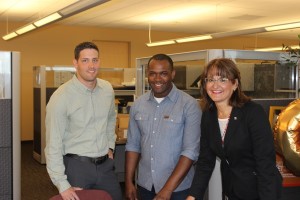
IT Governance Manager Zlata Kauzlaric (right) with two of the veteran fellows she’s hired: Casimier Schwandt (left) and Darron Lewis (center)
So far, 54 veterans have participated in the program, and 37 King County supervisors have enjoyed the benefits.
Supervisors can work with their department HR staff to create opportunities for veterans to contribute to their teams, review and select from existing veteran candidate pools, or post those opportunities on the County’s career site. Veterans hired into these learning experiences are paid at similar rates as student interns.
The program helps support six-month, full- or part-time, paid learning experiences, and enables agencies to extend their veteran’s experience for a total of 2,080 hours. For those veterans who are residents of King County, half of the first six month’s salary – up to $6,250 – is reimbursed by the Levy.
There are currently three job postings for veteran fellowships with the County:
- Department of Transportation – Airport Division is seeking a Construction Management Veteran Fellow and a Lean Program Management Veteran Fellow.
- Metro is seeking a Veteran Fellow or Student Intern at Metro Transit.
Hiring managers are encouraged to consider how the Vets 4 HIRE program can add value to your teams.
For more information about the program, visit the Vets 4 Hire site, reach out to Program Manager Susan Navetski, or contact your agency’s HR representative.
Share this:

It’s National Social Security Month!
by Kirk Larson, Social Security Washington Public Affairs Specialist
National Social Security Month is celebrated in April and is dedicated to educating you about Social Security programs and services. From programs that help support you through life’s journey, to services that help put you in control, to systems that help protect what’s important to you, Social Security is committed to helping secure today and tomorrow for you and your family.
During National Social Security Month, we encourage people to take control of their future with my Social Security at www.socialsecurity.gov/myaccount. Create a my Social Security account to check your earnings history, confirm you have enough credits to retire, see an estimate of future benefits while still working, or manage your monthly benefits once you begin receiving them. You can also check the status of your claim or appeal, request a replacement Social Security card, and get an instant benefit verification letter.
Our Retirement Estimator is another great tool that provides you with immediate and personalized benefit estimates based on your own earnings record. This allows you to receive the most accurate estimate of your future retirement benefits. Estimate your benefits now at www.socialsecurity.gov/estimator.
After you have viewed your earnings history for accuracy, confirmed you have enough work credits to retire, and determined the best age to retire, you can get started on the next phase of your life right away by retiring online! It’s fast and easy at www.socialsecurity.gov/retireonline.
For more than 80 years, Social Security has changed to meet the needs of our customers. During National Social Security Month, and throughout the year, Social Security puts you in control with secure access to your information anytime, anywhere. From estimating or managing your benefits, requesting a replacement Social Security card, to retiring online, visit SocialSecurity.gov today, and see what you can do online at www.socialsecurity.gov/onlineservices.
Share this:

King County hosting Administrative Professionals Day event, April 25

Career Support Services and the Administrative Professionals Advisory Committee are pleased to host King County’s 3rd Annual Administrative Professionals Recognition Day event on Wednesday, April 25.
This year, approximately 100 outstanding administrative professionals were nominated for recognition. Join us as we recognize and celebrate the valuable contributions administrative professionals throughout King County government are making.
The event will be held from 11:30 a.m. to 1 p.m. in the Bertha Knight Landes Room at City Hall, 600 4th Avenue, Seattle.
Space is limited! Register at Eventbrite, and email the committee with any questions you may have at AdministrativeProfessionals@KingCounty.gov.






 Employee News