
Kudos! RASKC receives $75,000 grant from Petco Foundation

Crossposted from Tails from RASKC
 RASKC recently received a $75,000 grant from Petco Foundation. The award came shortly after RASKC was recognized for being one of the highest-performing animal care agencies in the nation. Read the full story below or click to view the stories aired on KING 5 News.
King County Executive News Release
KING 5: More Pets Finding Homes in King County (interview with Dr. Gene Mueller)
KING 5: “Cat condos” coming to King County Animal Shelter
Read more from Tails from RASKC
Share this:

Featured Job: CH Special Projects Manager PPM-III

Closing Date/Time: Mon. 07/31/17 11:59 PM Pacific Time
Salary: $38.66 – $49.00 Hourly
Job Type: TLT (Term-Limited Temporary)
Location: Chinook Building, Downtown Seattle, Washington
Department: Department of Public Health–Community Health Services
Description: Public Health- Seattle & King County’s Health Care for the Homeless Network is seeking a Health Care for the Homeless Special Projects Manager (Project/Program Manager III) to provide project management capacity needed to complete several critical special projects related to federal governance requirements, program evaluation, input from program consumers regarding planning and evaluation, and the oversight and strategic input provided the program by both the King County Board of Health and the program’s community advisory body- Health Care for the Homeless Network (HCHN) Planning Council. It works in close collaboration with the HCHN leadership team and supports the HCHN Program Manager and Operations Manager.
Examples of duties include supporting the HCHN Program Manager in work with the King County Board of Health and the HCHN Planning Council around federal governance requirements, program evaluation, and operational input from program consumers. Other duties may include support for grant applications, contracts development, and quality assurance.
Contact: For questions about the position, please contact Denise Hawthorne at denise.hawthorne@kingcounty.gov. For questions about the application process, please contact Catherine Fitzpatrick at Catherine.fitzpatrick@kingcounty.gov.
Learn more about this position, or view all available jobs.
Share this:

Yesler Bridge Rehabilitation Project: Update, Terrace Street closure

 Terrace Street next to the Yesler Building, and south of the Chinook Building, will be closed beginning today, Wednesday, July 26, and is scheduled to re-open the week of Monday, August 7. The south end of the alley between 5th Ave and 4th Ave, including the garage entrance and exit, will only be accessible from Jefferson Street. This closure is needed to accommodate demolition activities and concrete pours.
The Yesler Way Bridge Rehabilitation Project, which will improve safety and reliability while preserving the bridge’s historical elements, will continue through fall of 2017. If you have any questions or would like to discuss the project further, please contact YeslerBridge@seattle.gov or 206-684-8684. To learn more about the project, visit the project website.
Share this:

Federal Way Youth Action Team making a difference
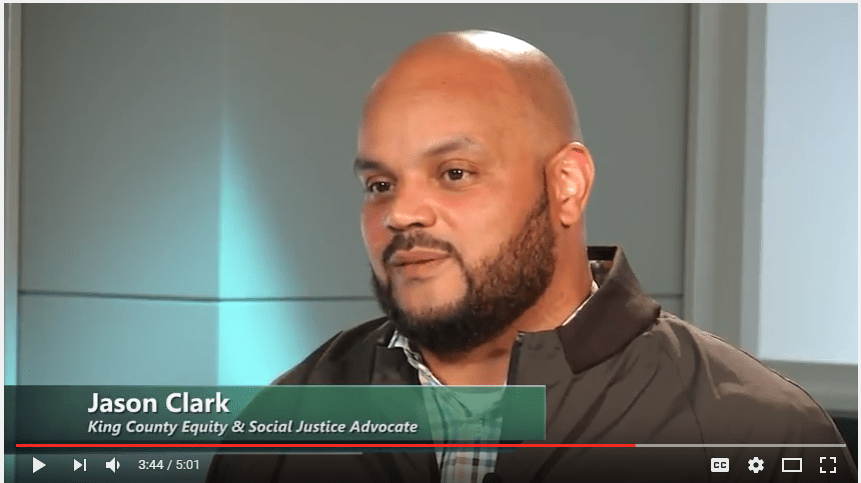
See how the community in Federal Way is working together to help at risk kids. This video features local organizations, such as the HYPE Program, CHI Franciscan Health, and the Federal Way Boys & Girls Club as well as commentary from Jason Clark, Equity and Justice Advocate with King County Superior Court.
Youth mentors are needed for this growing Federal Way community support network. Click here to learn more.
Share this:

Our thoughts on the West Point Independent Review Report
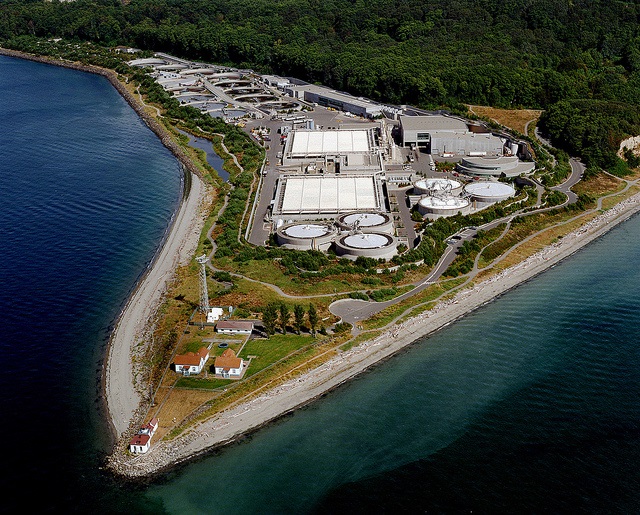
Crossposted from Clean Water Stories
As promised last spring, the King County Council has publicly shared the results of an independent review of our West Point Treatment Plant operations.
The report took an unbiased look at our operations and maintenance practices as part of an effort to learn from what happened at West Point on Feb. 9, 2017, when severe storms and high flows led to flooding and serious equipment damage.
We agree with the report’s findings, which include a number of recommendations to improve plant operations, increase system redundancy, and strengthen employee safety and training.
Read more from Clean Water Stories
Share this:

Employee is proud to provide excellent customer service to King County residents
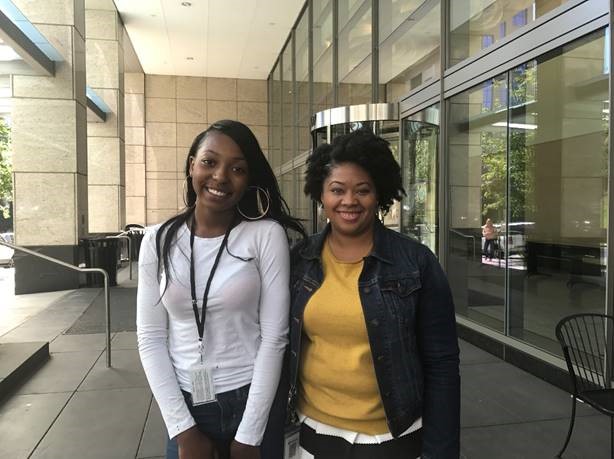

Pictured: From left, author Jimmy’a Carter and Teesha Bailey.
By Jimmy’a (jih-MY-uh) Carter, a summer intern for the Executive’s Office Customer Service team. Jimmy’a, a 16 year old who will be a junior this fall at West Auburn High School, plans to attend a four-year college and get a degree in youth counseling. She joins us from the Bridge to Prosperity mentoring program.
What do a fancy clothing store and King County have in common? For Teesha Bailey, serving store customers helped her transition to serving county customers. She currently works as a Confidential Secretary with the Department of Community and Human Services (DCHS) for Director Adrienne Quinn.
But two years ago, she was working at Neiman Marcus as a customer service representative for high-end customers: answering their questions, resolving complaints, handling sales and billing issues, and answering switchboard calls.
It kept her busy, but she really wanted a job where she could make the community better in a department that fit her need to help people. That’s why she had always wanted to work for the county, and because she had family and friends there who liked their jobs. They suggested that she apply.
She got the job, and now she supports DCHS and all of its divisions with administrative work on big projects like the Veterans and Human Services Levy and Best Start for Kids. They are also working with schools to try to help children who have made mistakes by showing them what they’ve done wrong and how to make better choices, instead of putting them in detention. Teesha also helps to support the Executive Office when they have issues that connect to DCHS.
She said she likes being an advocate for the community in government, and working to create more equity in King County so that everyone is treated the same, gets paid the same wage, and gets the same opportunities, no matter their skin color, culture, or background.
What stands out to me most about Teesha Bailey’s work is how she wants to help people and children who may not have been treated fairly, by connecting them with programs to improve their lives. She believes her persistence is what got her here today and she loves her work and would not change a thing, except to have opportunities to do even more to help the community.
Teesha has come a long way from selling fancy clothes, but she’s still committed to providing great service to her new customers in King County.
Share this:

Metro employee gets to “Be the boss”
By Hannah Debenedetto, intern with King County Department of Transportation
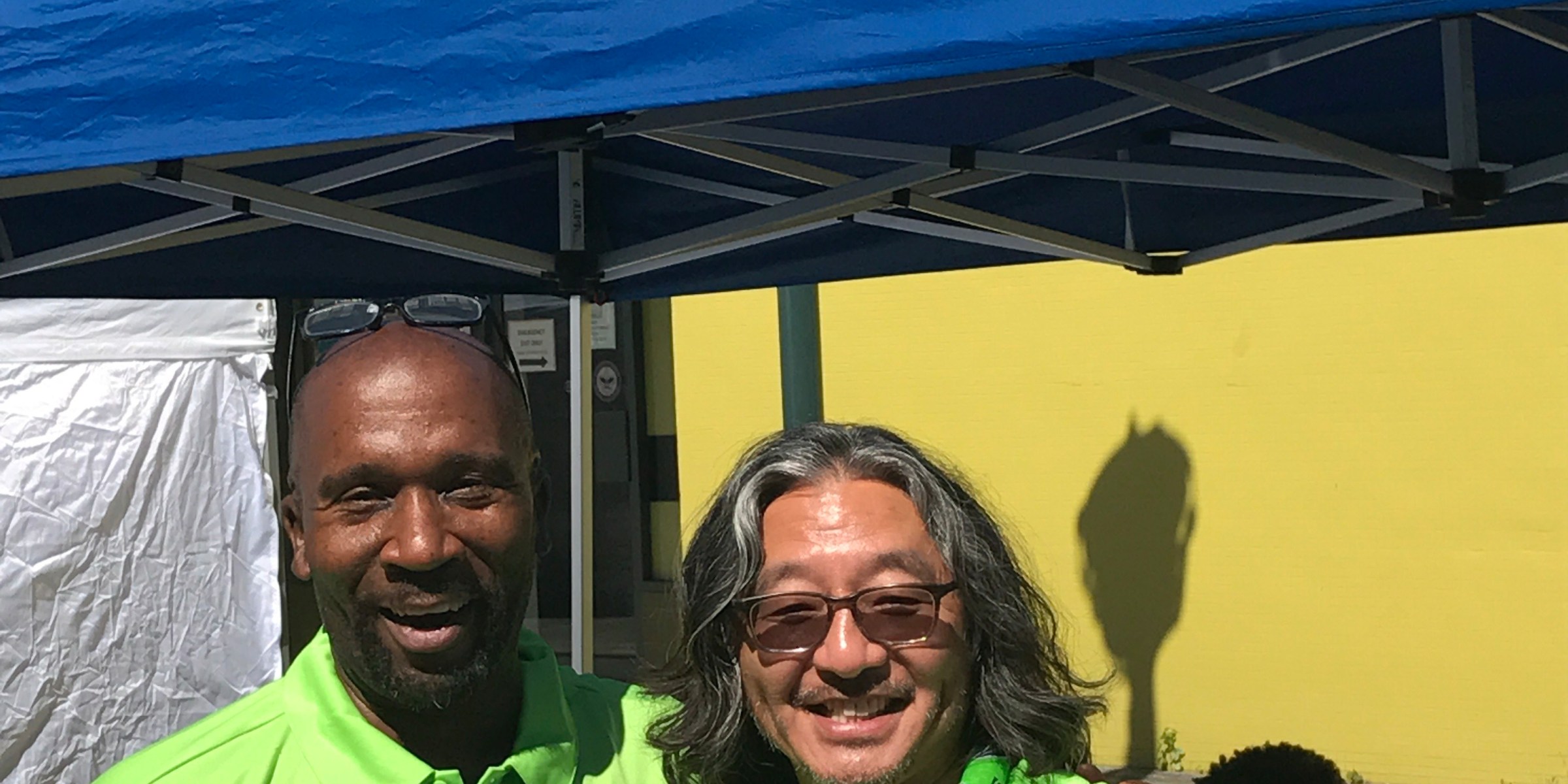
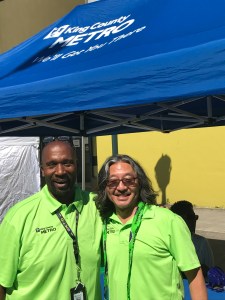 What would you do if you were boss for the day? Metro’s Gerald Freeman found out after winning an employee sweepstakes to “be the boss” of KCDOT Director Harold Taniguchi.
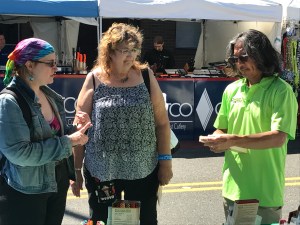
As a marketing specialist, Gerald is regularly at community events to help customers sign up for ORCA cards or to answer their questions. This month, Harold joined him for an afternoon helping customers in Metro’s booth at Kent Cornucopia Days.
“Harold jumped right into engaging people, answering questions, and referring people to me when he didn’t know the answer,” said Gerald,
Through the Employee Giving Program, a service connecting King County employees with nonprofits, Gerald’s name was entered into a drawing with almost 300 other participants. To be eligible, employees had to spend time learning about the Employee Giving Program.
Gerald said he would love to have Harold’s help again, especially if he could bring Metro’s General Manager Rob Gannon and County Executive Dow Constantine along too.
 Rob has his work cut out for him. He has completed one of three assignments, sitting in on employee interviews with Josh Isgur, a Human Resources analyst. He’ll complete the others in coming months. Three employees total won separate drawings to be his boss. In addition to Josh, there is Berni Hendrickson, an employee in Metro’s distribution center and Lanie Curry, a Human Resources associate in King County’s Drug and Alcohol program. Rob plans to report to his shifts in the coming months.
Thanks to all participants who took time to learn about the Employee Giving Program, and congratulations to the winners, you’re the Boss!
Share this:

Reducing customer wait times with Check the Line
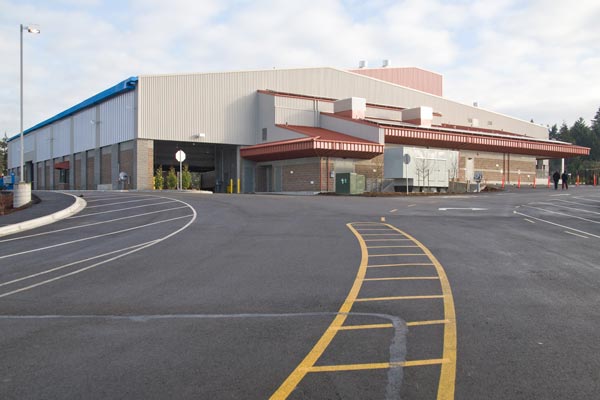
With an on-the-go lifestyle, customers are looking for ways to reduce waiting in lines.
 Web cameras at King County’s Algona, Bow Lake, Factoria, Houghton, Renton and Shoreline recycling and transfer stations help customers plan their trips using www.kingcounty.gov/checktheline, which shows the line of vehicles waiting to enter the facilities and facility wait times.
Solid Waste Division (SWD) Special Projects Manager Alejandra Calderon was the lead on the project, and oversaw implementation and outreach of the web cams at the six transfer stations.
Alejandra emphasized the practicality of the mobile-friendly website and its functionality: “What we wanted to do was improve the customer experience at our transfer stations. By installing a web camera that shows the line leading up to the scale house allows customers to go online and check how long the line is. We wanted to give customers the ability to make a more informed decision about when they should make the trip to dispose of their garbage and recycling.”
With a mobile-responsive web layout, customers can enjoy a seamless experience from desktop view to mobile view. Photos of transfer station entrances are updated every 60 seconds and feature a disposal wait time after weigh-in. Customers can determine if visiting another facility might potentially cut down on their wait time.
“It’s just a really customer service focused aspect; we wanted to make it easier for them and also drive some more information online. This platform works well on a mobile phone as well, so you can check it right before you leave, just to make that really good decision,” added Alejandra enthusiastically.
In addition to installing web cameras at the six urban locations and displaying wait times on the website, SWD also installed reader boards outside of the scale house to inform customer of the average wait time, “from when they weigh in, to the tipping floor – which is where you dump your garbage – dump, get back in, come out and weigh out at the scale” said Alejandra. Customers are charged for the weight difference of the loaded vehicle to when it’s empty.
“Our goal was to speed up the time people spent at our transfer station,” Alejandra added. “That included having our transfer station operators help doing some unloading for people that had difficulties; it included putting up signs at transfer stations with wait times.”

Shoreline Recycling and Transfer Station
To get the word out about the new service, Alejandra and SWD Communications Specialist II Matt Manguso teamed up for outreach efforts. Alejandra and Matt worked together to develop paid Facebook ads, in both English and Spanish, that introduced the service to customers in King County and encouraged them to “Go Online to Check the Line.” Other outreach efforts included sponsoring radio traffic reports and announcing the new service through newsletters, press releases, and social media.
“We really wanted to inform as many people as possible about this new service,” said Matt. “The Facebook ads and radio sponsorships allowed us to get this message out to a wide-range of King County residents and our customers, and since the service is on our website, it made sense to focus a lot of efforts digitally.”
Since launching the web cam and online service, Alejandra notes that communication efforts are beginning to pay off, but it will be a slow process to convert more people into users: “we’re starting to hear people are familiar with it, but I think it’s one of those things that will take a while for people to catch on to. But, it’s a great tool because our stations fluctuate a lot on demand and how many people are using it at the time.”
Variables such as weather, time of year and traffic congestion can trigger fluctuations in wait times, so in order to avoid long lines at transfer stations, customers are encouraged to make use of Check the Line tool.
“It’s just a good tool, I think, for people who use it on a normal basis. Small businesses especially will find it helpful. For example if a landscaper is getting ready to head to a station they can check the line on their phone and decide whether they should go to the station now because the line is short, or do a few more houses and wait for the wait time to decrease,” said Alejandra.
In addition to taking on a proactive approach to boost customer experience, Alejandra mentioned that this service can also help reduce greenhouse gas emissions by keeping cars off the roads during peak times. Using technological enhancements to improve county services, while making a conscious effort to protect the environment, showcases why King County is a Best-Run Government.
Alejandra attributes the fruition of the website and launch on October 1, 2016 to KCIT: “We really need to give credit to the people we worked with at KCIT, it was definitely a partnership. They do websites, they do all that. They took our ideas of how we wanted the site to look, how it should function, and did an incredible job of bringing it to life. They also worked really hard to make sure everything was ready to go by our launch date.
Camera feeds, disposal times, facility locations, hours of operation, and directions can be found at www.kingcounty.gov/checktheline.
Share this:

Searching for identity, author earns recognition with story collection

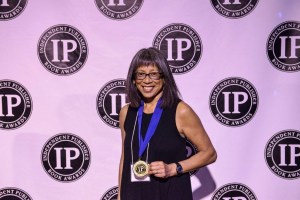
Donna Miscolta, recipient of the Independent Publisher Gold Medal for Best Regional Fiction, West-Pacific.
King County employee by day and published author by evening, Donna Miscolta writes novels and short stories inspired by anecdotes that she has witnessed or heard about in her family or within her community.
“I take that tiny, true piece and turn it into fiction,” Miscolta said. “From there, it takes on a life of its own, and it’s not really about any specific person, and yet many people recognize a part of themselves in these stories.”
Her latest work, “Hola and Goodbye,” is a collection of stories inspired by her grandmother’s journey as an immigrant in the United States; Miscolta explores the effects of assimilation common to immigrant families, which she hopes attracts readers from all walks of life.
“My grandmother came from Mexico in the 1920’s and she never learned to speak English, so I explored the dynamic of Spanish disappearing by the third generation,” Miscolta said, whose heritage is Mexican and Filipino. “It raises the question: what kind of things are lost in the process of moving to a new country and establishing a new life with new language, culture and traditions.”

Book Cover of Hola and Goodbye
As a result of Miscolta winning the Doris Bakwin Award for Writing by a Woman, the sponsor, Carolina Wren Press, published Miscolta’s “Hola and Goodbye,” which has generated more attention than she could have imagined possible. The book is a finalist for an International Latino Book Award.
Recently, Miscolta was nominated for 2017 Best of Seattle Reader Poll in the Best Author category, which came as a surprise to her.
“It was quite a surprise and an honor to be on the list with some famous authors, among them Sherman Alexie, Lindy West, Maria Semple, and Domingo Martinez, who was a finalist for the National Book Award several years ago,” Miscolta said.
For Miscolta, this will be an event-packed summer, including speaking appearances in Port Townsend, San Diego, Los Angeles and Missoula MT. More information about these events can be found at donnamiscolta.com.
“It will be nice to see my book in a different geographical environment,” Miscolta said. “Much of the promotion so far has been done in WA and CA.”
Her awards and accolades include the Gold Medal at the Independent Publishers Book Award in New York City, a presenter at the Women’s Museum in San Diego, and readings in Durham, Raleigh and Chapel Hill, North Carolina.
Awards like these validate Miscolta’s hard work and dedication to her craft. She is even more determined now to finish her next novel, which is currently in the works. Her first novel, “When the de la Cruz Family Danced,” was published in 2011.
“What it does, is it makes me feel like people out there are listening and it makes me want to get more work out in the world,” Miscolta said. “I’m working on another manuscript, which is based on a story titled “Strong Girls” that appears in the collection.
 Nearing thirty years with King County, Miscolta conducts outreach programming for students at King County schools about waste reduction, recycling and resource conservation in the Recycling and Environmental Services section in the Solid Waste Division. Through the Local Hazardous Waste Management Program, she is also working on a project with the Latino community on hazardous products education.
King County is a proud supporter of employee personal and professional development.
Best of luck of with your newest manuscript, Donna!
Share this:

Tech Tip: Identifying and reporting scams and malicious emails

By Ralph Johnson, Chief Information Security and Privacy Officer

Ralph Johnson, Chief Information Security and Privacy Officer
On July 6, 2017 the Federal Trade Commission (FTC) issued an alert on scammers posing as FTC officials who contact individuals and claim they have won prizes from a charity contest. The scammers ask for money to cover taxes or insurance costs associated with the prize. While this is a new malicious campaign, scammers use these basic tactics time and time again with slightly different wording to take advantage of unsuspecting individuals. It may seem like a day doesn’t go by without scammers contacting you online or by phone seeking money and/or personal information. Since this is so commonplace, it is worth exploring how to identify these schemes, and how to go about reporting them in the event that scammers target you.
Identifying the scam
Two common financial schemes involve coercing individuals into paying money to prevent a negative outcome, such as a tax audit or police investigation, or asking the individual to pay a fee up front to claim a prize. A third type of scam seeks individuals’ personally identifiable information (PII), such as Social Security numbers and birthdates, to commit identity theft. Individuals providing information to scammers may suffer large financial losses, as well as negative impacts to their credit. It is important that you know how to spot these scams so you can easily ignore them.
One final thing to be aware of is that scammers create convincing emails that may look like official communication from your employer, bank, credit card issuer, or a retailer. These emails often include a link to a very convincing, yet fraudulent website that will ask you to log in with your username and password. If you provide your credentials, the criminal can then use them to gain access to your legitimate account. From there, they can steal your personal information or generate fraudulent transactions. If you ever receive an email asking you to click a link to log in and update your account or change your information, be safe and use your browser to directly type in the legitimate website address for that account in order to complete this request. By doing this, you will always be sure you are on the right website.
Scammers constantly target individuals by email, false advertisements, and phone calls to bring these types of scams to fruition. Being wary of any communication that meets any of the above criteria will go a long way in keeping your information and money safe!
Reporting scams
Finally, it is very important that targets of online or phone scams report this to the proper authorities. Although it can be a bit embarrassing to have been hit by such a crime, reporting is the only way to direct investigators and regulators to pursue the criminals behind the scam or identity theft. Aside from reporting the scam to law enforcement, it is important to work with your bank, credit card issuer, or the business where your account was compromised to take the necessary steps in preventing further financial loss.
If you are the target of a financial scam, report it to the FTC at www.ftc.gov/complaint. If this scam was via email or over the Internet, also file a complaint with the FBI’s Internet Crime Complaint Center at www.ic3.gov/complaint.
Targets of identity theft can also file a report at www.identitytheft.gov and receive a recovery plan detailing how to move forward based on the type of scam committed.
It’s most likely a scam if you…
- Have to pay money to claim a “prize” or “winnings”
- Are asked for money to stop or prevent a police, FBI, or other federal investigation
- Have to provide your bank account number and information
- Are specifically asked to purchase any form of prepaid gift card to be used as payment
- Are approached with no prior contact to give out your date of birth, social security number, password, username or other personal sensitive information online or over the phone
- Are approached online or by phone in an unprovoked manner and asked for payment or personal information by someone claiming to be a government employee on official business






 Employee News