
Colorful “Kudos Wall” motivates employees to connect with one another and County


FMD Employees Janine Purdue, Judy Hairston and Elissa Benson stand in front of the colorful Kudos Wall.
Everyone loves to feel appreciated. Receiving praise is highly gratifying, and being praised in front of your peers or work group makes it that much more special. Facilities Management Division (FMD) has found an innovative way to do this and also engage employees in complimenting one another.
It all started at the December 2015 holiday potluck. FMD Secretary Judy Hairston remembers how the idea came to life, and was instrumental in helping it take off.
“Since it’s difficult for FMD as a large group to get together in one place, the holiday potluck planning team came up with several ideas to engage and recognize employees,” she said. “One of the ideas was to have staff submit compliments or ‘kudos’ for their co-workers, and some would be read aloud at the potluck.”
Share this:

Employee Town Hall available on-demand and in segments

 Our latest Employee Town Hall is now available to watch on-demand in its entirety or as individual segments.
Hosted by Natasha Jones, Director of Customer Service, the Employee Town Hall featured King County Executive Dow Constantine, Budget Director Dwight Dively, and Matias Valenzuela, Director of the Office of Equity and Social Justice, in a discussion on the 2017/18 budget forecast and its implications for employees and our priorities.
- Employee Town Hall (complete with captions – 59’26”)
- Read more to see all the segments available to watch
Share this:

King County Water Taxi recognized for innovation and efficiency


The King County Water Taxi was recently honored as one of the best passenger ferries of 2015 by Marine Log Magazine.
Denmark, Italy, Newfoundland, Spain, Washington – wait, what? While this could easily be an alphabetical list of random locations, it’s actually where a few of the Best Passenger Ships of 2015 are located.
According to Marine Log, an international publication out of New York City, the MV Sally Fox, the first of two new water taxi ferries recently acquired by the King County’s Marine Division, is one of nine vessels worldwide to receive this honor.
It does so because the ship and its crew are focused on providing passengers with an efficient passenger experience. One that makes it possible for people to commute without the headache or hassle of traffic congestion.
“Our schedule reliability is over 99%,” said Paul Brodeur, King County Marine Division Director. “Ridership has increased year after year, with over 515,000 passengers last year.”
“People are starting to catch on to it because it’s reliable, convenient and offers friendly customer service.”
Share this:

Curiosity and Gratitude

 Jennifer Hills, Director of the Office of Risk Management in the Department of Executive Services, was “devastated” when she looked at the engagement scores for her division. Lower than she expected “I was surprised because we’d been doing a lot of strategic planning and our 2012 employee survey results were so good.”
Hills resolved to approach the conversation with her 22 person division with “curiosity and gratitude”: curiosity about the underlying reasons for the scores and gratitude for the opportunity to be able to address concerns. This opened the door for honest communication that has benefited both the atmosphere and work in Risk Management.
To have the conversation, she kept it simple and borrowed from the engagement training. The agenda:
- What is your biggest fear?
- What are your hopes for how the data will be catalyst for change?
- What does the data tell us about our workplace culture?
- What action can we take that will have the biggest impact?
- Let’s pick 1 thing…
After 90 minutes of discussion where everyone participated and valuable ideas were generated, they created this list of three categories of things. “We couldn’t choose just one thing so we narrowed it down to safety and security, communication and our physical space.” Ideas were collected, discussed and people took on action items.
Safety and Security:
- Key Card Entry to Restrooms: can FMD designate some floors in the Administration Building as public restrooms and other floors employee only restrooms with key card or numeric keypad entry? (Jennifer)
- Safety Training for de-escalation techniques (Christine)
- Enhanced security in the lobby (Jennifer)
- When county employees arrive for ORM meetings, allow them through to wait in the conference room rather than in the lobby (Administrative Staff-implement now)
- Install a main phone on the 3rd Floor for visitors to call the county employee they are meeting with (delivery and county employees ask ORM front desk to use their key cards to provide entry to non-ORM spaces on the 3rd floor) (Jennifer)
- More visible FMD security patrol in Admin Building (Jennifer)
- Invite Collin Sanders, Chief of Security, to ORM staff meeting to discuss security concerns (Jennifer)
- Eliminated IN/OUT board and are using Lync and Outlook Calendars to identify staff availability. Training needed on Lync and Outlook calendar functions (Chauntelle will offer tutorial in conference room)
Communication:
- Section meeting minutes will be reported out to entire office (Managers)
- Claims Section will invite Insurance/Contracts Section to roundtable meetings (Karen)
- Insurance/Contracts Section will provide a presentation to Claims staff after April policy renewals (Winnie, Liz)
- Jennifer will send out a monthly newsletter to ORM staff to share information from senior leadership, DES Management Team meetings, provide updates on ORM projects, section activities, ORM staff recognition, etc. (Jennifer)
- Lack of departmental responses to claims is having a negative impact on our TCIs’ ability to investigate and resolve claims, and provide good customer service. TCI’s will provide Jennifer with a specific list of claims that are waiting for responses. Jennifer will schedule meetings with Department Leadership to include a TCI ambassador to share examples and impact, starting with DAJD. (Jennifer, Christine, Miesha)
- Risk Mitigation Funds may be available to assist departments with better document management, information flow, responsiveness. (Sean)
- Improve incident reporting by other departments to ORM. In particular, vehicle accidents need to be reported more timely. We need to create standard work around incident reporting. Use of technology for smart phone/tablet applications for incident reporting from the field directly to ORM. (Christine, Robert H., Sean, New Claims System)
- There is a strong need to access other departments’ documentation via a shared drive (transit reports, videos, photos, etc) (Stephen, Sean, Pam)
Physical Space:
- Since our first Employee Engagement meeting, staff noticed a reduction in the office noise level. Thank you everyone!
- Everyone was issued LED lights for use at their cubicles. Blue indicates recorded statement or phone call in progress, red indicates a need for uninterrupted time (Joan completed)
- We submitted a work order to FMD to have them consult on better noise absorbing or sound proofing of cubicles (Joan completed)
- Plum Room can also be used as a resource for phone calls, quiet work area, etc.
- White noise generators-would this help with noise level? (lack of consensus-Safety and Claims uses white noise generators if anyone would like to see/hear them in action)
- Earplugs will be ordered on the next Keeney’s office supplies order (Joan)
Follow-up to the discussion was quick and impactful. To address concerns about noise in the office that made transcription difficult, everyone was issued LED lights for use at their cubicles. Blue indicates recorded statement or phone call in progress, red indicates a need for uninterrupted time. A short term win was realized as staff noticed a reduction in the office noise level.
Hills issued the division’s first newsletter with kudos recognizing excellent work by employees. And, looking longer term, Hills engaged Integris to focus the division’s Lean journey.
“I’m really happy we got the scores we did because now I know what we can do to create a better work environment. I’ve seen a big change in our office.” People are more helpful to each other and communication has improved.
Her advice to those faced with difficult scores? “Approach the conversation with curiosity and gratitude. And, don’t fill in the pauses,” when you are having your discussion. “It’s tempting to try to fill in the pauses with solutions, but that’s when people come forward with their thoughts and ideas.”
Share this:

Dr. Gene Mueller: Lean supporter, employee advocate, animal lover
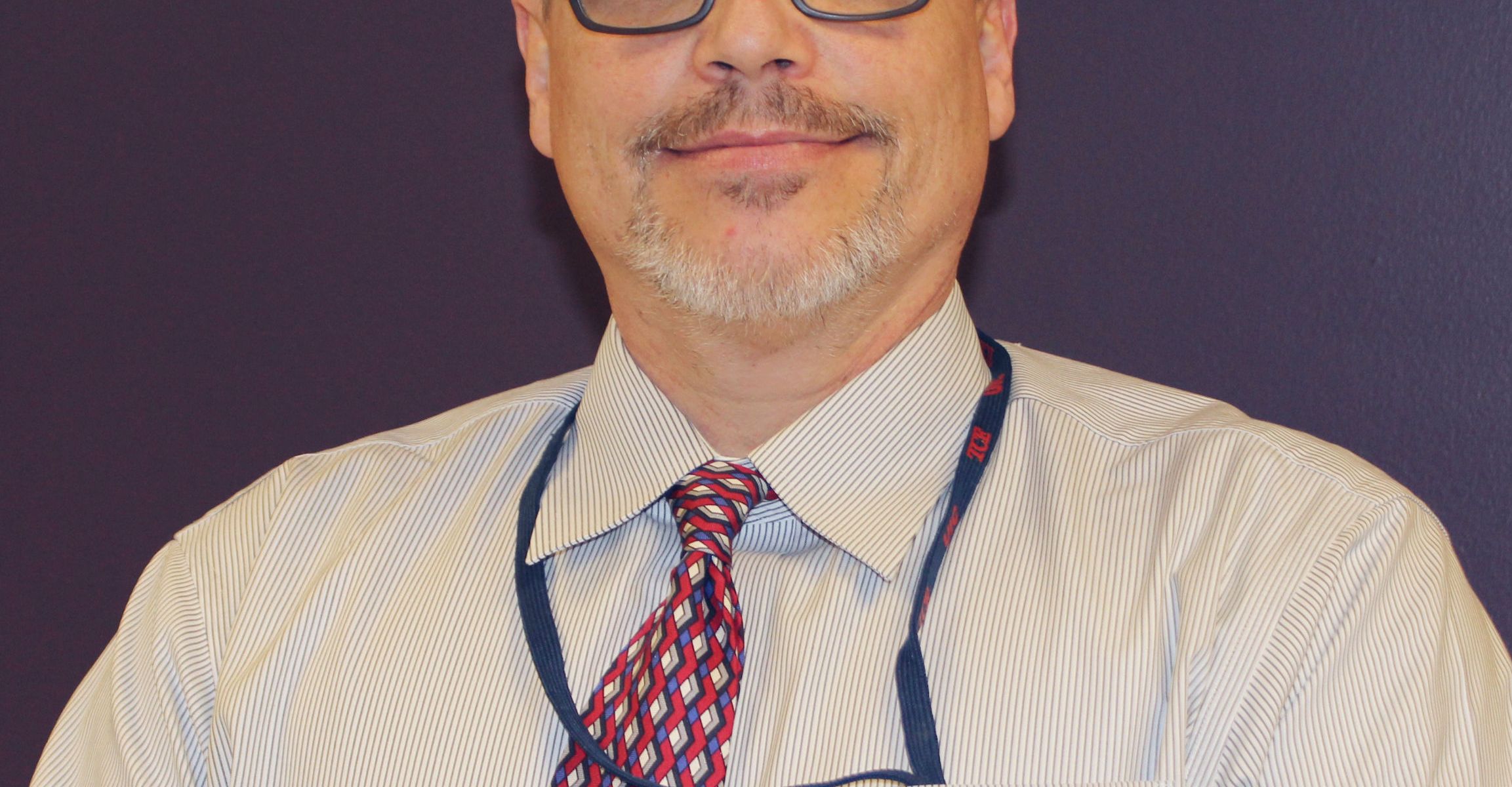
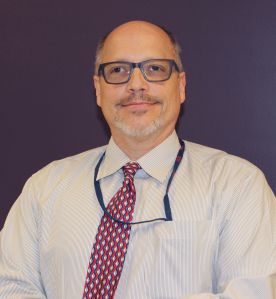
Dr. Gene Mueller has furthered the work being done to provide excellent animal services to the people of King County.
With the success of ensuring nearly 9 out 10 cats and dogs find a loving home and lowering the euthanasia rate to an all-time low of 12 percent, people are wondering what’s next for Regional Animal Services of King County (RASKC). For this reason KC employees reached out to RASKC Manager Gene Mueller to learn what their secret is and the future direction of the agency.
Originally from Illinois and a longtime licensed veterinary practitioner, since 2012 he has worked with King County to build on the work being done and further the executive directive to serve the needs of residents in maintaining a customer-service approach to animal services.
“When the program was almost shut down, there was an executive decision to do it right,” said Gene. “This empowered staff, and unfettered them to think creatively about what was possible to help animals.”
Share this:

Resurfacing project will have major impact on parking at Goat Hill Garage

 Parking spots at Goat Hill Garage will be extremely limited in April. A resurfacing project will temporarily block off part of the 8th floor and the entire 9th floor. Approximately 80 parking stalls will be unavailable for the duration of the project. The work is scheduled to begin during the first week of April, and will take about four weeks, depending on weather.
Goat Hill Garage users are strongly encouraged to use other transportation options such as carpools, vanpools, or public transportation. Please visit King County Employee Transportation Program for additional options. Instead of hosting in-person meetings downtown, please consider using Skype for Business (formerly Lync). FMD will send an advisory when the start date of the project is confirmed. Thank you in advance for your patience and understanding.
Share this:

Kudos! Route 4 bus driver

Just recently a bus rider noticed her route driver had a positive, courteous attitude and thought to share her praise for him with KC Employees.
“I was riding on route 4 from downtown towards the Central District. The driver had the BEST attitude and GREAT customer service. There was a panicky rider who though he missed her stop and he handled it with such grace. She even ended up having a nice, relaxed conversation with him all the way until she got off. He greeted everyone and said good-bye to everyone. If you can track this person down, please send my thanks!!”
Rest assured, we passed on her thanks to the employee and praised his great job to his manager.
Share this:

Skype for Business for Interviews

Recently, KCIT Leadership team members successfully used Skype for Business to conduct the first round of interviews for the Deputy Chief Information Officer position. Highly qualified resumes came in from across the U.S.
Alex Jacobson, KCIT Human Resources Associate used Skype for Business to conduct interviews.
“We scored the resumes but Chief Information Officer Bill Kehoe said the ability to communicate was really important and we didn’t exactly have budget to fly in folks from around the country,” said Alex Jacobson, KCIT Human Resources Associate. Enter Skype for Business.
Each candidate had a 30 minute Skype interview with a presentation. “It took a lot of coordination on our end and troubleshooting on the candidate’s end, but we worked out the bugs and made the entire process more personal,” said Jacobson “It really leveled the playing field, giving us access to the best candidates in the fairest possible way.”
Alex said it also saves money. “When you have this high level panel interview, you have to be mindful of panelists’ time and schedule. That is an expense in itself. We conducted all the interviews quickly and efficiently. Everyone was pleased with the process – especially the candidates. And it yielded some real surprises, that’s all I can say!”
Now that Alex is the expert in Skype for Business panel interviews, don’t hesitate to call him for help setting up Skype for Business for your next round of interviews.
Share this:

Web Advertising on the Assessor’s Website

The King County Assessor will begin testing the viability of web advertising on the Department’s website this week. This Pilot Project for web advertising was approved during the 2015/2016 budget process and is aimed at testing the revenue generating potential of web ads on the Assessor’s website.
Web ad security is a priority for this pilot, and a strong security protocol has been put in place to ensure that the ads are not vehicles for malware or viruses. In addition, the content of the ads will be focused on consumer services and must adhere to pre-approved content guidelines.
The web ads are being provided by a vendor that specializes in advertising on government web sites, and has successfully provided web advertising for a number of government agencies around the country, including the Washington State Department of Transportation, the Cook County Assessor, and the Massachusetts Bay Transportation Authority.
An important element of this pilot is to gather public feedback and to make sure the advertising does not interfere with the viewing or navigation of the Assessor’s website. If you have any questions or comments, we encourage you to send them to: web.ads@kingcounty.gov.
Share this:

Best-run government in action: Public Agency of the Year Award
Crossposted from the DES Express
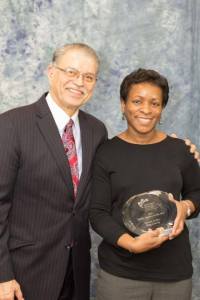
Fernando Martinez, Northwest Mountain MSDC President and CEO (left) poses with Sandy Hanks (right), recipient of the 2016 Public Agency of the Year Award for Martin Luther King County. (Credit: Ricardo Ibarra for NW MTN MSDC)
King County has been recognized by the Northwest Mountain Minority Supplier Development Council (NMMSDC) as the Public Agency of the Year. This award comes thanks to the efforts of Sandy Hanks and the Business Development and Contract Compliance (BDCC) team in FBOD.
NMMSDC covers a seven-state area, linking major corporations and public agencies to minority-owned businesses for the past 38 years. King County received the highest number of nominations ever for a public agency, and beat out contenders like the City of Seattle, City of Portland, and Multnomah County, Oregon.
Read more at the DES Express website.






 Employee News