
Featured Job: County Records Analyst

Closing Date/Time: Continuous
Salary: $27.90 – $35.50 Hourly
Job Type: Special Duty Assignment or Term Limited Temp (TLT)
Location: King County Records – Graybar Building, 410 Occidental Ave S, Seattle, 98104, Washington
Department: Department of Executive Services – Records & Licensing Services Division
Description: The Records and Licensing Services Division is seeking an enthusiastic records management professional to join our Records Management Program team. We are looking for a candidate who brings records management knowledge, skills, and experience along with passion, inspiration and a strong desire for excellence.
The ideal candidate will have a strong understanding of records management best practices and be able to share and explain those practices to agency staff in an engaging manner. To be successful, the candidate must be willing to talk to county employees about the jobs they do and the records they create and must be able to translate those conversations into easily understood records retention schedules and records management practices and processes. We are looking for a staff member who exhibits a strong sense of team-oriented camaraderie and good-humor in the workplace and who understands and wholly embraces the value and importance of providing world-class customer service. The King County Records Management Program is embarking on an exciting journey with a new content management system. The successful candidate will have a rare opportunity to participate in integrating this cutting edge electronic records management technology into King County’s evolving records management culture.
Learn more about this position, or view all available jobs.
Share this:

Tech Tip: Stay up-to-date with KCWeb

King County’s intranet, KCWeb, is your one-stop shop for employee news, information and the tools you use every day.
Make KCWeb your home page:
- In Internet Explorer, make sure you’ve closed all open tabs, then open Internet Explorer for the desktop.
- Tap or click Tools, and then tap or click Internet options.
- Under the General tab, enter the web address https://kcw.kingcounty.gov/, and then tap or click Apply.
- You’ll need to restart Internet Explorer to see your new home page. You can change your home page at any time, or set up multiple home pages that will open in separate tabs.
KCWeb includes an employee portal homepage – a central hub for the tools, news and resources – plus links to department, agency and division intranet sites.
Assistance: If you cannot access the new KCWeb, please contact the KCIT Service Center at 263-HELP or helpticket@kingcounty.gov. You can also get SharePoint login instructions here.
Share this:

Kudos! Resident praises employee for excellent customer service and community impact

The following is a letter from a King County resident giving Kudos to Rita Bellitto, Cable Administrator in the Office of Cable Communications, which helps cable TV subscribers who live in unincorporated King County.
Late last year I learned of the existence of and contacted the KC Office of Cable Communications. I spoke with Ms. Rita Bellitto, Cable Administrator. She was fantastic. She took the time to explain what would be involved to have cable services delivered to my neighborhood in Fall City, which is rural and has underground utilities. After almost a decade of my contacting the wrong people at Comcast, Ms. Bellitto introduced to the appropriate people at Comcast and she stayed in touch and was available whenever we requested her help. Once introduced, Comcast was spectacular.
By working with Comcast and my neighbors, who shared in the cost of installation, thousands of feet of buried and aerial cable have been placed. As of a week ago, eleven houses now have access to high speed internet where less than 1mbps was previously available. Another twenty neighbors are now working to build off the new infrastructure in place. Like many rural areas, my neighborhood has wide economic diversity, from horse estates to old mobile homes. Access to internet has increased our property values (about 7% according to a June 30, 2015 Wall Street Journal article), has increased the number of days several of us will work from home rather than individually commute to downtown Seattle, and has given my neighbors a cause to rally around.
All of this happened because there is a KC Office of Cable Communications and because Ms. Bellitto does her job so well. It is a pleasure to be a citizen of King County.
Kudos to Rita Bellitto and the entire Office of Cable Communications for modeling excellent public service and going above and beyond to meet customer needs!
Share this:

Employee Discounts: Seattle Sounders FC vs. Minnesota United

King County employees can get discounted tickets to the Seattle Sounders FC vs. Minnesota United at 7 p.m. on Sunday, August 20, at CenturyLink Field.
Tickets start at $25. Click here to buy tickets. All fans will receive their tickets via email 48 hours before the event.
Questions? Call Jordan Long at 206-965-8787 or email him at jordanl@soundersfc.com.
See all available discounts on the Employee Discount webpage.
Share this:
Cine en el Parque: Outreach opportunity

Employees are invited to participate in King County’s Cine en el Parque, Movie at the Park event on Saturday, Aug. 5 at Steve Cox Memorial Park in White Center, for the screening of Moana in Spanish with English subtitles.
Cine en el Parque is a terrific summertime outreach opportunity for County employees to reach the Latino community and connect residents with programs and agencies. DNRP would like to invite all departments to participate and promote their community programs and services.
Here’s what employees are signing up for:
- Arrive on site at 5:30 p.m.
- One or two volunteers (proficient in Spanish is preferred) to work the table from 6:30 p.m. – until the movie starts at dusk (at 8:30 p.m.).
- Provide interesting and engaging materials
- Bring a 10×10 tent, if preferred
- Employees are welcome to stay and watch the movie with family and friends!
- DNRP is asking King County programs, agencies and departments to help contribute to covering the cost of the event.
During the two hours befor
e the movie starts employees will have the opportunity to connect with movie goers about King County’s great programs and services.
To sign up or for more information, contact Marie Trigona.

Share this:

President of Chile takes picture with members of ARFF
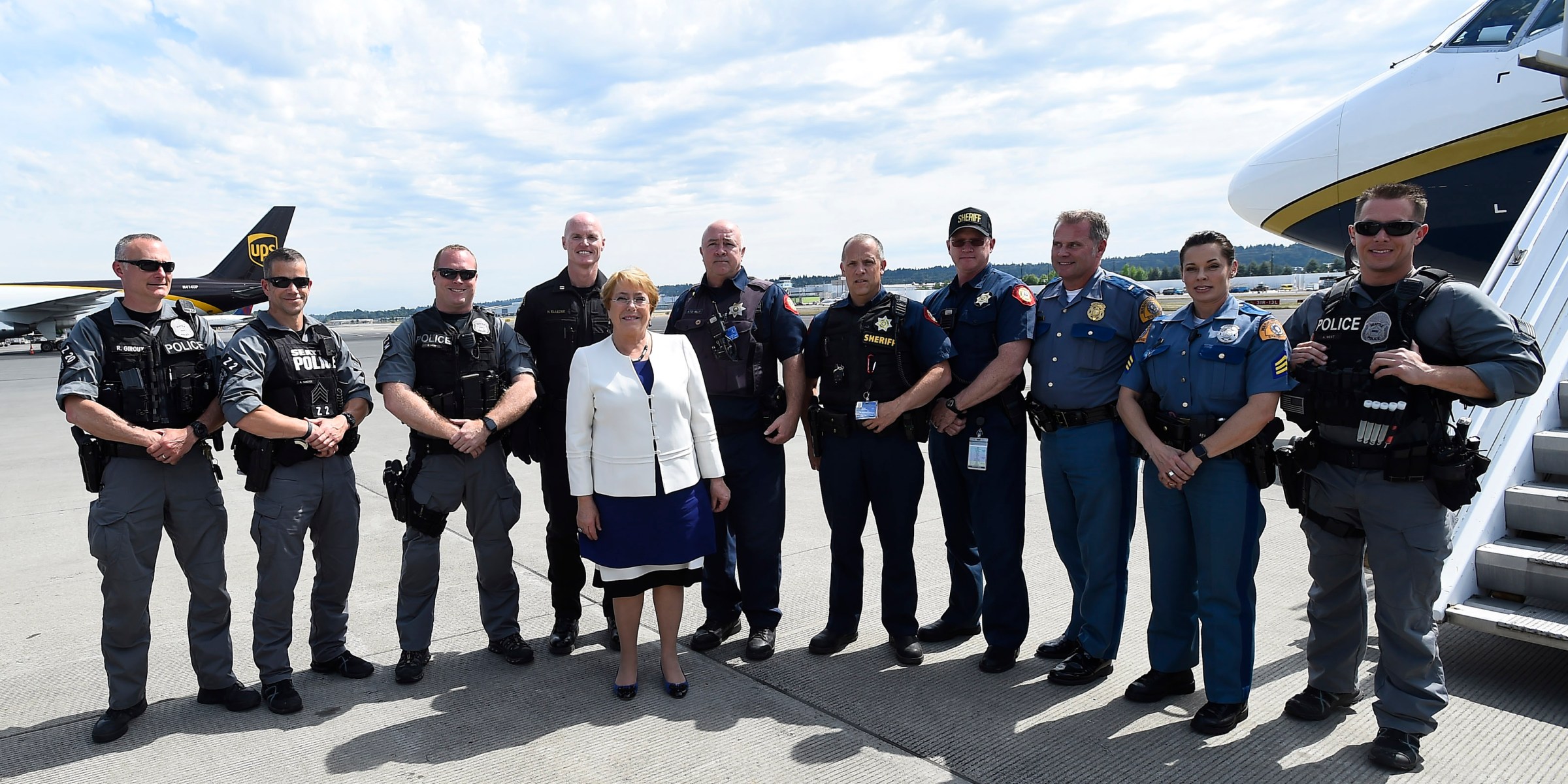
It’s not every day members of your team get to pose for a pic with a world leader, but this is King County International Airport/Boeing Field, after all.
President Michelle Bachelet of Chile was gracious enough to take time out of her busy travel schedule to visit with local law enforcement, including members of our Airport Rescue and Fire Fighting (ARFF) facility.
The backstory: Earlier this month, Pres. Bachelet touched down at Boeing Field as part of her visit to Washington state, which included meeting with local leaders King County Executive Dow Constantine and Governor Jay Inslee, among others, and a tour of Amazon’s facilities in Seattle. Before she departed the Evergreen State, the twice-elected Chilean president insisted she take a group picture with our folks.
Her office even posted the picture on the official Chilean presidential Flickr account.
In case you were wondering, the ARFF officers pictured are Chief Nathan Elledge, Deputy Kirk Wills, Deputy Bill Butterfield and Deputy Kirk Rains, along with members of the Seattle Police Department and Washington State Patrol.
Great work, everyone. And of course, gracias, La Presidenta!
Share this:

Watch your mailbox for Primary Election ballots
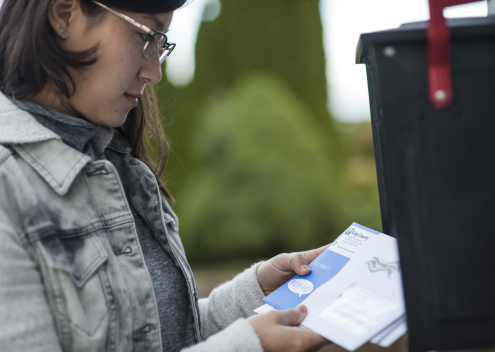
 King County Elections today mailed ballots to nearly 1.3 million registered voters. This Primary Election includes candidates for state and local offices as well as four ballot measures.
King County Elections has opened 10 new drop boxes in time for the Primary Election, for a total of 53 available drop boxes. The new ballot drop-off locations include Kenmore, Mercer Island, Tukwila, Newcastle and Rainier Beach in Seattle.
Make sure to read and follow directions on your ballot, sign the return envelope, and get it back before the August 1 election day deadline. Here’s how to return your ballot:
By mail: Put a first-class stamp on your ballot and mail it back to King County Elections. Your ballot must be postmarked by election day.
Ballot drop box: Return your ballot to any one of the 53 ballot drop-off locations; no stamp required. Your ballot must be returned to a ballot drop-off location by 8 p.m. on Election Day.
Accessible voting centers: King County accessible voting centers (AVCs) are open to voters who may have difficulty completing their mail ballot. Anyone who would like to vote at an AVC may do so.
Please encourage your friends, family and neighbors to let their voice be heard and vote.
Questions? Call King County Elections at 206-296-VOTE (8683). You can also follow Elections on Twitter, Facebook, Instagram and their blog to get the latest election updates and results.
Happy Voting!
Share this:

Health Hero: Chris and his CSA habit

Crossposted from Healthy Incentives
 Each Thursday this summer, King County Metro operator Chris Cappelletti packs up a fresh box of produce at Atlantic/Central base and buses or bikes it home. The local veggies come from farmers with Pike Place Market Farm to Go CSA (Community Supported Agriculture), a partner in King County’s CSA @Work program. We asked Chris to talk about why he is a CSA subscriber and the other healthy habits that make him tick.
How long have you been working for the county? In your current job?
I was hired as a part-time driver in May of 2015 and currently drive the 303 in the morning. I am also a woodworker at a shop in SODO, so I have remained part-time to leave time in my schedule for that work.
Read more at Healthy Incentives
Share this:

KCVP staff receives shout-out at Seattle Mariners game

Shared from the DCHS Touching Base Newsletter
Throughout the season, the Seattle Mariners recognize some of the brave men and women of the United States Military (active, reserve, veteran or retired) at each Friday and Sunday home game as part of their Salute to Those Who Serve program. On June 11 Michelle Bregel from our King County Veterans Program – Seattle office was recognized by the Seattle Mariners for her military service and continued service to the veterans of King County.
Michelle served on active duty in the U.S. Air Force, Security Police, from 1991-1997. She also served in the U.S. Air Force Reserves, Security Forces, from 2011-2017. Michelle has been an active member of the veteran/military community for over 25 years, having volunteered with many different organizations including Wounded Warrior Project, Team Red, White and Blue, Boys and Girls Club of America, Special Olympics, Red Ribbon Week, National Night Out, and the European Forces Swim League. She also served as a trained/certified Victim Advocate with the Air Force Sexual Assault Rape and Prevention program. She has four children and her oldest daughter is carrying on the family tradition of military service by serving in the U.S. Coast Guard.
To learn more about what DCHS is doing in our community, read the most recent issue of the Touching Base Newsletter (on SharePoint).

Share this:

Building awareness about poison hemlock dangers

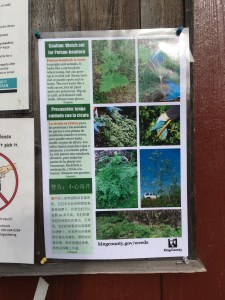 When King County’s Noxious Weed Control Team discovered the toxic noxious weed poison hemlock growing near multiple community gardens in the county, they knew a multilingual communication campaign was the only way to alert the diverse communities of gardeners who speak a wide array of languages
“All told, we installed more than one hundred posters in nine languages and 19 unique language combinations at 76 community gardens, farms, and other public spaces in King County,” Nate Dolton-Thornton, Assistant Education Specialist and Multilingual Outreach Lead with the Department of Natural Resources and Parks, said.
Young poison hemlock plants have carrot-like leaves and can only be distinguished from carrots by the reddish-purplish splotches on the stems. Even the root looks like a white carrot, but ingesting any part of the plant can lead to hospitalization and death.
Nate and his team did a tremendous job with the outreach to the multilingual communities throughout King County.
“First, we emailed the Seattle P-Patch listserv (email list) to get a sense of the languages spoken at each P-Patch from the on-the-ground perspectives of community members,” Nate said. “We also wanted to receive each community’s permission before installing any signs in them. Second, we used a list compiled by P-Patch staff of the number of individuals by language spoken at each P-Patch. Last, we communicated directly with the Community Garden Coordinators for each P-Patch we visited.”
While much of the communication efforts have been rolled out through signage, Nate said that continuous conversations are taking place with numerous community members and garden coordinators in English, Spanish and Chinese.
The efforts are paying off. In mid-May, Nate hosted a booth at the Danny Woo Community Garden for a Seattle Tilth compost giveaway and spoke with a number of organizers about poison hemlock and the County’s warning signs.
 “Afterward I ended up installing two signs at the Danny Woo Community Garden and mailing signs to the Mill Creek Community Garden in Snohomish and Freeway Estates Community Orchard in North Seattle,” Nate said. “Two weeks ago, one of the Freeway Estates Community Orchard members sent me an email. She’d found a poison-hemlock patch near the walk-in entrance to Meridian Playground. Working with one of our regional specialists, we coordinated for a senior gardener with Seattle City Parks to remove the infestation. These cascading effects help to show us how our project continues to protect people from this toxic plant.”
The team also manages a blog about noxious weeds in and around King County, on which they have written two blog posts about the dangers of poison-hemlock and the alert posters. Both posts are also available in Spanish.






 Employee News