
Students test the science and engineering behind water systems
Crossposted from Clean Water Stories
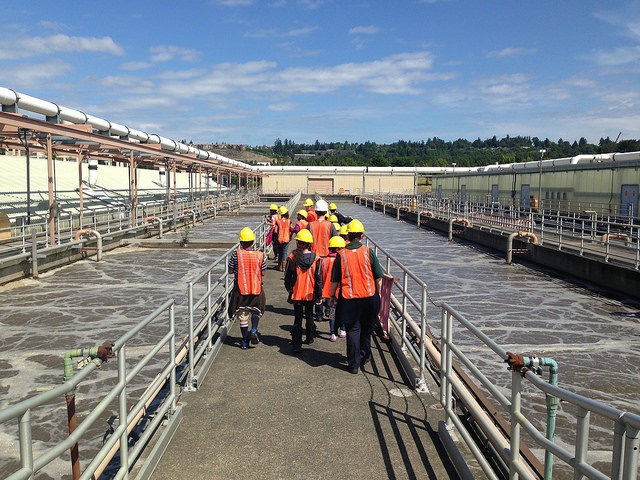
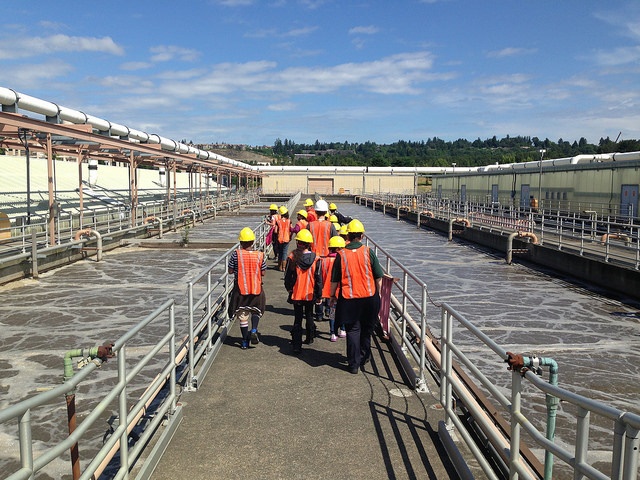 It’s that time of year, when King County Wastewater Treatment Division spends a lot of time with students. During spring semester, our educators and students in our service area work together in elementary school programs about water systems.
We know that 4th and 5th grade students are good candidates for this education. They are learning about science. They are curious. They haven’t quite outgrown the bathroom humor phase. They are the right age to help teach their parents good water/wastewater etiquette. We’re pretty sure that after a class or a tour, these young wastewater stewards point out things their parents shouldn’t put down household drains, like disposable wipes and grease. These kids are into it and they get it.
WTD’s education and tour programs aren’t just about schooling young people on good disposal practices. We are inspiring students to learn about water systems their generation will someday have to take over. We reveal the science and engineering behind these systems to engage the next generation of public health protectors and infrastructure innovators.
Read more at Clean Water Stories
Share this:

Kudos! ORCA LIFT celebrates two-year anniversary, receives praise from community

 ORCA LIFT celebrated its two-year anniversary in March of this year and with this milestone began the renewal process of expiring cards. Customers were directed to the ORCALIFT.com website for directions on the renewal process. We have received many positive comments from the customers using the online form, such as this one:
“I am writing to thank King County Metro for quickly processing my renewal of my ORCA Lift card. I applied to renew my card on Wednesday, and I got my new card by Saturday! It came on the same day I accidentally broke my current card (while using Metro to move to my new place). It’s the weekend, and I’m using the bus to move, and it’s finally not raining, but now my ORCA Lift card was toast… When I checked the mail at my new place, I found my replacement ORCA Lift card! I’m so grateful for the super-fast service just when I needed it! Thank you King County Metro and ORCA teams! You’ve literally kept me ‘moving’.”
Share this:

Auburn Symphony Orchestra discount for April 30

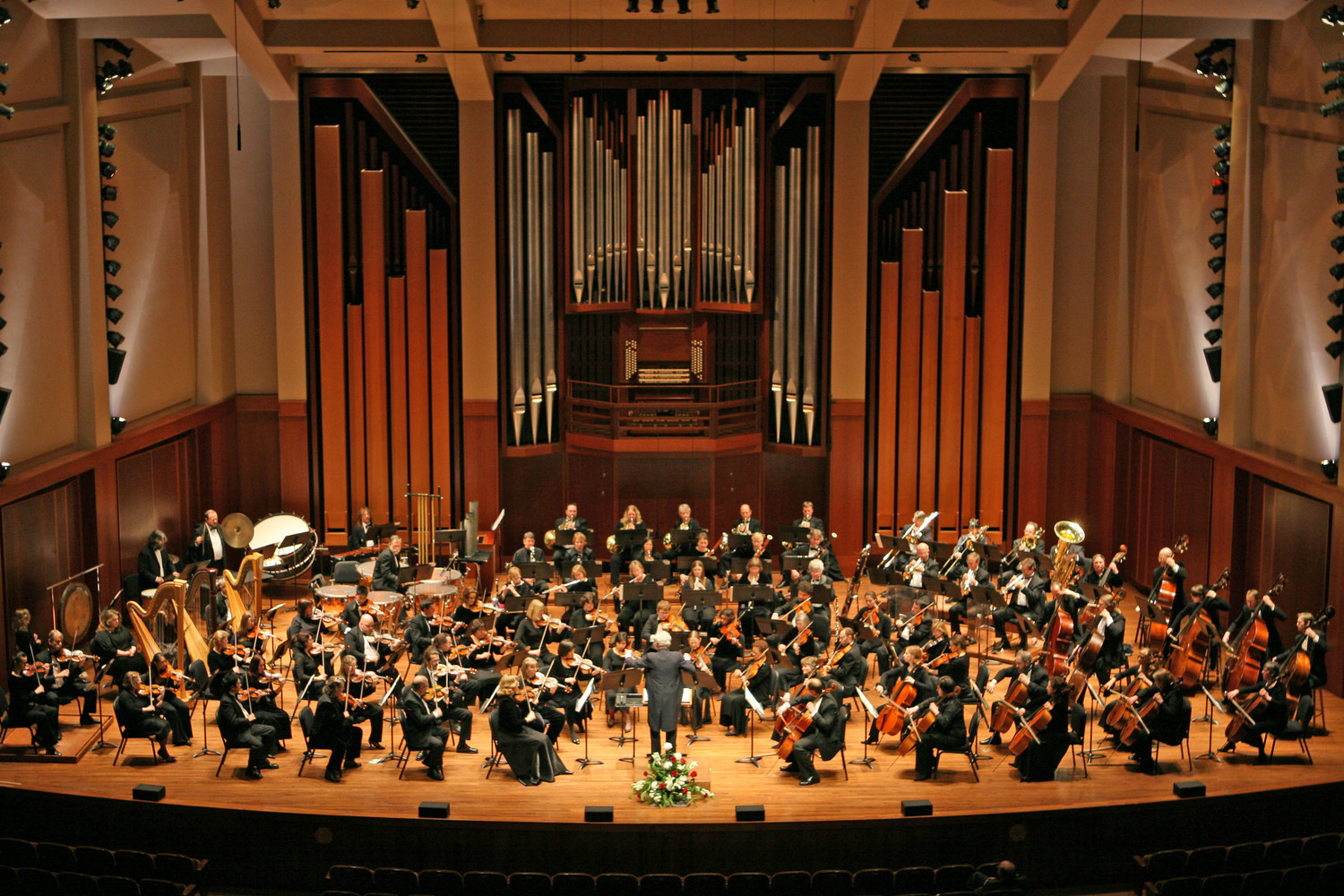
Auburn Symphony Orchestra at Benaroya Hall
King County employees are welcome to take advantage of an available discount for the Auburn Symphony Orchestra performance of “Love, Passion and Defiance” on Sunday, April 30 at 2:30 p.m. The event features Nikolas Caoile, as guest conductor and Daniel Lebhardt, as piano soloist.
Held at the Auburn Performing Arts Center (702 Fourth Street NE, Auburn, WA 98002), employees will receive a discount of $30 for general tickets, $24 for senior tickets and $10 for student tickets.
To receive the discount, employees can purchase tickets online using promo code kingcounty17 at www.auburnsymphony.org, or visit the box office in person and show King County ID.
See all available discounts on the Employee Discount Webpage.
Share this:

Employee Giving Campaign: Invite your favorite nonprofit by April 27
Employee referred nonprofits are our favorite! It is our goal, after all, to connect employees to the causes they are passionate about through the Annual Giving Drive.
All nonprofits must apply and meet eligibility requirements annually in order for them to be in the upcoming Annual Giving Drive.
Invite your favorite nonprofit here. Applications are due by Thursday, April 27, 2017.
Share this:

Executive unveils stronger community-centered response for youth and families in crisis

Crossposted from King County Youth Justice
 King County Executive Dow Constantine announced new options for parents, youth, school personnel and local law enforcement that will divert and reduce the number of youth who come into contact with the courts and detention facilities. The “Safe Spaces” proposal connects youth who may have traditionally gone into the criminal justice system to community-based alternatives that provide supports and crisis stabilization that were previously unavailable.
Youth and families can access counseling, healthcare, treatment for mental health or substance abuse, short-term crisis beds, education and mentoring and employment programs.
The Juvenile Justice Equity Steering Committee will lead a public engagement effort on the Executive’s proposal, to be concluded by May 31.
“Our goal is to ensure that every youth in King County is supported to achieve his or her full potential. With Safe Spaces, we will help even more of our young people through the rough patches in life, avoid the criminal justice system, and go on to happy and successful lives,” said Executive Constantine. “We can offer tools for youth and families that stabilize an immediate crisis and offer short and long-term services and supports. By investing early, we can move even farther towards our goal of zero detention.”
Read more at King County Youth Justice
Share this:

Long-time employee retiring, reflects on his time with King County

This article is featured courtesy of Jamie Holter, Communications Manager, Department of Information Technology
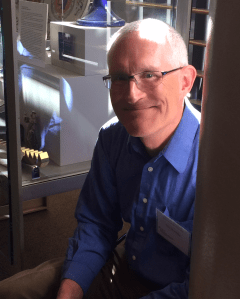
Gary Hocking
Gary Hocking, a KCIT Service Delivery Manager, is retiring after 39 years with the County. He shares his journey through the IT sector, how he came to work with King County, as well as several of his proudest accomplishments and his advice for the next person to fill his shoes.
What’s changed in 39 years? That is a question that is really pretty easy to answer: Just about everything, except the people. The folks that I’ve been privileged to work with in my career have all taken pride in the work they do and the resulting benefits to our community. Everything else in King County has changed though.
Looking back
In 1978, I started working at the Kingdome. John Spellman was County Executive. There were no computers and no networks. The only enterprise system in the County was the mainframe. The scoreboard system in the stadium was the closest thing there was to a computer in that facility. It filled a room and took 3 people to operate. All work was done on paper. Copies were made using carbon paper or pre-printed multi-part forms.
Then things began to change in the early 1980’s. First, a company called BASS (the precursor to Ticketmaster) came to town with a computer system that printed tickets as they were purchased. The Kingdome was such a huge venue for events, that BASS set up their office across the street and we installed their terminals at all of our ticketing windows. Concurrently, the first PC’s were developed, and the stadium acquired one (a Tandy TRS-80) for me to use in accounting for ticket sales associated with the 1984 NCAA Final Four hosted at the Kingdome. That proved successful, and the TRS-80 was replaced with a Compaq PC, a database application called D: base, WordPerfect, and Lotus 1-2-3. We used these tools to account for ticket assignments for the next NCAA Final Four the Kingdome hosted in 1989. This was also about when other staff at the Kingdome concluded that the use of computers would make their jobs easier.
Pretty soon, everyone had a computer and printer, but we were still printing everything we needed to share with each other. Then we heard about a small group in the King County courthouse who had installed a network to connect their computers and used a server as a place where everyone could store and share files. Since I’d worked with computers the most, the Kingdome management asked me to figure out how to do the same thing at the stadium. The County IT department was still only running the mainframe, so we were on our own.
This started a huge learning experience for me, and eventually a career course change. Collaborating with the IT folks in the County courthouse, attending courses on my own time, and reading, I learned about networking, the Novell Netware server operating system, and Microsoft MS-DOS for our PC’s. Being the only “IT” person at the stadium, I got to do everything – lay cable for the networks, setup the servers, setup the office PC’s, etc. I even got to install and manage one of the early email systems, but all of this was just running within the Kingdome, and I was still splitting my time between doing event management and IT work.
A new chapter
Then the person who was my manager at the Kingdome became the deputy director of the County’s Department of Public Works. In 1993, she called and asked if I would be interested in doing just IT work for her new department. That was an easy answer – yes. But I was walking in to a department many times the size of the Kingdome with offices in many different places. They had lots of PC’s but no networks and no servers, and I was the only IT person. Working with some new County contractors, we managed the installation of networks at all of the worksites, so then we had a bunch of network silos.
At about this time, the County merged with Metro. Metro had some IT folks who had setup a network connecting their sites. In 1996, a team made up of IT folks from the across the County and the former Metro group collaborated to setup the first County enterprise-wide area network. I was fortunate to be able to work on this team, which was another massive learning experience for me.
Over time, the department of Public Works grew out its own IT staff. Since I was the first hire, I was the supervisor/manager. The County reorganized, changing the makeup of Public Works and renaming it The Department of Natural Resources and Parks.
In 2001, Executive Ron Sims asked Wayne Watanabe (my peer in DOT at the time) and me to lead a reorganization of the County GIS program. This resulted in the formation of the King County GIS Center. The Executive decided to house the new GIS Center in DNRP, so they became part of the IT team I was managing.
Shortly after the King County GIS Center was in place, we started our slow progress on reorganizing all of IT in to one County department. It took until 2011, but here we are now.
Proudest accomplishments
None of these I can say I was solely responsible for, but to me, they are:
- While it’s not work related at all, my two sons have grown up to be fantastic young men.
- Managing ticketing for huge events at the Kingdome like the NCAA final four in ’84, ’89, big concerts, etc.
- Working on the team that implemented the first King County enterprise-wide network.
- Helping create the King County GIS Center – a hugely gifted group of folks, and an asset for the whole County.
- Being part of the formation of KCIT – we still have a long way to go to reach excellence in all of our service areas, but as long as we follow our own words on how to achieve excellence, we will.
For the next person to step into my role, I have one rule of advice: The world around us is always changing. To be successful, you have to embrace change and help shape it.
Share this:

Featured Job: Residential Appraiser I

Closing Date/Time: Mon. 05/08/17 4:00 PM Pacific Time
Salary: $28.40 – $36.00 Hourly, $2,153.69 – $2,729.93 Semi-Monthly
Job Type: Career Service, Full Time, 35 hrs/week
Location: Assessments – 900 Oakesdale Ave SW, Renton, Washington
Department: Department of Assessments
Description: The Department of Assessments is looking for an action oriented, creative thinker for the role of Residential Appraiser. The position will allow for the individual to expand interest in real estate, work within a culturally and generationally diverse environment, collaboratively set fair and equitable residential property values and use communication skills with the public to convey property assessment policies and procedures
Learn more about this position or view all available jobs.
Share this:
May Day events Monday, May 1
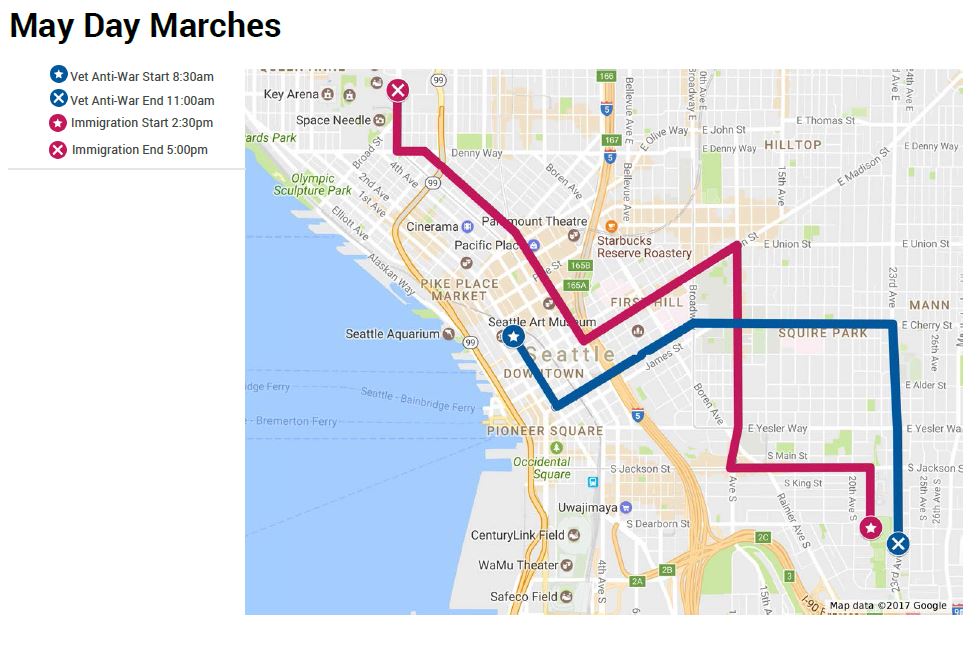
Several community groups are planning rallies, marches, and other events to mark May Day this Monday, May 1. These events include (see map below):
- May Day March – Some King County employees will participate in this year’s May Day March which focuses on labor and immigrant rights and begins at Judkins Park, starting at 11:30 a.m. holding the banner pictured. The march to downtown Seattle starts at 1 p.m.
- Veteran Anti-War march – Starting at 9 a.m. at the Garden of Remembranceat 2nd & University in Seattle, with a march to Judkins Park at 9:30 a.m.
- Rally and march on Amazon.com – 11 a.m. rally at Westlake Park, followed by a noon march on Amazon headquarters in South Lake Union.
- Anti-capitalism march – Commencing late afternoon or early evening, starting location and route to be determined.
Share this:

Cross-department collaboration tells the true story of the SoundGuardian
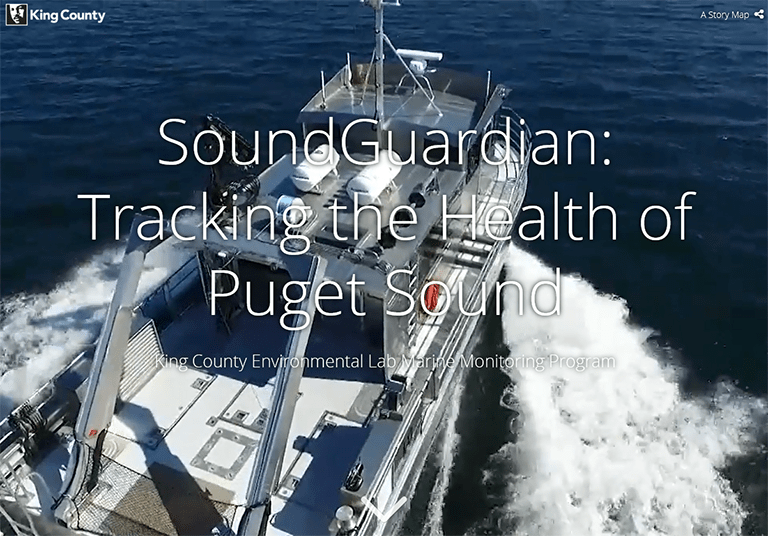
 King County Department of Natural Resources and Parks (DNRP) is a treasure trove of untold stories. Employees across four divisions work hard every day carrying out a broad mission to foster environmental stewardship and strengthen communities. It is hard to stop progress to recount our adventures and triumphs.
But when it was time to chronicle a legendary journey, employees across DNRP pitched in to help.
The County’s Environmental Lab has monitored streams, rivers, and Puget Sound for over 40 years. Field scientists sample, survey, carry out special projects, and respond to environmental emergencies. Routine water quality monitoring tracks the health of Puget Sound and inform decision makers.
 In 2015, King County commissioned a new research vessel to carry on this crucial mission. The previous vessel was a converted fishing boat that could no longer do the job after 40 years. With the new vessel, field scientists do more work in a day, run in bigger seas, and collect even more data than before. The Lab is now equipped to continue their critical work year round for decades to come.
We knew that this story needed telling, and we had a new communications tool to do it justice: GIS-based Story Maps. Story Maps combine location, text, and visual media in a three-dimensional narrative.
The Wastewater Treatment Division (WTD) stepped up to lead the storytelling effort, with the Lab, Water and Land Resources (WLR) and DNRP. Peter Keum of WTD’s GIS group navigated the Story Map platform. Peter helped communicators shape the story to the format. Peter’s entire group- and his wife, an artist- pitched in to review along the way.
The Lab’s Field Science Unit (FSU) gave us context and content. They let us ride along on marine runs, viewing and documenting their work. On the water, Kimberle Stark, WLR marine biologist, filled us in on monitoring and special projects. Tim O’Leary, DNRP videographer, documented the run and interviewed scientists. Matt Manguso, on a special assignment from Solid Waste Division, shot photos and developed text for a Web landing page.
 FSU Supervisor Ben Budka provided input, and insight throughout. He sent presentations, photos and underwater video. He politely corrected our creative nautical terms.
Back at the office, Paul Israel, on assignment from Parks, edited photos and videos. Saffa Bardaro, WLR Communications Manager, and Logan Harris, DNRP Public Affairs, added polish to the Story Map.
Everyone scrambled to launch it during Earth Week. Fred Bentler, DNRP’s Web lead, made sure it happened with a landing page in place when we were ready to hit “publish.”
We learned the pluses and minuses of the Story Map platform. We know a lot more about the Environmental Lab’s work. We know this Story Map only scratches the surface of their mission. Our most valuable lesson is about DNRP employees: when it is time to feature one of our great stories, they’re all in.
Share this:

Kudos to employees who care about our residents and our environment!
This piece was featured in the Seattle Times’ Rant and Raves list. Kudos to a DNRP employee for saving a bird’s day!
“RAVE To the woman working for King County who took my Saturday call about a coot (bird) trapped in a storm drain in Covington. She reached someone in Covington public works, who called me and said they were closed, but they were there first thing on Monday freeing the trapped animal. Public-sector heroes!






 Employee News