
Stop by soon! Flu clinic locations and schedules

Clinics are open to all King County employees and flu shots are provided at no cost to benefits-covered employees. Employees with no health benefits may self-pay for the vaccine at the clinic (flu shots are $30 each).
Flu shots are on a first-come, first-served basis. Check out the calendar below and mark your calendars for the location most convenient for you.
If you’re unable to take advantage of a worksite flu clinic, King County employees can get flu shots at clinics offered by the City of Seattle. Flu shots are also available through your primary care physician and many local pharmacies.
Flu-site coordinators will provide more information before your worksite’s scheduled date.
- Remember to come prepared to the worksite clinics:
- Bring your medical insurance card with you.
- Wear short sleeves, sleeveless shirt or clothing that bears your shoulder easily. This makes for speedy service and short lines!
- If you need a receipt, please tell the clerk when you check in.
For more information regarding influenza, visit the Centers for Disease Control and Prevention’s (CDC) Influenza resource page.
Read more at Healthy Incentives.
Share this:

Reminder: Mentors needed! Employees encouraged to apply

Do you have a specific job or technical skill you’d like to share? Are you passionate about King County and its success? Are you an experienced leader that understands the thrill of engaging and empowering others? If you answer “yes” to any of these questions, we need you.
The request for mentors has been very high, and we need a large pool of mentors to meet those requests. You don’t need to be a manager to be a mentor, just knowledge and expertise in a particular skill and an interest in sharing.
Help us create a vibrant, effective learning culture here at King County. Consider contributing your time and skills as a mentor. One hour. Once a month. That’s all it takes to impact someone else’s life.
Intrigued? Contact KCMentoring@KingCounty.gov today. The King County Mentoring Program is part of our Investing in You strategy. Find out more about the Mentoring Program here.
Share this:

Poofighters rock on and take the stage at world’s biggest, most extreme, wastewater Ops Challenge at WEFTEC in Chicago

Crossposted from Clean Water Stories
When asked why he became a wastewater operator, Darek Kenaston reveals, “The more I got into it, the more I was interested. It was a good fit. I’ve always been around the water. I grew up in Florida, two blocks from the beach. I love the water, and why not be part of protecting it?”
These days, people want good pay, meaningful work, and opportunities to grow their career. That makes a stable career helping clean water – plus an opportunity to be part of a team that builds comradery and skills – a winning combination.
Four employees from the King County Wastewater Treatment Division (WTD) make up the Poofighters – our team in the worlds’ biggest wastewater extreme challenge. For the past number of weeks, they’ve been gearing up to go “on tour” to Chicago, Ill., for the international Operations Challenge at the Water Environment Federation (WEF)’s WEFTECconference. There, they compete against other utility teams and prove their skills in five different, intense events.
In the spotlight, the clock is ticking and judges scrutinize their every move. The competition is mentally and physically challenging – with real-life-simulated scenarios – including cutting a pipe as fast as they can and rescuing a coworker (really a safety dummy) from a manhole.
Read more at Clean Water Stories

Pictured: Back in Black: True to their rock n’ roll theme, each year the Poofighters put out a new “album” and give away free copies at WEFTEC. While they look like CDs, the DVDs are filled with all the info someone needs to apply for a job at King County.
Share this:

New cat café opening soon to feature felines from RASKC

 Regional Animal Services of King County (RASKC) will be providing adoptable cats for Neko, a new cat café in Capitol Hill, opening in October. RASKC already works with Seattle’s first cat cafe, Seattle Meowtropolitan, to provide adoptable cats for customers to interact with.
“Working with Meowtropolitan has been a really cool experience,” said Nickie Ford, RASKC animal services coordinator. “We got started with them about a year and a half ago, I believe, and we found the cats, they really just thrive in that colony environment.”
Slated to open in mid-October, customers at Neko can expect to find 12-15 cats looking for forever homes in the “Catarium” area. The cats available for adoption at Neko will be cats with feline leukemia (FeLV) that are harder to adopt out due to their weakened immune systems. The disease is not transferable to humans.
“What we really want people to know is that these cats can still be very fantastic pets, and they can still lead very happy lives,” Ford said.
Read more in this article at The Capitol Hill Times.
Share this:

Taking action to protect your information

 Recently there was a large security breach with Equifax customers. Security breaches like this can be scary. You can help protect yourself from identity theft. Our Making Life Easier program has some tips to guide you. Go to http://www.kcmakinglifeeasier.com/login and enter user name King County. Once you enter the website, you can see the tips by clicking the link on the rotating photo menu.
For more individualized guidance, you can sign up to speak with a Money Coach at My Secure Advantage. My Secure Advantage is a financial wellbeing program that provides phone-based coaching and online tools to help you manage finances and meet your goals. King County provides 90 days of free money coaching on identity protection and any other topic. Call 888-874-7290 to enroll.
Share this:

Changes ahead for Metro and DOT

Crossposted from Inside Transportation
by Harold S. Taniguchi
Director, King County Dept. of Transportation
 Executive Constantine announced this week that he is working with the County Council to make a big change: In early 2019, Metro Transit will become a stand-alone County department, no longer part of the Department of Transportation.
This change makes sense. Public transportation is a top priority for the Executive and our region. Population and job growth mean that Metro must provide more and better travel options for all who live and work here—and Metro has a long-range plan for doing just that.
By becoming a department, Metro will be in a better position to partner with other agencies, to deliver the large increases in service and the investments in facilities and vehicles that will be needed, and to grow and support its top-notch workforce. Building upon the strength of General Manager Rob Gannon’s leadership, and the momentum of the division, now is simply a good time for this reorganization.
Read more at Inside Transportation
Share this:

New commuting options for employees: Sounder, Uber, Park-and-ride
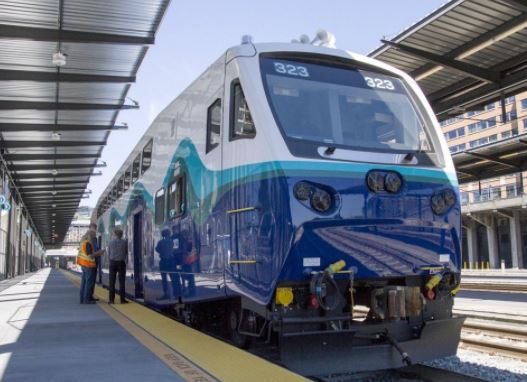
 Two new roundtrips have been added for the Sounder between Seattle-Lakewood, bringing the total number of roundtrips in South King and Pierce Counties up to 13 per weekday. During peak hours, Sounder trains will arrive as often as every 20 minutes. View the full Sounder Lakewood-Seattle schedule here.
A new transit discount program offered by Uber aimed at people living in Rainier Valley and South King County will allow for employees to get a $3.50 discount on all UberX and UberPOOL trips to and from qualifying light rail stations. To see participating light rail stations and full instructions to set up the discount in the Uber app, please click here.
A new temporary park-and-ride lot has been opened in south Bellevue. The new lot located at 1624 Bellevue Way SE, provides parking for up to fifty vehicles and includes four signed 15-minue parking spaces designated for pickup and drop-off. The lot is served by routes 249, 550, and 555/556.
As a reminder, Metro’s fall service revisions began September 23. As always, ID/ORCA cards are good for full fare on Sounder trains and Metro buses. For more information about employee transit options visit www.kingcounty.gov/ETP.
Share this:

Join us for our county-wide potluck, tomorrow September 28

Please join us on the Admin Plaza from 11:45 a.m. to 1:15 p.m. for our End-of-Summer countywide potluck on Thursday, September 28.
Can you help bring a favorite dish? Contact Nancy Kodani-Lee at 7-8012 or Julie Long at 7-0204 to let us know what you’ll bring. Beverages are not provided, please bring your own. There will also be a Table Tennis Tournament during the Potluck. Sign up with Jane Wu at 3-8523.
Share this:

2017 Employee Survey is underway

The 2017 Employee Survey is now underway. Have your say and help us make King County work better for you and our customers.
- Online survey: September 18 – October 6
- Paper survey: September 11 – October 6
You know your work better than anyone so let us know what’s on your mind! Speak Up. Be Heard. Make a Difference.
Each employee participating in the survey will receive an email from ORC International. The email address will be 2017KCEmployeeSurvey@orcsurvey.com. The subject of the email will be “King County Employee Survey – 2017”. Please check your junk email folder and if you have not received it yet, please contact KCEmployeeSurvey@kingcounty.gov.
If you have questions about the Employee Survey, please review our Frequently Asked Questions or contact your department survey representative. The annual Employee Survey is part of our Investing in You efforts. See all the employee survey responses here (intranet).
Employees in all branches and departments of King County, except the Superior Court, District Court and the Sheriff’s Office, and employees who are not Short Term Temps, interns or started after August 25, 2017, are participating in the survey.
Share this:

Social Media Spotlight: King County on Twitter

 The King County Twitter account @kcnews has officially become @KingCountyWA.
This change helps make it more clear that tweets are official information from King County government, and reduce confusion with other, similarly-named jurisdictions.
Follow @KingCountyWA on Instagram for information and news about services you can use, and tell us how we can serve you better. You should not need to re-follow @KingCountyWA if you already follow @kcnews.
Click here to view all King County social media pages.






 Employee News