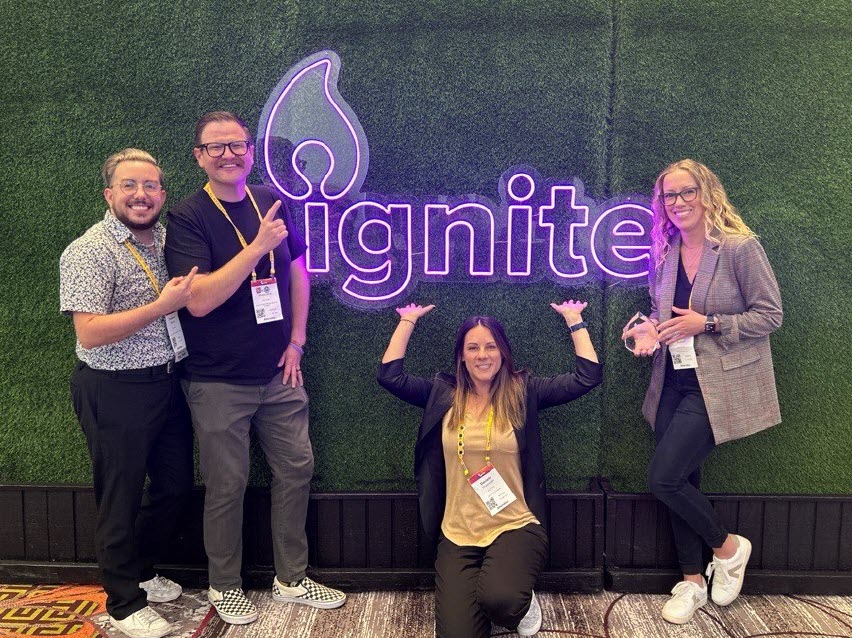
Pictured: From left to right, King County employees Cam Breither, Nico Megevand, Danielle Thueringer, and Sarah Buelow, holding her Trailblazer Award, pose together at the 2024 Ignite! Conference.
Every year, NEOGOV, an online human resources management platform, acknowledges employees or organizations who have used it to further creative change within their company. In 2024, Sarah Buelow, NEOGOV Supervisor within the Department of Human Resources (DHR), received the Trailblazer Award at the 2024 Ignite! Conference, for going above and beyond in embodying a drive for innovation, passion, and dedication.
Sarah has ensured that King County has been a sought-out beta tester and early adopter for a variety of enhancements to all of the modules in the platform. This has allowed King County to not only figure out the best ways to integrate new features proactively, but has also enabled the County to provide feedback during the development process so that new features work well for employees. More specifically, Sarah received the award for Innovative Spirit (early adoption and commitment to providing vital input for product enhancements), Product Proficiency (the ability to maximize the potential of product features), and Dedication (a commitment to product improvements and active participation as testers for new features).
Sarah’s professional background includes several years in Human Resources from both the private and public sectors, including a role as the NEOGOV System Administrator for another county agency in Washington. She is excited to see the growth and collaboration of different teams to make NEOGOV an essential part of the King County employee experience.
“As NEOGOV evolves within King County, we’ve leveraged an exceptional opportunity to form a strategic partnership with the Career and Culture Learning and Development team,” she said. “Our systems team is dedicated to enhancing the user experience, while the Learning and Development team focuses on best practices for learners and content creators within the system.”
Sarah began with King County in May 2023. Her position was the first career service role dedicated to supporting the NEOGOV platform. She started as the Application Lead before moving into a Special duty Assignment as the NEOGOV Supervisor with two Temporary Limited Term (TLT) direct reports supporting the scale and growth of the Learn and Perform modules. Her team supports the business and employee needs of the NEOGOV system, and Sarah also serves on all the NEOGOV vendors Customer Advisory Boards. Her team plans to expand their work to include an online learning platform that will provide a wide range of education and support services.
“Our dedicated and capable team is working diligently not only to resolve user issues, but also to develop a comprehensive training and support hub,” she shared. “This hub aims to ensure that all employees have equitable access to and engagement with a Learning Management System (LMS).”
In addition to these services, NEOGOV interacts with multiple human resources systems. This includes PeopleSoft, Laserfiche, and Origami, as well as departmental systems within DHR, KCIT, and the Business Resource Center. Sarah explains that while her team’s primary focus is the NEOGOV system, they continuously assess how all the systems interact to ensure technology effectively supports and engages the King County workforce.
“For example, on your first day as a new hire, you needed to log into NEOGOV using your applicant credentials to access onboarding and training tasks,” Sarah explains. “This is because our system updates your NEOGOV profile to reflect your employee credentials overnight, once your start date has been verified.”
“This process is also linked to your ability to access NEOGOV through single sign-on (SSO) on your second day moving forward and is the preferred NEOGOV login method.”
While Sarah is thankful to be recognized for her dedication, she understands that this work is ongoing. It requires gaining valuable user insights, developing successful practices, and providing consistent service.
“We partner with our e-Learning Advisory Board members from each department as well as the Community of Practice for learning and development practitioners across the county,” she said. “As advanced users in the Learn module, these folks share ideas and provide system feedback.”
Sarah reminds employees her team is committed to providing support and assistance to King County employees experiencing system issues with NEOGOV products. She emphasizes that for assistance with any of these products, employees should submit a ticket through the Cherwell Helpdesk by selecting Software & Web Support > DHR > NEOGOV.
“Submitting a Cherwell ticket ensures timely resolution of your issue and aids our efforts to secure additional FTE resources for our community,” she adds. “Another tip, if you need to access using the SSO link from the NEOGOV login page and are asked for the Employer Code, it’s ‘kingcounty’.“
Sarah’s colleagues are incredibly proud of all the amazing work she does as the Administrator for the NEOGOV platform and are happy that NEOGOV recognized her at the 2024 Ignite! Conference. Congratulations on this exciting achievement Sarah!






















 Employee News