
Goat Hill gears up for spring gardening

Every morning on his way to work, Dan Malone stops by King County’s Goat Hill Garden for a few minutes to rip up some weeds and make sure plants are growing as they should. Malone and fellow Goat Hill Garden Coordinator Heather Whitten, along with other King County employee-volunteers, tend and manage garden maintenance and growth on their lunch breaks and before and after work at the garden located across from the Chinook Building in downtown Seattle. Malone, a new Goat Hill Garden Coordinator, and Whitten, a veteran coordinator, have a few… Read More
Employee finds new ways to deliver energy and cost savings

Ben Rupert has been the Energy Manager in King County’s Facilities Management Division (FMD) for a little over a year but has already made significant contributions to the County’s reduction targets for energy use and operating costs in its facilities. King County is on track to meet its 2015 goal of reducing energy use in its facilities by 15 percent over the baseline 2007 usage. For more than two years, the County has been meeting its goal of generating the equivalent of 50 percent of county government energy needs through renewable resources. At… Read More
New approach to youth who commit violence in the home

The King County Prosecuting Attorney’s Office (PAO), in partnership with King County Superior Court and the King County Department of Adult and Juvenile Detention, plans to launch FIRS (Family Intervention and Restorative Services), a new juvenile diversion program geared to provide services to families who are struggling with domestic violence (DV). Unlike adult court, juvenile DV rarely involves intimate partner violence. Instead, the vast majority of cases in juvenile court involve youth acting out against their parents or siblings at a misdemeanor level. Many of these youth struggle with substance abuse and… Read More
Who is your favorite nonprofit?

If your favorite nonprofit wasn’t in last year’s Annual Giving Drive, now is the time to make sure they get in for this year. All nonprofits that turn in a complete, on-time application by April 30, 2015, and meet all of the eligibility requirements, can participate in the upcoming 2015 Annual Giving Drive and be eligible to receive payroll and time donations. “By being in the program nonprofits gain exposure and access to 13,000+ King County employees, payroll donations, which statistically are three to six times larger than one-time check gifts because… Read More
Public safety employees reach out to the community to build trust
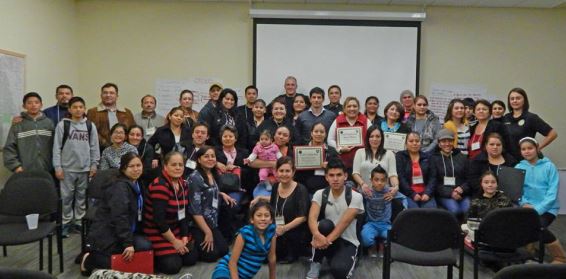
To build trust between law enforcement and Hispanic community in Shoreline and Lake Forest Park, Sheriff’s Office Community Service Officer Dahlia Corona started a workshop series called “Nurturing Trust, With Family, With Community – Padres Unidos-Familias Seguras.” “You’ll find that when there is a language barrier or a cultural barrier then there’s a disconnect between the police and the community,” Corona said. The workshops focus on topics such as positive discipline, domestic violence and child abuse, bullying, drug prevention and leadership in the community, and the role that law enforcement plays in… Read More
Five Questions with Debra Baker, ROYAL Project Manager, Department of Public Defense

1. Why did you choose Public Defense as a career? I began working in public defense right out of high school. As a young person I endured a lot challenges and knew that I couldn’t go to college right away. That’s when I stepped into the door of a public defense office – TDA (The Defender Association). I started there as a receptionist and went to school along the way. I fell in love with the work and chose over the years to remain in the work. Public defenders then were my… Read More
Marine employees rescue kayaker off Alki Point

Employees from the Department of Transportation’s Marine Division recently rescued a capsized kayaker in the water about a mile off Alki Point, bringing him to safety aboard their Vashon Island ferry. On Friday, March 13, 2015, Captain Frank Massaro and Deckhands Joe Chrisman and Scott Denhart, were operating the M/V Melissa Ann serving the Vashon Island route. After departing Vashon Island at approximately 5:58 p.m. bound for Seattle, the crew on the bridge noticed something in the water approximately one-half to three-quarter miles away. They slowed the vessel and looked through the… Read More
Singing employee brings unique voice to construction projects

When Patty Overby isn’t managing construction projects, she’s often singing in an a capella, barbershop chorus. “I think it makes you a better rounded person – for me it’s a big stress reducer and it’s a positive influence. It’s another opportunity to meet new people who are doing different things,” Overby said. A Project Manager in King County’s Department of Transportation, Design and Construction Section, Overby has worked at the County for more than 35 years. Overby has been singing all her life, but six years ago she decided to give the… Read More
Tony Wright appointed Director of Facilities Management Division

Tony Wright has been selected as the new Director of King County’s Facilities Management Division (FMD). FMD is charged with providing clean, safe, secure, environmentally sustainable and cost-effective facilities for King County and the public. FMD is also responsible for designing and managing capital construction projects that are responsive to customer needs. Wright has served as interim director of FMD since October and has demonstrated strong technical knowledge, professionalism and innovative leadership during that time. He joined King County in May 2014 and was responsible for managing high-profile, complex projects involving multiple King… Read More
Kudos! Michael Gish, Metro Link Light Rail Operator

This is a commendation for the motorman on a Link Light Rail train and the security personnel at Westlake Station. The particular train arrived northbound at Westlake Station at about 11:20 PM on January 30 and left southbound at about 1:40. After leaving the station and heading to my apartment on First Hill, I realized after a couple of blocks that I had left my backpack on the train, which also had the keys to my apartment. I hurried back to the station and contacted security. They outlined the “lost and found”… Read More






 Employee News