
Temporary subsidized employee parking ends September 2
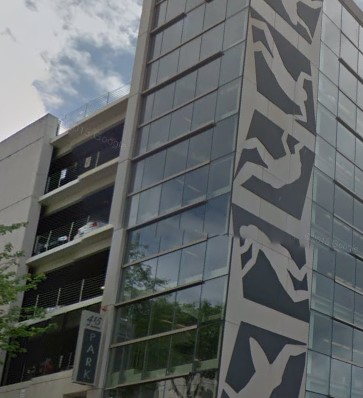
The temporary subsidized daily and monthly parking for employees at the two downtown garages (Goat Hill and King Street Center) will end on September 2. After that date, the standard employee rates will apply, as follows:
All-Day Parking
$20
Hourly Parking
| Hours | King County Employee Rate With ID |
| 0 to .5 | $4 |
| .5 to 1 | $7 |
| 1 to 1.5 | $8 |
| 1.5 to 2 | $11 |
| 2 to 3 | $12 |
| 3 to 4 | $14 |
| 4 to 5 | $15 |
| 5 to 6 | $16 |
| 6 to 7 | $19 |
| 7 to 24 | $20 |
| Evening (applies from 4 p.m. to 9:30 p.m.) | Up to 3 hours: $7 More than 3 hours and before 9:30 p.m.: $8 |
| Motorcycles (flat rate) | $7 |
Monthly Parking
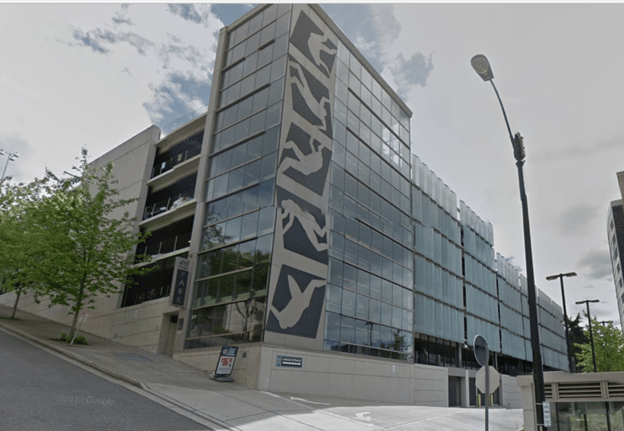
For employees who want to enroll in monthly parking, please read and complete a King County Employee Parking Application. The agreement details all available options, as well as employee garage parking policies. Completed applications should be submitted to FMD Parking Operations (fmdpo@kingcounty.gov) for processing.
If you are currently enrolled as a subsidized monthly parker via payroll deduction and want to continue under the standard rates, you will need to re-apply for monthly parking access. All current deductions and parking access will expire on August 31.
| Type | Rate |
| ADA | $150 |
| Carpool | $210 |
| Electric Vehicle | $210 |
| Reserved | $385 |
| Unreserved | $300 |
Pay Per Use Parking
Pay Per Use parking allows you the convenience of a 24/7 access card, without the commitment and cost of monthly parking. Once your account has been set up with a credit card placed on file, your total daily transactions will be charged at the end of the month. To enroll, select the Self Paid and 24/7 Pay Per Use boxes on the Parking Application.
For questions or further information, please contact FMD Parking Operations at fmdpo@kingcounty.gov.
Share this:

Executive Constantine congratulates KCIT on national award

King County Executive Dow Constantine emailed KCIT employees today to congratulate them on being named the nation’s #1 Top Digital County by the Center for Digital Government (CDG) and the National Association of Counties (NACo).

“This is the second year in a row that KCIT has received this prestigious award, and it is a recognition of everything you do to help us improve the way we work, collaborate, and connect with residents,” Executive Constantine told KCIT employees. “This award is a recognition of your hard work and innovative thinking, and the willingness of all King County employees to embrace new technologies in their work. Congratulations!”
KCIT’s work was recognized with a first place for King County among counties with a population of one million or more. In its award summary, the Digital Counties Survey noted KCIT’s work “to reimagine the city’s services in equitable ways, doing so with a range of new ideas, from accessible online applications for reduced transit fares — which grew last year by a whopping 2,000 percent among underserved populations — to online databases with digital evidence to help inform justice-related decisions.”
The Digital Counties Survey is developed in partnership with the National Association of Counties (NACo) and conducted by the Center for Digital Government (CDG). It identifies the best technology practices among U.S. counties, including initiatives that streamline delivery of government services; encourage collaboration; enhance cybersecurity and apply innovative and emerging technologies to county priorities.
Share this:

Elections partners with King County’s Supported Employment Program

There are 1.4 million registered voters in King County. Voter registration in the Department of Elections is an intense, customer service focused team tasked with ensuring county residents get to exercise their right to vote. Handling phone calls, emails, in-person visitors, and thousands of online registration updates keeps this team in constant motion.
When Kim Streeter, a Program Supervisor for the Department of Elections, was approached by King County’s Supported Employment Program to hire staff for a pilot program, it seemed like a great fit for all parties.
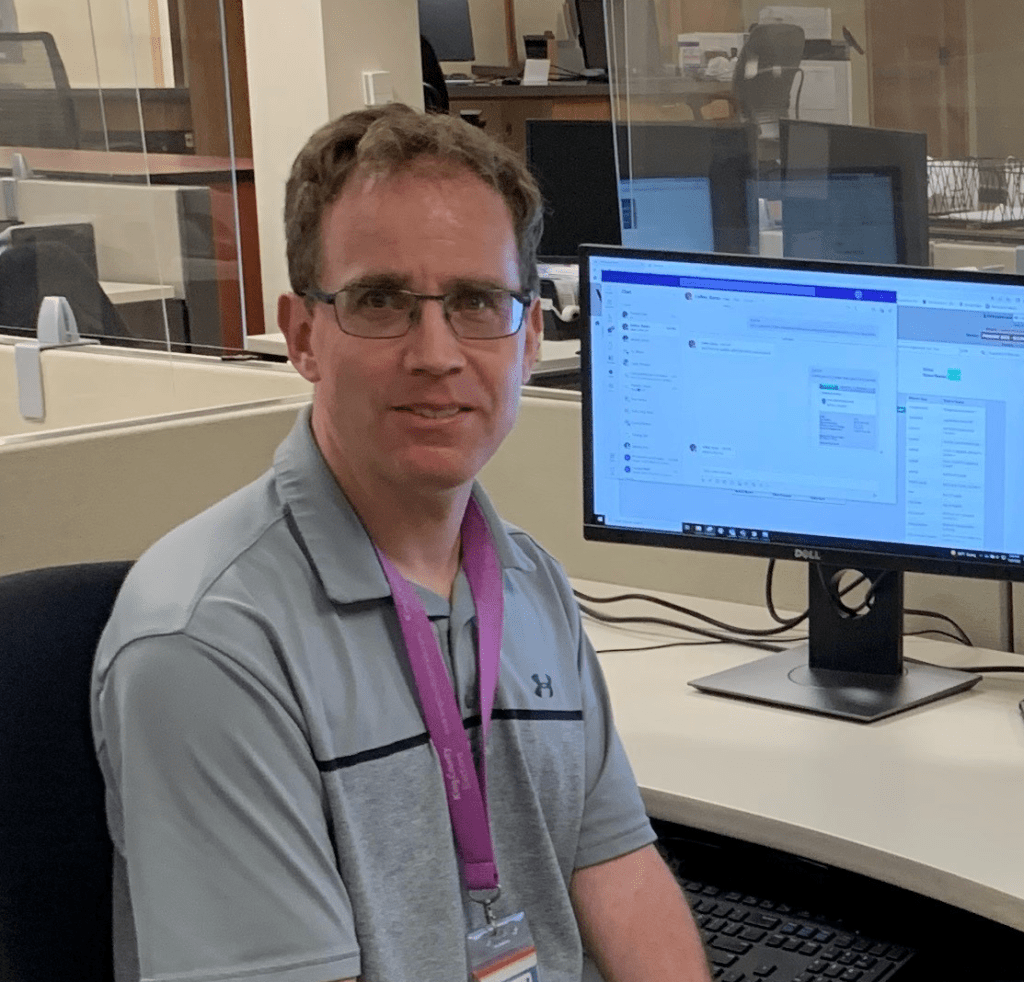
Department of Elections
King County’s Supported Employment Program matches job seekers with developmental disabilities to available jobs by identifying efficiencies and unmet needs throughout King County departments. The program allows each department to review its standard work practices utilizing Lean principles. A job coach is also available to help supported employees thrive in the workplace.
“We described the role we needed to fill to the Supported Employment Program Manager, and they provided us with several candidates to go through the interview process,” Kim said. “We hired Chris and over the last few years he’s become an integral part the team.”
From temporary part-time to permanent full time
Chris Noel was hired to work at the Elections headquarters in Renton, and then went remote when the COVID-19 protocols were implemented. “I like both, working in the office and remote,” Chris said.
Chris receives job coaching support through a community employment service provider called ENSO, a regional organization that supports persons with disabilities.
With support from his job coach at ENSO, Dora Sales, Chris went through the interview process to land the position. Dora then worked with Chris, Kim, and the team to ensure his success by helping with his training and integration into the work.
As a job coach, Dora supported Chris with various tasks, from taking notes during meetings to assisting in his training on the tools for the job. “Chris brought some solid work experience with him,” said Dora, “After only about a month, he was ready to work independently and has been working successfully in this role.” Chris has regular check-ins with his job coach to ensure he continues his success.
As a lifelong King County resident, Chris understands the importance of his role in the voter registration process. “I’m really proud to work with this team and as a representative of the disabled community,” he said. “These opportunities encourage people who might not feel like they have a place in the working world.”
Chris was originally hired for a temporary limited term (TLT) part-time position. Within a year, his position was made permanent, and most recently it was changed from part-time to full-time. He explained that he primarily works with the Washington Department of Licensing (DOL), which has a significant voter registration process. Chris is responsible for data entry, processing mail, and DOL records, and is receiving training to take on more tasks.
Working with the Supported Employment Program illustrates how inclusive hiring can help make great hires and create powerful success stories for King County departments and our community. For more information on how departments can participate in the Supported Employment Program, please reach out to Christina.Davidson@KingCounty.gov.
Share this:

Administrative Professionals Q2 recognition

King County Administrative Professionals are a large part of King County government’s workforce and valuable contributors to the success of every department. They support and provide direct services to internal customers and the public.
Administrative Professionals may include, but are not limited to, Administrative Specialists, Office Assistants, Executive Assistants, Customer Service Specialists, Dental and Medical Assistants, Court Clerks, and more.
- Celebrate the great work of Administrative Professionals and read about their accomplishments:.2022 Q2 Recognitions.
To show your appreciation and recognize an Administrative Professional that you’ve worked with, click here.
Share this:

Executive Constantine demonstrates progress on making region’s treatment plant more resilient to climate impacts

As King County hosts a four-day national conference of clean water agencies, Executive Dow Constantine showed progress toward making the region’s wastewater treatment system more resilient to climate impacts.
King County crews are preparing to install on-site batteries at West Point Treatment Plant, providing operators with an uninterruptable power supply when voltage sags occur. It’s the latest in a series of improvements to make the 56-year-old treatment plant more resilient to climate impacts. Read more.
Share this:

Crawling toward equality

By Dorian Esper-Taylor Disability Equity Specialist, Office of Equity and Social Justice and Jennifer Mechem, ADA/Civil Rights Section Manager, Office of Equity and Social Justice
Today marks the 32nd anniversary of the Americans with Disabilities Act (ADA) being signed into law on July 26, 1990.
One of the most influential civil rights marches was not a march, it was a crawl. Part of a series of demonstrations that included all forms of mobility, the Capitol Crawl on March 12, 1990, was a key moment in the path to the Americans with Disabilities Act (ADA).

Collectively as a society, we view civil protest through the lens of ableism. Systemically and historically, demonstrations are often not accessible. But people with disabilities were leading a new civil rights movement and redefining what protest looked like. In 1977, they had organized the longest sit-in in U.S. history to push the government to sign the first disability civil rights law, Section 504 of the Rehabilitation Act. In 1990, massive public protests to support passage of the ADA required collective unity and that no person be left behind. Over 1,000 people made their way to the Capitol on March 11, 2011, to demonstrate when the ADA was stalled in the House Committee on Public Works and Transportation.
Tired of being marginalized and pitied, the activists began these demonstrations with people chaining their wheelchairs together in the Capitol Rotunda. The most significant of these demonstrations happened the next day, on March 12, over a thousand people planned to demonstrate outside the White House. ADAPT (formerly known as American Disabled for Accessible Public Transit) wanted a demonstration that would not only display the struggles that people with mobility disabilities face, they wanted a demonstration that would shock people and defy the stereotypes of people with disabilities. They organized approximately 60 people to crawl up the Capitol steps to highlight the inaccessibility and the need for the ADA. Tossing their mobility aids aside, people crawled their way up towards the Capitol.
These demonstrations shattered stereotypes of people with disabilities, especially mobility disabilities, in every way. Instead of quiet and in the corner, there were loud demonstrations of civil disobedience. The news coverage of the Capitol Crawl brought national attention to the struggles of the 43 million Americans with disabilities. The New York Times showed a photograph of a man dragging himself and his chair up the steps, and the Los Angeles Times highlighted the more than hundred people arrested that week.
One of the people arrested was Cynthia Keelan, the mother of the youngest activist seen crawling up the steps. Jennifer Keelan-Chaffins was just eight years old. “Even though I was quite young, I realized that as one of the very few kids that got to be involved in this movement…it wasn’t just about myself, but it was about them as well.”
While the protests to pass the ADA continued for a week, the Capitol Hill protests were the most influential in changing public opinion and getting the votes to pass the law. At last, it was passed and the ADA was signed into law by President George H.W. Bush on January 26, 1990.
Learn more about the Capitol Crawl
Crawling up steps to demand their rights | ShareAmerica.
Share this:

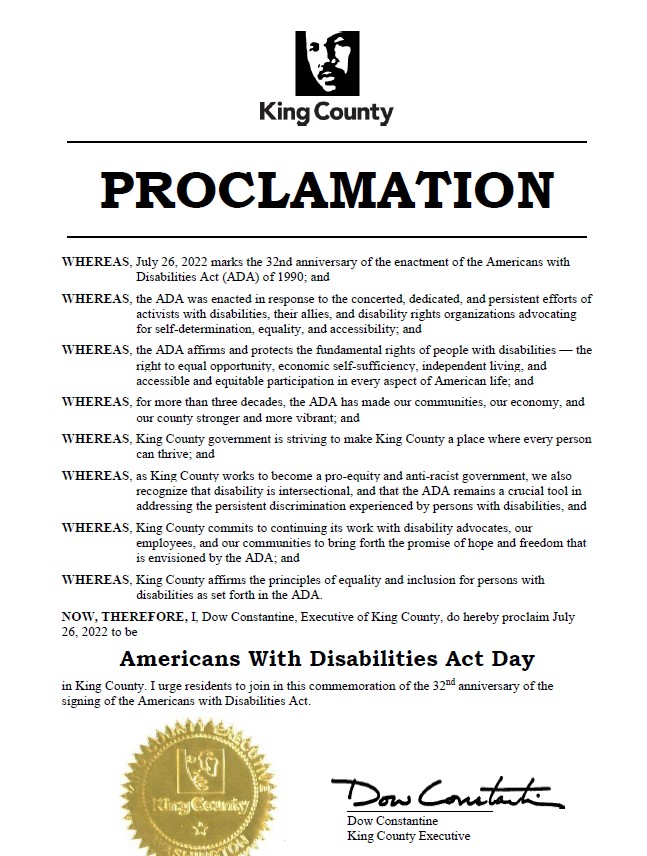
July 26 proclaimed Americans with Disabilities Act Day
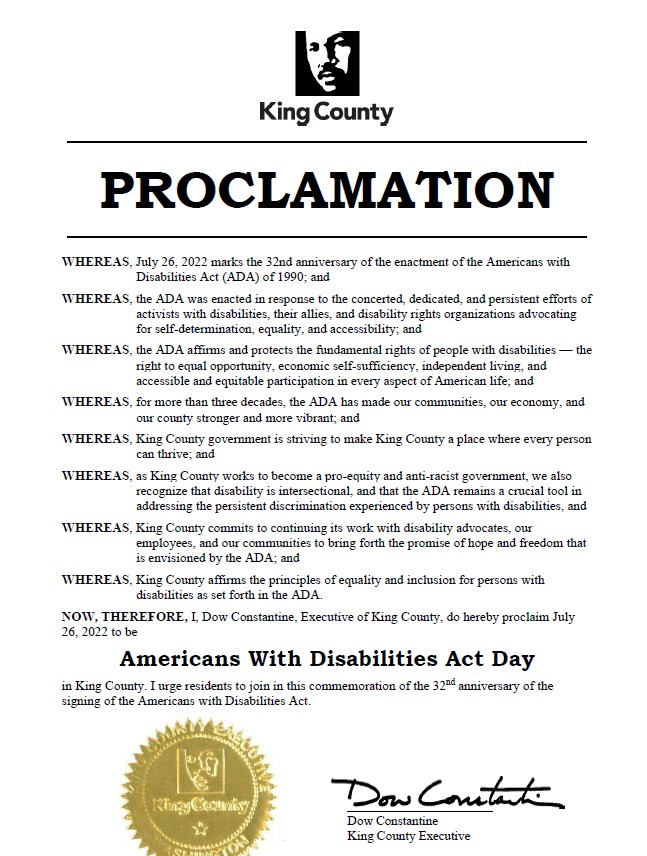
By Dow Constantine, King County Executive
On the 32nd anniversary of the signing of the Americans with Disabilities Act (ADA), with our work to become a pro-equity and anti-racist government, we also recognize that disability is intersectional, and that the ADA remains a crucial tool in addressing the persistent discrimination experienced by persons with disabilities.
Share this:

What’s hotter than the weather? Water Taxi Summer!

The Water Taxi is a cool way to beat the heat. It’s operating on its summer sailing season, with seven-days-a-week service to and from West Seattle, including midday sailings, and Friday and Saturday night service. Don’t forget your dog or cat, or your bike!
Hop aboard for a 15-minute ride across Elliott Bay while enjoying panoramic views of the Seattle skyline, Mount Rainier, and the Olympics. You can walk to the Mariners game or the Sounders match. When riding from downtown to West Seattle, you can take a shuttle from the Seacrest Dock that will take you to the West Seattle Junction or along Alki to the Admiral District. Read more.
Share this:

No AC? Can’t open your windows? Here’s how to stay cool.

Cross-posted from Public Health Insider
When it’s hot outside, it can be miserable inside if you don’t have air conditioning or can’t open your windows. Public Health Insider has put together tips that can help when it feels like an oven in your home. Read more.
Share this:

Take care working outdoors during extreme heat


(Updated August 14, 2023)
Extremely hot weather is forecast to continue for the next few days in our region, with very high temperatures expected. Some of our work needs to be performed outdoors. Executive Branch departments should evaluate planned field work to determine if this work can be postponed to when temperatures are cooler, where possible. If work must be performed, departments should attempt to adapt schedules wherever possible so work can be performed in the morning. Please see the following advice and tips (this applies to Executive Branch employees. Employees in other branches of County government may receive additional guidance from their leaders). For complete Department of Labor and Industries requirements, please refer to WAC 296-62-095 Outdoor heat exposure.
For managers and supervisors
- If an employee normally performs field work outdoors for extended periods, please consider curtailing all non-critical outdoor work
- Consider adjusting employee work schedules, locations, or regularly assigned duties during extreme heat days if these are options
- If employees must work outdoors, please attempt to have work completed in the morning and avoid work in direct sunlight
- Ensure employees take frequent breaks in the shade or air-conditioned locations (for example, office space, library, community center, grocery store), and reduce drive times, if possible
- Encourage employees to frequently consume water or other acceptable beverages to ensure hydration
- Wherever possible, employees should avoid outdoor work in direct sunlight from 9 a.m. to 6 p.m. on extreme heat days.
For outdoor workers
- Talk to your supervisor about adjusting scheduling to avoid all non-critical outdoor work on the hottest days, or perform critical outdoors tasks in the morning only
- Take breaks in the shade or in an air-conditioned space
- Stay hydrated. Have a beverage with you at all times, and sip or drink frequently. Don’t wait until you’re thirsty to drink.
- Avoid sunburn. Use a sunscreen lotion with a high SPF (sun protection factor) rating and wear protective clothing.
For everyone
- Check on at-risk friends, family, and neighbors
- If you’re outdoors, take breaks in the shade or in air-conditioned buildings. Avoid direct contact with the sun
- Avoid exercising or strenuous activity in direct sunlight from 9 a.m. to 6 p.m. when the heat is most intense.
- Stay hydrated. Drink plenty of water and don’t wait until you’re thirsty to drink more
- NEVER leave infants, children, or pets in a parked car, even if the windows are cracked open! It only takes a few minutes for severe medical problems and even death to occur
- Watch for signs of heat exhaustion or heat stroke. Seek medical care immediately if you know someone who experiences symptoms. Follow up with your supervisor if you seek medical treatment
- Certain health conditions and medications make people more sensitive to heat. Check with your doctor about whether you are at greater risk.
Signs of heat exhaustion
- Heavy sweating
- Weakness
- Cold, pale, and clammy skin
- Weak pulse
- Fainting
- Vomiting.
Signs of heat stroke
- High body temperature (103° F or higher)
- Hot, dry skin
- Rapid and strong pulse
- Possible unconsciousness.
For our furry friends
- Limit exercise on hot days. Exercise in the early morning or evening hours
- Walk your pet in the grass if possible, to avoid hot surfaces burning their paws
- If your pet is outside, make sure they have access to shade and plenty of cool water.
Get more information at kingcounty.gov/BeatTheHeat. For more pet safety tips, read this article from the American Red Cross.






 Employee News