
City Hall Park activation
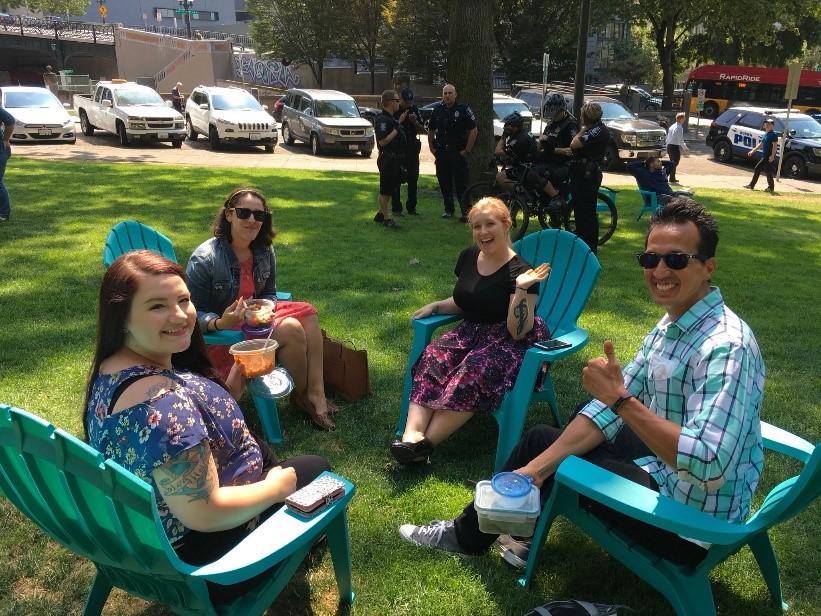
Facilities Management Division and the Department of Executive Services Director’s Office have been working with stakeholders for more than a year to help improve City Hall Park and King County Courthouse surroundings. Earlier this month, KIRO-TV ran a story about the collaborative efforts of King County and the City of Seattle to “activate” the park with games, food trucks, and buskers.
The soft launch took place on Aug. 6, attracting dozens of King County employees and other downtown people, who enjoyed the new amenities on a sunny day. King County Superior Court has also been promoting the park activation through its social media channels, and KCTV produced a short promo video.
Share this:

2018 Equity & Social Justice Speaker Series

You are invited!
 The 2018 Equity & Social Justice Speaker Series invites you to a Lunch & Learn Tuesday, Aug. 28, noon to 1 p.m. in room 123 of the Chinook Building. This session features The Anti-Defamation League, with a presentation by Hillary Bernstein and Miri Cypers (Director), and is brought to you by KC Equity Fund and KCIT ESJ: Learning, Advocating, Cultivating.

Share this:

Recount refresh
Crossposted from Election Connection
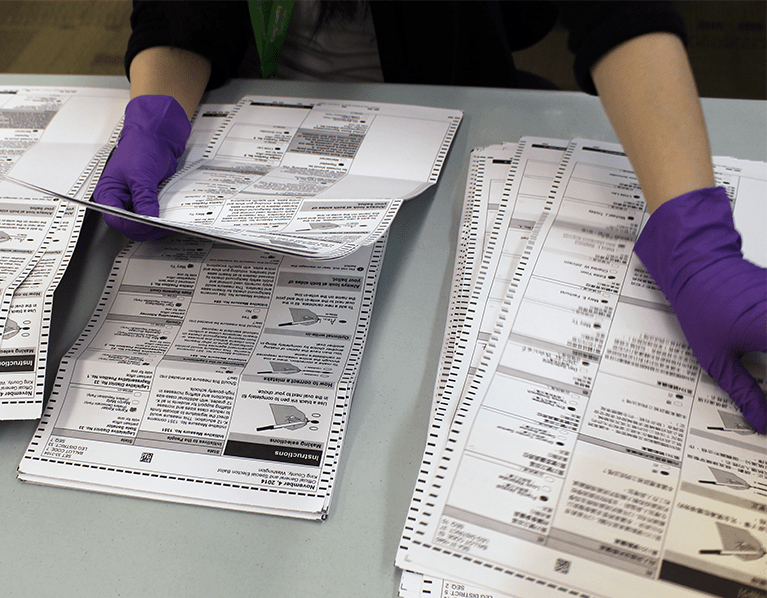
We had a few close races this month and thought it would be helpful to share how a recount works.
It’s important to know that there are two different types of recounts, machine and manual, and that there are different thresholds for each, as well as for the type of race. There are also no mandatory recounts for state advisory votes or local measures.
Mandatory Machine Recount – A machine recount is when in all ballots for that race are re-scanned and re-tabulated electronically. For all races and statewide measures a recount is triggered if the gap is fewer than 2,000 votes and also less than .5% (.005) of the total overall votes cast for both candidates.
Mandatory Manual Recount – A manual recount is when all ballots for that race are counted by hand. For statewide races and measures a recount is triggered if the gap is fewer than 1,000 votes and also less than .25% (.0025) of the total overall votes cast for both candidates. For other races a recount is triggered if the gap is fewer than 150 votes and also less than .25% (.0025) of the total overall votes cast for both candidates.
Occasionally, someone may request a recount. This situation requires an application for a requested recount which must be filed within two business days after the County Canvassing Board or Secretary of State has declared the official results of the primary or election for which the recount is requested. The application must specify the race or state measure to be recounted.
Visit our Elections website or the Secretary of State’s website for more information about the recount process. View our previous blog post about recounts here.
Share this:

When you come to work, you want to be in a happy environment. This is what we help create!

Crossposted from Clean Water Stories
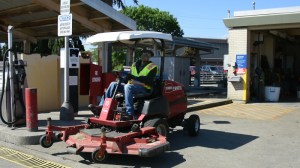
Seasonal workers help us accomplish a lot of work in a short period of time during the good weather of spring and summer. This is super helpful when you have treatment plants like South Plant with about 100 acres of landscaping and buildings!
Happy place = happy at work
If you’re like most working people, you spend enough time at your job that it’s like a second home. And most people would agree it’s nicer when your workplace is tidy – even beautiful.
A pleasant work environment isn’t just a bonus or a “nice to have.” Studies show that a clean, nicely-maintained workplace is good for business. It’s safer and makes employees happy, healthy and more productive. It leaves a good first impression on customers – and is part of being a good neighbor.
Help when we need it most
Every spring we hire a group of short-term employees that help us keep our treatment plants and other facilities looking good – and feeling good. Given the title of “seasonal workers” – they are vital staff who help us accomplish a lot of work in a short period of time – work that is best done in the good weather of the spring and summer seasons.
“Our job description varies with the day,” explains South Treatment Plant seasonal worker, Calvin Dunbar. “One minute we can be cutting grass and the next moment using a chain saw to limb trees. I love the job because we gain a lot of experience with different equipment, tools and projects.”
Team member Giovanni Rivera agrees. “It changes every day – whether it’s irrigation systems, digging, pruning, mowing, edging – or sometimes helping the utility workers – we do a lot around here.”
Seasonal worker do all kinds of activities that help keep our treatment plants well-maintained. On any given day, they may use backhoes, tractors, Gator carts, dump trucks, mowers or forklifts. They can also gain resume-boosting trainings like flagger certification, dust-fit mask training, a forklift certification, and First Aid / CPR training.
Seasonal worker do all kinds of activities that help keep our treatment plants well-maintained. On any given day, they may use backhoes, tractors, Gator carts, dump trucks, mowers or forklifts.
South Plant has about 100 acres of landscaping and buildings.
Building experience and future careers
As seasonal worker John Franklin points out “working for the summer season – it gives you a taste of what it’s like working for King County.”
In fact, the team’s supervisor, Chris Tinnin notes that “there’s been a number of long-time employees who started out as seasonal helpers. Many people – instrument techs, operators, supervisors – started their careers in this job.”
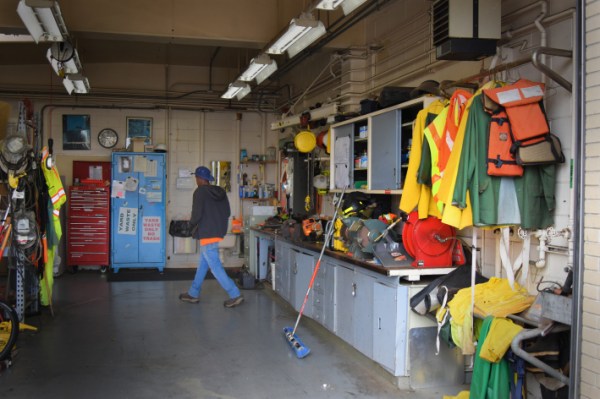
Seasonal workers do a lot – such as maintaining irrigation systems, digging, pruning, mowing, and edging.
The South Plant seasonal crew is just one of many crews who help maintain our 3 major treatment plants and facilities all over the Puget Sound.
Helping morale – and public perception of what a sewage treatment plant is like
The team talked about how their co-workers see and appreciate their work – giving them compliments like “hey – that looks great.” Chris says “It’s really important because at the end of the summer – all of a sudden the [treatment] plant’s looking beautiful. They give us a big boost.”
And the seasonal workers themselves appreciate being in the beautiful environment they help create. Team member Duane Walker, who worked in a corporate setting for many years, points out it’s just “nice to be outside.”
And if that weren’t enough, the “beautification” of our treatment plants helps in yet another way – educating the public about what we do. “Before community members come to one of our treatment plants for an education tour, they usually think about how gross it is going to be,” explains Susan Tallarico, Education and Engagement Supervisor. “And although there are some smelly realities when it comes to cleaning wastewater, most of the public is pleasantly surprised with how clean and attractive the buildings, grounds and trails are. Our seasonal workers help make our treatment plants a place where people want to come back and learn more about how we protect the environment.”
Interested in a job as a seasonal worker? We post positions in about April or May each year. Watch for announcements or sign up for alerts at the King County Job site: https://www.governmentjobs.com/careers/kingcounty
Share this:

Social Media Spotlight: #CityHallSelfie Day

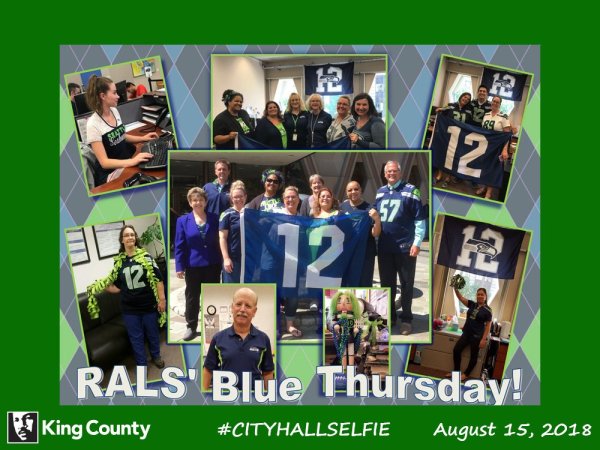
King County employees had a great showing for #CityHallSelfie Day last week!
To view the selfies, visit King County, WA on Twitter and search – you guessed it – #CityHallSelfie!
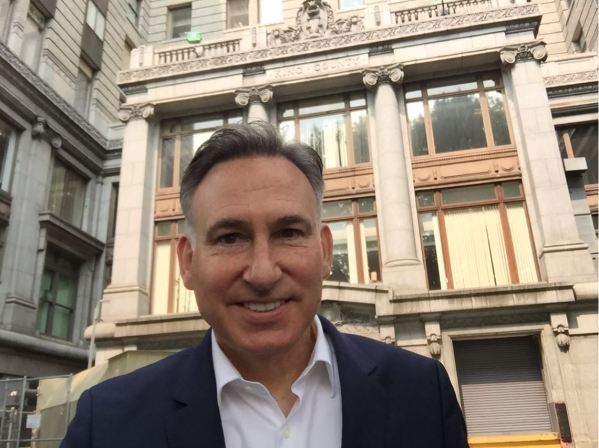
In addition to viewing the selfies from our King County team – including Executive Constantine and, one of our favorites, RALS’ #CityHallSelfie #Twelfie – you can view how public servants around the country and around the world celebrated!
Share this:

Featured Job: Education Specialist – Immunizations Program

Closing: 09/03/18 11:59 PM Pacific
Salary: $25.44 – $32.24 Hourly
Location: Chinook Building, Seattle, WA
Job Type: Special Duty Assignment or Term-Limited Temporary
Department: Public Health – Seattle & King County
Job Number: 2018ZK-08517
This position is open to all qualified candidates and is a 6-month term limited temporary or special duty position that reports to the Immunization Educator Consultant in the Communicable Disease Epidemiology and Immunization Section. The Education Specialist performs Vaccines for Children Program site visits with enrolled clinics in King County utilizing pre-designed assessment methodologies. The incumbent evaluates clinic data to determine whether current VFC program policies and procedures regarding vaccine ordering, reporting, inventory management, and vaccine dose documentation are effectively carried out by the practice. The Education Specialist also provides information to health care providers, and conducts outreach to schools, child care providers, and adult vaccine providers to ensure optimal community vaccination coverage levels.
Contact: For more information, contact HR Analyst Zackary King at Zackary.King@KingCounty.gov.
Learn more about this position or all available jobs.
Share this:

Trail Spotlight: Eastside Rail Corridor

Crossposted from King County Parks Plog
One of the most exciting projects happening at Parks is the development of the Eastside Rail Corridor (ERC). This trail is being developed in partnership with Renton, Bellevue, Kirkland, Redmond, and Woodinville, along with Sound Transit, Puget Sound Energy and many others.
Once completed this 42-mile recreational trail will connect the Cedar River Trail and Lake to Sound Trail (in progress) with the SR 520 Trail, the I-90 Trail, Redmond Central Connector, the Cross Kirkland Corridor, the Sammamish River Trail, and the East lake Sammamish Trail! That’s a lot of connections.

The new section of the Eastside Rail Corridor where it connects with the Lake Washington Trail.
As if this wasn’t enough, the ERC will be the first example in the region of trail-oriented development where adjacent businesses in Bellevue’s Spring District will be trail-facing. This will bring vibrancy, and vitality to a hallmark of regional recreation and mobility.
Now, it will be a while before this trail is completed, but at least for now we have the existing Lake Washington Trail (also known as the Lake Washington Loop Trail) which circles Lake Washington via a collection of on-road bike paths, regional trails and some protected bike lanes.

Intersections sporting new safety standards on the Eastside Rail Corridor interim trail.
The Lake Washington Trail going north from Renton will now take you onto a couple of the existing interim gravel sections of the Eastside Rail Corridor. While not yet paved, they’ll give you a feel for the coming trail.
So what are you waiting for?! Get outside and explore this new section of Your Big Backyard, get a flavor of the days to come, it’s going to be one awesome trail. Also, join Parks for a celebration of the new interim ERC sections on September 8 at North 43rd Street in Renton.
Share this:

King County’s South Treatment Plant celebrates perfection with prestigious environmental awards
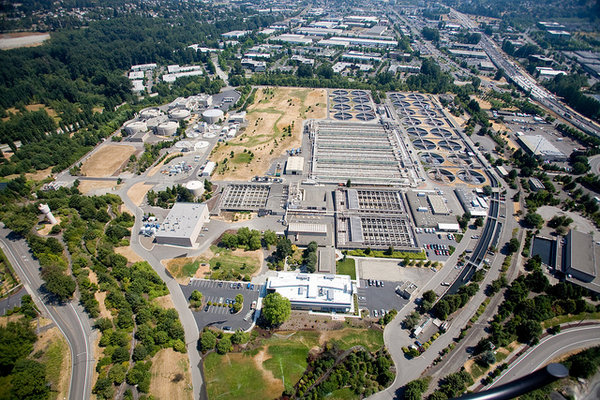
The Washington State Department of Ecology honored King County’s South Treatment Plant with a coveted “Outstanding Performance Award” for operational excellence that resulted in perfect compliance with all permit conditions in 2017.
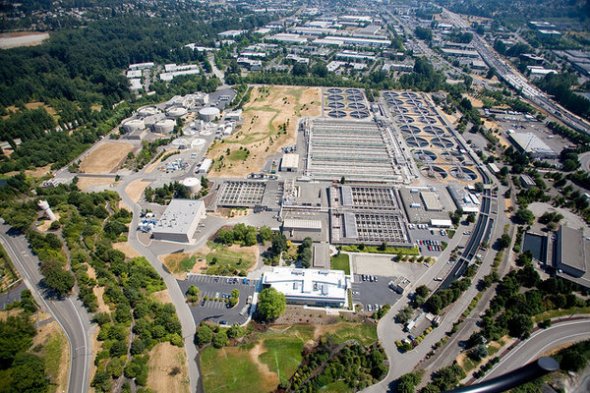
King County’s South Treatment Plant in Renton.
South Plant is one of 111 wastewater treatment plants out of about 300 statewide that received the recognition. To earn the award, the plant had to operate around the clock for the entire year with no violations of any kind. In addition to meeting or exceeding effluent pollution removal requirements, the plant operations also flawlessly complied with monitoring and reporting obligations, pretreatment requirements, and spill prevention planning.
The plant was also the recipient of the National Association of Clean Water Agency’s “Platinum Peak Performance Award” for 20 consecutive years of perfect compliance with effluent discharge requirements under the federal Clean Water Act and the state’s Water Pollution Control Law.
In service since 1965, King County’s South Treatment Plant in Renton protects public health and water quality for about 700,000 people in communities south and east of Lake Washington. The plant treats an average of 90 million gallons of wastewater each day, with a capacity to treat up to 300 million gallons during severe storms.
The plant site also hosts the award-winning Waterworks Gardens Park, where art, technology and nature join in a unique way. The park’s extensive network of wetlands acts as a natural treatment system to clean stormwater runoff from the plant site. Waterworks Gardens is open to the public year-round from dawn to dusk.
Additional information about the South Treatment Plant is available online.
Read the original news release here, and read about DNRP’s other awards in the Newsroom!
Share this:

Metro Transit to become independent department Jan. 1

Shared from King County Council News
King County Metro, recognized this month as the best large transit system in North America, will become an independent County department with Monday’s unanimous approval of legislation by the Metropolitan King County Council.
In September 2017, Executive Constantine announced his proposal to make Metro Transit a stand-alone department rather than a division of the Department of Transportation.
King County has been responsible for public transit since the voter-approved merger of the county with the Municipality of Metropolitan Seattle (Metro). Metro Transit has been a division of the King County Department of Transportation (KCDOT) since 1994. The adopted legislation will make Metro Transit responsible for all of the functions currently in the Transit Division of KCDOT as well as the Marine Division of KCDOT.

Metro Transit General Manager Rob Gannon
Rob Gannon, who has been the General Manager of Metro, will become the department’s first Director and General Manager when the legislation takes effect on Jan. 1, 2019.
“This change strengthens Metro Transit by giving it the organizational flexibility to meet the rapidly growing needs of transit riders,” said Council Vice Chair Claudia Balducci, who serves as the chair of the Council’s Mobility Committee. “Mr. Gannon has been an effective leaders and I am confident in his ability to continue to build an efficient and adaptable transit service that works as part of an integrated transportation system to improve mobility for all residents in King County.”
“General Manager Rob Gannon is an excellent choice to lead Metro Transit. I trust that he, along with the incredible staff at Metro, will continue providing first-rate transit service while pushing to improve regional mobility,” said Council Chair Joe McDermott. “I look forward to working with Mr. Gannon as we tackle our transportation challenges and opportunities.”
“This department will coordinate and provide more mobility options as it collaborates with other groups, businesses, and cities. Mobility throughout the county is important,” said Council Vice Chair Kathy Lambert. “I know Director Gannon will do an excellent job and that Metro will continue to be a national leader in transit service.”
The legislation also calls for the new Metro Transit Department to emphasize:
• Innovation in the development, planning and delivery of mobility and transit services around the county,
• Performance standards to meet the increasing demand for transit among King County’s residents, and,
• Foundational commitments to equity and addressing disparity through transit services.
The Council unanimously approved Gannon’s appointment as Metro Director at today’s meeting. Gannon who, served as Metro’s Deputy General Manager from 2011 to 2013, has been Metro’s General Manager since 2016.
The riders who board Metro’s 200 bus routes, use a Metro vanpool, walk onboard the King County Water Taxi, or reserve a ride on an Access paratransit van, will not see any changes in service when Metro becomes a county department.
Share this:

Pet of the Week: Eggsy

Crossposted from Tails from RASKC
Fall head over heels for Eggsy, our Pet of the Week!
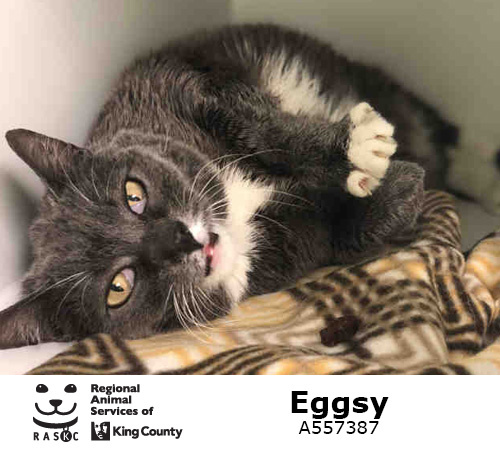
This sweet and loving senior boy would love to cuddle up with you at home in his golden years. Eggsy also loves petting and will knead you in contentment.
Eggsy is a gentle and affectionate boy who likes to take things slow. As one of our “Bashful Blue” personality pets, he may get a little nervous in new situations and would do best in a family who understands he may need some time to warm up. Once he gets to know you, Eggsy will be making “muffins” in your lap in no time!
Eggsy does seem to get colds off and on. He has also been treated for URI, and has symptoms that may continue long-term and may be contagious to other cats. An informational handout is available to potential adopters, and the staff at RASKC will be happy to answer any questions you may have. Regular veterinary visits are always recommended. Eggsy also had some teeth pulled earlier this year, so he may have some special dietary needs.
If you’re looking for a lap cat, Eggsy is looking for you! He is litter box trained, neutered, current on vaccinations, and microchipped. His adoption fee includes a free visit to the veterinarian of your choice and 30 days of opt-in pet insurance through Trupanion.
You can find out more about Eggsy on our website at kingcounty.gov/AdoptAPet, or visit him in person at the King County Pet Adoption Center in Kent.






 Employee News