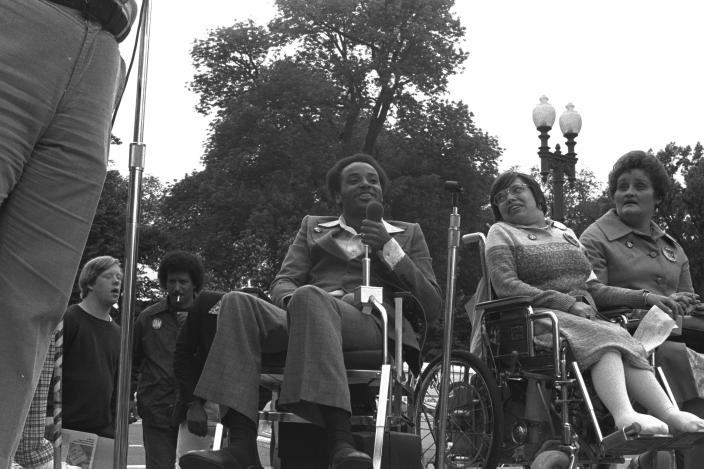
Tech Tip: KCIT shares accessibility tips for Outlook, Office, and Teams

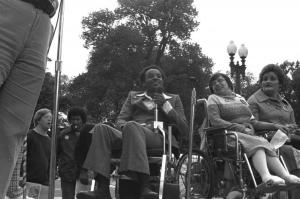
Since one out of five people has a disability, it is important to support everyone’s accessibility needs. Whether it’s larger text sizes or closed captioning for online meetings, accessible technology makes a real difference.

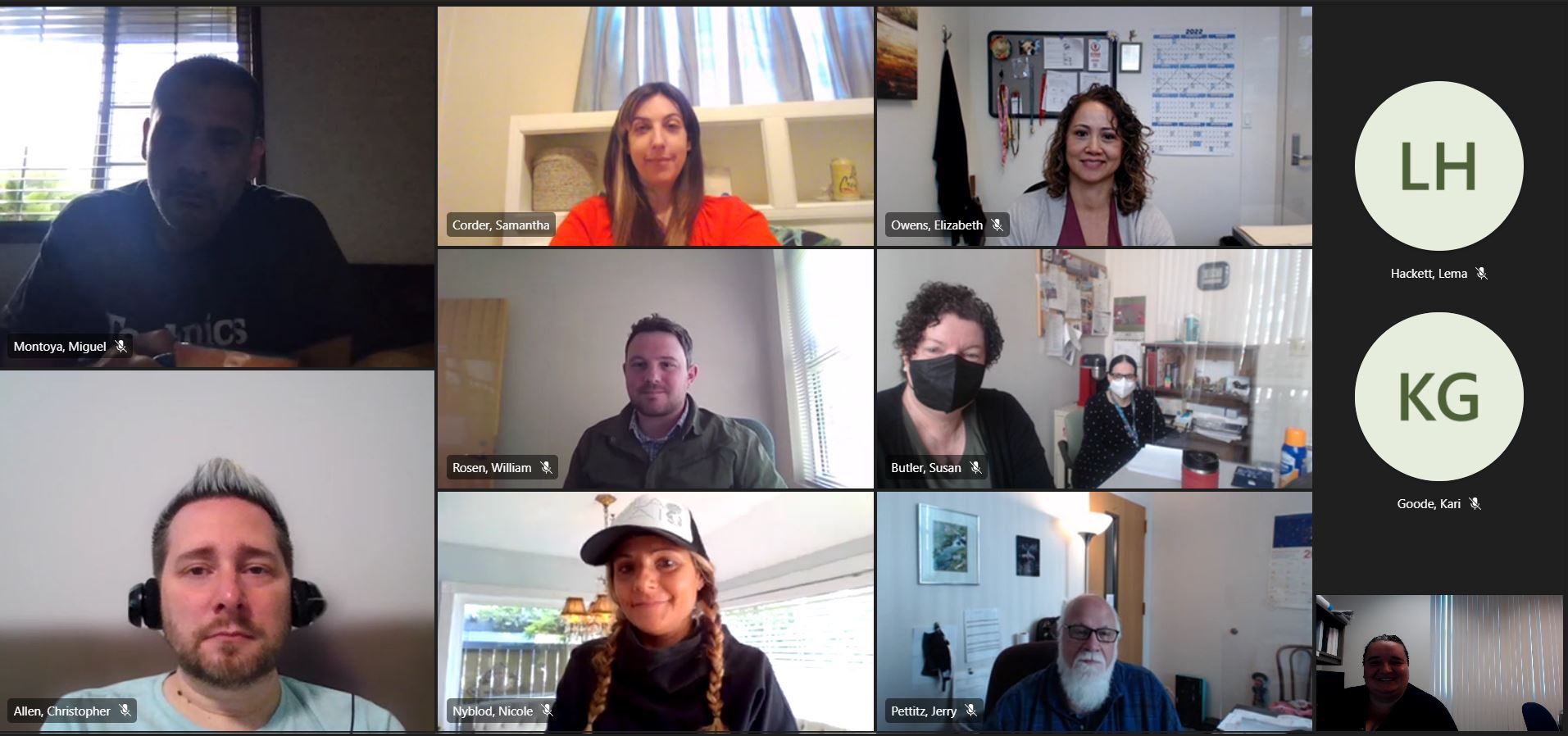
KCIT developed this online training series with Microsoft to discuss accessibility features in Outlook, Office, and Teams. Take a look to learn how you can support this work.

For help using accessible technology, contact the KCIT HelpDesk here or at 206- 263-4357.

Recorded Teams Meetings will be deleted after 90 days

Microsoft has implemented a new policy to auto-delete recorded Teams meetings from the meeting owner’s OneDrive after 90 days. This policy will only apply to recordings created on or after April 15; previously recorded meetings will not be impacted.

Going forward, meeting owners will be notified via email when recordings are deleted and can retrieve the files from their recycle bin. This will improve file management by removing unneeded recordings from employees’ OneDrive. Employees can save and share recorded meetings using Microsoft Stream. View the quick guide to uploading Teams Meeting Recordings to Stream.

If you need help, Executive branch employees can LiveChat with the KCIT Helpdesk. Employees in separately-elected agencies should contact your department IT support.

Airport staff to present on diversity and inclusion at industry conference

Cross-posted from Executive Services Express

Vanessa Chin and Kevin Nuechterlein’s proposal for a presentation on diversity and inclusion has been selected by the Northwest Chapter of the American Association of Airport Executives (NWAAAE) for their fall conference. Their presentation will be titled, “Sustainable Culture Change for a More Diverse and Inclusive Airport.”

“For me, one thing I want to definitely impart with the airport industry is that the way that King County empowers our airport to live out our True North values and embed equity in all the work we do,” said Chin, Business Information Management Manager for King County International Airport.

Click here to learn more.

New Finance and Business Operations Division employee taps into experience to drive success and promote inclusion

Cross-posted from Executive Services Express

Sue Mason is the new Labor Equity Program Supervisor in the Finance and Business Operations Division in DES. Her job includes administering the county’s priority hire program and collaborating with unions, pre-apprenticeship and apprenticeship programs, and contractors to support the hiring, retention, and training of underrepresented workers, and encouraging folks to consider construction as a career.

Click here to read the full announcement.

It’s safe to give help: Questions and answers about secondhand fentanyl exposure

Cross-posted from Public Health Insider

As the powerful synthetic opioid fentanyl has spread across King County and the rest of the nation, it has, unfortunately, become more common to encounter a person who may be experiencing an opioid overdose.

Questions arise about what to do in that situation – how to give help, and whether it’s safe to do so. Some stories in the media have raised worries about whether people who come into close contact with someone experiencing a fentanyl overdose could get exposed to the drug while trying to help.

Dr. Scott Phillips, Medical Toxicologist and Medical Director of the Washington Poison Center, addresses some of those questions, and explains the science behind them. Click here to read the full story.

COVID-19 update: Considerations and recommendations as we move into spring

Cross-posted from Public Health Insider

With cases slowly but steadily rising over the past month in our region, we’re taking a closer look at what we know about the state of the pandemic locally. The bottom line is that although ongoing ups and downs in COVID-19 activity are likely, it’s best not to become infected and there are effective ways to reduce our risk.

Click here for a brief look at the current COVID-19 situation in King County and recommended strategies for anyone who wants to reduce their risk for COVID-19 and long COVID, especially people at higher risk for severe infection.

Celebrating Earth Day 2022

By Dow Constantine, King County Executive

Climate change can feel overwhelming, especially now that we are experiencing the impacts in unprecedented ways. Last summer’s record-setting extreme heat event, coupled with more frequent flooding and greater wildfire risks, makes it clear that climate change is no longer a projection or prediction – it is right here, right now, and certain to get worse.

Yet as we mark the 52nd Earth Day, we also see the progress we are making each day to create a more resilient, more sustainable, more equitable future for all who call King County home. Thanks to outstanding work by our dedicated employees, we are delivering on bold commitments we made in the 2020 Strategic Climate Action Plan.

Here are just some of our initial results:

  • The 3 Million Trees initiative I announced on Earth Day last year is off to a strong start, increasing urban tree canopy, protecting forestland that is absorbing carbon now, and preparing local forests for climate impacts.  
  • King County Metro recently opened a brand-new charging facility for our battery-electric bus fleet, strengthening our position as a national leader in the transition to fleets powered by clean, renewable energy.
  • We are starting and completing new segments of our regional trail network, connecting more cities in South and East King County to high-capacity transit.
  • Our Solid Waste Division will soon become the first organization in the state – public or private – to roll out a new model of battery-electric heavy-duty trucks manufactured in Renton.
  • I have proposed updates for stronger building and energy codes that will help transform our region’s built environment, ensuring that new buildings where we live, work, and gather will be healthier and more energy efficient.
  • We are making access to affordable green homes connected to transit more equitable with the County’s transit-oriented development bond.
  • We kicked off a community-led strategy that will invest $20 million in energy and job-creating projects in urban unincorporated King County.
  • We are developing a Wildfire Risk Reduction Strategy to increase public safety in King County’s urban-wildland interface.
  • We are simultaneously reducing flood risks and improving habitat, producing better results faster for people, salmon, and orcas.

Our strong start would not have been possible without the contributions and guidance of frontline communities – those disproportionately impacted by climate change. We recognize that climate change deepens the racial inequities that already exist here in King County and across America, and as we move toward a green future we are committed to ensuring our actions mitigate these impacts.

This early progress demonstrates that we have the expertise, the resources, and the strong partnerships needed to produce measurable results. What we must do now is accelerate our climate actions and operate at a regionwide scale, mobilizing the efforts of cities, nonprofits, businesses, and community partners.

Success will require systemic changes that create more opportunities for our talented employees to achieve goals faster, which is what I have directed my Senior Leadership Team and Cabinet members to do. By unleashing the full potential of our dedicated workforce, we will build on our momentum as a climate leader.

Thank you, as always, for the inspiring work you do each day.

Juvenile Division uses Lean process to align with new law

As shared from Roll Call: the DAJD newsletter, December 2021 – January 2022 issue

Washington state lawmakers signed House Bill 2277 in July 2020, prohibiting the use of solitary confinement statewide.

Pictured: A CFJC workgroup has been meeting weekly to identify policies and practices out of alignment with state legislation surrounding solitary confinement.

While DAJD’s Juvenile Division is already in alignment with the local King County Ordinance No. 18637 passed in December 2017, this new state legislation created new definitions of both “isolation” and “room confinement.” These definitions posed significant challenges to the Juvenile Division as the Restoration Hall, a living hall where youth spend their free time learning behavioral skills after exhibiting challenging behavior, is now considered isolation.

A lean process team was convened consisting of juvenile detention officers, detention supervisors, mental health professionals, program team members, management and Juvenile Detention Guild representatives. They gathered for several weeks to reimagine practices to be in alignment with Washington state legislation. A charter was developed and approved by the project sponsor, Division Director Allen Nance.

The workgroup has been diligently meeting every week in recent months to identify current policies and practices out of alignment with the state legislation, creating new workflow processes, and developing their training plan. Training on the new legislation and restorative practices began in early November.

Pictured: JDO Curtis Delgardo pieces together a workflow.

Members of the workgroup include: JDO Jason Smith, JDO Kevin McAfee, JDO Hammel Bullard, JDO Barbara Camarillo-Vasquez, JDO Curtis Delgardo, Restorative Justice Coordinator Rich Reed, Mental Health Clinician Reina Galvez, Detention Supervisor Belenda Wilson, Detention Supervisor Derek Ander-son, Program Manager Ashley Mareld and Deputy Division Director Quanetta West.

Happy 79th birthday to retired Sheriff’s Deputy Harris

Retired Deputy Jerry Harris’ daughter recently contacted the King County’s Sheriff’s Office about her father, who had worked for KCSO from 1969 until his retirement in 1987.

“He was very fond of his time with the department and proudly displayed his uniform on his wall,” said Chief Jeff Flohr. “His daughter requested a surprise visit for his 79th birthday, and we were happy to oblige.”

Newcastle Police Chief Jason Houck and KCSO Community Engagement Specialist Manny Apostol visited Deputy Harris at his assisted living facility. He shared memories as an MPO and a homicide detective at Precinct 2, and showed off his retirement badge.

As an Air Force veteran, Harris was presented with an American flag from Deputy Houck. Specialist Apostol contacted the photo lab, which managed to track down Harris’ department photo from 1976. An 8×10 image was made, framed, and presented to him as a gift from the department.

“We were happy to make Deputy Harris’ 79th birthday a memorable one,” Chief Flohr said. “We look forward to next year when he turns 80!”

Meet the City Hall Park Neighborhood Outreach Team

By Katie Rogers, Department of Community and Human Services

Updated Oct. 6, 2022

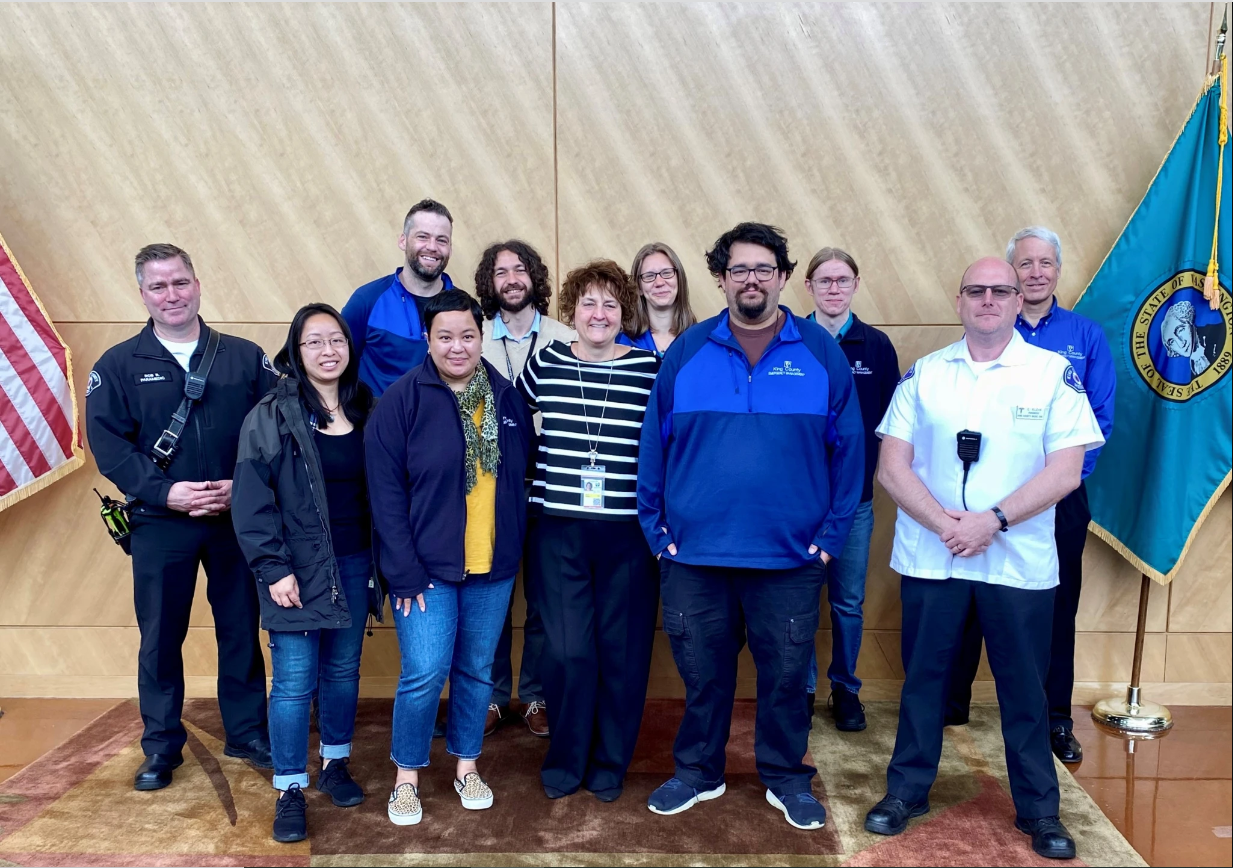
While downtown, you may come across people in blue coats assisting our unsheltered neighbors around City Hall Park. These people are part of the City Hall Park Neighborhood Outreach Team, a one-of-a-kind program funded through the Behavioral Health and Recovery Division (BHRD) within the Department of Community and Human Services (DCHS). 

Robert Ewanio, a King County employee since 2013, supervises the outreach team and is a familiar face around City Hall Park. He took a Special Duty assignment last year to work directly with the outreach team. 

“I saw that the position was open, and I wanted to be involved in the program,” said Ewanio. “Let’s bring behavioral health into the street. People who are in crisis can rely on a trained behavioral health professional to respond, often before police respond.” 

The City Hall Park Neighborhood Outreach Team is made up of eight people. The team includes one mental health professional, and seven peers, and the peers are people who have lived experience, either with homelessness, mental health issues or substance use disorders.

“I’ve been coming to the office throughout the entire pandemic, and during the pandemic the number of people sleeping outside in downtown began to rise, but there was never a time where I felt unsafe,” Ewanio said. “People are trying to survive, and they are trying to live, and you would be surprised how far a simple ‘hi’ goes in the community.” 

The team has seen many people come and go around the park, but one particular incident with an individual stands out.

“Shelby George on our team administered NARCAN as they were overdosing on fentanyl. She saved someone’s life that day,” Ewanio said.

Between November 15, 2021 until the end of September 2022, the outreach team responded to 1060 people in crisis, and made 165 shelter and housing referrals. The team actively monitors the area, and as more connections are made, the team expects the numbers to rise. 

“This is such an incredible resource downtown and shows the County’s willingness to invest in programs that take a human-centered approach and build relationships in the community,” said Whitney Abrams, Chief People Officer at King County. “I encourage employees to reach out directly to the neighborhood outreach team if you are in the service area and have questions, suggestions, or concerns to share. This is a partnership, and ongoing communication and engagement in and around our buildings is critical to the program’s success.”

The area around the park has historically lacked outreach and resources. Since the program began, 64 medical referrals have been made, and 88 case management referrals were made. When an encampment was cleared on Yesler, the team was able to find shelter for seven people. 

Assistance to people in the area is quite varied. The outreach team has encountered individuals who were walking into traffic or standing in the road blocking traffic on multiple occasions, assisting the individuals out of the roadway and back onto the sidewalks.

On another occasion, the outreach team engaged with an individual who was lying on the sidewalk in the same spot for two days in a row.  On the second day, the individual opened up more about why they had not moved, stating someone took their wheelchair and couldn’t move.  The outreach team connected with the Chief Seattle Club and were able to get them a wheelchair and connect them to services there.

Prevention is critical

Not everyone is receptive or willing to use these services. Some people in crisis may have suffered from negative experiences or trauma in their past, and they are anxious or unwilling to be reliant on others for support. In these cases, the team continues to make contact, check on their health and wellness conditions, and ideally build up a trusting relationship.

Prevention is a critical part of the work. Being able to recognize a familiar face, and the services people know they can access, it keeps people engaged, and it reduces the triggers for crisis. If people are getting more food and water, it is less of a trigger for crisis. The connection also reduces the likelihood of crisis.  

Kelli Nomura, Director of BHRD at DCHS recognized the unmet need in the area and helped develop the neighborhood outreach program. 

“The team is proactive in connecting people to possible resources, and has a good understanding of what the City is doing, what the neighborhood is doing, and how to connect people to other resources.”

There is nothing similar to this program, it is a mix of hybrid outreach and de-escalation.

“It is an important investment to have a behavioral health presence in an area that is typically underserved, and our successes are evident by getting folks connected to behavior health and social services,” Nomura said.  “What is most critical in this program is trust—connecting people with an established contact in order to build a relationship.”

When City Hall Park reopens, the City Hall Park Neighborhood Outreach Team will still be in the area, and they plan to be a part of the process of engaging with the community and responding to King County staff in the area.  The service area for the team is from Yesler Way to James Street and 2nd Ave to 6th Ave.

Contact information

To speak with a Neighborhood Outreach Team member directly, or if you see someone in crisis within the service area and don’t know what to do, call 206-537-3770.

For Building security issues or after-hours security escort, contact FMD Security at 206-296-5000 or FMD.Security@kingcounty.gov.

In an emergency situation, call 9-1-1 first, then call FMD security at 206-296-5000.