
Data dashboard shows how vaccinated and boosted people have weathered the omicron surge

Crossposted from Public Health Insider
King County residents who have gotten a booster dose of the COVID-19 vaccines are far less likely to get seriously ill than people who aren’t fully vaccinated, according to a newly updated data tool from Public Health – Seattle & King County.
Public Health has been tracking how well the vaccines are protecting King County residents against the worst outcomes of COVID-19 – hospitalizations and deaths. The data reported on the Outcomes by Vaccination Status dashboard has shown consistently that the vaccines are working.
Now, the dashboard has incorporated booster doses, and the benefits are even clearer: An additional dose gives you a huge boost in protection. Read more.
Share this:

King County marks two years of COVID outbreak, looks ahead to next phase of pandemic response
March 1 marked the two-year anniversary of King County Executive Dow Constantine’s emergency declaration in response to the COVID outbreak in King County, the first community in the nation to face an outbreak of the novel coronavirus, shortly after the nation’s first case was discovered in Snohomish County. Relying on trusted health leaders to chart the course forward and keep the community safe, King County has gone from the epicenter of the outbreak, to now one of the nation’s highest vaccinated communities with the some of the lowest cases and death rates two years later. Read more.
Share this:

Employee Appreciation Day is March 4

King County values the many contributions of each and every single one of our employees. Thank you for your hard work providing services for King County residents, and your dedication during these challenging times. We appreciate your efforts to continue growing, building, and leading the way in making King County a welcoming community where every person can thrive.
Share this:

2022 Engagement Survey starts March 7, and email to participate

Between Monday, March 7, and Tuesday, March 9, most employees will receive an email in their King County inbox from KC Employee Survey (kcemployeesurvey@us.confirmit.com) with the subject line “Welcome to the King County 2022 Employee Survey” inviting them to have their say in this year’s Employee Engagement Survey.
Here is what the email will look like:
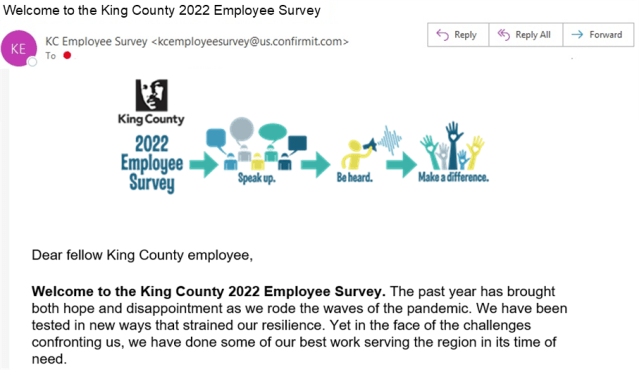
The 2022 Employee Engagement Survey will take place from March 7-25, and it is a great opportunity to let County leaders what is going well and where we need to improve. Remember that changes happen from your suggestions.
The survey — which can be taken on your work computer or a mobile device — will take no more than 15 minutes and can be done during work time. Your responses are 100% anonymous and cannot be traced back to you.
Here’s what you can expect in 2022:
- All employees will take the survey electronically, saving 80 reams of paper – or roughly five trees each year.
- The survey will be available in English, Spanish, Vietnamese, Chinese, Amharic and Somali.
- The most important elements of the survey will not change: the confidentiality and anonymity of participants, and our commitment to act on what employees tell us.
- You can take the survey on work time.
- When you speak up, you’ll be heard, and it will make a difference.
All employees are eligible for the employee survey, except the following:
- Employees in Superior Court, District Court, and Prosecuting Attorney’s Office
- Employees who are interns or short term temporary (STT)
- Employees who have not worked at the county for at least 3 months prior to the survey period (for 2022, employees must have started before December 7, 2021 to be eligible).
For FAQs and more information about the survey visit www.kingcounty.gov/employeesurvey.
Share this:

Celebrating 2022 Women’s History Month
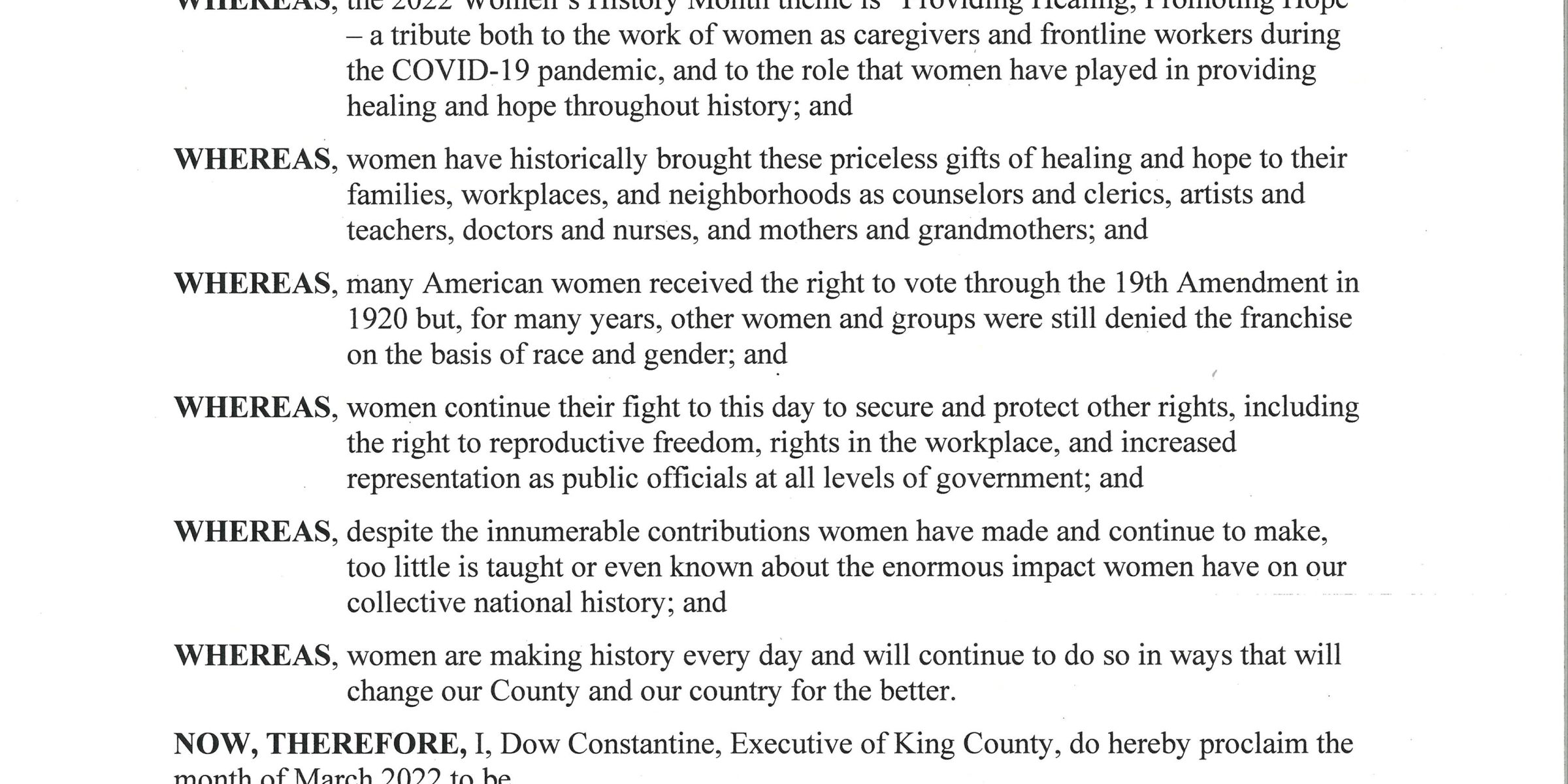
King County Executive Dow Constantine has proclaimed the month of March Women’s History Month in King County, and encouraged all residents to participate in events to commemorate and honor women and their contributions to our community and nation.
“The 2022 Women’s History Month theme is ‘Providing Healing, Promoting Hope” – a tribute both to the work of women as caregivers and frontline workers during the COVID-19 pandemic, and to the role that women have played in providing healing and hope throughout history,” Executive Constantine said in the Proclamation. “Despite the innumerable contributions women have made and continue to make, too little is taught or even known about the enormous impact women have on our collective national history.”
“Women are making history every day and will continue to do so in ways that will change our County and our country for the better.”
Share this:

Updates to mask requirements and other COVID-19 restrictions

Starting today, March 1, restrictions on in-person work and In-person meetings will be removed for King County employees, and updated mask requirements and other guidance come into effect:

- Employees must wear a mask in indoor settings and enclosed spaces that are accessible to the public. This applies to all King County buildings, facilities, and structures that the public can enter, including public lobby and meeting spaces, public indoor recreation spaces, public service counters, and similar spaces open to the public.
- Masks are not required in areas that are not accessible to the public, because all employees are fully vaccinated or otherwise accommodated as required by county policy.
- Masks remain required on transit and in congregate settings and health care facilities, including detention facilities and public health clinics.
- Social distancing requirements and capacity restrictions in buildings, elevators, and other locations have been lifted.
- The subsidized daily rate is $10 for employee parking at the Goat Hill Parking Garage and King Street Center Garage is now available.
Starting March 12, King County is removing most restrictions in alignment with updated State of Washington guidance:
- Masks will be optional in all settings, including public facing spaces, except on transit and in congregate settings and health care facilities, including detention facilities and public health clinics, where masks will continue to be required.
- We support anyone who wants to continue to wear a mask.
Thanks to our vaccine mandate and the success of the booster program, and other precautions King County employees and residents have taken, we are now able to lift many of the COVID-19 restrictions we’ve had in place for months. We are continuing to work closely with public health officials and monitoring COVID-19 trends. If warranted, the County will not hesitate to reintroduce restrictions.
Departments are now beginning to implement their Future of Work plans, which set out how services will be delivered moving forward, whether that’s in-person, remotely, or a hybrid of both. Department leaders have begun to share the plans and expectations for teams and operations, which vary from team to team across the county. For more information about Future of Work plans, please visit our Future of Work intranet site and talk to your supervisor for details specific to your workgroup. This direction is for King County Executive branch employees, including Assessments, Elections, and the Sheriff’s Office. Employees in other branches of County government may receive additional guidance from their leaders.
Share this:

2022 Engagement Survey starts March 7
 King County’s Employee Engagement Survey is back in 2022.
Every year, the County’s Employee Engagement team recommends improvements to the data and survey process. Many of these improvement ideas come directly from employees. Their feedback helps us improve the employee experience and data quality, and to provide better analysis.
Here’s what you can expect in 2022:
- All employees will take the survey electronically, saving 80 reams of paper – or roughly five trees each year.
- The survey will be available in English, Spanish, Vietnamese, Chinese, Amharic and Somali.
- The most important elements of the survey will not change: the confidentiality and anonymity of participants, and our commitment to act on what employees tell us.
- You can take the survey on work time.
- When you speak up, you’ll be heard, and it will make a difference.
The 2022 Employee Engagement Survey will run from March 7 to 25, and all employees are eligible for the employee survey, except the following:
- Employees in Superior Court, District Court, and the Prosecuting Attorney’s Office
- Employees who are interns or short-term temporary (STT)
- Employees who have not worked at the county for at least 3 months prior to the survey period (For 2022, employees must have started before December 8, 2021 to be eligible).
Look for the survey starting March 7 and do not miss this great opportunity to have your say.
Share this:

Three required trainings must be completed this quarter
King County Executive branch employees are required to complete three mandatory trainings by the start of April 2022:
- Harassment Prevention for Employees: complete by March 30, 2022
- King County Immigrant and Refugee Ordinance: complete by April 1, 2022
- Cybersecurity: complete by March 31, 2022.
For employees assigned the courses as part of New Employee Orientation, due dates are 90 days after your hire date rather than the dates listed above.
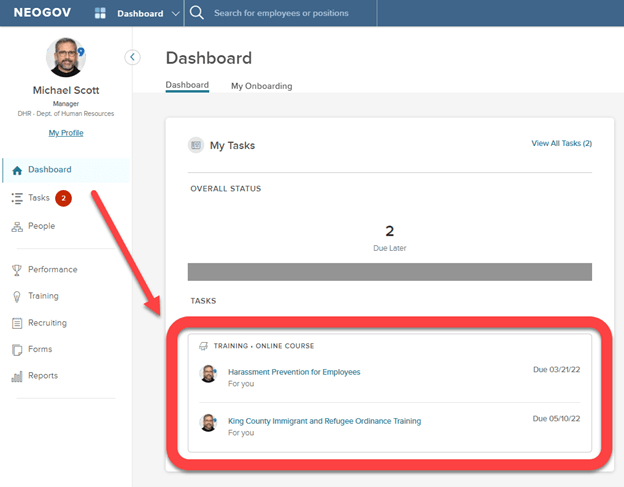
To find both the Harassment Prevention for Employees and Immigrant and Refugee Ordinance trainings, go to your KC eLearning NEOGOV Learn dashboard. To see your completed trainings, click on Training and then View Course Transcript (see below):

If you are yet to complete either training, you will find a direct link to the course on the front page of your Dashboard, under your Tasks (see below):
To find the Cybersecurity training, go to training.knowbe4.com and click on either Training or Go to Training (see below). You may be asked to log in with your King County email address:

Employees who do not have regular access to a computer will receive alternative instructions and timelines for completing these trainings.
Employees will be paid for their time taking these training and supervisors will work to fit them into schedules. If you have any questions, please talk to your supervisor.
Thank you for helping us provide a workplace experience built on mutual trust and respect, equity, inclusion, and opportunity, where every employee can be their best and do their best work.
For assistance with the trainings, please contact KCIT and open a HelpDesk Ticket. You can do so here online, or by calling the HelpDesk at 206-263-4357.
Share this:

Meet new county employee and Health Hero, Amber Heyward

 For Black History Month, Balanced You is excited to recognize our many talented Black employees in different bodies of work around the county.
Welcome new county employee, Amber Heyward. With a background in HR, Learning and Development and Organizational Development, she started at King County four months ago as an Organizational Development practitioner.
In this video she talks about her team’s goal to build equitable and enjoyable workplaces and why she was drawn to government work and King County specifically. Watch this video to learn more.
Share this:

Metro celebrates Black History Month with special event featuring Dr. Terrence James Roberts
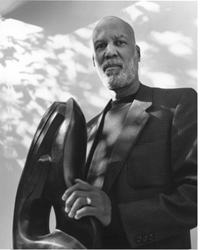
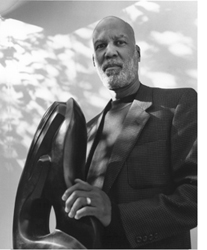 Metro’s Office of Equity, Inclusion and Belonging is honored to continue the celebration of Transit Equity Day and Black History Month with a special Lunch and Learn event featuring Congressional Gold Medal recipient, scholar, and Civil Rights figure, Dr. Terrence James Roberts.
Dr. Roberts is one of the Little Rock Nine, the group of nine black students who enrolled at formerly all-white Central High School in Little Rock, Arkansas in September 1957. The nine students’ attendance put to test the landmark Brown vs. Board of Education United States Supreme Court ruling that segregation in public schools was unconstitutional.
Join Dr. Roberts for a conversation on this history and present day efforts to realize racial justice. All King County employees are invited.
- Monday, Feb. 28 from noon to 1 p.m. Register here.






 Employee News