
Supported employee takes pride in his work, shares joy with community

The Supported Employment Program (SEP) provides employment opportunities within King County government to people with disabilities. With an assigned job coach, and supportive supervisors and team members, participants are encouraged to fulfill their potential, pursue career goals, and thrive in a helpful environment.

Pictured: Office Assistant and Supported Employee Naveed Labib
One employee within the Supported Employment Program who enjoys his work and the chance to make a difference is Naveed Labib, an Office Assistant in the Transit Facilities Division of the Metro Transit Department. Naveed has been with King County since January 2018. While some of his duties include working on payroll, completing time sheets, utility billing, and filing, they have recently expanded. He now also helps other groups beyond his specific team within the Division.
“It feels good to go beyond, and be proven to be reliable and independent,” Naveed shares. “I love being productive and love working hard.”
Naveed also credits his supervisor, Jake Jacobovitch, for being a supportive and caring manager. Jake is a superintendent within the Transit Facilities Division and has been with King County overall for 36 years, and with Metro Transit the last nine years. He oversees the environmental compliance group, his division’s equity and social justice program, the safety program, and Naveed.

Pictured: Naveed’s supervisor Jake Jacobovitch
“Wherever Naveed goes, I go with him,” Jake explains. “I’m proud I hired Naveed. He’s developed into a wonderful person and employee.”
“Jake is an amazing superintendent,” said Naveed. “He is so supportive.”
Naveed likes completing his duties and takes satisfaction from knowing it is important, meaningful work. He explains how he’s proud to earn his keep and be on top of things, especially with his favorite task, the time sheets.
“I enjoy doing time sheets, I like to help out everybody,” he said. “Time sheets, utility billing – I enjoy working with numbers, and something I also really enjoy is knowing how others can rely on me and being dependable.”
“I tell myself each day, if I finish what I’ve needed to do and proven to others it’s another day that they can depend on me, then I feel good.”
“Naveed is very reliable. He is precise in his duties and tasks. So much so that the accuracy of his work is recognized,” added Jake.
The Supported Employment Program provides job coaches and additional support for each employee. Naveed shares how in his King County position, he has been able to gain some independence, while still knowing he has a team of supportive people in his corner.
“Initially when I started, I had support from two job coaches, and we were meeting weekly, but currently I just have one. He calls me monthly, and we talk about any issues,” he said.
Naveed has transitioned to remote work, as has the rest of the administrative team during the pandemic, and he continues to produce accurate and timely work. During this transition, he has become more independent and requires even less job coaching support.
Jake shares how he worked closely with the Supported Employment Program Manager, Christina Davidson, to recruit a full-time employee (FTE) that met the division’s business needs and ensured that both Naveed and the overall workgroup were successful.
“In 2017 leaders said we had a SEP program, and that it was a priority within Metro Transit to participate, so we identified a body of work and completed interviews with different candidates, then chose Naveed,” he said.
“There was a big emphasis to make it a success, so we worked with SEP staff and Naveed’s job coach to ensure we would be successful.”
Naveed explains his journey to getting his role at King County. He first got involved with supported employment about 12 years ago through the King County School-to-Work Transition Program, where young adults with disabilities are connected with jobs based on their interests and skills.
“I worked at a library, Trader Joes, and other places, but out of all of those jobs I enjoy working at King County the most,” said Naveed. “I enjoy working with people the most, and I have an amazing superintendent who is always looking out for my best interests.”

Pictured: Naveed as a Snowflake Lane reindeer
In addition to his work at King County, Naveed also stays busy in his free time. He has received his Associates and Bachelor’s degrees, regularly completes adventurous, long-range walks, holds a part-time job, and also works at Bellevue’s Snowflake Lane during the holiday season.
“I recently started working part time at CVS Health as a retail associate, working the cash register, stocking items, and checking out customers,” he said. “And also, during the holidays I work at Snowflake Lane in Bellevue as a reindeer. It’s a beautiful job and it keeps me happy.
“I get to dress up and walk down the streets every evening, waving at the audience, and have pictures taken. I love it.”
The Supported Employment Program has been a rewarding experience for Naveed and Jake, one that they both strongly recommend other workgroups consider, and are grateful King County has made the effort to develop it.
“It’s important that people with a disability are given paid opportunities to develop their skills and interests,” said Naveed. “It’s important to broaden their knowledge about different positions they could do as well as expand their communication skills through work experiences with their fellow employees. I feel like this helps each person understand more about themselves.”

Pictured: Naveed and his coworkers as Snowflake Lane reindeers
Jake adds the Program is a great way to help adults with disabilities find a workplace that suits them and is willing to work with them.
“There are many people with disabilities that can do the work, but they can’t navigate through the system. Not just at King County but everywhere,” Jake said. “This initiative is a good one to give opportunities to individuals who may need help in applying to ensure it’s a good fit and to be successful.”
Jake and Naveed hope that by sharing about their positive experiences with the Supported Employment Program at King County, they can inspire others with disabilities to know that there is a place for them, with supportive, caring colleagues and dedicated support staff.
“It’s important for the general public to know about this program, to find the resources they need and help young adults with disabilities to find a job and see their options,” Naveed said. “We want to encourage more people to come work for King County.”
To learn more, visit the Supported Employment Program website, or contact Program Manager Christina Davidson at Christina.Davidson@kingcounty.gov to find out how to take advantage of this program.
Share this:

Vanpool and Vanshare program requirements lowered from five riders to three

Starting Jan. 1, 2022, King County employees may start a King County Metro Vanpool or Vanshare with only three or more participants and the cost will be covered 100% by the Employee Transportation Program (ETP). This reduced ridership minimum from five participants to three or more participants is being offered after the recent survey of employee safety programs highlighted employee interest in more shared ride options for commuting into downtown Seattle. As a result of the survey and support from ETP, the Executive’s Office approved continuing the 100% subsidy for employees commuting in a Metro Commuter Van through the end of 2022.

The Metro Commuter Van program is ideal for groups of consistent commuters who have a common route to work and are willing to share the driving and bookkeeping roles in the van. The program includes everything for your shared ride to work – the van, fuel, maintenance, insurance, roadside assistance, and the Home Free Guarantee program. There are nearly 30 existing Metro Commuter Vans from various King County departments traveling to worksites throughout the county, some able to accommodate up to 15 passengers. In addition, for commuters traveling to Seattle’s downtown core, parking costs for vans may also be covered.
Metro Vanpool is your direct commute to work where the van is parked overnight at the assigned driver’s home. The driver picks up passengers at pickup locations and then travels to the worksite. The vanpool can travel in HOV lanes and pass for FREE through WSDOT toll facilities, and is a great way to reduce stress and save money.
For commuters riding the train, ferry or bus, Metro Vanshare can provide the first connection to the terminal or station, or link the last couple miles from the terminal or station to your worksite.
To find an existing Metro Vanpool or Vanshare, or find others to start a new group, create your commute profile at www.RideshareOnline.com. If you would like to start a new group with at least two other participants who share a similar commute, start here and submit information about your group to start the process.
Please know that any transportation benefit amount in excess of the IRS limit for the year, $270.00 for 2021 is taxable income and will show in your W-2.
For more information about this commute option or your ETP program, please visit www.Kingcounty.gov/ETP or ask Hossein, the ETP Manager.
Share this:

Paid Family and Medical Leave benefit and rates to increase Jan. 1

The state of Washington is making the following changes to the Paid Family and Medical Leave (PFML) program, effective Jan. 1, 2022.

Higher premiums
The total premium rate for Washington PFML will increase to 0.6% (from 0.4% in 2021) of each employee’s gross wages up to the 2022 Social Security cap of $147,000 (was $142,800 in 2021).
Increased benefit for employees
The maximum PFML weekly benefit will increase to $1,327 for leaves beginning in 2022 (from $1,206 in 2021). The PFML benefit amount is based on your income.
Employees to pay a larger portion of the premiums
In 2022, employers will pay 26.78% of the premium and employees will pay 73.22%. In 2021, employers paid 36.67% of the premium and employees paid 63.33%.
The PFML premium calculation occurs on Sept. 30 each year and is governed by state statute (see RCW 50A.10.030). The rate hike appears to be driven by high usage of the program over the last year, coupled with reduced payrolls feeding into the program during the pandemic.
To learn more about PFML rates, go to the Premiums Calculator on the Washington PFML website. For complete information about PFML and to apply, go to Paid Family and Medical Leave or contact them by email paidleave@esd.wa.gov or by phone at 833-717-2273.
Share this:

Our recent survey about employee safety programs
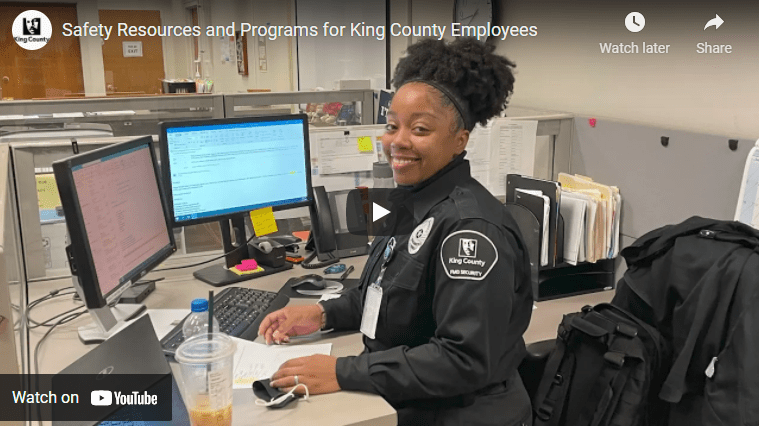
Almost 2,500 King County employees who work in downtown Seattle recently had their say on new and existing programs designed to enhance safety at and around county worksites in the downtown campus.
A total of 6,833 employees were invited to take the survey, with 2,491 submitting responses. The key findings were:
- For existing programs, employees were most interested in the Security Escort program (57% very or somewhat interested) followed by Walk-pooling (47%), VanPool (35%), Goat Hill Garage Tunnel (30%), and VanShare (25%). Almost half (42%) of employees were very or somewhat interested in a walking bus program.
- There is a large gap between those that are using safe travel programs and those that are interested. This indicates a lack of awareness in safe travel programs.
- The top thing that employees reported that would help them feel safe traveling to and from work was an increase in security presence in and around county buildings, parking garages, bus stops, and train stations.
- Of those who were interested in a vanpool, carpool, walking bus, or security escort, the average amount of time they would be willing to wait was approximately 13 minutes.
These responses are helping the county provide solutions that help employees commute more safely to and from work. One of the immediate actions in response to the survey was the launch of the Walking Bus pilot program, which leaves the King County Courthouse each weeknight to the King Street Station and the Colman Dock, accompanied by a Facilities Management Division security escort. Watch this video to learn more about this and other programs available to you. You can always find information about safety at work on our Future of Work site.
Share this:

Spend your Flexible Spending Account money

Do you have money left in your Flexible Spending Account (FSA)? Check the balance of your Health Care or Day Care FSA by going to Navia Benefits and signing in to your account. Expenses incurred by Dec. 31, 2021, must be submitted for reimbursement by March 31, 2022.

For this year only, any unused funds in your 2021 Health Care or Dependent Day Care FSAs will automatically roll over and be available next year. You do not have to be enrolled in an FSA next year to access these funds. (Normally, the Health Care FSA allows you to carry over up to $550 and the Dependent Day Care FSA does not offer a carryover feature.)
Day Care FSAs
- Use your Day Care FSA to pay for day care or dependent care expenses for your child under age 13, disabled spouse, or dependent parent so you can work or attend school full-time.
- Day Care FSA funds can also be used to pay an eligible family members to watch your children, as long as the family member is not your tax dependent (your spouse, the parent of the child, your dependent, or your child under the age of 19).
- Online or virtual day cares and camps are not eligible for reimbursement with Day Care FSAs, according to IRS regulations.
- See the complete list of Day Care FSA Eligible & Ineligible Expenses.
Health Care FSAs
- You can use your Health Care FSA funds to pay for a variety of medical, dental, and vision expenses for you, your spouse or eligible domestic partner, and your dependents.
- Health Care FSA funds can be used to pay for orthodontia, laser eye surgery, eyeglasses, and over-the-counter medications and supplies, including menstrual care products. They can also be used for eligible ergonomic office equipment when you obtain a letter of medical necessity from your doctor.
- See the complete list of Health Care FSA Eligible & Ineligible Expenses. You can also shop online at the FSA Store.
If you have questions about your FSA benefits, contact Navia Benefit Solutions at 425-452-3500 or email Navia Benefit Solutions.
Share this:

$2 million for King County departments, agencies to increase language access services

We know language access and providing King County communities with accurate information in a language they understand is more important than ever. When people can receive information and services in the language and format that is accessible, it leads to more equitable and healthier outcomes

King County has $2 million in federal funding to distribute to departments, agencies and divisions to increase language access as part of our pandemic response and recovery efforts. The Office of Equity and Social Justice (OESJ), in partnership with the Office of Performance, Strategy and Budget (PSB), will be allocating these resources. Applications will open soon.
This program is meant to improve Language Access Supports, including limited English proficiency, English Language Learners, American Sign Language users, and individuals with communication barriers and disabilities, especially as it pertains to COVID-19 and COVID-19 impacts. Applicable uses include, but are not limited to:
- Contracting translation or interpretation services for live services or translating documents
- Disseminating translated materials to all media, such as ethnic media or social media
- Purchasing software or equipment to facilitate language access
- Responding to disability-related accommodation requests
OESJ will host two informational sessions for agencies interested in applying:
Informational Session #1
Thursday, December 9, 2021 11:00 AM-12:00 PM
Zoom Webinar Link: https://kingcounty.zoom.us/j/89864608633
Webinar ID: 898 6460 8633
Call by phone: (253) 215-8782
Informational Session #2
Monday, December 13, 2021 1:00 PM-2:00 PM
Zoom Webinar Link: https://kingcounty.zoom.us/j/84197669972
Webinar ID: 841 9766 9972
Call by phone: (253) 215-8782
If you have additional questions, reach out to the Office of Equity and Social Justice by emailing oesjgrants@kingcounty.gov or KClanguages@kingcounty.gov.
Share this:

Connecting to VPN? You’ll need to verify your identity

King County’s AnyConnect VPN software will get MFA (Multi-Factor Authentication) security starting on December 1, 2021.
What does this mean for you? Each time you connect to VPN you must provide your username (username@kingcounty.gov) and password, and verify your identity on a separate device such as a cell phone or digital fob – just like when you access your Microsoft account. For employees currently enrolled in MFA, no additional action is necessary. Simply respond to the MFA security requests on your enrolled device, as described below.
If you are not enrolled in MFA, please do so immediately to maintain access to VPN. You can check to make sure you’re enrolled and set your MFA preferences at My Account (microsoft.com) on the Security Info page. For assistance, Executive branch employees should contact the KCIT Helpdesk. Employees in separately-elected agencies can contact their department IT support.
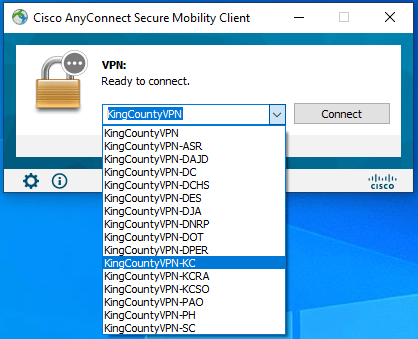
1. Preview of the new AnyConnect VPN login process: Select your department and click Connect to start VPN. Note: The current “KingCountyVPN” option will be removed shortly – please select your department. If you don’t see your department in the dropdown list, choose KingCountyVPN-KC.
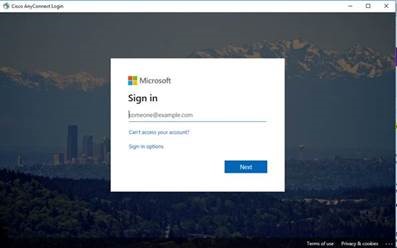
2. Enter your King County username (username@kingcounty.gov) and password.
3. A notification will ask you to verify your identity on a separate device.
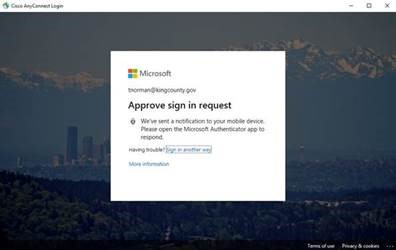
4. Approve the MFA challenge using your enrolled device (your cell phone or fob). Remember: Never approve an unexpected MFA challenge; it could be someone attempting to access your account.
Employees accessing VPN must select their agency from the drop-down list in their desktop client, or use an agency-specific URL to log in (see list below). If your agency is not listed here, you should use https://remote.kingcounty.gov/kc
- https://remote.kingcounty.gov/asr
- https://remote.kingcounty.gov/dajd
- https://remote.kingcounty.gov/dc
- https://remote.kingcounty.gov/dchs
- https://remote.kingcounty.gov/des
- https://remote.kingcounty.gov/dja
- https://remote.kingcounty.gov/dnrp
- https://remote.kingcounty.gov/dot
- https://remote.kingcounty.gov/dper
- https://remote.kingcounty.gov/kcra
- https://remote.kingcounty.gov/kcso
- https://remote.kingcounty.gov/pao
- https://remote.kingcounty.gov/ph
- https://remote.kingcounty.gov/sc
Share this:

Changes coming to PeopleSoft – new login and security requirements


Starting Monday, Nov. 22, you will be prompted to log in to PeopleSoft using your King County network username and password. This streamlined login experience gives you one less password to manage and better protects your PeopleSoft account from cyber attacks using Multi-Factor Authentication (MFA) security, also called “two-step verification.”
For employees currently enrolled in MFA, no additional action is necessary. If you are not currently enrolled in MFA, you should do so immediately to maintain access to PeopleSoft. Executive branch employees should contact the KCIT Helpdesk. Employees in other branches of county government may contact their agency’s IT support.
Review this quick reference guide for more information about logging in to PeopleSoft with King County’s single sign on and MFA.
How Multi-Factor Authentication (MFA) safeguards your information
Ninety-nine percent of organizations that experience cyber security issues don’t use Multi-Factor Authentication, also called “two-step verification.” That’s why King County requires MFA when you log in to Microsoft apps such as Outlook or Teams, and is expanding this important security measure to other web-based apps. In addition to your regular username and password, you must also verify your identity by responding to an MFA security challenge sent to a separate device, such a cell phone or digital fob. Your information is safer because thieves would need to steal both your password and your phone or fob, making it harder for bad guys to log in as if they were you.
For assistance, Executive branch employees should contact the KCIT Helpdesk. Employees not in the Executive branch can contact their department IT support.
Thank you for keeping King County safe from cyber attacks.
Share this:

New Gender Identity in the Workplace policy
By Whitney Abrams, Chief People Officer
This week, as we celebrate Transgender Awareness Week, we are launching a new King County policy: Gender Identity in the Workplace: Policies for Supporting Transgender, Non-Binary and Gender Diverse Employees.
This policy sets out guidelines to address the workplace needs of transgender, non-binary, and gender diverse employees and helps us create a safe, inclusive, and productive workplace that is free of harassment and discrimination in accordance with the county’s Non-Discrimination, Anti-Harassment and Inappropriate Conduct Policy.
Our True North – Making King County a welcoming community where all people can thrive – applies just as much to the workplace culture we are building at King County as it does to our community. We all play a crucial role in Leading the Way and helping to provide a welcoming, inclusive workplace.
I encourage you to review the policy and become familiar with your role in supporting the needs of our transgender, non-binary, and gender diverse colleagues and helping us create a safe, supportive, and respectful workplace culture where every employee can thrive.
Thank you for everything you do for our residents and your colleagues, and for helping to ensure everyone feels welcome, respected, and supported at work.
Key elements of the policy
- King County employees have the right to be addressed by the name and pronoun that correspond to their gender identity, and managers and supervisors shall support their employees in the workplace by modeling and enforcing the use of the name and pronoun corresponding to each employee’s gender identity.
- The repeated and deliberate refusal to respect an employee’s gender identity (for example, deliberately referring to the employee by a name or pronoun that does not correspond to the employee’s gender identity) can constitute harassment and is a violation of the county’s Non-Discrimination, Anti-Harassment & Inappropriate Conduct Policy. If an employee is unsure what pronouns a coworker uses, it is appropriate to politely ask that coworker how they would like to be addressed.
- The County will update items used in the workplace during everyday interactions, such as email accounts, employee directories, business cards, name tags, and all similar items that do not pose legal or security implications, to ensure the employee’s name and gender expression are represented according to the employee’s gender identity.
- The photograph or name on an employee identification badge may be updated at any time to reflect the employee’s gender presentation. Fees for a new county-issued badge shall be waived in these cases.
- Transgender, non-binary, and gender diverse employees have the right to comply with county dress codes in a manner consistent with their gender identity or gender expression. Within county gender-segregated job assignments, all employees will be classified and assigned in a manner consistent with their gender identity, not their sex assigned at birth.
- Employees shall have access to the restroom and/or comfort stations corresponding to their gender identity. That is, transgender women must be permitted to use the women’s restroom, and transgender men must be permitted to use the men’s restroom. Any employee who has a need or desire for increased privacy, regardless of the underlying reason, will be provided access to a gender-neutral, single-stall restroom, when available. No employee, however, shall be required to use such a restroom.
- The policy also sets out processes to support employees transitioning in the workplace, as well as processes for reporting conduct in violation of the policy.
Share this:

Taking action on September pulse survey responses

The most recent employee engagement pulse survey found that Engagement, Well-being, and Belonging indices are all trending upwards since the previous survey, and that a sense of belonging among teams can help reduce stress and increase well-being.
The pulse survey, conducted in September 2021, took a deeper dive into belonging to better understand how our public service work benefits when employees have a strong sense of belonging and well-being.
Key findings included:
- Well-being, engagement, and belonging are all trending up for most demographics, except 51 and older where belonging and engagement have decreased.
- There were significant increases in employee concerns about contracting COVID-19, mental health, and emotional demands of work.
- At King County, a strong sense of belonging is associated with:
- Much lower levels of workplace stress:
- Only 23% of employees with a high sense of belonging report regularly feeling excessive stress at work compared to 52% of employees with a low sense of belonging.
- Employees with a low sense of belonging are more likely to experience stress related to conflict with co-workers, uncertainty about their role/work, a lack of control over their work, or a poor relationship with their manager.
- Much greater willingness to stay at the organization if offered a similar job at another company:
- 84% of employees with a high sense of belonging are willing to stay at the organization compared to only 38% of employees with a low sense of belonging.
- Much greater enthusiasm for work:
- 94% of employees with a high sense of belonging are enthusiastic about their work compared to only 67% of employees with a low sense of belonging.
- Much lower levels of workplace stress:
At the same time, more than three-quarters (76%) of expected action plans have been entered. Of those, almost half (44%) are focused specifically on improving employees’ sense of belonging.

Popular actions include:
- Team activities to build belonging
- 3 things that have most shaped people
- “I am, but I am not”
- Rose and thorn
- Regular practices to promote connection
- Ice breakers at the beginning of meetings
- 1-5 check ins
- Recognizing people for effort and growth
- Creating opportunities for collective problem solving
- Engaging people in decisions impacting them
- Make it a practice to ask team for input and incorporate what is shared.
Summary of key findings and recommended responses
| Finding | Recommendation |
| Engagement, Well-being, and Belonging indices are all trending upwards since the June 2021 survey. | Continue to execute action plans focused on belonging and well-being. |
| Employees feel that they have the resources to manage their health but mental health concerns and concerns about contracting COVID-19 are increasing. | Leaders and managers should continue to show support for employee health and well-being especially around issues of mental health. |
| A sense of belonging among teams can help reduce stress and increase well-being. Leaders and managers play a critical role in creating this sense of belonging. | Leaders and managers can help build a culture of belonging and well-being by shifting away from trauma holding crisis management and toward a healing, relational culture. Specifically, leaders and managers should be intentional about including employees in decision making, showing appreciation, and creating safe spaces for listening/sharing different perspectives. Senior and department leadership can help this by demonstrating behaviors that model vulnerability, empathy, and inclusion. |
| On-site workers are less familiar with important Office of Equity and Social Justice (OESJ) communication topics compared to remote workers. | OESJ topics should be communicated using channels that are inclusive of on-site workers that may not work at a computer with regular access to email. |
The survey was a random sample of Executive Branch employees, conducted via email and QR code invitation. A total of 877 responses were collected between Sept. 8 – 27, 2021.






 Employee News