
My Secure Advantage: New May webinars and COVID-19 financial resources

As the number of businesses affected by the coronavirus continues to rise, so do the financial impacts on countless employees. My Secure Advantage (MSA) remains steadfast in its commitment to provide responsive, relevant personal financial guidance to employees and their families throughout this crisis and the better days to come.
Register now for new May webinars
- Navigating your Finances in Unpredictable Times: May 1, 2020, 9 a.m. Register here.
- Investor Education: Managing your Money in Volatile Markets: May 1, 2020, noon. Register here.
- Tips for Major Purchases: May 12, 2020, 9 a.m. and noon. Register here.
- I Want to Buy a House: May 28, 2020, 9 a.m. and noon. Register here.
Stay up to date with MSA’s latest COVID-19 resources:
- Financial Checklists For COVID-19
- What emergency relief options should I consider during the coronavirus pandemic?
- What issues should I consider if I lose my job?
- What issues should I consider during a recession or market correction?
- Your Income & COVID-19
- Financial Resources for Health Emergencies
- Smart Financial Moves During The COVID-19 Crisis
- Stock Market Corrections & Your Investment Strategy
Share this:

Black/African Affinity Group finds strength

At King County, having a community to connect with is crucial, even more so in dealing with the COVID-19 pandemic, and the County’s Employee Resource Groups, or Affinity Groups, are helping employees support one another.
The Black/African Affinity Group centers on providing employees with a community platform. Historically, the focal point of African American life has centered around community such as family, churches, neighborhoods, and organizations, providing a way to connect, share resources, and share knowledge.

Pictured: Danita Carter
“Our goal in our Black/African Affinity Group is to bring collective souls together for one purpose… to share our gifts and talents in a way that they benefit our community,” said Danita Carter, Records and Licensing Services (RALS) Finance Manager and Co-Chair of the Black/African Affinity Group.
“We have so much to offer, not only to each other, but also others that are seeking guidance, direction, and resources. During this time of uncertainty, we stand together; sharing ourselves, and bringing value by serving others.”
The Affinity Group has used its collective knowledge and networks to help people in the community. For example, a Black/African community member recently reached out to the Affinity Group seeking information about current COVID-19 practices and policies dealing with renters, landlords, and evictions of tenants. Multiple members of the group rose up in support and provided resources and information to help their fellow community member.

Pictured: Jabari Hampton
“It is essential that we do this work as one of many tools that disrupts and transforms oppressive structures,” said Jabari Hampton, Liaison for Capital Projects in Metro’s Vehicle Maintenance Division, and Communications and Membership Chair for the Affinity Group.
“As our community continues on its restorative journey, we will continue to create space for connection, healing, and development.”
Natasha Sable, a Functional Analyst I with Access in Metro’s Mobility Division and an Administrator with the Black/African Affinity Group Leadership Council, decided to put her creativity to use to give back to the community and help with COVID-19 response efforts. She searched the internet for an effective cloth mask design and created the first batch of 16 masks using fabric from her own personal supply.

Pictured: Natasha Sable and masks she donated to Metro’s Transportation for Pandemic Response team.
Natasha donated the first batch of masks that she created to Metro’s Transportation for Pandemic Response (TPR) training team. TPR is a collaboration between various divisions that was launched in early April and transports individuals that have tested positive or presumed positive for COVID-19 to various approved sites such as quarantine isolation sites, shelters, hospitals, and more.
“I wanted to provide peace of mind to whomever ended up with the mask donations, whether it be the drivers or passengers, even if it was just to help minimize any personal stress,” Natasha said.
For Adé Franklin, Division Director of Transport Facilities, Metro Transit Department, and Co-Chair of the Black/African Affinity Group, being a member of the affinity group is important on multiple levels.

Pictured: Adé Franklin, who was also a guest speaker at the 2018 Lift Every Youth Graduation.
“When I think about what being a part of the Black and African Affinity Group means to me, I remember a conversation amongst our Leadership Council where the following quote from Rabbi Hillel was shared: ‘If I am not for myself, who will be for me? If I am not for others, what am I? And if not now, when?’,” Adé said.
“The first question reminds us to honor ourselves through self-care. The second reminds us that we must take care of one another. And the last reminds us to have a sense of purpose in our service. At least, in reflecting on what BAAG means to me – this is what comes to mind.”
If you are interested in joining the Black/African Affinity Group, email Jabari Hampton, Communications and Membership Chair. For information about the Affinity Groups, including the policy, visit the Affinity Groups webpage, download this flyer, or watch this video.
Miesha Vaughn and Ebony Frazier contributed to this article. Miesha is a Tort Claims Investigator in the Risk Management Division, and her role within the Affinity Group is Community Health and Outreach Officer. Ebony is a Project/Program Manager in the Community Corrections Division, and her role within the Affinity Group is Strategic Advisor.
Share this:

Learning about your benefits: Life and disability insurance

In this short video, learn about the life and disability insurance options available to you as a new employee, during qualifying life events, and during Open Enrollment.
This video is part of a short created to help employees make informed choices about their options, and better understand their employee benefits package. View all the videos here, and get more information and resources on the Benefits, Payroll and Retirement website.
Share this:

Featured job: Advanced Registered Nurse Practitioner – Covid-19 Response Recovery Centers

Salary: $42.69 – $60.09 Hourly
Location: Multiple locations in King County, WA
Job Type: Short Term Temporary, Part Time, Std Wkly Hrs Vary
Department: DPH – Public Health
Job Number: 2020NH11611
Division: Community Health Services
Closing: Continuous
Learn more about this position or view all available positions.
Share this:

Vanpools for just 2+ riders available for essential workers
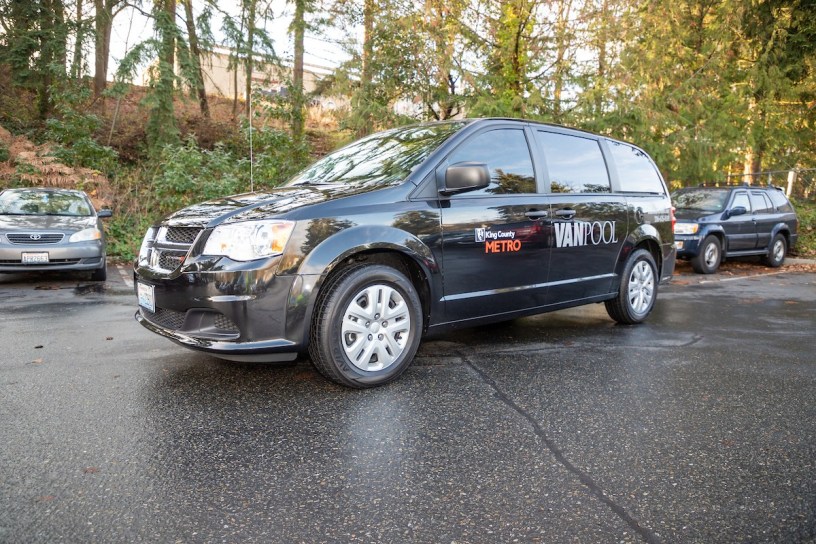
 Crossposted from Metro Matters
To support COVID-19 response and recovery efforts, King County Metro is offering essential workers the opportunity to form temporary vanpools with as few as two riders.
Metro Vanpool is a commuter service using Metro vans for small groups of people – normally five or more coworkers, friends, or neighbors – with a similar origin or destination.
Read more from Metro Matters
Share this:

Not seeing friends and family is hard, but it’s worth it

 Crossposted from Public Health Insider
Grandparents miss cuddling their grandbabies. Teens miss hangouts and deep talks with their closest friends. We miss seeing our siblings and cousins, best friends, barbers, co-workers, teachers, and gym buddies. Everyone is feeling the strain from the lack of in-person interaction that makes life rich and full. COVID-19 is taking a toll, and we all want life to get back to normal and to spend time together face-to-face.
As much as we yearn to see our loved ones, there’s a lot at stake if we let go of the stay home measure prematurely. People living in King County and the state of Washington deserve so much credit for the sacrifices they’ve made in staying home. Our actions have proven that we can slow COVID-19 down, and its saving lives. Now we need to protect those gains and prevent a sudden increase in illness.
Read more from Public Health Insider
Share this:

Public records during COVID-19

COVID-19 has changed so much about the way we work, but one thing that hasn’t changed is that we are stewards of the public’s records. As such, we must maintain both good records management practices and provide timely responses to requests for public records, whether those come from the public directly, or through a public records officer (PRO) or coordinator. King County’s Executive Branch has received over 100 public records requests specific to COVID-19. The PROs coordinating these requests are working to collect responsive records as efficiently as possible while trying to minimize disruptions to the important work that is being done under uncommon conditions.
One such condition is that many County employees are telecommuting, and in some cases using their own personal equipment to perform their job duties. It’s important to remember that every record you create, receive, or use to conduct County business is subject to the Public Records Act (RCW 42.56), which ensures transparency in government through broad disclosure of public records. The definition of a record is all encompassing, including but not limited to, text messages, emails, photos, notes, files, word documents, etc. Records subject to disclosure include those created in the conduct of County business within the scope of your employment, whether created on personal devices (e.g., phones, tablets, computers, etc.) and/or in personal accounts (e.g., email, social media, etc.).
Wherever possible, you are encouraged to create and retain records within the County’s systems (as accessed through Office 365 or VPN) and not locally on personal devices or through personal accounts. Please reach out to your department’s PRO immediately if you receive a public records request, and please be as responsive as possible to your PROs if they reach out to you for records.
Share this:

Third payday of the month, April 30

Almost all King County employees get paid on a biweekly basis, every-other-Thursday, resulting in 26 pay periods per year. You usually receive two paychecks per month, but April 30 will be your third payday of the month.
The net dollar amount of these “third” paychecks may be larger because not all deductions are taken out. For example, Deferred Compensation, supplemental insurance premiums, Benefit Access Fees, and Employee Giving donations are not deducted from these checks.
For more information about your paycheck, go to Payroll or speak with your department Payroll representative or timekeeper.
Share this:

Showing up for community in a time of confusion and need

King County employees are finding new ways to serve their community during the COVID-19 outbreak by applying for temporary assignments through the Emergency Deployment Program.
Josephine Wong, whose regular job is as the Deputy Director of the Department of Community and Human Services (DCHS),is temporarily overseeing one of the County’s isolation and quarantine locations for individuals who cannot safely self-quarantine or isolate in their own home, or do not have a home. Her position oversees employees who have deployed through the program as an Emergency Site Worker IV.

Pictured: A thank you note from the Kent Isolation/Quarantine site that a community member posted on their window.
“This program is saving lives and preventing infections, flattening the curve to give more time for our healthcare system to respond, and this is how we can show up for our community in a time of confusion and need,” Josephine said. “This program helps people safely isolate, heal, and return to their community.”
She explains why having these facilities is critical to the response. Many people at these sites may live in congregate (group) housing or with a medically vulnerable person, they may not have a home, or are first-responders or health care workers. Through the facilities, guests at these sites have access to safe and secured shelter with a washroom, public health nurses, responsive care, meals, and other comforting amenities during a time that can be physically and emotionally challenging.
“We provide safe, comfortable temporary housing for people who have been exposed to COVID-19 and are awaiting their test results, people who have already tested positive and may not have somewhere they can safely isolate on their own, and folks who have been exposed and not tested yet,” she said.
“By providing these isolation and quarantine units, we are helping to reduce and slow the spread of COVID-19 in our community.”
Having employees who want to help in the fight against COVID-19 and can deploy to fill these emergency positions at the sites throughout the County’s response is essential to meeting an urgent need in the community. Josephine shares how individuals at each site have found it incredibly meaningful know that the County, and County employees, care about their health.
“While this can be a difficult time for all of us, we are so grateful to the staff who have deployed to serve in the County’s COVID-19 response,” she said. “Our guests have told us how appreciative they are for a safe place to rest and recover and how much it means to them that someone cared about them.”
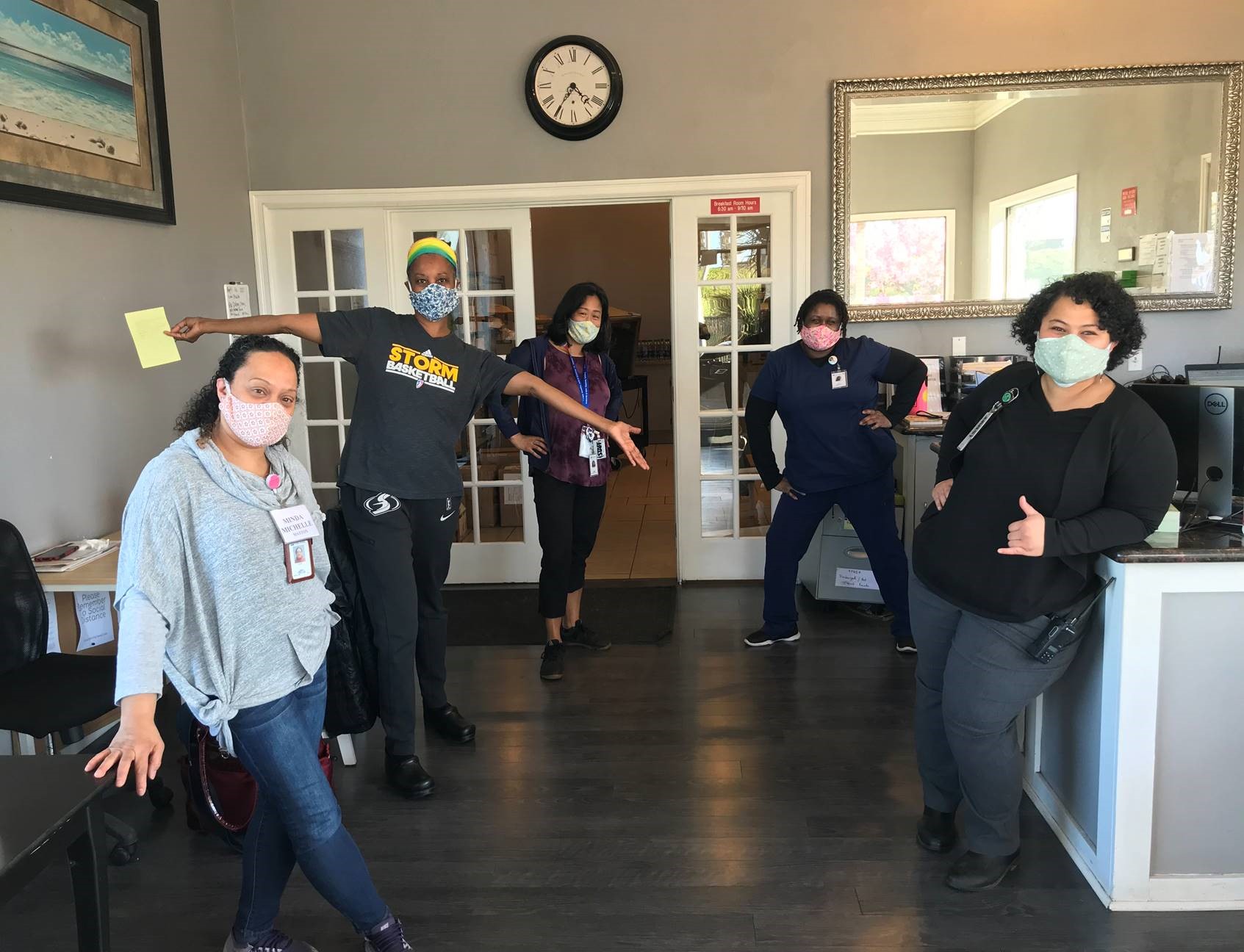
Pictured: King County employees at one of the sites posing for the camera.
“We know this program is working as intended, and we need more deployed employees to help us continue to do just that.”
Employees can make a significant impact through the Emergency Deployment Program. Josephine urges those who have capacity to consider applying for the opportunity to be a part of this response. Each employee will be trained in their specific duties, and will abide by system and safety protocols set in place to keep all employees healthy and safe.
“Many people have asked about how they can help during this time, and this is one way they can help. For those who are able to support our COVID-19 response, we are grateful and ready for you to join in this effort,” she said. “You will provide relief to your King County colleagues who have been doing this for 7 weeks, some without any days off.”
“If you’ve wondered how you can help, this is a way to serve our community. We’re waiting for you to step up and help in this fight to save lives here in King County.”
For more details and to complete the application for the Emergency Deployment Program visit www.kingcounty.gov/emergency-deployment. To learn more about the locations for isolation and quarantine, developed through a partnership with local organizations in response to COVID-19, visit the DCHS Isolation/Quarantine and Assessment/Recovery Facilities webpage.
To learn more about the work Josephine and other employees are doing, view this video. View more photos in the slideshow below.
Share this:

County VPN is experiencing problems

King County is currently experiencing VPN problems, which are impacting all County employees. The appropriate KCIT teams are working on the issue. Email, phone service, and access to SharePoint OneDrive and Skype remain unaffected. We will update you when the problems are fixed.
Thank you for your patience.






 Employee News