
Support setting up remote workspaces

Many King County employees are teleworking through July 5, 2021, as we try to limit the transmission of the novel coronavirus and slow its spread.
Remote work has its challenges. To support teleworking employees, King County will provide assistance, where needed, with equipment to support telework. This assistance may take four forms:
- Taking equipment home from work
- Purchase of home office equipment
- Furniture, equipment, or supplies for a medical accommodation
- Connectivity support
Necessary furniture and equipment can be purchased prior to the end of 2020, and the County will provide computers and technology to support teleworking. Employees can procure necessary office furniture and equipment through County supply contracts and/or purchasing cards (P-Cards) with supervisor approval. Purchases should be made through the standard work group protocol via blanket contracts or other vendors that include delivery to the telework site.
Any purchases related to setting up and operating a telework office must be approved by supervisors in advance, documented, and reported for reimbursement to the County. Expenditures associated with teleworking are eligible for federal COVID-19 reimbursement to the County through Dec. 30, 2020. Federal COVID-19 reimbursement to the county may not be available after Dec. 30, 2020, for furniture for teleworking spaces.
It can be challenging to maintain good ergonomic practices when working away from the office. For information on ergonomic resources and assistance while working remotely, please visit King County’s Ergonomic Evaluation website. If you need assistance with the ergonomics of your home workstation, first complete the self-assessment checklists on the website. If you have a medical restriction and/or require an accommodation related to your home workstation, please request an ergonomic evaluation (requires SharePoint login).
These guidelines apply to employees hired before September 1, 2020 who anticipated working from County facilities and are now primarily teleworking. For more details, please see page 6 of the Guidance for Workforce, Operations, and Customer Service Recovery.
Share this:

Free webinar for employees: Student Loan Repayment Strategies, Sept. 24

 For many employees in the first half of their careers, student loans represent a significant component of expenses. During this free webinar offered by My Secure Advantage, attendees will learn how to pay off their loans more quickly, or lower monthly payments to fit better within their budget. The webinar discusses repayment options for both federal and private loans by walking through a variety of real-life examples.
- Thursday, Sept. 24 from 9 – 10 a.m. or noon to 1 p.m. Register here.
Employees who register and cannot attend, will receive a recording of the webinar, along with a copy of the session presentation and handouts, within 24 hours.
For questions or more information, contact Balanced You at 206-263-9626 or email BalancedYou@kingcounty.gov.
Share this:

Featured Job: Public Health Evaluator

Salary: $41.76 – $52.93 Hourly
Location: Seattle, WA
Job Type: Special Duty Assignment or Term Limited Temp (TLT)
Department: DPH – Public Health
Job Number: 2020ML11837
Closing: Continuous
Learn more about this position or view all available positions.
Share this:

Guide for parents with children at home due to COVID-19

The announcement that most schools will start remotely in fall of 2020 creates additional challenges for working parents, as does caring for elderly or sick family members.
King County has put together a new guide for parents with children at home whose school or childcare has closed because of COVID-19 to help them better understand their options for adjusting schedules and taking leave to care for family members.
The Guidance for parents with children at home sets out several options for working parents, such as adjusted work schedules, the various leaves available, and accessing accrued time off.
Please work with your supervisor and seek approval when pursuing any of the options in the guide, and consult your Human Resources Manager (SharePoint: employee access only) for more information.
Share this:

Executive branch EEO/AA Committee recruiting new committee members
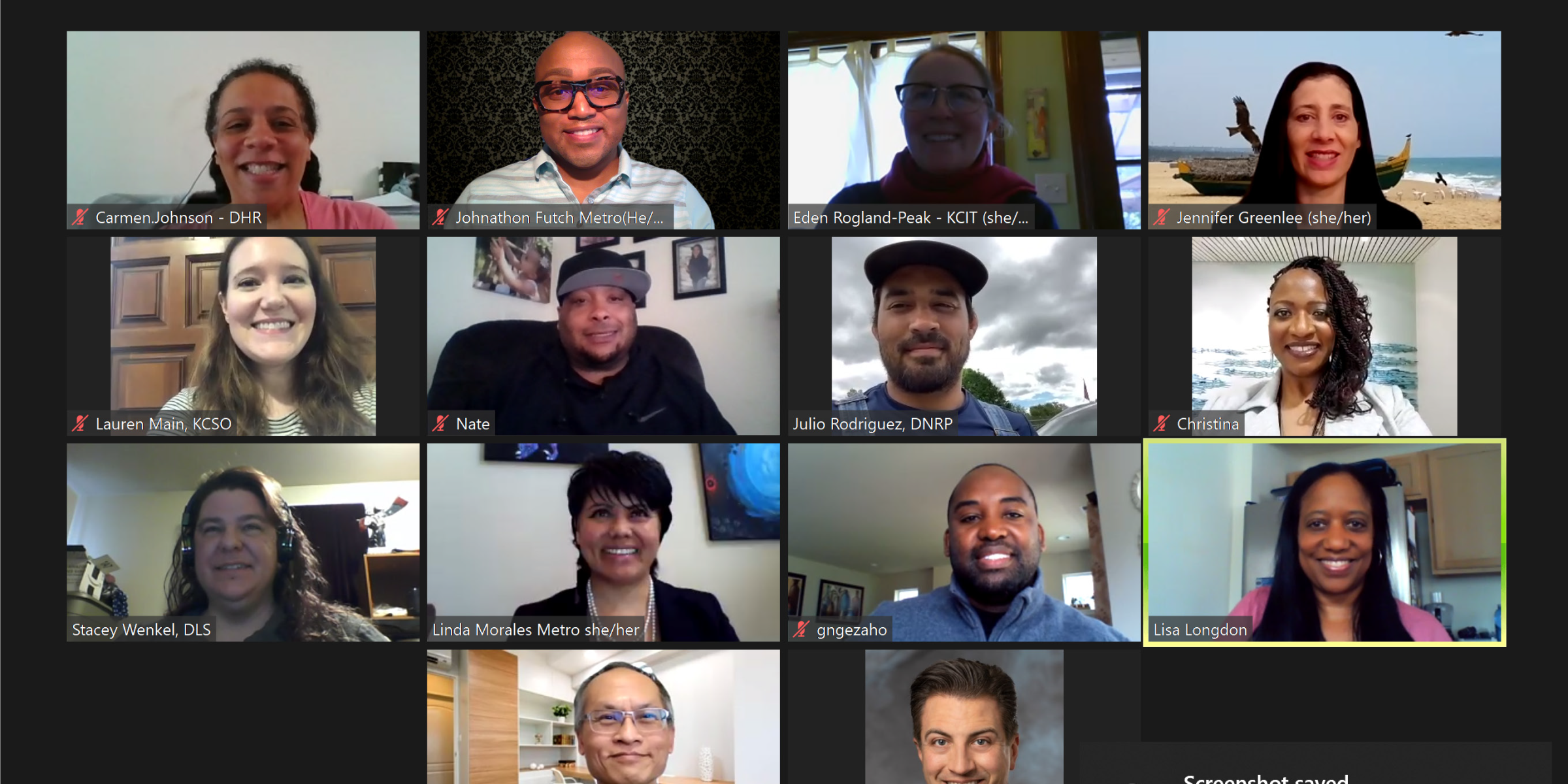
 The Equal Employment Opportunity and Affirmative Action Committee is recruiting new committee members for the 2021– 2023 term. The committee is employee-based and serves in an advisory capacity to the County Executive; developing and reviewing strategies, systems, policies and guidelines to implement and enhance executive branch EEO/AA plans.
The committee is actively recruiting representatives recruiting representatives from the following departments for the 2021 – 2023 term:
- Department of Assessments (DA)
- Department of Executive Services (DES)
- Department of Local Services (DLS)
- King County Information and Technology (KCIT)
- Metro Transit Department (MTD)
The application period closes September 14. View qualifications and apply here. A short video with additional information regarding the committee can be viewed here. For questions contact Lisa D. Longdon, EEO/AA Program Manager, at 206-477-3258 or Lisa.Longdon@kingcounty.gov.
Share this:

Building a more resilient, sustainable, equitable King County: Executive Constantine announces regional strategy to confront climate change
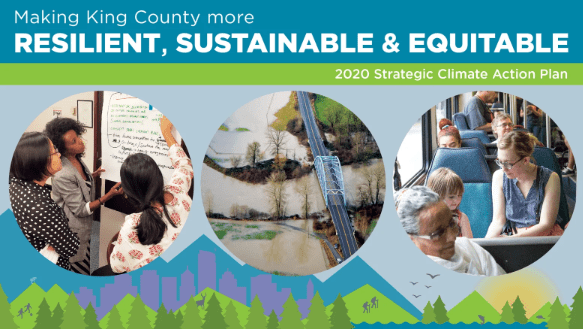
King County Executive Dow Constantine today announced his proposal for the 2020 Strategic Climate Action Plan, which includes cutting greenhouse gas emissions countywide in half by the end of the decade, a stronger focus on climate justice, and preparing the region for climate impacts.
“Climate change is impacting King County today, deepening inequities and intensifying natural hazards – flooding, wildfires, extreme heat – that put people, our economy, and our environment at risk,” said Executive Constantine. “We surpassed many of our goals from the current Strategic Climate Action Plan by listening to experts, basing decisions on science, embracing innovation, and forging strong partnerships. This next plan builds on our momentum, operating at a region-wide scale with a stronger commitment to climate justice.”
The 2020 Strategic Climate Action Plan is a five-year blueprint for county climate action, integrating climate change into all areas of county operations and its work with all 39 cities, partners, communities, and residents.
Read more in the official press release, and view the video below to learn more.
Share this:

Featured Job: Economic Development and Veteran Initiatives Manager/PPM IV
Salary: $100,134.11 – $126,926.18 Annually
Location: WA 98188, WA
Job Type: Career Service, Full Time, 40 hrs/week
Department: DCHS – Community & Human Services
Job Number: 2020SC12001
Division: Adult Services
Closing: 8/30/2020 11:59 PM Pacific
Learn more about this position or view all available positions.
Share this:

Pet of the Week: June

 Hi! My name is June and I am available for adoption. I am an affectionate lovebug who would be thrilled to cuddle up with you at home! I am a very smart dog! At the shelter I am practicing how to “sit”, “stay”, “come”, and “stop.” Because of my shy nature, I would do best in a calm, quiet home. My personality color is BLUE. I am a gentle and loving dog who likes to take things slow. I may get nervous in new situations, so I am looking for a family who understands that I might take some time to warm up. Once I get to know you, I will be a very devoted friend.
Read more and view all available pets at www.kingcounty.gov/adoptapet. Have you or someone you know adopted a pet from RASKC? Let us know. We’d love to tell your story.
Share this:

Taking a stand to end violence, racism, and death

Dear fellow King County employees,
This week, our nation is once again convulsed by the police shooting of a Black man – this time Jacob Blake in Wisconsin.
With the worldwide outrage and protests in the wake of the killing of George Floyd in Minneapolis earlier this year, people from all walks of life are demanding immediate, and meaningful change. The shooting of Jacob Blake again shows how far we still have to go, and the struggles that we must overcome, to make a fair, equitable and racially just society a reality.
I know many are hurting right now. Just as the killing of George Floyd did, this latest shooting highlights the painful reality not just of our past, but our present. I recognize that our Black neighbors, friends, loved ones and colleagues, experience this pain most acutely.
It is directly to you that I now speak – our Black/African American colleagues and co-workers. As a white man, I recognize that I cannot begin to understand your experience in the same way you do, in the way Black and indigenous Americans in particular, including perhaps your own ancestors, have for generations.
What I and each of us must do is to stand strong and move in solidarity and unity to dismantle and replace the institutional and structural racism which impact all communities, but especially and uniquely black, indigenous and communities of color.
Finally, I recognize the importance of today as the anniversary of Dr. Martin Luther King’s “I Have a Dream” speech delivered on the steps of the Lincoln Memorial 57 years ago. There he challenged America to grow up, grow out of its stunted adolescence, and live up to its promise – challenged all Americans to work toward a better, more just future. It also does not escape me that this is also the 65th anniversary of the death of Emmett Till, the Black 14-year-old who was lynched in Mississippi and whose death continues to serve as a clarion call against racist hate and violence.
To you and to all County employees I say that to give in to hopelessness and despair is to fail to rise to Dr. King’s challenge, and to give up on America. Individually and collectively, we must take a stand and work for racial justice, to build a nation that fulfills its potential and its noblest founding ideals.
As the King County Executive and as your colleague, I am committed to using my position to do this, starting here in Martin Luther King Jr. County.
Please stay strong and stay safe. Thank you.
Sincerely,

Dow Constantine
King County Executive
Share this:

BRC gets national attention for credit card solution


King County continues to make waves nationally, in so many positive ways. Julia Cordero’s article about the county’s implementation of virtual credit cards as a new payment method in 2019 was recently published in Insight magazine, a national industry magazine that highlights best practices and innovative solutions. Cordero initially presented at Oracle Applications and Technology Users Group’s national conference last year. She was asked to write an article for Insight.
By Julia Cordero, ERP Project/Program Manager, Business Resource Center
What are Virtual Credit Cards?
With procurement card fraud on the rise, organizations are looking for ways to minimize unauthorized transactions. The now ubiquitous EMV chip cards have emerged as a way to increase security for card-present (CP) transactions, which are those in which the customer physically uses the card at the point of sale. In contrast, card-not-present (CNP) transactions, such as those involving online purchases, continue to be vulnerable to fraud.






 Employee News