
Pet of the Week: Sadie

 Crossposted from Tails from RASKC
Need a warm snuggle buddy for the coming chilly winter nights? Check out Sadie, our Pet of the Week!
This genteel older lady loves to stop and smell the roses! Sadie has a lot of pep in her step and loves going for long walks… sniffing here, there, and everywhere! Afterwards, Sadie just wants to hang out and cuddle, and she thoroughly enjoys neck scratches.
Read more at Tails from RASKC
Share this:

Tech Tip: A change in county email quarantining

Microsoft has changed the daily quarantine notification message to make it easier for email users to review possibly suspicious emails quarantined over the last 24 hours. This adds an extra layer of protection by allowing King County employees to preview messages online without releasing them to their inbox.
Got a message that doesn’t need to be quarantined? Simply click on the “Review” button in the email to view the message and be routed to the quarantine portal. This section will explain why the message was quarantined and other information about it.
After reviewing the summary information, to double check it is a valid message, click on the “Preview Message” button to view it. If the message is okay and should be released, click on the “Remove from Quarantine” button and it will be delivered to the mailbox. Please be cautious when releasing messages from quarantine.
If the message looks suspicious, just leave the message in quarantine. If it’s in the inbox, delete it without opening.
Why all the steps for a simple email? Short answer: King County employees are targeted daily by malicious and dangerous phishing campaigns. We all need to be alert and careful to protect our systems.
Share this:

Rev Up For Retirement seminar on Nov. 13

Are you too young to think about retirement? Think again! With increasing concern over the future of Social Security and the stability of retirement plans, it’s a good idea to stay informed and to prepare in advance. Please join the King County Retirement team for a three-hour seminar featuring guest speakers from Social Security and Jean Cormier, an expert in Medicare choices and options. Employee resources available through King County will also be shared.
Wednesday, Nov. 13, from 11 a.m. – 2 p.m., King Street Center, 8th Floor Conference Room, 201 S. Jackson St. Registration is required. Register here.
Please bring a lunch and plan on joining us! Please note: Attendance is strictly voluntary, on your own time, and non-work related. For more information, contact King County Benefits, Payroll and Retirement Operations at KC.Orientations@kingcounty.gov.
Share this:

DNRP Division Day in the Enchanted Habitat, Nov. 1

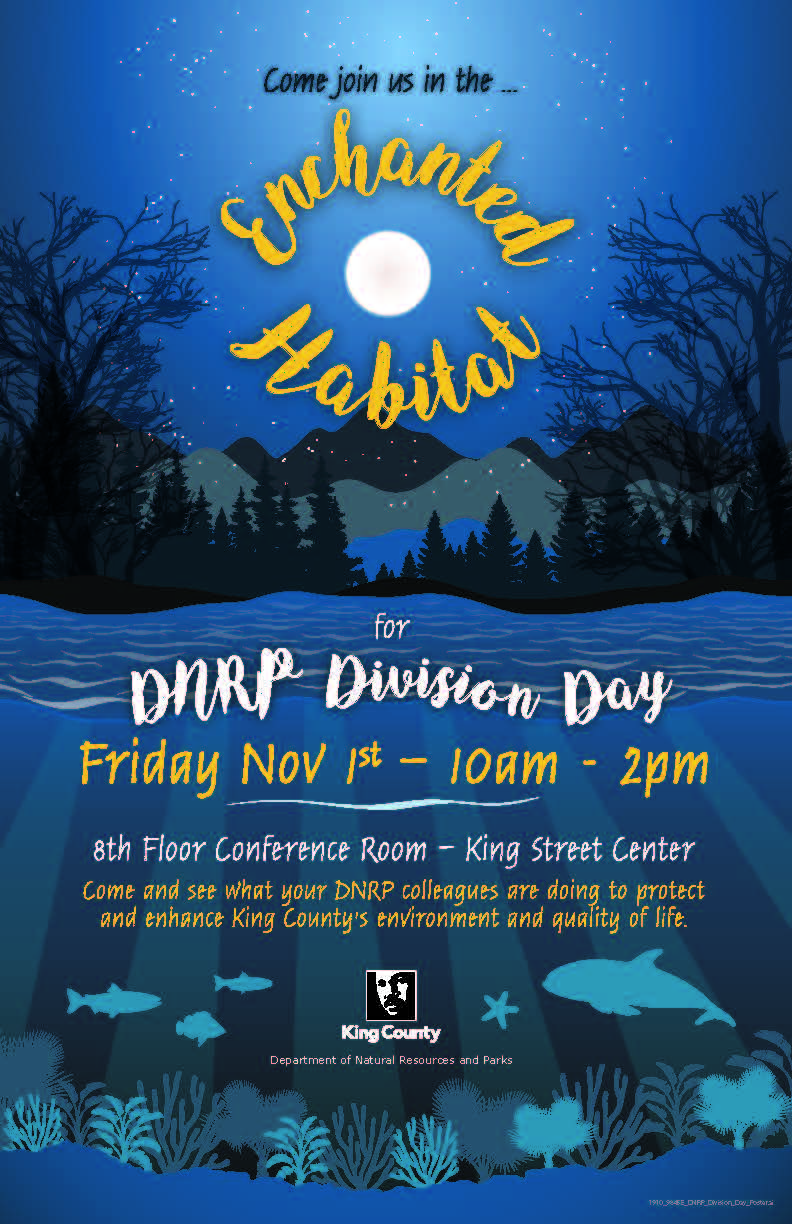
View the event flyer.
Employees are welcome to join the Department of Natural Resources and Parks (DNRP) for their annual Division Day expo on Friday, Nov. 1 from 10 a.m. to 2 pm. in the 8th Floor Conference Room at King Street Center.
Come and see what your DNRP colleagues are doing to protect and enhance King County’s environment and advance our “We are responsible stewards” value.
Visit displays and check out the innovative and progressive work the department is doing to preserve and enhance the ecological health of King County – and the health and well-being of our residents. This fun annual event is not only inspirational, it helps all of us become better ambassadors for DNRP when we know about the great things our colleagues are up to.
Enchanted Habitat is our “prom” theme for DNRP’s 2019 Division Day. No date needed and you can skip the awkward baby blue tuxedo or puffy-sleeved taffeta dress. On the other hand, there might be a 1 Million Trees coffee mug in it for those who do stop by in habitat-friendly prom wear.
Fill out an outreach “scavenger hunt” card for a chance to win tickets for next summer’s Concerts at Marymoor series (generously provided by King County Parks), and other fun gifts. Be sure to stop by the photo booth and to treat yourself to free popcorn!
Share this:

Five questions with John Miller, Organizational Development Practitioner, Department of Human Resources

 Why did you start in your role with King County?
My King County journey started more than 21 years ago in central finance, shifted to permitting, then to Lead Analyst on the Business Resource Center – Business Intelligence (BI) Team. Most recently, I joined (on Special Duty) the Department of Human Resources – Career and Culture Division’s Organizational Development Team. Throughout my career I have been steadfast in maturing as an Equity and Social Justice (ESJ) Practitioner.
I started here in King County because of my passion to serve.
As an old offensive lineman you do the most difficult work every offensive play. You protect, create opportunities and drive. You get no credit for when things go well and all of the credit when things go bad. Service is one of my core values. We, as King County employees, have the privilege and responsibility to uphold values that advance favorable outcomes for our communities.
What do you do in your role?
As an Organizational Development (OD) Practitioner I will be joining 5 other incredible individuals in developing an OD plan and consulting with departments to support cultivation of a healthier workplace culture where every employee can thrive.
On this ESJ Practitioner journey, I have collaborated with a collective of brilliant change leaders in advancing equity, racial and social justice for our workforce and the communities we serve. Our collective is advancing digital equity in disadvantaged communities, building inclusive policy design processes, increasing our risk appetite in achieving equity, developing marginalized community youth, making our contracting processes more equitable, delivering equity analytics, building community relationships, improving workplace culture and empowering our workforce to thrive. I am because of them. Thank you!
On the BI Team I worked with an amazing team in meeting the reporting and analytics needs (payroll, HR, finance, budget) of King County. The BI Team’s vision is to mature King County in analytics through the application of a value’s driven/data supported modality.
Why did you choose this field as your career?
I didn’t choose these fields. These fields chose me.
People and numbers are at the core of everything we do, so I couldn’t ignore the draw to the opportunity to build relationships while leveraging data in creating stories centered in virtuous values.
As a Black man I live with the cost of having to survive inequitable and unjust systems. As a father of four young men, I have a responsibility to do my part in disrupting these systems so that my son’s, our communities of color and indigenous ancestry and our future has a more positive experience. I am driven to continue the efforts of those who came before me.
What is the biggest challenge of your job?
Navigating the resistance to change and practicing self-care in the midst of the whirlwind of obligations.
What do you enjoy most about your work?
The people, bridge building and seeing planted seeds (processes, policy, programs and people) blossom.
Share this:

EGP Nonprofit Expo now offering online option

The Employee Giving Program (EGP) hosts multiple expos for employees to meet amazing nonprofits and get to know the work they are doing in the community. This year the EGP offers an online option, every Thursday from noon to 1 p.m. via Skype. Here employees can meet nonprofits in an online webinar and learn about a specific topic each week. View the upcoming schedule below, and click on the link to download a calendar invite to Outlook with Skype access information.
- Oct. 31: Animals
- Nov. 7: To be decided
- Nov. 14: Youth
- Nov. 21: Environment
The replay of previous webinar topics, such as Hurricane Dorian and natural disaster relief, and South King County nonprofits, can be viewed here. Find out more about this year’s Annual Giving Drive at www.kingcounty.gov/giving.
Share this:

2019 Annual Giving Drive: Spotlight on nonprofits supporting Natural Disaster Relief Efforts

King County’s Annual Giving Drive Program started Oct. 7, and almost 1,200 nonprofits are taking part this year. Throughout this year’s drive, we’ll be featuring four nonprofits in different categories. This week, we’re highlighting nonprofits that support communities that are impacted by natural disasters and focus on relief efforts.
- American Red Cross Northwest Region (9343) 1900 25th Ave. S. Seattle, WA 98144 – This foundation prevents and alleviates human suffering, in the face of emergencies and natural disasters, by the power of mobilizing volunteers and generosity of others.
- Peace Winds America (9472) 2366 Eastlake Avenue East, Suite 228, Seattle, WA 98102 – This foundation strengthens response and preparedness to natural disasters and man-made crises by responding and coordinating with NGOs, governments, private sectors, and more.
- ShelterBox USA (9683) 8374 Market Street #203, Lakewood Ranch, FL 34202 – Providing emergency shelter and vital supplies to support communities around the world who are overwhelmed by disasters or humanitarian crises.
- King County Search Dogs (9171) PO Box 50643, Bellevue, WA 98015 – An all-volunteer unit providing trained human and K-9 searchers to assist with locating and recovering missing people, especially in situations of natural disasters.
All these nonprofits focus on communities that have been affected by natural or man-made disasters and crises, providing relief to people around the globe. The Employee Giving Drive Program offers employees the option to participate in a nonprofit expo online or in person, making it more inclusive. Don’t forget to also download a Giving Passport, which once you complete, you can be entered for a chance to win a prize. For more information, a list of participating nonprofits or if you would simply like to donate, visit the Employee Giving Campaign Annual Drive Nonprofit Search Directory. Happy Giving!
Share this:

Reasonable Accommodations in King County Superior Court

This story is part of our series celebrating Disability Awareness Month.
 Access to justice for all persons is a fundamental right; however, for individuals with a sensory, mental or physical disability, this access can be filled with challenges. Implemented in 2007, Washington State General Court Rule 33 (GR 33) was designed to assure that persons with disabilities have equal and meaningful access to the judicial system.
GR 33 requires courts to provide prompt response to requests for accommodation in accordance with the Americans with Disabilities Act of 1990 and the Washington State Law Against Discrimination (RCW 49.60). The rule also requires each court in Washington state to designate a principal point of contact for the public in need of accommodation from the court, and must publish instructions and a request form for the public to use. Courts are permitted to request additional information about an individual’s qualifying disability to assist in determining the appropriate accommodation. The rule applies not only to accommodations needed in court hearings and trials, but also addresses access to court programs and services.
Once determined to be reasonable and for a qualifying disability under the ADA, accommodations in the form of auxiliary aids and services are provided at no charge to the requestor and may include use of equipment or devices, materials in alternative formats, qualified interpreters, and closed captioning, among others.
And there is a great deal of need for accommodation in the community accessing court programs and services. In 2018, King County Superior Court’s Access Coordinator fielded over 115 requests for accommodation, and that figure does not capture all accommodations provided by other departments within the court such as Assistive Listening Devices coordinated directly through the Court Operations Department or ASL interpreters scheduled through the Office of Interpreter Services. The number of requests is expected to continue to rise in 2019 and beyond as word circulates within the community that such assistance is available.
Coming to court to resolve one’s personal and professional disputes can be stressful, filled with anxiety over the very issues the court is helping to resolve. Having a disability shouldn’t add to that anxiety or put an individual at a disadvantage, and the assistance the courts have implemented through GR 33 deliver helpful measures to mitigate those effects.
Share this:

Open Enrollment begins Nov. 1 and ends Nov. 15

Don’t miss your opportunity to evaluate your benefit choices and make changes. If you haven’t already done so, make sure the right benefit options are in place for you and your family next year.
- See what’s changing next year.
- Review the Benefit Access Fee associated with your medical plan if you cover a spouse or domestic partner. If you qualify for an exemption, you must confirm this each year during Open Enrollment.
- Consider enrolling in a Flexible Spending Account—Health Care and Dependent Day Care FSAs reduce your taxable income, but you must enroll each year.
In-person assistance with Open Enrollment will be available at Transit Bases, and in the Chinook Building:
- Nov. 1: 8:30 a.m. – 3 p.m., North Base
- Nov. 5: 8:30 a.m. – 3 p.m., Ryerson Base
- Nov. 6: 8:30 a.m. – 3 p.m., Atlantic/Central Base
- Nov. 6: 9 a.m. – 4 p.m., Chinook Building, Room 222
- Nov. 7: 9 a.m. – 1:30 p.m., Bellevue Base
- Nov. 12: 8:30 a.m. – 3 p.m. East Base
- Nov. 13: 11 a.m. – 4 p.m., Chinook Building, Room 222
- Nov. 14: 8:30 a.m. – 3 p.m. South Base
- Nov. 15: 9 a.m. – 4 p.m., Chinook Building, Room 233
For more Open Enrollment and benefits information, call 206-684-1556, email KC Benefits, or go to Open Enrollment.
Share this:

Training Spotlight: Mindful Leadership

Mindful Leadership, Dec. 5: A mindful leader embodies leadership presence by cultivating focus, clarity, creativity, and compassion in the service of others. Leadership presence is a tangible quality. Mindful leaders can fell the space in fast-paced, high-stress situations and work to create a culture of trust. Leadership presence is a tangible quailty. This requires full and complete attention, with curiosity and openness, in the present moment. Those around a mindful leader see and feel that presence. Register and learn more.
View more training and development opportunities at www.kingcounty.gov/learning.






 Employee News