
Harborstone Credit Union and BECU discounts available for employees

Through the Harborstone Credit Union Preferred Employer Program, when employees open a new membership that includes a savings, checking, and direct deposit, they will receive a $100 deposited to the account, a 0.25% discount on vehicle loans, and a paid appraisal on home loan purchases and refinances that are funded through Harborstone (a $700 average value). To receive the discount and apply, employees should contact Galileo Tan, Preferred Employer Program Manager, at 206–310-7204 or galileo.tan@harborstone.com.
With BECU, Employees can earn a $200 bonus deposit by opening a new Member Advantage Money Market account and meeting the member advantage requirements. Find out more. Free financial education webinars are also available: self-paced and in-person.
View all available discounts at www.kingcounty.gov/employeediscounts.
Share this:

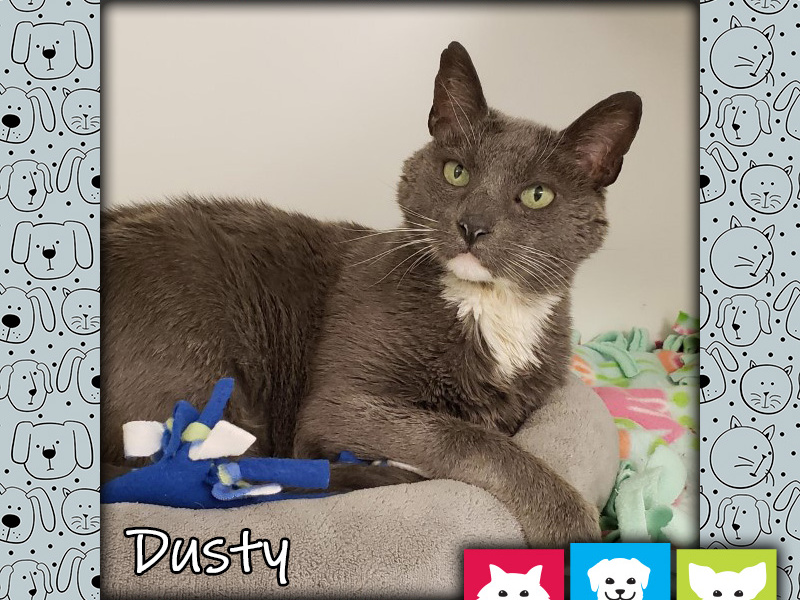
Pet of the Week: Dusty

 Crossposted from Tails from RASKC
Say hello to this handsome gentleman – Dusty is our Pet of the Week! This senior boy is very sweet and loving, and loves pets from head to tail. His favorites are head rubs and scratches behind his ears. Dusty also likes the double-cheek smoosh – where you gently rub both his cheeks at the same time. He may even do the roly poly as you pet him! And unlike some cats, Dusty enjoys a good gentle belly rub.
Read more from Tails from RASKC
Share this:

Featured Job: Registered Nurse Clinical Quality Optimizer

Salary: $101,566.41 – $131,934.41 Annually
Location: Seattle, WA
Job Type: Special Duty Assignment or Term Limited Temp (TLT)
Department: DPH – Public Health
Job Number: 2019-10738
Closing: 11/7/2019 11:59 PM Pacific
Learn more about this position or view all available positions.
Share this:

King County Drug Court celebrates 25 years, Oct. 30

 Empowering lives and strengthening communities since 1994, the King County Drug Court is holding a celebration for its 25th year anniversary. The public and employees are welcome to attend. There will be inspiration, music, food, and the celebration of graduates, current participants, service providers, and community partners.
Wednesday, Oct. 30 from 3 – 5 p.m. at the King County Courthouse, Room E-942, 516 Third Ave Seattle, WA 98104.
For more information contact Mary Taylor at Mary.Taylor@kingcounty.gov.
Share this:

Knowing your role during winter weather and emergencies

 As we approach winter, this is a great time to ensure you are well-prepared for an emergency or inclement weather at home or work. There are many online resources that you can use to make sure you and your family have what you need to Make it Through an emergency – from an extended power outage to a more severe event. We strongly encourage you to take personal preparedness seriously.
As a county government, we are also reviewing our internal emergency preparedness procedures and Continuity of Operations Plans. In case of a significant disaster or emergency, county leaders must prioritize which functions and services will be provided and which can be delayed or suspended. This prioritization informs King County’s employee emergency designations.
We want to make sure you understand the expectations of your role during an emergency. We have updated our employee emergency designations this year to clarify employees’ roles and responsibilities during an emergency. Executive branch department and division leadership will communicate which designation applies to your role by October 31.
I have asked department leadership to review and clarify employee designations using the three following classifications:
- First Responders: Employees who, in the early stages of an incident, are responsible for protecting and preserving life, property, evidence, the environment, and restoring order.
- Mission-critical Employees: Those employees who provide, maintain, and re-establish essential county functions as described in agency Continuity of Operations plans.
- Non-mission Critical in an Emergency Employees: Employees who staff county functions or services that may be delayed, suspended, or diverted in an emergency while essential functions are prioritized.
We value every employee’s contribution and appreciate your commitment to public service. In an emergency, any employee may be called upon to perform an essential function if they have the necessary skills. King County’s response and staffing needs during inclement weather and emergencies will be responsive to the situation and vary based on function. Please contact your supervisor if you have questions about emergency reporting procedures.
Sincerely,
Casey Sixkiller
Chief Operating Officer
Share this:

Learn how to boost your retirement savings

 Employees and their spouse or significant other are invited to learn more about saving for retirement with the King County Deferred Compensation Plan. Upcoming in-person sessions on Oct. 29, 30, and 31 will include: Social Security Simplified, Retirement Savings Options, Savings Strategies, and Achieving Financial Goals. See details and registration here.
Other sessions are offered throughout the year. For more information about Deferred Compensation Plan education — including webinars — visit the Deferred Compensation webpage. For questions please contact KC Deferred Comp.
Share this:

New funding opportunity from the Veterans, Seniors and Human Services Levy

The King County Department of Community and Human Services is now accepting applications for a facilitator for the recently awarded Countywide Commercial Sexual Exploitation (CSE) Collaborative. The facilitator will support the four awarded agencies in building a shared mission and vision and to develop a service model and work plan to steward the goals identified by the Collaborative. Applications are due Wednesday, Nov. 13, 2019 by 5 p.m.
There is up to $65,000 in VSHSL Technical Assistance and Capacity Building (TACB) funds available. The investment period is Dec. 2019 – Dec. 31, 2020, subject to change. Funding and guidance is provided by the Veterans, Seniors and Human Services Levy (VSHSL) and the VSHSL Implementation Plan.
Successful applicants will support the Collaborative to develop and implement strategies that will lead to long-term investments in communities, organizations and individuals to promote agency, safety and the well-being of persons with lived experience in the sex trade.
For question and to apply contact Allison Jurkovich at AJurkovich@kingcounty.gov. For additional information visit the funding opportunities webpage.
Share this:

2019 Annual Giving Drive: Spotlight on nonprofits supporting animal welfare

King County’s Annual Giving Drive Program started Monday, Oct. 7, and almost 1,200 nonprofits are taking part this year. Throughout this year’s drive, we’ll be featuring four nonprofits in different categories. This week, we’re highlighting four nonprofits that support and offer animal adoptions, rehabilitation for senior animals, and training services.
- Greyhound Pets, Inc. (9935) PO Box 891, Woodinville. WA 98072 – This foundation places retired Greyhounds in loving and secure homes and educate the public on the benefits of Greyhounds as family companions. They have multiple locations across the Puget Sound area, as well as Idaho and British Columbia.
- North Beach Progressive Animal Welfare Society (9463) 2222 SR 109 Hoquiam, WA 98550 – A no-kill, nonprofit, all volunteer animal shelter devoted to finding unwanted or homeless animals a loving forever home.
- Purrfect Pals (9221) 230 McRae Rd NE, Arlington, WA 98223 – Through placement and prevention programs, this foundation works to end cat homelessness in the Puget Sound region – because every cat matters.
- Emerald City Pet Rescue (0973) 2962 First Ave South, Suite B, Seattle, WA 98134 – A nonprofit founded by Vivian Goldbloom in 2013, to rescue abused, neglected, and homeless animals from high volume shelters around the country.
All these nonprofits focus on rehabilitating, adoption, and training/educational services for animals. With various nonprofits participating this year, the Employee Giving Drive Program offers employees the option to participate in a nonprofit expo online or in person, making it more inclusive. Don’t forget to also download a Giving Passport, which once you complete, you can be entered for a chance to win a prize. For more information, a list of participating nonprofits or if you would simply like to donate, visit the Employee Giving Campaign Annual Drive Nonprofit Search Directory. Happy Giving!
Share this:

Recycling program builds relationships between King County and Spanish-speaking communities

Advancing our “We are responsible stewards” value

Pictured: The leadership team for the facilitadores after completing a King County provided grant training class.
The Recicla más, or Recycle more program, provides information about recycling in Spanish to communities throughout King County. Started in 2011, Recicla más has relied on developing a partnership with facilitadores, or community educators, in the Latinx community to help improve and increase recycling. The Solid Waste Division (SWD), in the King County Department of Natural Resources and Parks, is further expanding this work with several multicultural/multilingual communities in King County to educate residents and businesses about recycling , composting, and waste prevention best practices. These partnerships ensure that the program educates and empowers these communities through culturally sensitive and culturally competent principles.
Gerty Coville, Program/Project Manager for Recicla más, explains why doing this work from an equity and social justice perspective is essential. Gerty has been with King County since 1990, and began her work in SWD in 2000. She explains how SWD regularly seeks to create programs that address community needs using an equity and social justice lens.
“The program addresses the needs of people in a way that resonates with them,” said Gerty. “This is a community we have not worked with before due to language, cultural and access barriers.”
Because management of solid waste has a direct impact on climate change, resource conservation, and environmental health, Gerty emphasizes how essential it is to have programs like Recicla más.
“Working directly with these communities, who are motivated to learn more about recycling, composting and waste prevention, will have big impacts in King County,” she said.
The program is managed by Gerty and includes 14 community educators, called facilitadores, five of whom serve on the leadership team developing outreach and engagement strategies. These facilitadores further expand existing partnerships between SWD and community groups to promote education about the importance of recycling. They help to develop program materials to teach the public, and bring feedback or ideas to the table for future equity and social justice efforts. This work helps build inroads to communities that may be hard to reach. This is essential to building trust with these communities so that the program makes a difference.

Pictured: The entire group of facilitadores at a recent meeting.
“The work we are doing providing services to these communities is impactful. These communities are growing and make up a growing percentage of our population,” said Gerty.
“We started with focusing on the Spanish speaking community because demographically the Spanish language community comprises about 11% of the King County residential population. We make great efforts to reach multiple dialects within the Spanish-speaking community,” she added.
The program focuses on areas outside of downtown Seattle, mainly in the south end of King County, but also in pocket areas southwest, East and north where multilingual communities live. In addition to these partnerships with communities and the facilitadoras, the program relies on social media and digital advertising to spread the word. Its Facebook page has almost 2,000 likes and regularly shares information in colorful videos and images. Its online presence is popular and Gerty explains this has been a successful platform for outreach because the Latinx community prefers social media engagement.
“From a strategic perspective we thought ‘who are our most vulnerable and least accessible communities who can’t access these services?’ so we have to go to them,” she said. “We develop outreach programs to meet the community where they are, in terms of their recycling and composting practices, but we still have a long way to go and a lot of multilingual/multicultural communities to reach.”
While the program’s success is due to the continued growth of this region and the equity and social justice ordinance King County has put in place, the fact that employees prioritize community needs and their work addressing these needs has also contributed to its success. It is a practice that Gerty takes pride in.
“King County employees know we have a diverse community to serve,” she said. “They know this is our community and we are directed to provide service so if we don’t do that, it is a deficit to our community.”

Pictured: The Solid Waste Division ESJ strategic team.
Gerty looks forward to passing on this meaningful work in recycling and environmental health to the next generation of King County leaders, and expanding the reach of culturally resonant programs like Recicla más. She sees the program as an opportunity to both educate communities, and highlight their role in King County’s work.
“In the program we are working to ensure that we have the resources to devote to a whole array of groups so we can teach multiple topics to those communities and help them gain experience in the research conservation world,” she said.
“It would be great for people to learn about this and maybe one day come to work for King County, making our workplace a more multicultural and welcoming place.”
The Recicla más program is also a great example of how King County applies the True North value “We are responsible stewards” to its work. Gerty and the Solid Waste Division are thoughtfully using resources and skills to make a deep impact on both the environment and the King County community. To learn more about the Recicla más program, visit www.kingcounty.gov/reciclamas.
Share this:

Meaningful program creates workplace efficiencies and opportunities for employees

King County’s Supported Employment Program matches job seekers with developmental disabilities to available jobs by identifying efficiencies and unmet needs throughout King County departments. The program allows each department to review its standard work practices utilizing Lean principles. A job coach is also available to help supported employees thrive in the workplace.
Christina Davidson, Supported Employment Program Manager shares how meaningful this can be in several ways.
“When creating opportunities to be more inclusive with our hiring we are also creating efficiencies and cost savings in departments,” she said. “It’s pretty cool to get to hire more inclusively and have it also help your bottom line.”
One of these new hires is Mariam Laine, who recently started working in the Department of Public Defense (DPD) in the Client Clothing Room. DPD maintains a clothing room to support their clients with trial clothing for court appearances, so they hired Mariam to maintain, organize, inventory and fill requests for trial clothing for all of the divisions. Mariam also supports the finance department by scanning digital receipts for assigned counsel cases. Prior to centralizing the Client Clothing Room, all of the DPD divisions were maintaining their own clothing and purchases.

Pictured: The Department of Public Defense maintains a clothing room to support their clients with trial clothing for court appearances, so they hired Supported Employee Mariam to maintain, organize, inventory and fill requests for trial clothing for all of the divisions.
“There was no standard process, so we took a Lean approach and created one large clothing closet for all the divisions to utilize,” said Laura Federighi, Chief Financial Officer for DPD. “I thought that managing the clothing room and supporting with administrative needs in our department seemed like a good fit for the Supported Employment Program.”
“There are so many jobs that people can do if we structure them right. Employees in the Supported Employment Program bring so much to the worksite.”
Terry Howard, Project/Program Manager III and Mariam’s direct supervisor, agrees. She shares that Mariam has been a great help in the workplace, handling incoming requests and inventory as well as maintaining the clothing room.
“Mariam’s been a great fit too. She is eager to learn and takes pride in her work. She’s also a joy to work with.”
Mariam takes satisfaction in her work, and the opportunity it has provided her to become independent. Helping employees grow and share their skill sets with one another is an important part of the program.
“I feel happy here and I like working full time. I am able to move into my own apartment, which was a goal of mine,” she said. “I have enjoyed meeting new people, making friends and learning new things. I am pretty shy, so my coworkers have helped me to feel more comfortable.”
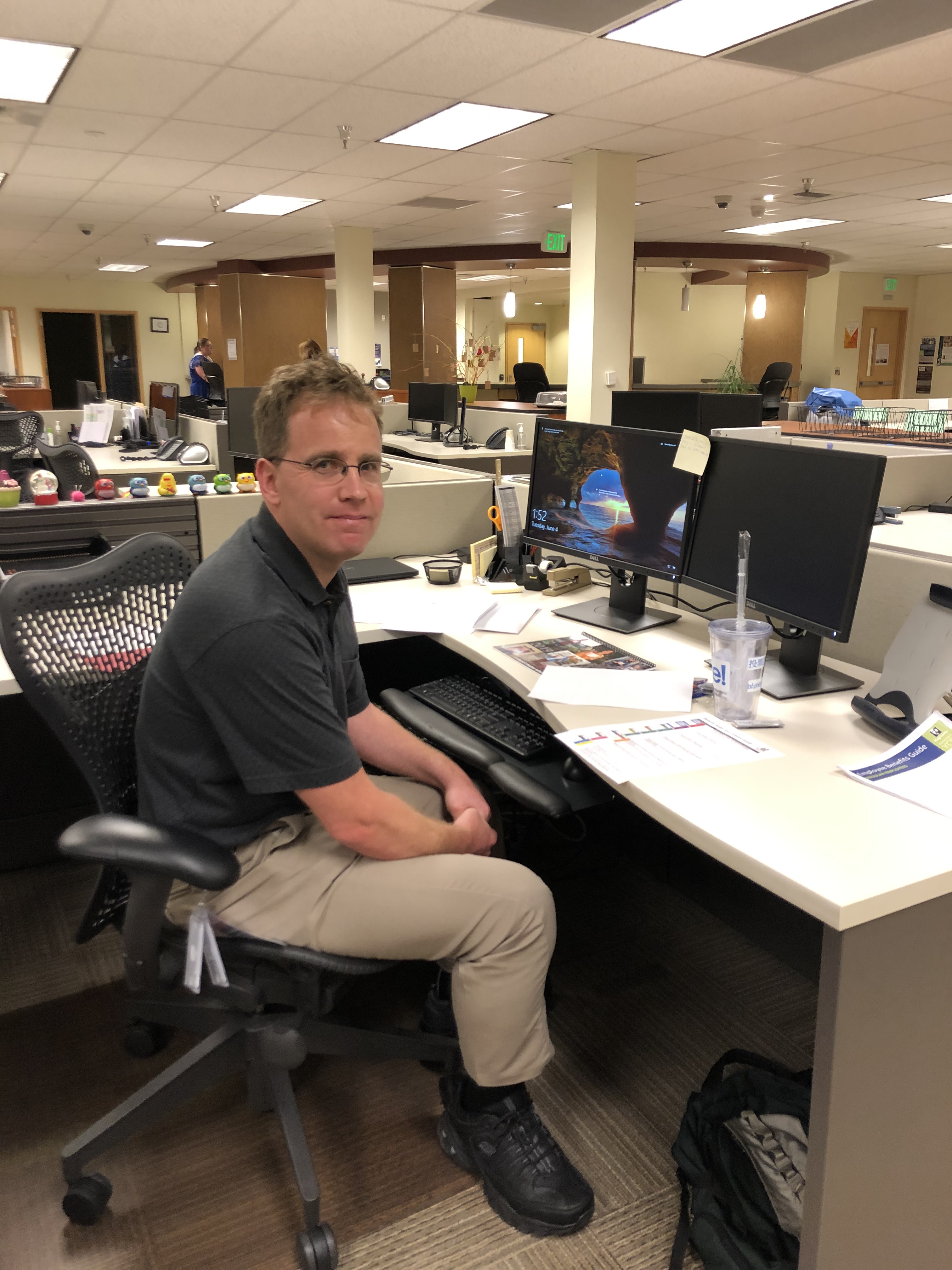
Pictured: Supported Employee Chris Noel
Another supported employee is Chris Noel, who works at the Department of Elections as a Data Entry Assistant. His position works to process voter records. The Elections office receives a high volume of voter records each day from the Department of Licensing that need to be processed within the voter tracking system.
Kim Streeter, Program Supervisor I, shared how important it is these records are updated regularly and kept in order.
“Our average amount of records per day is 800. When we have to pause for the election cycle and those individual records start really building up. It has gotten up to 28,000 records,” she said.
Chris was brought on board to verify voter registration information for new and existing voter accounts. His work has helped him gain new skills. It has also opened up training and mentoring opportunities for members of the team to train Chris on the standardized procedures.
“Hiring Chris has helped us keep up with our records. It has also giving other employees leadership opportunities to provide training to him,” Kim said. “Chris is great at his work. He is dependable and dedicated to doing a good job.”
Chris’s job coach helped onboard him at Elections with the initial training, and now checks in regularly to support Chris, Kim and the entire team when needed. The work varies and allows Chris to get to know his coworkers and feel that he is making a visible impact.
“I like working in a quiet atmosphere where everyone is friendly and helpful. I enjoy doing different tasks,” he said. “After being unemployed for two years, finding a job that I really enjoy, and receiving positive feedback about my work, I feel really happy to come to work every day.”
The program is doubly effective as it meets line of business needs, but does so in a way that provides real value to each supported employee. Departments within King County who participate in the program benefit from a dedicated employee who cares about their work.
“The Supported Employment Program continues to grow. We are now have 55 supported employees within King County,” said Christina.
“Big thank you to the leadership in Department of Public Defense, Elections, and other departments for utilizing the Supported Employment Program to fill their business needs.”
To learn more, visit the Supported Employment Program website, or contact Program Manager Christina Davidson at Christina.Davidson@kingcounty.gov to find out how to take advantage of this program.
To support the Department of Public Defense with a clothing donation, contact Terry Howard at Terry.Howard@kingcounty.gov.






 Employee News