
Training Spotlight: Lean Problem-Solving and Stories that Lead

Lean Problem-Solving, Oct. 10: In order to effectively solve problems once and for all, they must be solved at the root. Participants I this course will learn basic A3 Problem Solving, the powerful method borrowed from the Toyota Production System (TPS), techniques to incorporate problem solving and continuous improvement in daily work and build on existing Lean practices within your organization. Learn more and register on Eventbrite.
Stories that Lead, Oct. 18: This one-day class explores stories as creative strategies that can help you create a workplace—and a life—that inspires profound results.Through reflective processes and story sharing, participants explore three qualities of leadership stories-Voice, Values and Vision- and how these help us show up as leaders. We also experience shaping our stories to build connection with those who might follow. Learn more and register on Eventbrite.
Visit www.kingcounty.gov/learning to learn more about trainings and other opportunities to invest in YOU!
Share this:

Shots aren’t super-flu-ous, they keep our community healthy!

Crossposted from Public Health Insider
We can no longer deny the signs, the sun is setting earlier, and kids are back in school, summer is coming to an end. Now is the perfect time, before bugs start spreading in your kids’ class and sneezes begin echoing through your office, to get your recommended yearly flu shots.
To help you decide when, where, and how to get vaccinated, we compiled answers to some of the most common questions we see regarding to flu vaccinations below.
Read more at Public Health Insider
Share this:

Featured Job: Legislative Records Specialist

Salary: $37.20 – $50.03 Hourly
Location: Seattle, WA
Job Type: Appointed, Part-Time
Department: King County Council, Office of the Ombuds
Job Number: 2018-08597
Closing: 9/19/2018 11:59 PM Pacific
The King County Ombuds Office is seeking a resourceful, detail oriented Legislative Records Specialist with knowledge of the Washington Public Records Act (PRA) to join our team. The Legislative Records Specialist is a part time, benefited position that will manage public records requests made to the Ombuds and Tax Advisor Offices and assist the Ombuds in the retention of Ombuds records to the County’s Records Center and Archives and of electronic records to the County’s electronic records management system.
The ideal candidate will be a certified Public Records Officer with the ability to exercise sound, independent judgment; exhibit strong organizational skills and use a high degree of tact, discretion and diplomacy in dealing with sensitive situations and concerned or upset individuals.
For more information contact Tracy Calderon at 206-477-0979 or tracy.calderon@kingcounty.gov.
Learn more about this position or all available jobs.
Share this:

State retirement plan contributions increased Sept. 1

Employee and employer contribution rates for the following retirement plans increased Sept. 1, 2018, as approved by the State Legislature.
In addition, the King County employer contribution rate for PERS Plan 3 and PERS JBM Plans 1 and 3 increased to 12.83%.
Law Enforcement Officers Fire Fighters (LEOFF) plans do not have a rate adjustment.
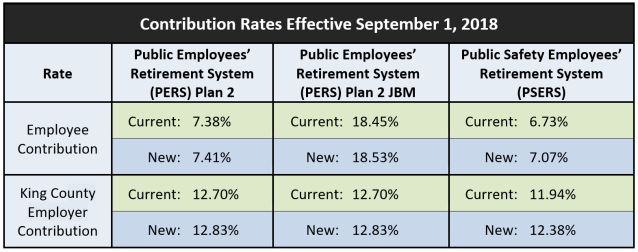
New contribution amounts will be deducted from the second paycheck:
- If you are paid on the 5th and 20th of the month, your new contribution will appear on your September 20 paycheck.
- If you are paid every other Thursday, your new contribution will appear on your September 20 paycheck.
If you have any questions about the rate change, please contact the Washington State Department of Retirement Systems (DRS) at 800-547-6657 or recep@drs.wa.gov. More information is available on the DRS website at drs.wa.gov.
Share this:

GPS locators coming to fleet vehicles

This fall, King County is installing Global Positioning System (GPS) equipment, also known as the Automatic Vehicle Location (AVL) System, in most County vehicles. KCIT is overseeing implementation of this technology.
AVL is designed to enhance internal services and public service delivery, as well as advance the Executive’s Best Run Government and Combating Climate Change initiatives. The AVL System will automate and expand data collection to drive decisions on issues such as right-sizing our fleet, minimizing fuel consumption and greenhouse gas emissions, and helping us better manage field operations. Implementing this technology will help County agencies optimize routing and dispatch, improve response times, facilitate data-driven capital and operating decisions, and expedite sharing of accurate real time service information (such as snow plowing) with the public.
The system will be implemented in phases throughout the remainder of 2018 and into 2019/2020. Employees will receive more information from their department leadership when their phase is coming up.
An executive policy is being developed to establish standards for uses of the AVL System. The policy will also provide users with guidelines regarding their authority and responsibilities for the data collected and the records generated by the system. When the policy is finalized, it will be available here.
AVL will be installed on most vehicles managed by the Fleet Administration Division. The system will not be installed on revenue-generating vehicles such as buses, vanpools, or Access vans. You can find more information about the AVL Project here.
Share this:

Discount available for Seattle Symphony performances, Sept. 12, 13 and 15

King County employees are welcome to take advantage of an available discount for upcoming Seattle Symphony performances tonight, tomorrow and Saturday.
Sept. 12 and 13 – For Distant Worlds: Final Fantasy the music will be performed by the Seattle Symphony while the video game plays on the giant screen above. Buy tickets to Final Fantasy and the symphony will waive the handling fee when promo code FANTASY19 is entered. Purchase tickets here.
Saturday, Sept. 15 – The Opening Night concert will kickoff music director Ludovic Morlot’s final season and feature pianist Jean-Yves Thibaudet performing. Buy tickets and receive 20% off using promo code LUDO20. Purchase tickets here.
See all available discounts on the Employee Discount webpage.
Share this:

City Hall Park line up

Food trucks will be in City Hall Park from 11 a.m. – 2 p.m. between 3rd and 4th Avenues, just south of the Courthouse Building.
- Today, Wednesday, Fish Basket NW. More info here.
- Tomorrow, Thursday, Plum Bistro Mobile. More info here.
- Friday, Kukree. More info here.
Every weekday a park concierge will be on-site from 10 a.m. – 4 p.m. There will be games, outdoor seating and buskers from noon to 4 p.m. View the upcoming schedule here.
Share this:

First Untold Story performance to be held Sept. 20 in Renton
The first of three performances for US – The Untold Story will be held Thursday, September 20 at the Department of Elections in Renton. It will be from 1:30-3:30 p.m. in the Alvine Room.
Each of the performances will feature stories submitted by King County employees of color who responded to the question, “What’s your untold story of racism?” These stories are available to read on the Untold Story Project blog.
Local poets and actors will perform the readings under the direction of Seattle actor and storyteller Jekeva Phillips. The discussion to follow will be facilitated by conceptual artist and community-builder Natasha Marin.
- Sign up for the September 20 performance at the Elections Office in Renton here.
- Registration for the October 9 performance at King Street Center is full.
- Sign up for the November 13 performance at the Wing Luke Theatre in the International District here.
The ESJ Literary Project is a joint effort of the Solid Waste and Wastewater divisions. Contact Donna Miscolta or Julia Yen for more information.
Share this:

Employee Survey coming spring 2019
Dear fellow King County employee,
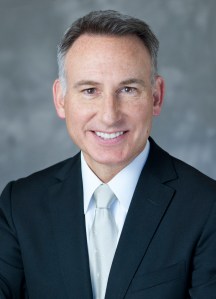
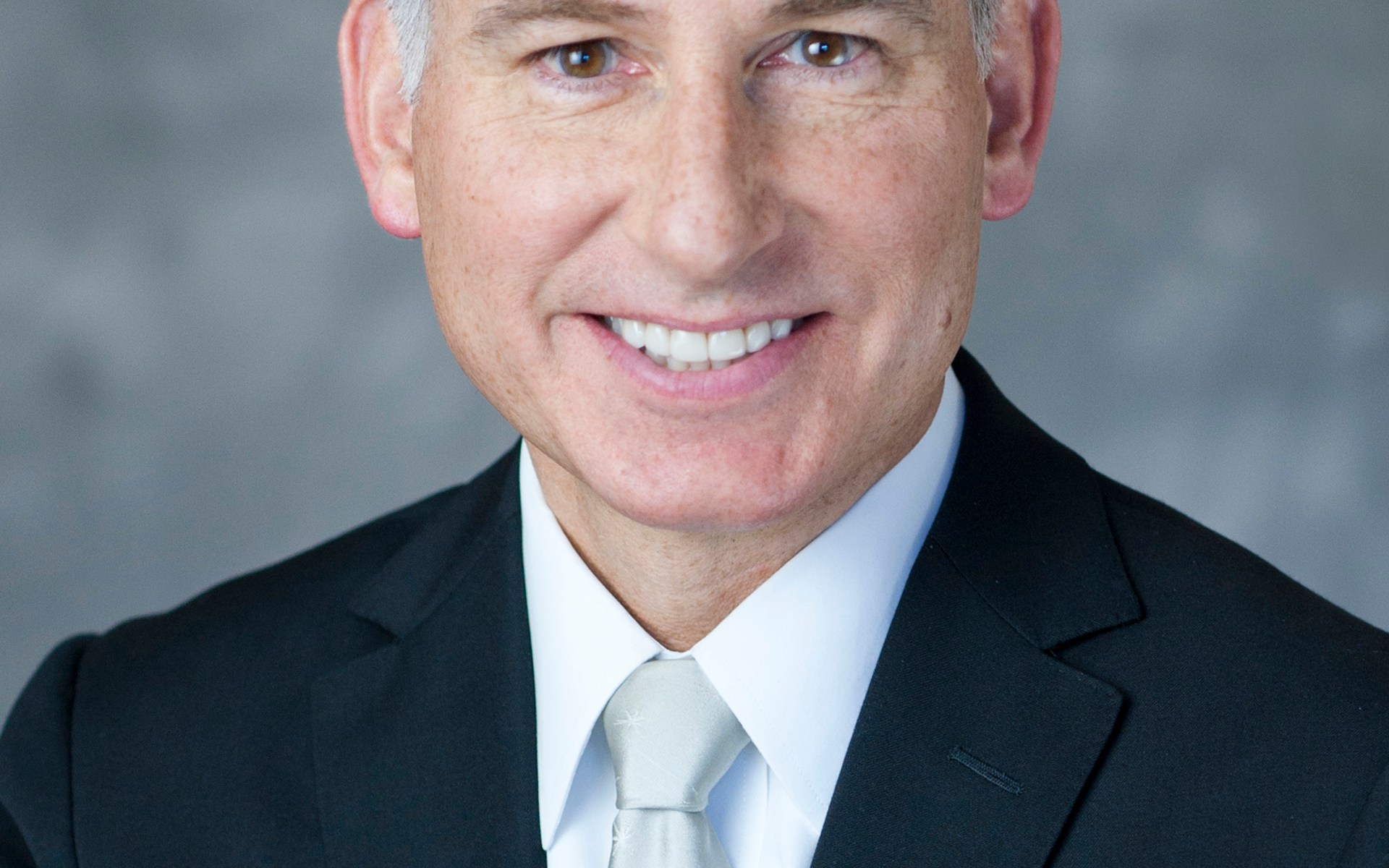
King County Executive Dow Constantine
Through our Investing in YOU work we’re continuing to build a workplace where you have the tools, support, and opportunity to do your best work.
For the past three years we’ve used the annual Employee Engagement Survey to hear from you about how can we make King County a better place to work, and how we can provide services more effectively to our residents.
Using what we’ve learned on our engagement journey and in response to your feedback, we’re making improvements to the engagement survey process.
First, based on your feedback, we are switching administration of the annual employee engagement survey from fall to spring. We heard that fall is a very busy time for you and that spring would offer more time for digesting the results and creating action plans. So, the next survey will be administered in spring of 2019 and will continue on an annual basis.
Second, beginning in 2019 you’ll see some exciting changes: a shorter survey, the ability to check in more frequently to see how things are going, and more robust information about the relationship between engagement and how our organization performs. But we’ll continue to provide the pieces that we heard matter to you, such as the ability to track data trends over time, reports that help you figure out where to focus your efforts strategically, and the ability to look at data through an Equity and Social Justice lens.
In the meantime, we remain focused on acting on 2017 results. In the past year workteams, divisions and departments have created 285 action plans to address issues like career advancement, work life balance and how we work together as teams. I asked my Cabinet and members of my Senior Leadership Team to create action plans of their own to address your feedback through the survey about their visibility, communicating openly and honestly and modeling expected behavior. I also have my own action plan and have been enjoying getting out to your worksites to learn more about what you do and hosting listening sessions in my office with groups of employees.
I look forward to sharing more information with you as we get closer to the launch of the next survey. Thank you again for everything you do for our residents and our region.
Sincerely,

Dow Constantine
King County Executive
Share this:

Featured Job: Registered Nurse – Juvenile
Closing: 09/30/18 11:59 PM (GMT -8:00)
Salary: $35.36 – $49.51 Hourly $73,548.80 – $102,980.80 Annually
Location: King County Youth Service Center – 1211 East Alder Ave, Seattle
Job Type: Career Service, Full Time, 40 hrs/week
Department: Adult & Juvenile Detention
Job Number: 2018CB08318
Department of Adult and Juvenile Detention, in partnership with Public Health – Seattle & King County, is recruiting for Registered Nurses who have a strong interest in working with our community’s justice-involved youth. As Public Health nurses, we strive to provide the highest quality of care through a trauma-informed lens. If this type of practice speaks to your passion, we encourage you to apply!
For more information, contact HR Analyst Caroll Budny at 206-477-6464 or Caroll.Budny@KingCounty.gov .
Learn more about this position or all available jobs.






 Employee News