
Featured Job: Transit Pass Sales Representative

Closing: 7/9/2018 11:59 p.m. Pacific
Salary: $19.98 – $28.54 Hourly
Location: Seattle, WA
Job Type: Career Service, Full Time, 40 hrs/week
Department: Transportation – Transit Division
Job Number: 2018RL08274
Transit Pass Sales Representatives sell transportation passes and ticket books to the general public and area employers in-person, by telephone, mail order, on-line and at community events, using customized and Microsoft computer applications.
An unusual feature of this job is that qualified Career Service incumbents may bid on vacancies in another customer-service oriented job called Customer Information Specialist that answers customer questions by phone regarding transit routes, schedules, fares, the ORCA card program, transfer points and other transit services from the Customer Information Office call center. These two groups of employees may choose to transfer by seniority to positions in either group as vacancies occur, if qualified. They also have the opportunity to work overtime in vacant work shifts in either group.
For more information, contact Sr. HR Analyst Reeshema Lewis at 206-263-8413 or Reeshema.Lewis@KingCounty.gov.
Learn more about this position or all available jobs.
Share this:

Learning from listening
Crossposted from Best Starts for Kids Blog
Part 3 of our Community Owned Data blog series
This is the third post in our month-long Community Owned Data series we are doing to highlight our learnings from the Best Starts for Kids Health Survey. We brought the data to specific communities in the form of “data dives,” asked what they thought, and learned a lot from community input and data interpretation! In this post, we share more about what we heard and learned.
During the data dives, we presented data about five important topics covered in the health survey. These topics are:
- Reading, Singing and Telling Stories to Children
- Family Resilience
- Parent/Caregiver Emotional Support
- ACEs
- Thriving Children
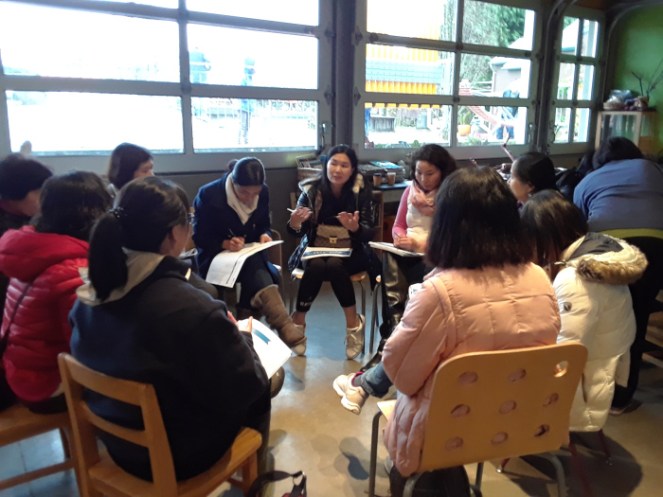
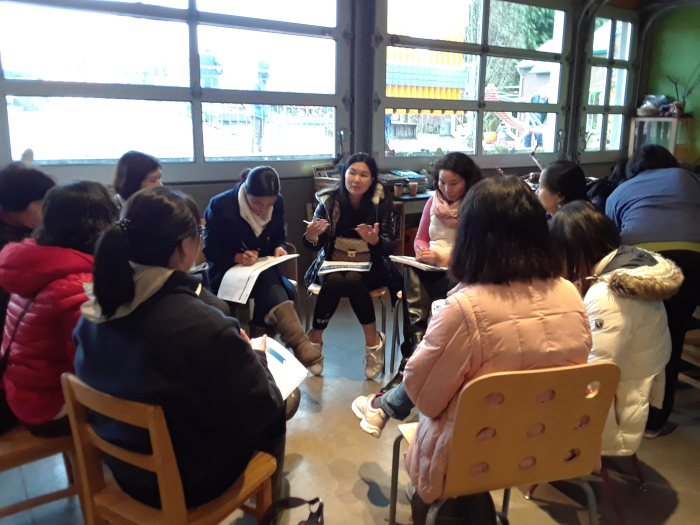
Data Dive participants.
Note: We link to data throughout this post. Please know that the data you initially see represents all of King County. In order to dig deeper into the data and find more specific information on different communities, click on the “demographics” tab. It was this deeper data that we brought to communities so they could interpret their own, specific community data.
Reading, Singing, and Telling Stories to Children
Having a secure attachment with caregivers is essential for a young child’s brain development, and provides the foundation for lifelong learning including problem solving, communication, self-control, and relationship building. Reading, singing, or telling stories to children every day helps support attachment and gives their growing brains opportunities to develop new neural connections. In King County, 73% of children age five and younger are read, sung to, or told stories to on a daily basis.
 Families shared a variety of barriers to daily reading. One was a lack of access to books in their primary language, and other challenges with children who don’t want to speak their home language. It can take a long time to get to a library, because of distance and transportation. For parents who never had the experience of being read to when they were children, it might not come as naturally to read to their children. Parents working long hours have less time to spend with children. Parents of children with special needs also pointed out the unique challenges they face in doing activities daily. As one Chinese American caregiver said,
Families with special needs have different experiences. When my kid wants to read, he would read for the whole day. When I want to read with him on another day, he doesn’t want to read any more.
Some also wondered how the question would be interpreted in different cultures, especially oral cultures. For example, parents who tell their children stories about their workday might not think that “counts” if they are not sitting down with a book. Samoan and Native parents in particular were proud of their culture of singing and telling stories and saw this a strength in their parenting.
Family Resilience
Resilient families provide safe, supportive, and nurturing environments for children to grow, helping children be more independent, cope with stress, and build strong relationships with peers. The Best Starts for Kids Health Survey asked about four components of family resiliency when faced with challenges: acknowledging strengths (89 percent), staying hopeful (94 percent), talking together about what to do (88 percent), and working together (88 percent). Overall, only 32 percent of families said that they did all four of these things all of the time.
One thing we heard from participants at many data dives was that doing all of these things all of the time is an extremely high bar for families, and that even healthy and resilient families could realistically respond “most of the time.” After hearing this feedback, we looked at how many families did all of these practices all or most of the time. At 78%, this is much higher!
Participants also said that culture can impact these practices, and different communities have different definitions of resiliency and different strategies (such as praying together, or learning together, more so than talking about issues). As one Black, African-American parent asked,
Who determines the terminology? My interpretation of resiliency is different. We have to be careful when we have people writing questions for our culture.
Participants recommended community spaces where parents can be supported in their emotional well-being and resilience as well as basic needs, and where their culture would be affirmed and supported.
Parent/Caregiver Emotional Support
Raising children can be hard work! Caregivers who have emotional support can better meet the emotional needs of their children, and report higher confidence in their ability to care for their children. In the Best Starts for Kids Health Survey, 75 percent of parents and caregivers said they had someone to turn to for day-to-day emotional support with parenting.
However, participants in seven out of eight data dives felt that this level of support was not available to parents in their communities. They described social isolation due to migration and gentrification, and for LGBTQ2S families, lack of support from families of origin. Samoan families felt that their close-knit community did provide emotional support for almost all members.
Adverse Childhood Experiences (ACEs)
Adverse childhood experiences, or ACEs, are toxic stressors during childhood that have been linked with lifelong consequences for health and well-being. The Best Starts for Kids Health Survey asked about eight ACEs, such as whether a parent or guardian was incarcerated, or whether the child witnessed violence in their home or neighborhood. The Best Starts for Kids Health Survey found that 9% of children have experienced two or more ACEs, but this varied among different race and ethnicity groups, neighborhoods, household income, and more.
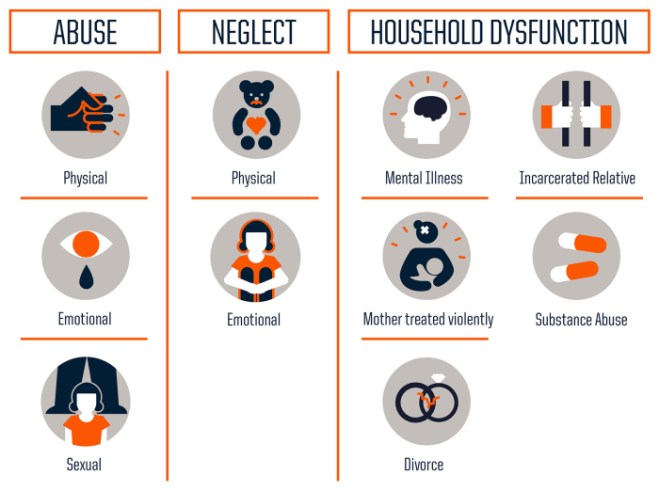
The “mainstream” accepted list of ACEs. Source: Centers for Disease Control and Prevention; Credit: Robert Wood Johnson Foundation
Many data dive participants felt that ACEs were likely to be under-reported, since parents may not want to acknowledge difficult or taboo issues, or may feel uncomfortable sharing this information with a government entity.
Some participants also suggested that their children experienced a much wider range of challenges than those defined as “ACEs” in the survey – for example, stress as a result of structural and institutional racism, poverty, and homophobia. As one Somali caregiver commented,
Our stress is not from ACEs. Our ACEs are different. They come in the form of stress caused by things we lack but could be achievable.
Participants also emphasized the importance of resilience; experiencing ACEs doesn’t dictate a child’s future outcomes. In fact, among Best Starts for Kids survey participants, children with two or more ACEs were just as likely to be thriving and to have protective factors as children that had not experienced one or no ACEs. One participant in the Black/African American community café shared that she felt saddened but unsurprised by the ACEs data we shared. But, she said,
I see it as a point of strength. Look how many of these [ACEs] I’ve experienced, but we’re here.
Participants suggested many ways to support families and children that are experiencing ACEs, such as supporting parents in positive parenting practices; decreasing stigma about mental and behavioral health issues; ensuring that workforces that serve children and families understand ACEs; and helping families meet basic needs like housing.
Thriving Children
The Best Starts for Kids Health Survey asked about key markers that research has shown indicate thriving children. For little ones between zero and five years of age, they include a healthy attachment to parents or caregivers, showing curiosity and interest, the ability to regain calm behavior after an upset, and expressions of joy or happiness. For those in kindergarten through fith grade, we asked about interest and curiosity; the ability to finish tasks; and staying calm when faced with a challenge. In King County, 59 percent of zero-to-five-year-olds displayed all of these qualities, but only 30 percent of elementary age children did.
Participants had many ideas about the cause of this drop, and many felt that the data did reflect what they saw in their communities. Many communities saw it as evidence of a lack of support for their children in the school environment, citing disproportionate discipline and lack of staff who reflected the identities or understood the experiences of students. One Native parent shared,
The reason this is so low is because of how unsuccessful our community is in the public education system. How our needs and wants are not recognized by the elementary system. Doesn’t surprise me at all, seems pretty accurate to me.
Somali participants also felt that unsafe neighborhoods, lack of safe housing and adequate income were impacting their children’s ability to thrive.
Participants also had a lot of feedback about how the idea of “thriving” children is measured and defined. In the research about this construct, it is called “flourishing and resilient children.” But many parents reported that this language did not resonate with them at all, or was unclear; they suggested “thriving” instead. Participants also felt that the components of this could be biased, vague, or subjective. As one provider commented,
I think this is an Americanized way to look at it. Understand it might not be, culturally, their experience, but their child could still thrive.
Parents saw many ways to promote more thriving children, from changing the school environment to providing more quality early learning programs.
Upcoming…..
We’ll wrap up the series next week with a contribution from one of our Spanish speaking facilitators, interactive data visualizations, and an intro to our more in depth data write ups. So stay tuned! As always, if you have any questions, feel free to leave us a comment below. You can also contact the Best Starts data team directly at BSK.Data@KingCounty.gov.
Share this:

Himalayan Blackberry: June Weed of the Month
Crossposted from Noxious Weeds Blog
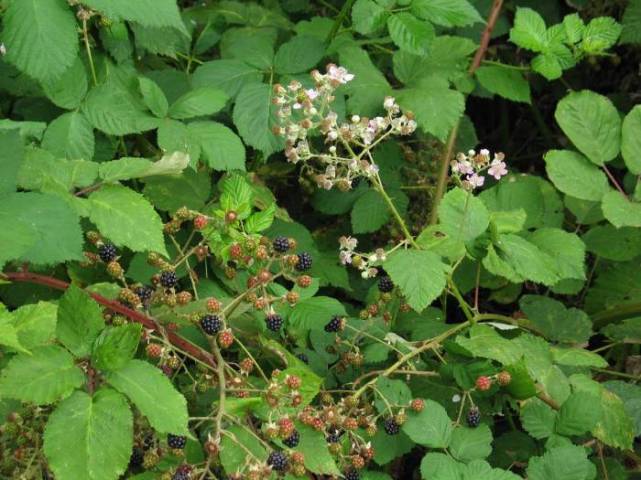
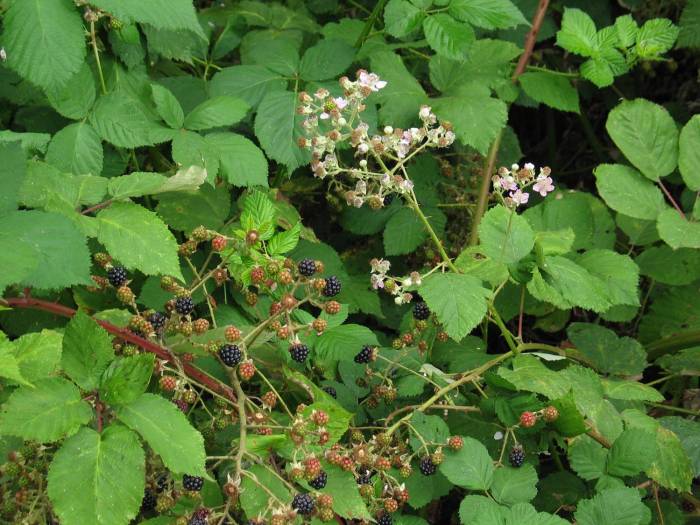
- Himalayan blackberry (Rubus armeniacus) displaying its famous edible fruits. Photo by Susan Aldrich-Markham of Oregon State University.
If Washington ever decided on a state weed, Himalayan blackberry (Rubus armeniacus) would be a strong contender. Some people hate its thorns, some love its berries, but almost everyone has a strong opinion about it. Yet, for all its fame, this plant has only grown in our region for a little over one hundred years—a striking example of just how quickly a noxious weed can take over.
Even the origins of Himalayan blackberry are almost mythic. In the late 1800s, botanist and entrepreneur Luther Burbank brought the plant to his California farm in the hope of selling it far and wide. Burbank was a constant experimenter, and his creations include the Shasta daisy, elephant garlic, and the predecessor to the Russet potato. His newfound blackberry was both vigorous and delicious, and grew especially well in temperate climates. It seemed to Burbank like the perfect fit. (Thinking the plant was from India, Burbank named it “Himalayan Giant,” although it actually originated in Armenia.)

- Luther Burbank admiring one of his many developments, a blue poppy. “Luther Burbank 1900 Papaver” by unknown author, Library of Congress / CC BY 2.0.
A century later, those same traits have created an ecological disaster throughout much of the United States. Himalayan blackberry stems (often called canes) are large, thick, arching, star-shaped in cross-section, and have big thorns. They can quickly grow up to 15 feet tall and 40 feet long, outcompeting many other plants and forming dense monocultures. The plant spreads by forming roots at the tips of its arching canes, as well as through white to pink flowers that look like those of wild rose and produce up to 13,000 seeds per yard.
It dominates in disturbed sites, such as empty lots and roadsides, but also more intact habitats such as riparian areas and open spaces. Himalayan blackberry is especially troublesome along riverbanks: overhanging branches can hide eroding banks, while its aggressive growth prevents trees from establishing that might stabilize the banks and shade the water. Himalayan blackberry’s damage extends to animal species, too: in a 2010 study based in British Columbia, the author found a decrease in breeding bird species within areas dominated by Himalayan blackberry.

- Himalayan blackberry grows quickly to form dense, nearly impenetrable infestations.

- Himalayan blackberry has stout, ridged, thorny canes.
What’s more, Himalayan blackberry isn’t the only invasive blackberry growing in our area—though it is the most common. The other, evergreen blackberry (Rubus laciniatus) looks like Himalayan blackberry from far away, but up close you can ID it by its leaves: While Himalayan blackberry has large, toothed, rounded or oblong leaves that grow most often in groups of five, evergreen blackberry has much more deeply serrated leaves divided into 3-5 leaflets.
Luckily, while these two species are probably here to stay in the Pacific Northwest given how widespread they are, neither are impossible to get rid of in a particular area (albeit with a little blood, sweat and tears). Because of their invasiveness and impacts on natural and agricultural resources, both species of blackberry are Class C Noxious Weeds in Washington. They are not regulated in King County, meaning control is not required but is encouraged as part of conservation, restoration, forestry or other land management practices. The decision to control blackberry and how to do it depends a lot on what your goals are and what resources you have. It’s not easy, but the benefits can be huge! For more information on invasive blackberry control, see the following resources:
- Blackberry identification and control
- Himalayan Blackberry – King County Noxious Weed Alert
- King County’s Best Management Practices for Blackberry
Last, if you understand the damage these two invasive plants cause, but really love the taste of blackberries, we have a solution for you: trailing blackberry (Rubus ursinus), a low-growing native blackberry with slender stems and alternate leaves divided into 3 leaflets. It doesn’t produce as many berries as the two invasive species, but many people say they taste even better. Once you’ve eradicated your invasive blackberries, consider planting some trailing blackberry in their place—that way, you can still enjoy those freshly picked blackberries!
Share this:

Pet of the Week: Lila Rose

Crossposted from Tails from RASKC
 This pretty flower is Lila Rose, our Pet of the Week!
This young girl came to us because she wasn’t a good fit in her previous home. Her personality color is “Rambunctious Red,” meaning she is a spirited cat with a fun-loving personality. She may need some time to get used to people and new surroundings. When she does get comfortable, Lila Rose is an affectionate lovebug who likes to “talk” to you!
Lila Rose may be sensitive to handling at times, so she would do best in a home with cat-savvy people who know when to give her some space. Because she likes to take her time with new people, she may also do best in a calm home without children or perhaps with older, respectful children. Take the time to get to know her and she will be a devoted friend!
Lila Rose is spayed, current on vaccinations and microchipped. Her adoption fee includes a certificate for a free veterinary exam and 30 days of free pet insurance through Trupanion.
Visit Lila Rose at the King County Pet Adoption Center in Kent, or see her profile online at KingCounty.gov/AdoptAPet.
Share this:

Metro’s adult fare change effective Sunday

Effective Sunday, July 1, Metro will convert to a single adult fare of $2.75, anytime, anywhere.
One-zone, two-zone, peak and off-peak fares will no longer apply.
There will be no change in the fares for youth, ORCA LIFT and RRFP.
A partir del 1º de julio del 2018, Metro cobrará una tarifa única de $2.75 para adultos. Ya no se aplicarán tarifas de zona 1 zona 2 y hora pico. No habrá cambios en el costo para jóvenes, niños ORCA LIFT y RRFP.
Visit What to Pay to learn more.
Share this:

Training Spotlight: The Fundamentals of Coaching

The Fundamentals of Coaching is a half-day training being held Aug. 30 and Nov. 13 in Room 560 of the King County Administration Building.
This half-day training introduces the fundamental skills of coaching. Have you ever wondered if coaching could be applied on your job? Do you know that you can have an effective, seven-minute coaching session with an individual or co-worker? Are you aware of the mindfulness practices included in coaching? Come join us for The Fundamentals of Coaching course, where you will become familiar with the basic elements of coaching such as the mindsets and skills a coach uses to help others move forward. Participants will engage the materials through instructor-led classroom discussions and interactive social learning.
Objectives:
- Become familiar with the discipline of coaching
- Learn how mindfulness practices improve the coaching experience
- Describe the mindsets and skills a coach uses to help others move forward
- Acquire skills to facilitate results within 15 minutes of the conversation
- Practice coaching others and being coached
We covered Building Change Management and Effectiveness last week, and there is still space available! It is a one-day training being offered July 27 and Sept. 7 in room 560 of the King County Administration Building. Craig Fleck will join King County’s own Debra Baker in delivering the session.
 Learn more and register for The Fundamentals of Coaching, Building Change Management and Effectiveness, or both on Eventbrite before the session fills up, and visit Learning and Development on KingCounty.gov to learn more about trainings and other opportunities to invest in YOU!
Share this:

Latino Outdoors hikes Alki Beach Trail

Crossposted from King County Parks Plog
By Gabriel Avila-Mooney, Communication Specialist for the King County Regional Trail System
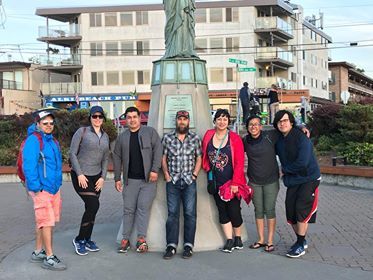
On Monday, June 4, I joined the Washington chapter of Latino Outdoors, in a partnership with King County Parks, and walked the Alki Beach Trail. A scenic late afternoon hike ended in a beautiful sunset, highlighting one of the unique regional trails in King County.
It was a fun opportunity to meet other Latinos in my area and talk about living and working in the beautiful Puget Sound Region.
If you’re looking to join other Spanish speakers in hikes around the region, join the Latino Outdoors Washington Facebook group for events and happenings in Your Big Backyard and beyond!


Share this:

Supreme Court decision will not affect strong partnership with labor
Dear fellow King County employee,

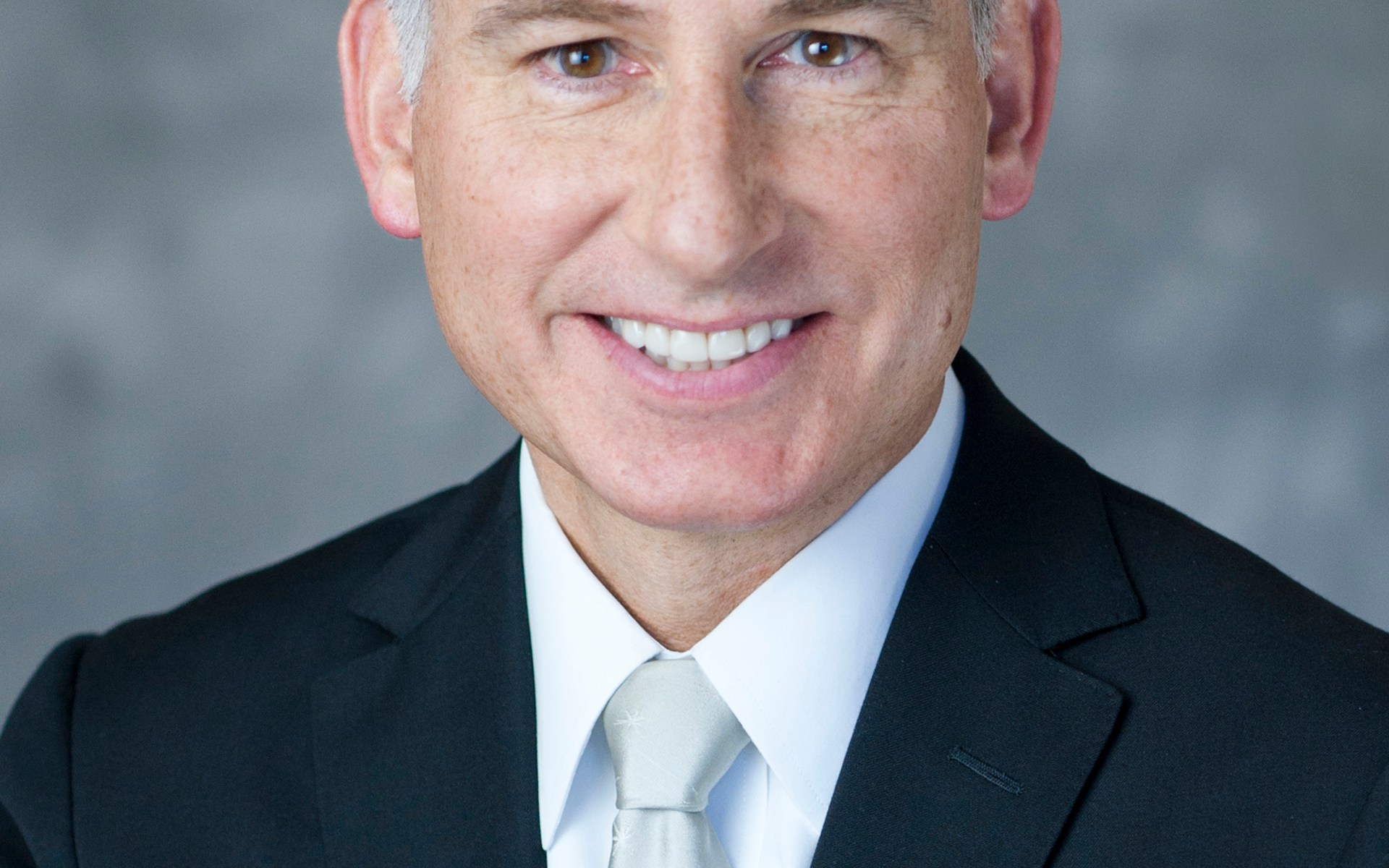
King County Executive Dow Constantine
Today, the Supreme Court handed down its decision on Janus v. American Federation of State, County and Municipal Employees, ruling that state and local public employees cannot be required to pay union dues or fees.
Labor unions have always been valued partners in our efforts to make King County a great place to work, and a highly effective service provider for our residents. Just last month, the King County Council approved our groundbreaking Master Labor Agreement jointly developed with our Coalition of Unions, which gives us a new framework for building on our efforts to be a workplace where every employee has the tools, support, and opportunity to do their best work for the people of King County.
The decision will present challenges for unions and their ability to provide the highest level of representation for their members, and we will work together to meet those challenges.
We are assessing the potential impacts of this decision on King County, and will share more information with you as soon as it is available. If you have questions about your represented status please contact your union representative.
Sincerely,

Dow Constantine
King County Executive
Share this:

2018 Seattle Pride Parade in pictures


Executive Constantine with the King County contingent in the 2018 Pride Parade.
Hundreds of King County employees and their friends and family joined King County Executive Dow Constantine to celebrate diversity, fairness, and justice at the Seattle Pride Parade Sunday.
“Another fantastic #SeattlePride on the books! Times are difficult, but in King County, we’re striving to make sure that #allarewelcome,” Executive Constantine shared on Twitter Sunday.
King County Metro Bus 6885 was wrapped for the occasion, and traveled the parade route with a King County Medic One rig, courtesy of Public Health.

 Public Health has a long history of participating in the Seattle Pride Parade. They joined the King County contingent to celebrate this year’s theme; Pride Beyond Borders. Click on the following image to view their photo album on their Public Health Insider blog. (Can you spot our Public Health staff?)
 @KingCountyWA compiled a Twitter Moment, and included images from @kcexec, @kcmetrobus, @OurSeattlePride, @PurpleHayesRN, @KCPubHealth, @kcassessor, @KIRO7Seattle, @KCCouncil, @FireDogPhotos and @SoundTransit. Click the following image and enjoy.

Share this:

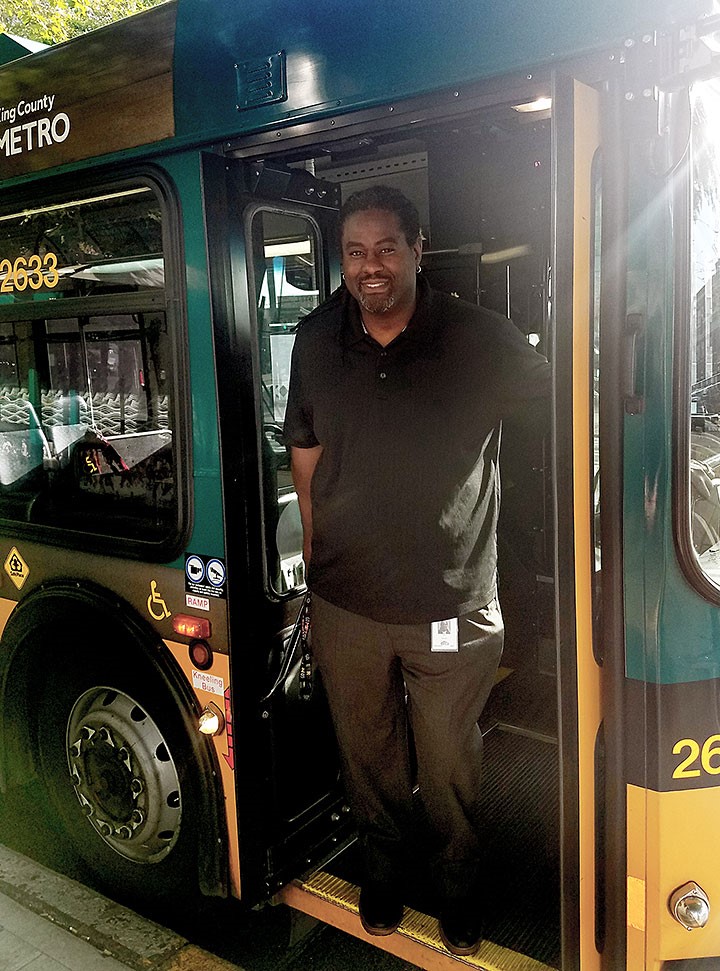
Metro managers who #RideTransit: Terry White
Shared from the Employee Transportation Program
In honor of #RideTransit month, we’re talking with four Metro managers about their transit commutes and any advice they’d like to pass along to new riders.
Deputy General Manager Terry White has several options for his transit commute. He lives in the Soos Creek area south of Renton, and likes to walk north to Fairwood to catch Route 102 into Seattle – or walk south about the same distance to catch Route 157. Either walk is about one and a half to two miles, so he gets a little exercise. He may also drive north to the Renton Highlands and take the Route 111 or Route 114 bus.
“And some days, I’m just interested in catching something different because I work here,” White says with a smile. That can include driving to Tukwila to take heavy or light rail (Sounder or Link), even though these — especially Link at the Tukwila International Boulevard station — involve more driving.
White grew up locally in a car-free home. “We rode the bus everywhere,” he says, rattling off examples, “the zoo, museums, the fair, church.” Today, he finds riding less stressful than driving and says, in most cases, it takes about the same amount of time once you factor in finding a place to park and getting from there to your destination.
His transit commutes allow him to check and respond to emails, getting his work day started on the way in and finishing it on the way out. If he’s all caught up, he may browse the news or catch a nap.
His suggestion for people who haven’t tried transit? “Find an alternative way to get to work and give it a shot, I would say for at least a month, and see if it helps your disposition,” said White. “If you do it for just one day, you may have a bad experience and decide it’s not for you. But if you can go a month, I think you’ll see the true value of transit.”






 Employee News