
Sisters Who Care about breast cancer awareness
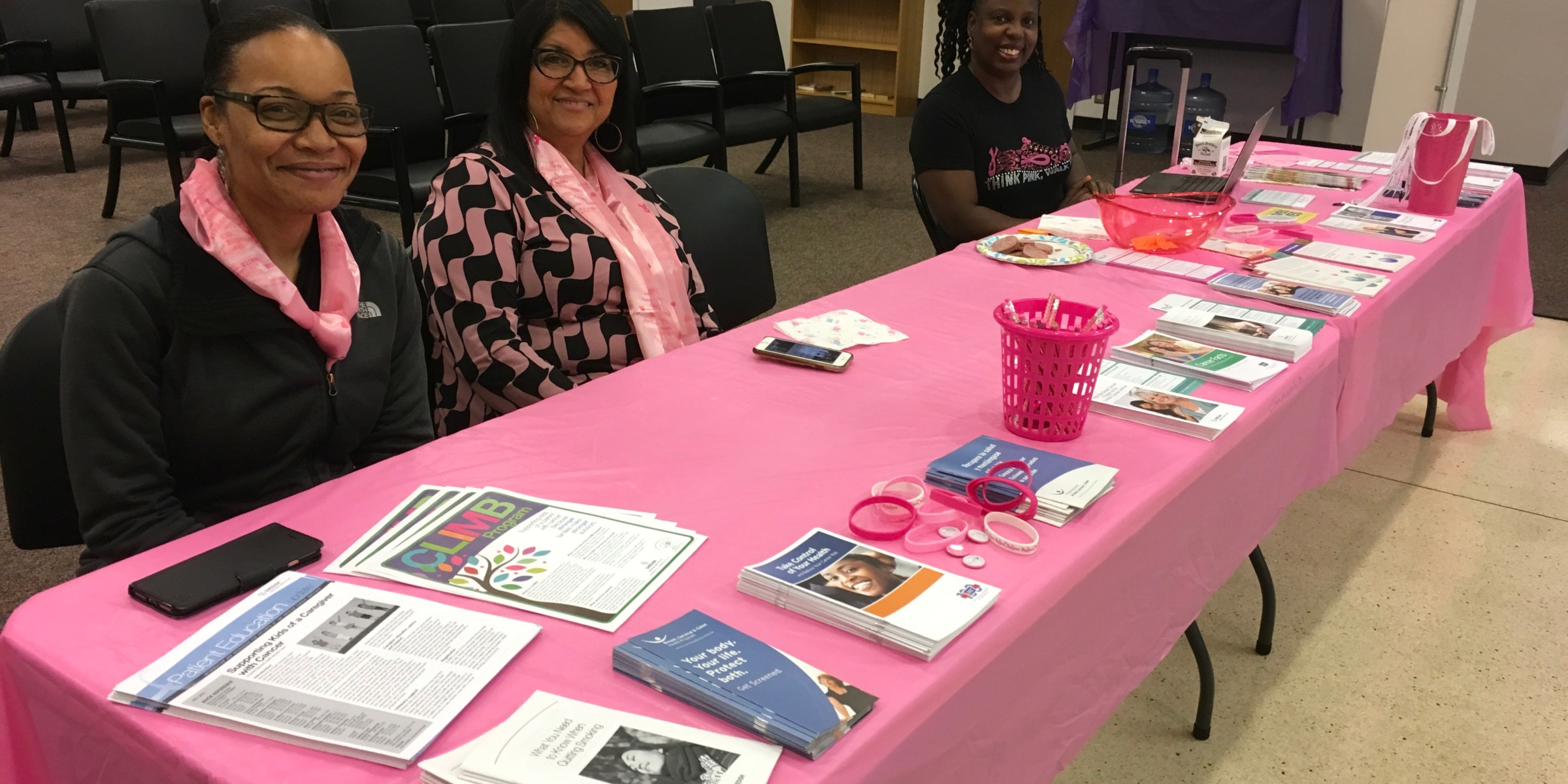
True to their name, the Sisters Who Care really do care about their Juvenile Court colleagues and clients. This group of employees includes African American women who champion various causes and projects throughout the year. They are responsible for the annual Juneteenth celebration, and this month they feature Justice in Pink, a focus on Breast Cancer Awareness Month.
Justice in Pink is the brainchild of Superior Court Renton Unit Supervisor JoeAnne Taylor and Renton Juvenile Probation Counselor Darlin Johnson who noticed many co-workers and family members were affected by cancer diagnoses. Justice in Pink is designed to educate Juvenile Court staff and the families they serve about early intervention, types of cancer and types of treatment.
Every Thursday in October over the lunch hour the Sisters Who Care are dressed in pink at the entrance to Juvenile Court handing out information about cancer, treatment and the benefits of early intervention.
Thank you to Janaye White, Shirley Noble and Darlin Johnson who took their place at the table on Oct. 11.
Share this:

Look for Open Enrollment information in your mailbox

Check your home mailbox for important benefits and Open Enrollment information mailed recently to the address you have listed in PeopleSoft. Open Enrollment takes place Nov. 1 – 15 and is your opportunity to:
- Enroll in the new short-term disability plan (Regular employees only)—Learn more at Life and Disability Insurance. To help you decide if this benefit is right for you, use the decision support tools, including videos, claims examples, rates, and coverage highlights.
- Change medical plans—Use the Plan Comparison Charts and other resources on the Medical plan page to consider whether Kaiser SmartCare or KingCare Select (Regence) makes sense for your family. The KingCare (Regence) plan is also still available. Note: KingCare Select is not available to Deputy Sheriff/PSPMA and TEA-DOT employees.
- Select the appropriate Benefit Access Fee—or exemption. If you cover a spouse or domestic partner on your medical plan, a Benefit Access Fee may be automatically applied, depending on your benefit group and the plan you choose. If you qualify for an exemption, you must confirm this each year during Open Enrollment.
- Enroll in a Flexible Spending Account—Health Care or Dependent Care FSAs reduce your taxable income. The health FSA maximum contribution for 2019 is $2,650.
- Contribute—Give to the Employee Giving Program during the Annual Giving Drive.
What if you don’t participate in Open Enrollment?
- You will remain enrolled in your current medical plan.
- The Benefit Access Fee associated with your medical plan and benefit group will automatically be applied if you cover your spouse or domestic partner.
- You will not be enrolled in a Flexible Spending Account.
- Your other benefit choices will remain the same for next year.
For more Open Enrollment and benefits information visit www.kingcounty.gov/Open-Enrollment or contact Benefits, Payroll and Retirement Operations at 206-684-1556, by email at KC.Benefits@kingcounty.gov or at the Chinook Building, 401 Fifth Ave., 2nd Floor, Seattle 9 a.m. – 4 p.m., Monday – Friday (closed Veterans Day, Nov. 12).
Share this:

Supported Employment Program recognized at Governor’s Employer Award Program
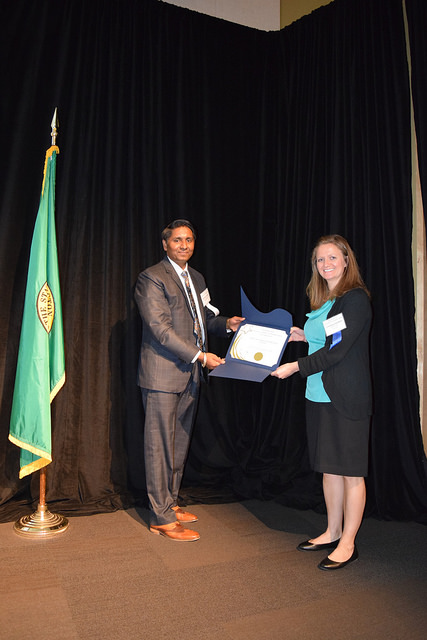
King County’s Supported Employment Program was nominated for the Employment and Disability Issue Governor Awards for 2018 Public Sector Employer of the Year. The awards ceremony was held at the Microsoft Conference Center on Wednesday, October 17. The program was recognized by the Washington State Governor’s Committee on Disability Issues & Employment (GCDE) for the efforts of public employers (federal, state, local government) and their efforts to recruit, hire and advance the employment of individuals with disabilities.
Although King County did not win the award, (hats off to the City of Bellevue) this was a great opportunity to not only recognize the work and commitment of program staff, but also the Executive’s commitment to supported employment.
“Although King County’s Supported Employment Program did not win the award today, I am honored that the nomination was considered and continue to be grateful for Christina’s work and the direction our program is going,” said Jeff Casem, Disability Services Supervisor.
Attending the event included (from left to right): Jeff Casem (Disability Services Supervisor), Whitney Abrams (Chief People Officer), Christina Davidson (Supported Employment Program Manager), Ting Chou (Department of Adult and Juvenile Detention Administrative Office Assistant), Susan Stremel (Department of Community and Human Services Program Manager), Brooke Caddock (King County Council Office Assistant) and Liesa Spring (Senior Employment Consultant from Trilium Employment Agency.


Share this:

Employees participants needed for discussion about engagement data

The employee engagement team is looking for employees with ideas on how to improve the county’s response to what employees have said about their experience at King County. Contact Brooke Bascom at Brooke.Bascom@kingcounty.gov if you are interested in participating in a discussion that looks at:
- Are we responding to the engagement data in the most effective way?
- What works about action planning at the workgroup level?
- What doesn’t work about action planning at the workgroup level?
- What do we need to do that we’re not currently doing to improve engagement at King County?
- What should we keep doing to improve engagement at King County?
Share this:

Training Spotlight: Communication skills in the workplace and Introduction to strategic planning

Communication Skills in the Workplace, Oct. 25: Communication skills are vital in today’s workplace. In this course you will identify the four primary communication styles, learn how to recognize your style as well as the styles of others, and how to overcome common communication roadblocks and barriers. Learn more and register
Introduction to Strategic Planning, Nov 1: This training provides an overview of what strategic planning is, when and why to develop a strategic plan, and how it fits with other management systems and functions. The basic elements and processes used to develop a strategic plan and key issues that need to be addressed with implementing strategic plans will be described. Participants will be provided with several planning tools to help with a planning effort. Learn more and register
Share this:

Q&A with our Elections translators: Juan Vazquez, Spanish

Crossposted from Election Connection
We’re highlighting the great work our translators do helping make our elections and services accessible to every member of the community. Here we sit down for a brief Q&A with Juan Vazquez, our Spanish language translator.
What brings you to working in local government at King County? I was born in Mexico, but immigrated to the United States when I was thirteen. I attended Seattle University for my Bachelor of Arts, then completed my Master of Arts at the Monterey Institute of International Studies in Monterey, CA. Afterwards I went on to work for the U.S. Department of State as a Foreign Service Officer serving in Cape Verde and Brazil.
I enjoyed living overseas and working for the federal government, but I wanted to come back home to make a difference in my community so I decided to join King County Elections. I want to be part of an organization that strives to provide all citizens with the opportunity to participate in the democratic process.
Read more at Election Connection
Share this:

Employee Giving events Oct. 23 and 31
This year’s Annual Giving Drive is in full swing and there a plenty of events around the county that you can take part in to support, or discover, your favorite nonprofit, such as:
Pancake Feed, Oct. 23, 7 – 9 a.m. Courthouse, 1st Floor, RM W-150: Join us to eat some delicious pancakes and help us support the S.H.E.R.I.F.F. Fund! Benefits the S.H.E.R.I.F.F. Fund 9008.
Festival of Frights Halloween Carnival, Oct. 31, noon – 1:30 p.m., Lean Lab, third floor of Admin Building: The Executive Office presents the first Festival of Frights Halloween carnival, a carnival of spooky sensations, The event will benefit Peace for the Streets by Kids from the Streets and Project SeaWolf.
For information about other Employee Giving Program (EGP) Events, view the special events calendar. To add an EGP event to the calendar submit the information here.
Share this:

Kudos! King County Community Court featured on King 5!

The King County Community Court, a collaboration between King County District Court, the City of Redmond and the King County Library System, was recently highlighted on KING 5 news. The article and video explained how this new court, set up at the Redmond Library, encourages non-violent offenders to seek help and rebound from their mistakes.
“We’re holding people accountable, but at the same time, concurrently, allowing them to rehabilitate themselves in hopes that they will not come back into the system,” said Judge Lisa Paglisotti, who oversees the King County Community Court.
View the full article and watch the video here at KING 5.
Share this:

Women in Leadership Lunch and Learn, Oct. 30

WILpower increases knowledge and skills about leadership through a series of nine monthly interactive workshops with expert speakers, as well as regular networking and discussion groups that reinforce the powerful messages heard in the workshops.
Please consider attending a Lunch & Learn presentation by the Chair of the WILPower Leadership Team, Susan Seah October 30 from noon to 1pm in Chinook Conference Room 124. Women in Leadership (WILpower) trainings for 2019 will start January. View the calendar for 2019 WILpower workshops here.
Share this:

Pet of the week: Pearl

Crossposted from Tails from RASKC
 We have a real gem for Pet of the Week: meet Pearl!
This young pittie was brought to RASKC by a good Samaritan. When she first arrived, Pearl was very nervous. She has since come out of her shell to show her shining personality – which we call “Rambunctious Red. Read more






 Employee News