
King County employees support West Point crews and operators

This article is featured courtesy of Monica Van der Vieren, Communications Specialist, Department of Natural Resources and Parks
The first question King County employees asked when they heard about the unprecedented West Point Treatment Plant flooding was, “What can I do to help?”
King County Wastewater Treatment Division has been all hands on deck working around the clock to restore high quality service to the treatment plant since unprecedented flooding damaged the plant Feb. 9. Operations and maintenance crews from other treatment plants, offsite facilities and downtown pitch in at West Point. Employees throughout the system manage a larger work load with some flows transferred to other plants.
But there isn’t much that untrained employees can do to help out at West Point.
King County’s emphasis on service and teamwork shows at times like these, and people found a universally-appreciated way to show support: food.
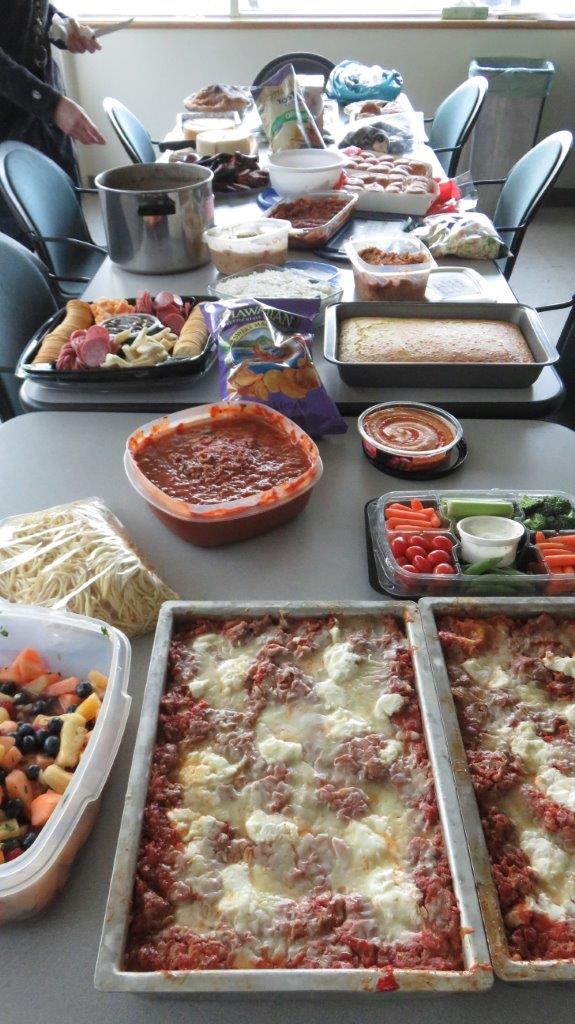 It started with a suggestion by Paige Myers , assistant to the DNRP Director, to cook up a big pot of chili for the hard-working crews. Another employee volunteered to make homemade cornbread. And the idea grew from there.
Since late February, employees throughout the Department of Natural Resources and Parks, Human Resources Division, Office of Labor Relations, and the Executive Cabinet have signed up to serve West Point crews buffet style lunches once a week. They cook, bake, buy food and donate cash to set a welcome table in the Rainier conference room every Friday. Paige Myers coordinates the entire operation each week.
On April 14, as the expected date to restore secondary treatment approaches, crews and operators will be treated to a pizza lunch from cash donations.
On March 10, the kindergarten and first grade girls of Daisy Troop 40196 sent a special treat: boxes of Girl Scout cookies. The cookies were accompanied by hand-made cards from the troop saying “Thank you for the hard work and long hours you are putting in to get the West Point Treatment Plant fully restored. We appreciate the work you do to protect our water!”
WTD employees sent signed cards with praise: “You inspire me! Thank you for all the hard work you are doing to get our system back up and carry out our mission!”
West Point workers appreciate the support as much as the food. Operators who are used to working behind the scenes providing high quality wastewater service day after day are now on the front lines restoring the treatment plant. Everyone’s routines have changed. While most King County employees can’t step in to help, we can let our hard working, dedicated colleagues know that we’re standing by them throughout the restoration effort.


Share this:

Why King County is leading with racial justice

Yesterday King County Executive Dow Constantine announced that King County is prioritizing racial justice in our work and the implementation of our Equity and Social Justice (ESJ) Strategic Plan.
We all benefit from having an equitable and just society where everyone has a fair shot at success and is able to contribute, where no one is held back because of the color of their skin.
The Office of Equity and Social Justice has put together a short Q&A to answer some questions that you may have.
Why is King County focusing on racial justice?
When we look at data across our communities, whether its people’s health, access to housing and good paying jobs, graduation rates, incomes or incarcerations, disparities are greatest when we look by race. The most persistent and detrimental disparities are starkest when we look at race. By leading with racial justice we are committing to taking on the root causes of our most challenging problems and to focus where we can have the biggest impact and needs are greatest.
Our ESJ approach is comprehensive, working to address all forms of inequities, discrimination and bias. By leading with racial justice, we will learn the tools and strategies that apply to all inequities and will be able to apply them to eliminate all forms of discrimination and disparities and their intersection with race.
Share this:

Profiling amazing women working throughout King County: Diane Gimenez, Utility Laborer, King County Metro

Diane Gimenez, Utility Laborer, King County Metro
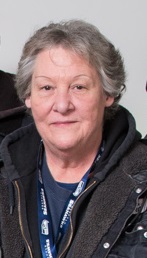
How did you get your start in utilities? I started with Metro back in June 1995. When I started I was a maintenance worker, and then I moved to become a utility laborer in 1998.
I took the job because it looked like it would be challenging. You were outdoors and I liked working outside. Then in 1998 I put in an application to get my CDL (Commercial Driver’s License). It was a good opportunity to move up and get another position within the County.
Do you bring a different perspective to your work? Yes. You can work together to eliminate problems, and if people don’t know how to do that, then you just have to show them. I’ve seen this with other women in the workforce who worked alongside me and led me in the right direction. This gave me a lot of incentive to do my job well.
Do people treat you differently because you are a woman? Actually, they will give you the respect you deserve if you have the endurance and you’re a hard worker. You have to overlook all of the negative things and know that hard work is going to pay off in the end.
I’ve had supervisors who say thank you for doing a great job. Getting that little pat on the back gives you more incentive to work hard.
I’ve also met people who say things about me being a woman, but that’s pretty much meant to be expected in any job or classification. I just have to keep pushing and show them I can do it, telling myself ‘Yes, I can do it.’
Do you have advice for young women considering a career in utilities? You have to work smart and don’t hurt yourself. You want to do your job and accomplish what you came out here to do, and if you have to ask for assistance, then yes do it. In our job description we have to be able to lift up to 50 pounds, but there are ways to work smart and break down the load.
You can get along with everybody out at Metro. We all try to work together since we’re ‘Metroids.’ That’s a little nickname we have for all of us here in Metro.
If you could go back in time, what do you wish you would have done? Actually I don’t know if I would have done anything different. I enjoy my job, I really like my job. I’ve had a few surgeries and I’ve always wanted to go back to my position. If I can go back then that’s what I’m going to do.
I’m proud of myself. I’m proud to be a ‘Metroid’ and to do this work. I’ve done it, I’m still doing it and I’ll keep doing it.
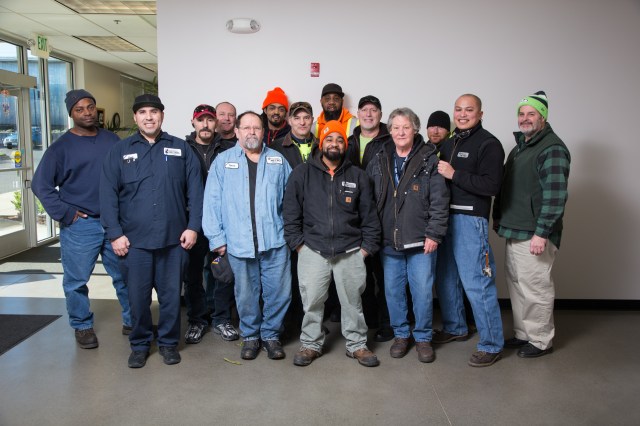
Diane with her coworkers from the Shelter Appearance day shift. Starting from left to right in consecutive order: Paul Jones, Jose Reyna, Andy Franco, Dan Thorn, Thomas Pickett, Micah Roberson, Mark Berry, Andre Boudy (in back), Oscar Freeman (in front), Mitch Carlson, Diane Gimenez, Scott Fuller, Ryan Abin and Ron MacMillan.
Share this:

Getting creative: Local 17 supervisor uses visual mapping to engage employees in the decision-making process
This article original appeared in the PTE Local 17 Insight Magazine. We have been given approval from L17 to use this article.
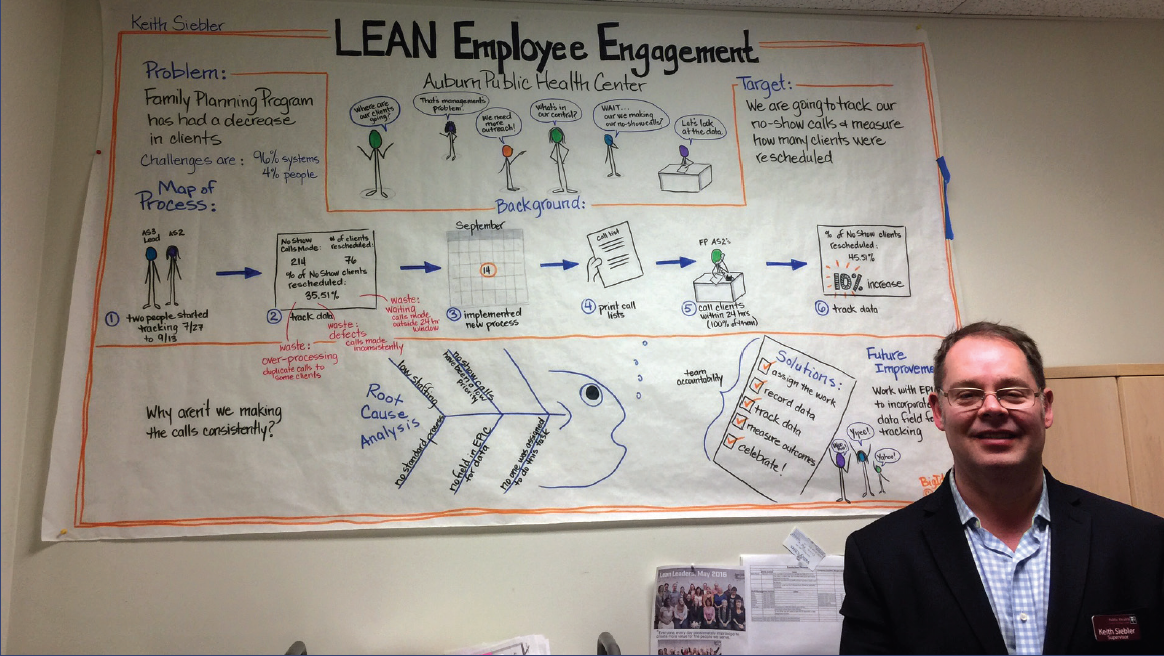
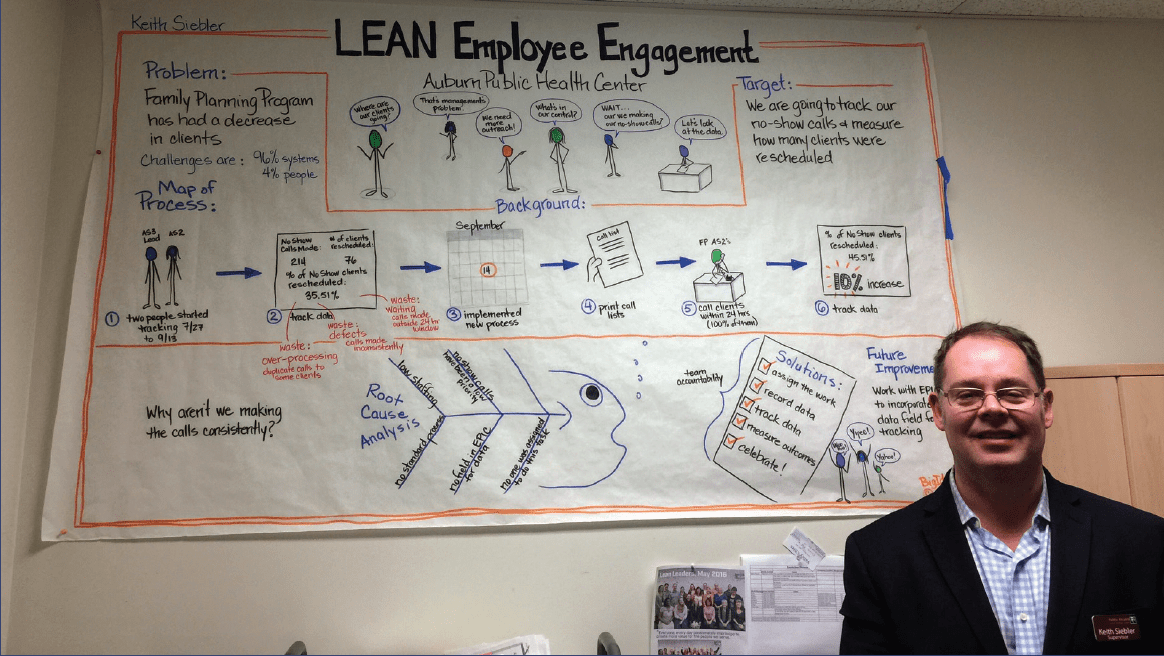
Keith Siebler stands next to one of the posters he envisioned for use in his trainings and discussion with King County employees.
When Local 17 member Keith Siebler started working at the Auburn Public Health in King County nearly five years ago, he encountered a few conflict situations between employees. And while it’s not unusual for supervisors to manage conflict, Siebler wanted to come up with a creative and productive way to address some longstanding issues.
As a Public Health Administrative Support Supervisor (PHASS), Siebler supervises Administrative Support staff and is in charge of day-to-day operations at the Auburn clinic. But prior to his work at King County, he worked in the private sector where he had seen visual mapping in action.
Visual mapping is the process of utilizing visual information, usually in the form of pictures or graphics, to help people absorb and synthesize a large amount of information quickly. In the corporate sector, it is often used by project managers who have to get all members of their team on the same page in order to successfully complete a project.
Or if you’ve ever watched a video by economist and former Secretary of Labor Robert Reich, you can see the power of using visuals. (His ‘Why Right-to-Work is Wrong for Workers’ video is highlighted on the Local 17 webpage: http://www.pte17.org).
Siebler’s first visual map allowed his employees the opportunity to examine their role in the client experience and productivity at the Auburn clinic. He noticed that because of the graphic, employees had better interactions with the information in the moment, and later revisited the graphic and the conversations that had emerged from the original discussion.
“Visual mapping is a great way for managers and supervisors to reach employees with clear and transparent communication as well as to increase employee participation in the process – it’s a win, win!” said Siebler.
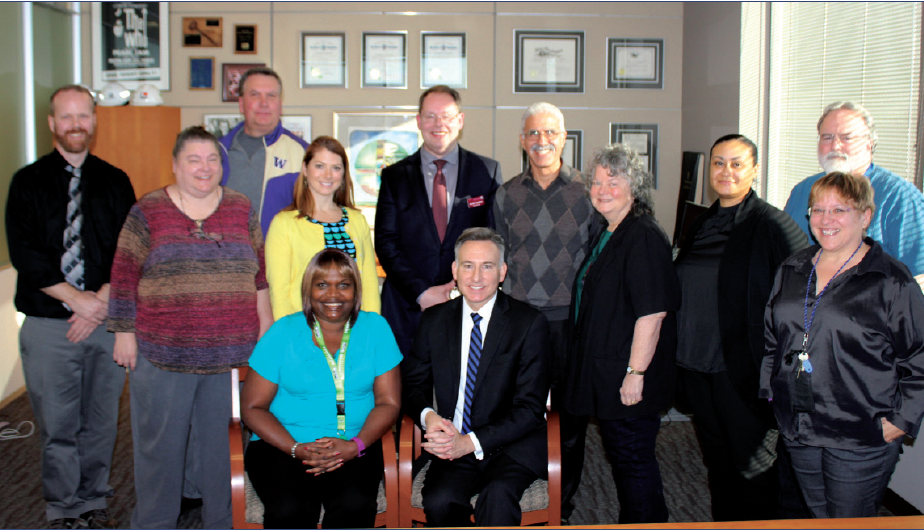
Several Local 17 members – including Keith Siebler – played an active role in King County Executive Dow Constantine’s first employee listening session in December.
To create a visual map, Siebler first starts with the main topic in the center of a paper, and then adds all of the subtopics he can think of – a process called ‘mind mapping.’ He then works with a graphic facilitator to make the mind map more visually stimulating.
Science has shown that people absorb data better when it’s accompanied by visuals. In fact, eighty percent of the population learns through primarily visual means. And with a visual map, not only do people better absorb the learning material, but they feel a stronger sense of connection to the process and the solution.
“Because the visual map is often created with group input, by the time it is completed, the audience looking on already owns it,” said Siebler. “They own it because they helped create it.”
According to Siebler, every map is different, which is why they work so well.
“There’s only one visual map of any unique body of information in existence, so it’s unpredictable and engaging,” he said. “And because you’ve never seen anything like it, you stop to look it over.”
Recently, Siebler and several other Local 17 members – including Local 17 President Lois Watt, Vice-President Hossein Barahimi, Steve Ford, and Jennell Hicks – were invited to King County Executive Dow Constantine’s first “employee listening session” in December. These sessions were created to hear from employees about the issues they are facing in their workplaces, and to learn what the County can do to help its employees thrive.
When Siebler introduced his visual map on getting employees engaged in the LEAN process, Constantine was impressed by the power of visual information.
As a manager, Siebler talked about his passion for employee engagement, reducing absenteeism, reducing Human Resources complaints and grievances, and developing staff for career advancement.
“Keith understands how employee engagement benefits not only the County, but the individual employees,” said Local 17 Union Representative Ceci Mena.
She continued: “He is passionate about making King County a place where employees feel supported, safe and engaged. All the work he has done has not been at the request of management but because he recognizes the changes that need to be made and wants to be proactive.”
As his Local 17 Union Representative, Denise Cobden shares a similar sentiment.
“Not only has Keith shown that he is a leader in his job at Seattle-King County Public Health, he has also been involved as a leader representing members for Local 17,” said Cobden.
“From serving on bargaining committees, helping negotiate contracts, to attending grievance meetings on behalf of our members, Keith is a well-respected member of the King County community by management and our membership alike.”
For Siebler, working for King County has been a really good fit. He applauds the progressive efforts of the County in taking the lead on issues from preventative health care for children, to clean energy and new technology.
“I am excited to be part of organization that is focused on the future,” said Siebler. “It takes bold leadership to address all of the challenges we face as an organization and I enjoy being a part of it.”
Share this:

Social Media Spotlight: King County Metro Instagram

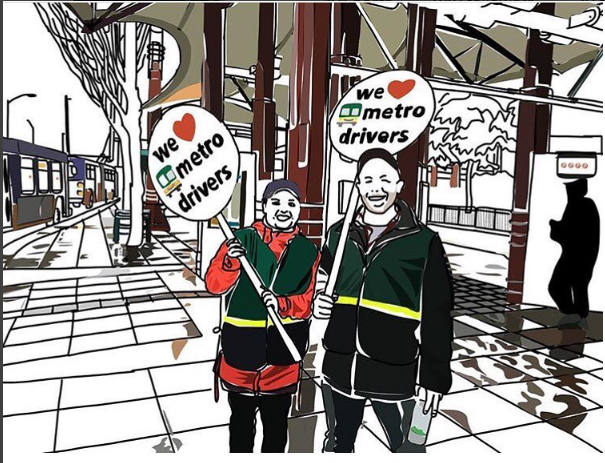 King County Metro Transit provides transit service across King County. Reach customer service at 206-553-3000 or visit metro.kingcounty.gov.
Follow KCMetrobus on Instagram today!
Click here to view all King County social media pages.
Share this:

Free Home Ownership Program classes

Are you interested in buying a home but want to keep your down-payment to a minimum? This seminar is presented by HomeStreet Bank to help you learn about low down-payment programs and strategies, how to use down payment assistance and the eligibility requirements, which down payment assistance programs are in your area, and how to assess your eligibility for programs.
This class will be held at:
- Thursday, April 13, from noon to 1 p.m. Chinook Building
- Tuesday, April 18, from noon to 1 p.m. King Street Center
Registration is required. Please call the HomeStreet Hotline at 206-628-0207, or go online to www.homestreet.com/KingCo.
Share this:

Featured Job: Transit Vehicle Maintenance Technical Information Processing Specialist

Closing Date/Time: Tue. 04/04/17 11:59 PM
Salary: $20.21 – $28.87 Hourly
Job Type: Term Limited Temporary, Full Time, 40 hrs/wk
Location: Multiple locations in King County, Washington
Department: Department of Transportation – Transit Division
Description: This position assists the Transit Vehicle Maintenance Section in support of Metro Transit and Sound Transit revenue vehicle maintenance employees. The Technical Information Processing Specialist is responsible for verifying, entering and tracking a variety of technical data with multiple computer systems/programs, including payroll, work orders, supplies, and other applications.
Learn more about this position or view all available jobs.
Share this:

Employee discounts available for Silverwood Theme Park and T-Mobile

Two new discounts are available to employees:
At Silverwood Theme Park employees get discounts of up to $9 per ticket. Go to www.silverwoodthemepark.com, click on the ‘BUY TICKETS NOW’ graphic in the upper right-most corner of the page, then type in promo code KING17.
- June 10 through July 14 discounted price is $39.00, regularly $48.00 (ages 8-64), and $20.00 (ages 3-7 & 65+), regularly $25.00, plus 6% tax.
- July 15 through July 30 discounted price is $40.00, regularly $49.00 (ages 8-64) and $21.00, regularly $26.00 (ages 3-7 & 65+), plus 6% tax.
- August 1 through September 4 discounted price is $42.00, regularly $51.00 (ages 8-64) and $23.00, regularly $28.00 (ages 3-7 & 65+), plus 6% tax.
King County employees are also eligible for the T-Mobile Advantage Program and can receive a $25 rewards card for every T-Mobile ONE™ line activated. Rewards card can be used toward the purchase of a new device or accessories, or applied to a bill. Click here for more info. Employees are also welcome to take advantage of a limited time offer to receive $200 via bill credit for each line brought to T-Mobile. Click here for more info. To get started with setting up a T-Mobile account, click here.
See all available discounts on the Employee Discount Program webpage.
Share this:
Kudos! Palliative Mobile Care Program featured in national news

 This project, coordinated by King County’s Health Care for the Homeless Network and UW Medicine’s Harboview Medical Center was recently spotlighted for its life-saving work to provide care to King County’s homeless population.
The Palliative Mobile Care Program aims to reduce unnecessary or unwanted end-of-life care and to give homeless people a say in the process. Since January 2014, has served more than 100 seriously ill men and women in the Seattle area, tracking them down at shelters and drop-in clinics, in tents under bridges and parked cars.
Read more about this amazing program in the original article at USA Today.
Share this:

That plume you see is sediment, not sewage

Crossposted from Clean Water Stories
 The power of imagery was on full display in a March 12 front page Seattle Times aerial photograph of West Point Treatment Plant and its adjacent waters. The photo purported to show a plume of sewage and stormwater that had discharged from the plant’s emergency outfall before the bypass gate was closed early in the morning of Feb. 16. The accompanying story began: “A mighty river of brown, raw sewage and stormwater makes a plume offshore at Discovery Park, plainly seen from the air…It’s from the West Point Treatment plant, gushing untreated wastewater into Puget Sound.”
Unfortunately, that was untrue and the power of the photo is in how it was wrongly described. At King County’s request, the Times clarified its reporting on March 20 to reflect that what its readers were actually seeing is sediment. The sediment plume regularly builds up around West Point in the shallow beach area, south of the lighthouse.
“West Point is a pronounced geographic feature that interrupts natural sediment movement along the shoreline,” says Bruce Nairn, King County’s oceanographer. “On an ebb tide, flows move north.”
This particular Feb. 16 sediment plume is corroborated by field scientists, water quality samples, historical photos, wind patterns, currents, and tidal movements.
Read more at Clean Water Stories






 Employee News