
Inclusion Works!

 In observation of King County’s Disability Awareness Month, we would like to highlight a success story in progress …and an employer who is taking steps to ensure a more inclusive and diverse workforce that recognizes the professional contributions of individuals with behavioral health disabilities.
Meet Nick…
Nick is an Inventory Specialist at Amazon who ensures that multiple Amazon locations are fully stocked with supplies for his hard-working colleagues. He recently celebrated nine months as a full time Amazonian, and has received praise from his supervisors.
Nick moved to Seattle in 2006, looking for a better life. “I didn’t know resources or how to get around. I finally ended up in a shelter and living on food bank donations.” At one point, Nick ended up in the hospital, and his search for employment became even more difficult.
He then connected with the King County Behavioral Health and Recovery Division (BHRD), and enrolled in BHRD’s Supported Employment Program (SEP). This program helps individuals with behavioral health disorders, including mental illness and substance use disorders, either enter or re-enter the workforce.
This is accomplished with the assistance and support of employment specialists and an integrated team of professionals, including prescribers, therapists, case managers, housing providers and substance use disorder providers.
Through BHRD’s SEP – and their partnership with Northwest Center and Amazon – Nick gained employment. Today, he reports that having ongoing support during his initial stage of re-entering the workforce has changed his life for the better. “I think my confidence has grown. I’ve gotten into the routine of working. Before, I couldn’t afford things that I saw. Now I see things and I can afford to buy them because of my job. I bought a smart phone with money I earned from working. Amazon and the (supported employment) program helps people get back on their feet to where they can survive.” Nick tells others with behavioral health disabilities, “Keep trying. Don’t get discouraged. Keep trying until you can describe what you’re looking for to an employer. It’s worth it!”
Congratulations Nick!
Share this:

The Annual Employee Giving Drive and National Hispanic Heritage Month

 The County’s 2016 Annual Employee Giving Drive began last week, and this year’s goal is to raise $1.82 million! The Employee Giving Program is a philanthropic resource for King County employees that benefits county employees by providing prescreened nonprofits, allowing you to plan your giving, making it possible for you to donate time (vacation or compensatory hours), and offering anonymity.
In observance of Hispanic Heritage Month, the following are four nonprofits serving the King County area that are eligible to receive donations through the Employee Giving Program. Take a look at the services they provide!
- Casa Latina (9307) Empowering Latino immigrants through employment, education, and community organizing.
- El Centro de la Raza (9349) Human & Emergency Services (food, housing, etc.), Child & Youth programs (college readiness, academic achievement, etc.), & Education/Asset-building programs (employment, etc.)
- Open Doors for Multicultural Families (9668) Dedicated to the needs of diverse families who have loved ones with developmental disabilities and special healthcare needs.
- VIVA Hispanic Foundation NW (9094) Provides educational support and opportunities, conducts programs aimed at empowering the Hispanic and other minority communities in the State of Washington.
You may pledge either online in PeopleSoft or with a paper form. Through payroll donations, employees can donate to as many as 20 nonprofits, and contributions can be made bimonthly (first two pay checks each month), monthly (second paycheck each month) or annually (first paycheck in January).
Every donation made through the Employee Giving Program is tax deductible. Just keep track of the proper paperwork and you can deduct your donations when you file your taxes!
This year’s drive runs through November 18. For more information, visit the EGP site. For additional questions, contact your EGP Ambassador, email EmployeeGiving@KingCounty.gov or call 206-263-9405.
Share this:

Facilities Management Division goes deep for employee survey, focuses on language, access and privacy
Judy Hairston, Customer Relations and Employee Engagement Manager, wants to make direct contact with all 324 employees in the Facilities Management Division (FMD) during the employee survey period. It’s important to her because she wants people to know she is accountable to them in her new role overseeing employee engagement.
“I know people have concerns about confidentiality and follow-up and I think being able to see my face and ask me questions helps.”
This is no easy task in a 24/7 operation, but FMD’s team of three is committed to improving on last year’s 58 percent response rate. Judy, Denise Gregory-Wyatt, Service Delivery Manager, and Confidential Secretary Gloria Fontenot, who normally work from 8 a.m. to 5 p.m. have flexed their schedules and stretched their hours to reach everyone in the division. So far, they have reached 86 percent of the employees in their division –160 who received paper surveys and 120 who received electronic surveys.
They have paid particular attention to barriers that last year may have kept people from answering the survey: language, concerns about privacy, lack of access to computers and confusion about some questions on the survey.
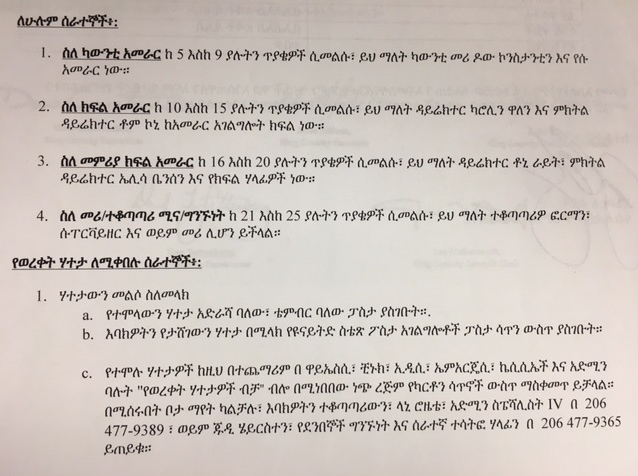
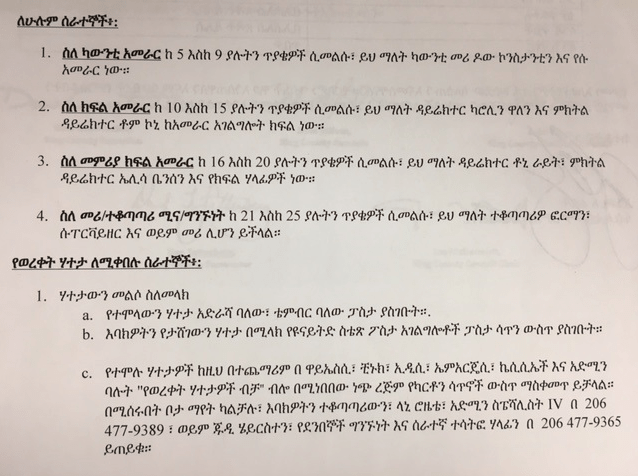
Amharic translations for employees with questions.
To make the English language survey more accessible to their employees whose speak another primary language, FMD had the survey translated into Vietnamese, Spanish, Tagalog and Amharic. So far, Amharic has been the most requested.
To reassure people about confidentiality, FMD worked with Elections to get ballot boxes which are secured by red tape not to be broken until paper surveys are collected and sent to ORC at the end of the survey period. And, Judy, Denise and Gloria are able to reassure people in person that answering the demographic questions will not allow people to identify their individual survey responses.
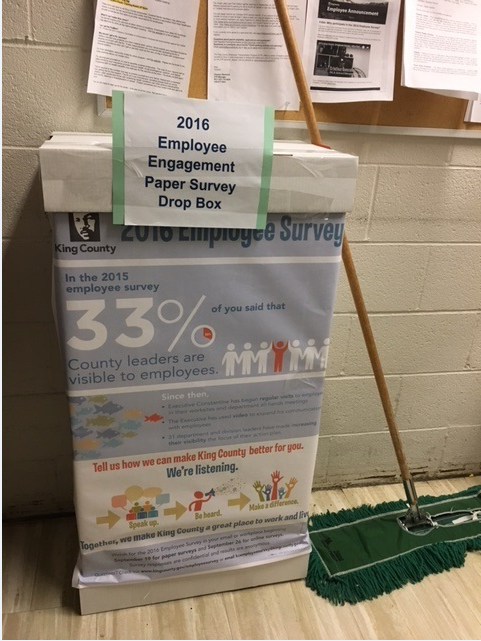
An employee paper survey drop box helps make it easier to collect them.
“About one half of our employees don’t have access to email,” said Judy. So, to make sure the survey gets directly into the hands of each employee, Judy, Denise and Gloria show up at their staff meetings, when employees pick up their supplies and during breaks to personally hand each employee a survey and let them know their voice matters. Division leaders allow everyone to take the survey on work time.
“The other thing we did was create a cover letter that helps people answer questions that were confusing to them last year.” More clear explanations of who is meant by County Leadership, Department Leadership, Division Leadership and Managers/Supervisors are included along with help answering questions about the type of work you do.
Judy pulls out a chart and looks at it. “Later this week I’ll walk my floor to see if everyone got the survey and see if they have questions.” Her mind is already on the future.
FAQ: If I am the only person in my work unit in a certain demographic group how will my confidentiality be protected?
Any personal details in the questionnaire will not be used to identify how individuals have responded to the survey, but rather to understand any differences across employee groups within King County.
ORC is legally bound to ensure that no one from King County has access to identifiable raw data.
To maintain confidentiality, ORC reports only when groups of 6 or more people answer a question. This includes demographic groups. For example, if you are the only African-American person or person over 50 in your work group, results will not be reported for African-Americans or people over 50. The report will say “r” next to those categories instead of giving the percent positive for the question.
See the department report below for an example. This report shows the number of respondent in each age category and then reports the percent positive for each question only when there are 6 or more people in that category. You can see here that there are no people under 18 so ( r) appears. There are 73 people ages 18-35 so the percent positive for each question is given for that demographic.
Share this:

Five questions with Kara Hannigan, Training and Organizational Development Manager, Human Resources Division

 Why did you start as a Training and Organizational Development Manager with King County?
I’ve worked in learning and leadership development for many years across different sectors. Initially as a high school teacher, then training librarians and patrons to use computer applications and the Internet while working for The Bill and Melinda Gates Foundation, and most recently, at Starbucks leading management and leadership development. What I love about learning and development is that, in an organization that cares about its employees and makes learning a priority, you can really make a difference.
Coming to the County may seem like a big change, but I was excited about the focus on employee engagement and best run government. These priorities really said something to me about the kind of learning culture County leaders want to create here. And, being in service to people who are in service to others really spoke to my values.
What do you do in your role?
I will be leading the centralized support for Learning and Development. We connect employees to learning opportunities that help them “bring their best” to work every day. While there are resources out there, like KC eLearning and instructor-led classes, there’s an opportunity to make sure more people have access to these resources. It’s also important to ensure we’re offering development in the skills most important to achieving our mission of being a best-run government.
Through our offerings, and more communication about when, why and how to use them, we can help employees excel in the roles they have and prepare for their next role.
Why did you choose this field of employee learning as your career?
The theme throughout my career has been connecting people to learning that improves their lives. I didn’t have a master plan; I’ve just followed work that interests me and feels like it’s adding value. Leading learning in many contexts has kept me learning and growing as well. You know the saying about taking your own medicine.
What is the biggest challenge of your job?
I’m still new to the County so right now it’s learning the organization and understanding the King County landscape. There are so many different departments, divisions and diverse audiences. Our small team is looking to make an impact in a large organization, which is a challenge. We’re working right now to identify the areas where we can add the most value, and we’ll be looking for partnerships with others to tackle the barriers to accessing learning.
What do you enjoy most about your work?
I really do love the spark that learning something new creates for people. I love leading a team that gets to do that for others, and I love the collaboration and creativity that comes from a group of people with that shared passion for helping others grow.
Share this:

Payroll beefs up security for direct deposits
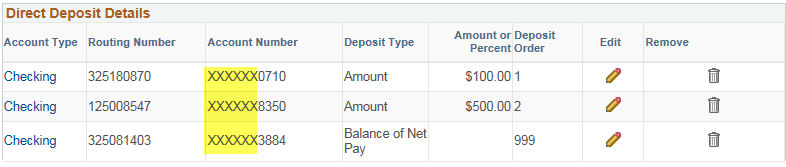
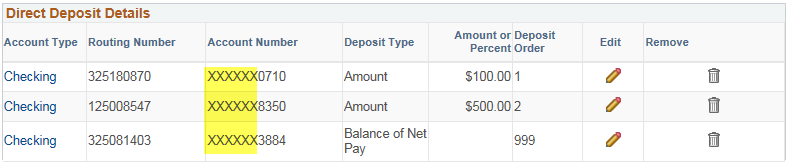
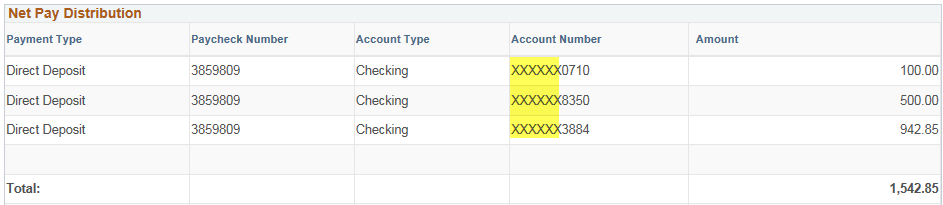
To better protect the security of your banking information in PeopleSoft for direct deposit, beginning this week, bank account numbers will be masked in Self-Service except for the last four digits. Previously, the entire bank account number was visible. You will only see the entire number when you add a new bank account; after that, only the last four digits.
This change can be seen in two different areas of PeopleSoft Self-Service: Direct Deposit and View Paycheck (see examples below).
Self Service > My Payroll > Direct Deposit
Self Service > My Payroll > View Paycheck
You will continue to receive an automated message from PeopleSoft any time an account number on the direct deposit screen is changed or a new number is added. If you did not change your direct deposit information, contact your payroll administrator immediately. Note: For the security of your direct deposit, all new or changed account numbers go through a pre-note process with the financial institution prior to your pay being deposited into the new account. This takes at least one payroll cycle.
Share this:

Tech Tip: Cyber security and social media

There are more than 1.6 billion social network users worldwide. This is why cyberattackers love social media. In fact, one recent study reports more than 600,000 Facebook accounts are compromised everyday.
Here’s the lowdown on their favorite attacks:
- Like-jacking: occurs when criminals post fake Facebook “like” buttons to webpages. Users who click the button don’t “like” the page, but instead download malware.
- Link-jacking: this is a practice used to redirect one website’s links to another which hackers use to redirect users from trusted websites to malware infected websites that hide drive-by downloads or other types of infections.
- Phishing: the attempt to acquire sensitive information such as usernames, passwords, and credit card details (and sometimes, indirectly, money) by disguising itself as a trustworthy entity in a Facebook message or Tweet.
- Social spam: is unwanted spam content appearing on social networks and any website with user-generated content (comments, chat, etc.). It can appear in many forms, including bulk messages, profanity, insults, hate speech, malicious links, fraudulent reviews, fake friends, and personally identifiable information.
When it comes to everyday email, here’s what you can do:
- Always check the recipient of an email and the source of a message.
- Don’t click any strange links and know what a phishing attack looks like.
- Don’t install software from untrusted sources.
- Don’t trust people blindly and don’t give away confidential information to strangers.
Share this:

The annual Employee Giving Drive is underway

The County’s 2016 Annual Employee Giving Drive has begun!
Last year’s drive raised more than $1.75 million for hundreds of nonprofit organizations. This year’s goal is $1.82 million.
This is the power of our workplace giving program. We can harness our individual actions to make a substantial collective impact in areas such as the access to education, food and hunger, and the arts.
The Employee Giving Program is a philanthropic resource for King County employees, and benefits county employees by:
- Providing prescreened nonprofits
- Allowing you to plan your giving
- Providing you the ability to give time (vacation or compensatory hours)
- Providing anonymity
You may pledge either online in PeopleSoft or with a paper form. Through payroll donations, employees can donate to as many as 20 nonprofits, and contributions can be made bimonthly (first two pay checks each month), monthly (second paycheck each month) or annually (first paycheck in January).
This year’s drive runs from October 3 to November 18. For more information, visit the EGP site. For additional questions, contact your EGP Ambassador, email EmployeeGiving@KingCounty.gov or call 206-263-9405.
Share this:

County recognizes and celebrates value of workers with disabilities, proclaimed October Disability Awareness Month

As the Metropolitan King County Council declared October as Disability Employment Awareness Month in King County, the Council celebrated the talents and contributions of county employees with temporary or permanent disabilities serving the public.
“Families and communities within King County are enriched by the diversity and perspective of those living with a disability,” said Council Chair Joe McDermott. “We must continue to strive to address the injustices that linger and remove the barriers that remain, so that all lives are equally valued, no matter ability.”
In addition to the Council’s reading of the proclamation, observation of the month will include an informative poster display in the King County Courthouse tunnel, a training session on October 11, and a Lunch & Learn on October 25:
- Invisible Voices: Video and Discussion training session, Tuesday, October 11 from 10 a.m. to noon at the Chinook Building, Room 121. Please register online.
- Employment Assistance For Individuals with Behavioral Health and/or Developmental Disabilities Lunch & Learn will be held Tuesday, October 25 from noon to 1 p.m. at the Chinook Building, Room 115. Please register online.
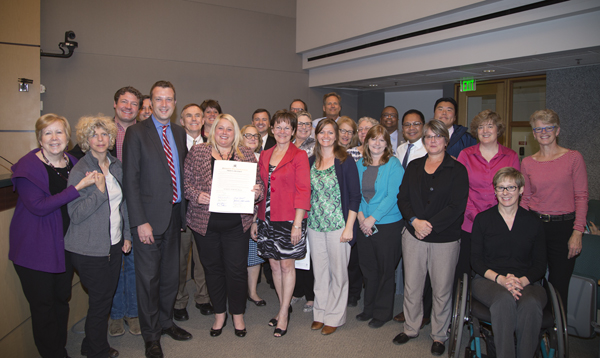
Pictured: Kelli Williams, Director of the King County Office of Civil Rights and Open Government (holding proclamation) is joined by members of the King County Council and County Employees after the Council proclaimed the month of October Disability Awareness Month in King County.
Share this:

Employee survey participation continues to grow, nearing 50 percent in some departments
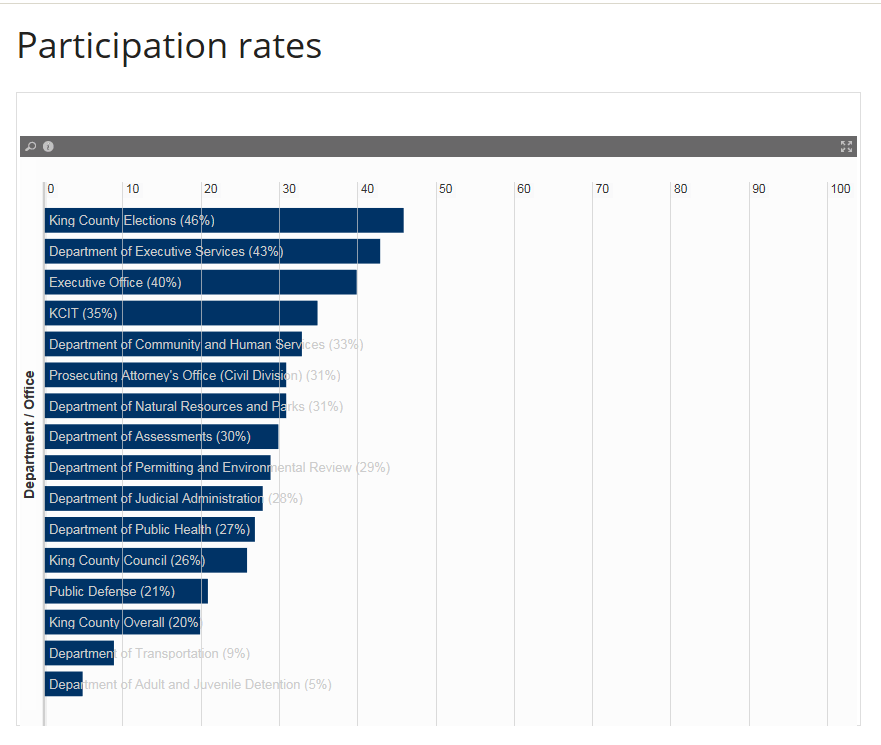
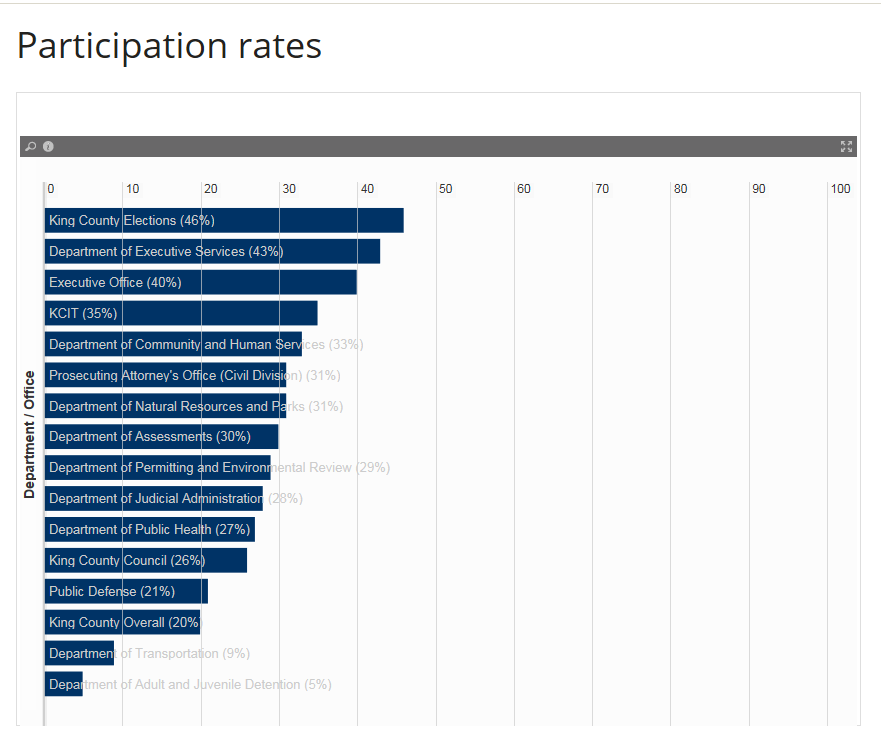 The 2016 Employee Survey, open until Friday, October 21, continues to gain responses, with some departments nearing 50 percent. View the data on the survey website to find out how your department is doing.
As a reminder, King County is committed to increasing equity, fairness, opportunity and social justice in all we do. This includes equity in our employee experiences. We are asking for you to complete demographic questions so that we can learn whether employees with different backgrounds and characteristics have significantly different work experiences at King County. This information will only be reported in the aggregate for groups 6 or larger. So please complete the personal details section. It will make the survey more meaningful. It will in no way lead to you being identified.
The email you received from 2016KCEmployeeSurvey@orcsurvey.com is unique to you and cannot be forwarded to others. Your responses are completely anonymous to King County and the consultant only shares analyzed results, never individual responses.
If you need your survey link resent or you did not receive your survey link, you can request it directly to the ORC International Support Desk at support@orcinternational.com. You can also contact the support desk if you are having technical difficulties with your online survey link.
King County Sheriff Office, District Court, and King County Superior Court employees are not participating in the 2016 Employee Engagement Survey. Only the Civil Division of the Prosecuting Attorney’s Office is participating in this year’s survey. Employees in other divisions are not participating this year.
The survey should take about 15 minutes to complete and can be taken during working hours. You can learn more about the survey at www.kingcounty.gov/employeesurvey.
Share this:

Featured Job: Communications Manager

Closing Date/Time: Wed. 10/12/16 11:59 PM Pacific Time
Salary: $92,830.40 – $117,665.60 Annually
Job Type: Career Service, Full Time, 40 hrs/week
Location: King Street Center – 201 S Jackson St, Seattle, Washington
Department: Department of Transportation – Director’s office
Description: This exciting career service opportunity is open to all qualified candidates. The position manages the Department of Transportation’s Office of Communications and reports to the Department Deputy Director. The Communication Manager supervises eleven staff members in the Director’s Office who perform a wide range of duties, including strategic communication planning, management of media relations, public affairs, public involvement, community outreach and engagement , website design, graphics, photography, videography and publications. The Communications Section provides service to all KCDOT Divisions, which include Metro Transit, Roads Services, Fleet Administration, Marine, and the King County Airport. The Section also works closely with King County Executive staff to ensure clear and consistent messages for key Executive and county-wide initiatives.
The responsibilities of this position include managing, planning, developing, implementing and evaluating communications services for the Department. This position manages external and internal communications, media relations, public relations and public involvement. Responsibilities also include managing staff to appropriately and effectively communicate agency messages.
Learn more about this position or view all available jobs.






 Employee News