
Come see us at the Northwest Film Forum’s Archival Screening Night!

 Crossposted from Bytes and Boxes
The King County Archives is delighted to be participating in a screening of clips from local archives and cultural organizations at the Northwest Film Forum, located in Seattle’s Capitol Hill neighborhood. The event is being held in honor of Archives Month and promises to be a treat.
The King County Archives is contributing a variety of clips, including some local sports history, 1930s silent film, and more!
We hope to see you there!
Share this:

#AskAnArchivist Day is October 5

 Curious about archives or what archivists do all day? On Wednesday, October 5, archivists around the country will be taking your questions on Twitter – including staff at the King County Archives! The day-long event is part of American Archives Month and helps to celebrate the importance of preserving and researching historical records. Follow @KingCoArchives and tweet at us using #AskAnArchivist with your questions about archives or King County history.
For more information about #AskAnArchivist Day or American Archives Month, visit the Society of American Archivists website.
Share this:

Featured Job: Environmental Intern

Closing Date/Time: Sun. 10/09/16 10:30 PM
Salary: $17.70 – $22.43 Hourly
Job Type: Intern
Location: King Street Center – 201 S Jackson St, Seattle, Washington
Department: Department of Natural Resources & Parks – Solid Waste Division
Description: The Solid Waste Division (SWD) of King County Department of Natural Resources and Parks have an opening for a graduate intern in their Recycling and Environmental Services (RES) section. The King County Solid Waste Division plans, develops and implements a variety of waste reduction and recycling programs that target residents, businesses, local governments, and schools.
Learn more about this position or view all available jobs.
Share this:

Celebrating Latino/Latina Heritage Month in King County

 King County Executive Dow Constantine has proclaimed the month beginning September 15 “Latino/Latina Heritage Month in King County.
“I urge all County residents to join me in celebrating the many contributions of people of Latino heritage to our community,” Executive Constantine said in his Proclamation.
More than 55 million people of Latino/Latina ancestry live in the United States, with almost 200,000 calling King County home.
You can read the Executive’s proclamation here (SharePoint).
Share this:

Challenge: Take Your Commute to New Heights

 You could win a custom adventure by participating in Washington’s Wheel Options campaign during the month of October!
As a King County Employee, you can participate in the Washington State Ridesharing Organization’s annual Wheel Options campaign. Commute via bicycle, transit, carpool, vanpool, walking or telecommuting for at least six days next month and – in addition to reducing congestion and saving money – you’ll be eligible to win a customizable adventure!
Wheel Options encourages commuters across Washington to reduce their number of drive-alone trips. Visit Wheel Options to register, learn more about commute options, and become eligible to for the prizes; which include the custom adventure, gift cards, and many other great prizes.
The King County Employee Transportation Program offers a variety of healthy commute benefits to King County employees, to reduce the stress and costs of commuting. For more information, visit the ETP site.
Share this:

King County leaders discuss 2016 Employee Survey

The 2016 King County Employee Survey is now underway, and we’ve been asking some County leaders why the survey is important to them and their employees, and how they will act on the results.
In this first video, we talk to Caroline Whalen, Director of the Department of Executive Services, Harold Taniguchi, Director of the Department of Transportation, Commander William Hayes, Director of the Department of Adult and Juvenile Detention, and John Wilson, the King County Assessor.
Watch the video by clicking the image below (captions coming soon).
Share this:

Executive Unveils $11.3 Billion Proposed Budget

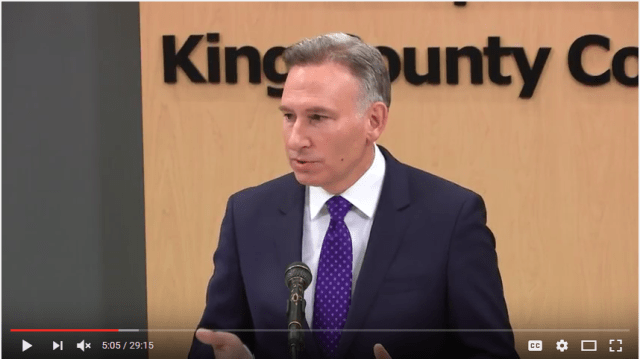
On Monday, King County Executive Dow Constantine transmitted his 2017-2018 proposed biennial budget to the Metropolitan King County Council.
The proposed $11.3 billion, two-year budget invests in Metro Transit, human services, and other important programs that reflect the values of King County residents and again maintains costs below the rate of population and inflation.
Find out more by watching the Executive’s address below or read more on the budget website.
Share this:

Track department results of 2016 Employee Survey
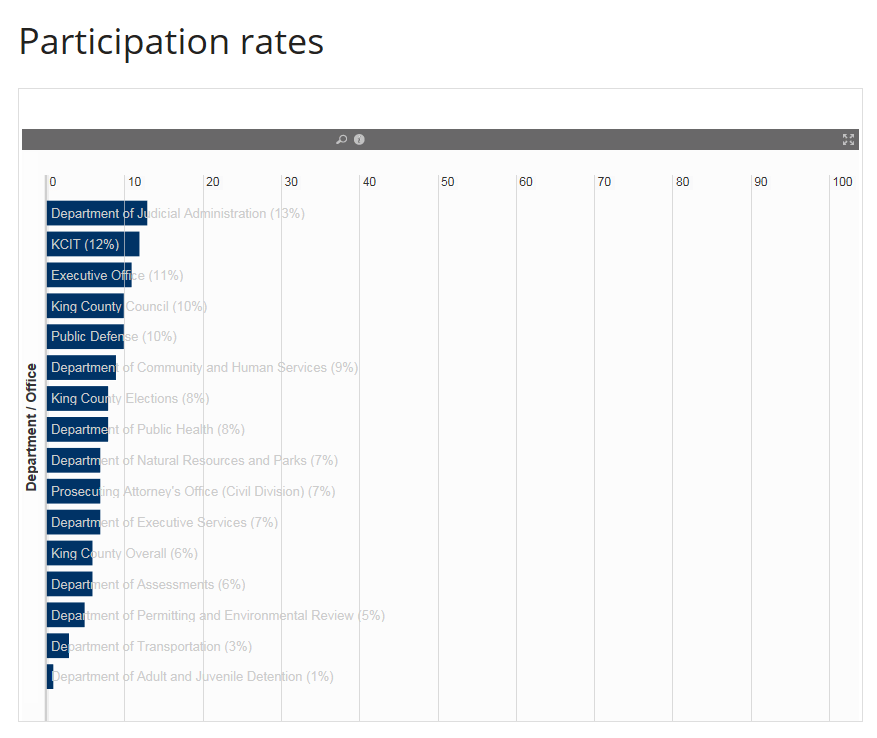
 The King County employee survey is now underway through Friday, October 21. Track how well your department is participating by checking out the data on the survey website.
Surveys were emailed to most employees from 2016KCEmployeeSurvey@orcsurvey.com on Monday, Sept. 26. The email is unique to each employee and cannot be forwarded to others. If you did not receive a survey email, please contact KCEmployeeSurvey@kingcounty.gov.
Please note your responses are completely anonymous to King County and the consultant only shares analyzed results, never individual responses.
The survey should take about 15 minutes to complete and can be taken during working hours. The Superior Court, District Court and the Sheriff’s Office, are not participating in the survey. You can learn more about the survey at www.kingcounty.gov/employeesurvey.
Share this:

100%ers!

 Three work groups have already reached 100 percent participation!
- In DNRP: Water and Land’s Science and Technical Support Group has a Science and Admin work group that got there day one
- The Continuous Improvement Team in Performance Strategy and Budget in the Executive’s Office
- In HRD the Comp and Employment Group.
In HRD, Director Susie Slonecker is treating Comp and Employment to lunch.
Go teams!!
Share this:

KCIT uses 2015 survey results to empower employees through career exploration
One of the three key areas that came out of the 2015 King County Employee Survey was the need for career development. Employees were eager for training to improve their skills and for opportunities to advance in their careers.
It is with this in mind that King County’s Department of Information Technology (KCIT) formed its Employee Engagement Committee (EEC), to help create ways to improve the employee experience, and give each person the skills needed to advance their career.
With members from different KCIT teams and units, the EEC is able to bring different perspectives and ideas together, resulting in a successful all-day career exploration event for KCIT employees.
Robert Malcolm, an Application Developer, explains that the idea for this came from a much larger process of discussion and brainstorming.
“The need for employee growth resonated with a bunch of us on the committee,” he said. “We just wanted to do something about engaging employees in their work, and showing them a place to go in their jobs.”
“Once we realized it was an area of need we became impassioned to do a career-day type of event.”
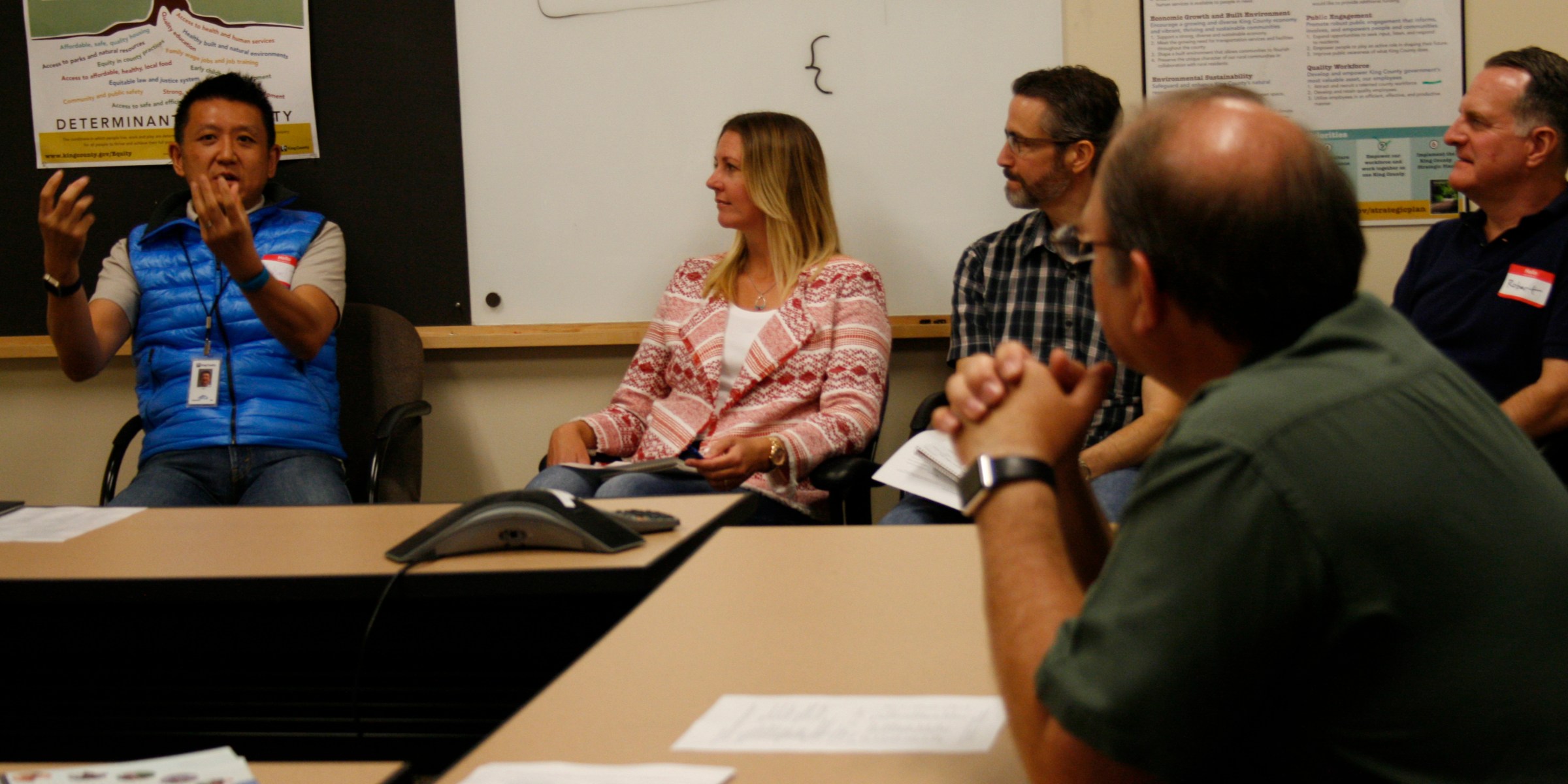
Through careful planning and ongoing relationship management to ensure representatives from many service groups were included, the first Day of Discovery for KCIT employees was a great success. Over 100 employees attended the all-day event, held at the Chinook Building.
Employees were able to attend two-hour sessions that featured staff from multiple KCIT Services to learn more about opportunities for career growth. Employees also received specific information regarding the training and skills needed for various positions within KCIT. The event even provided an eLearning Lab to engage employees in additional online learning opportunities outside of KCIT.
Dijana Steward, a KCIT Project Manager, explains that the event was planned down to the last detail, to ensure every employee in attendance found it meaningful.
“The EEC essentially broke up into two groups,” she said, “One handled the logistics like room prepping and food, and the other worked with the ‘talent’.”
“We even had a ‘Leadership Lounge’ with refreshments and give-aways where management and supervisors, like KCIT CIO Bill Kehoe, could hang out and connect with employees.”
The event was so successful, the EEC wants to make it an annual, if not semi-annual event, and find ways to make the event accessible to employees who work in remote locations or different hours. Building on this momentum, the EEC also plans to follow up with other ideas it came up with for employee development. One is a web space that will allow for employees to connect to other resources.
“We wanted to have an event, but also a SharePoint space for employees to come interact with,” Dijana said. ““So we continue to work on the SharePoint site, adding content and building a framework.”
The other is a possible mentoring program to help employees learn about careers and qualifications.
“The next big thing is a mentoring program,” said Robert. “We want to connect people who want a new job with people who can give them the resources and skills to get that job.”
These exciting employee engagement programs are sure to be just as successful as the Day of Discovery. They are not only building on the direct feedback of employees through the 2015 Employee Engagement Survey, but are also grounded in the creativity and passion of real KCIT employees who are empowered to make change happen in their work place, and are committed to the success of their fellow employees.
The KCIT Employee Engagement Committee will also be working with KC Human Resources on its upcoming King County wide Mentoring Program. The program seeks to expand connections and opportunities between employees to foster career development and growth.
For a first-hand narrative from the Day of Discovery, read “Day of Discovery” KCIT employees embark on a journey to new career opportunities on the KC Employee News site.






 Employee News