
Social Media Spotlight: King County Department of Public Defense blog

 For The Defense tells stories about the people who work for King County’s Department of Public Defense: Their work, the issues they face, the challenges they experience and the successes they celebrate. It looks at the criminal justice system through the lens of public defense — issues of racial disproportionality, the criminalization of people who are poor and mentally ill, reforms that are needed to make the system fairer and more equitable. Finally, it looks at the clients we serve. When we can, we’ll tell their stories, too.
Follow the For The Defense blog today!
Click here to view all King County social media pages.
Share this:

Featured Job: Industrial Maintenance Electrician

Closing Date/Time: Mon. 08/29/16 4:30 PM
Salary: $39.63 – $41.56 Hourly, $82,430.40 – $86,444.80 Annually
Job Type: Career Service, Full Time, 40 hrs/week
Location: West Point Treatment Plant – 1400 Discovery Park Blvd, Seattle, Washington
Department: Department of Natural Resources & Parks – Wastewater Treatment Division
Description: This position performs a variety of highly skilled journey-level work constructing, troubleshooting, maintaining and wiring a wide variety of equipment and conducting preventive maintenance programs. This position requires the use of analytical skills in implementing various aspects of process control.
The Wastewater Treatment Division is committed to the principles of equity and social justice. We value diverse perspectives and life experiences in our workforce, and are committed to building a culturally diverse and inclusive environment. WTD strives to provide equitable services to residents and businesses across King County.
Learn more about this position or view all available jobs.
Share this:

Kudos! Compassion and respect earn client kudos for public health nurse

This note came to the department’s public inbox this month. For context, many state Department of Social and Health Services (DSHS) offices include an office staffed by public health nurses, who are based in nearby public health centers and deliver Maternity Support Services (MSS) and limited family planning services. One of those nurses is Paddee Buzzard, from Federal Way Public Health Center.
To Whom This May Concern-
I found out I was pregnant early on and was completely scared. I came in to DSHS to take another test and to just talk to someone about what to do next. When I came in to DSHS, I was nervous and I really hadn’t stopped crying for a few days. I was called back to Paddee’s office and that was where I was completely surprised. Paddee was AMAZING! She was calm, she eased all my concerns, helped me with all the things that I needed to get done next and got me excited. I cannot thank her enough for how she helped me! It really means a lot to have someone treat you like you are their family, especially in a time like this. She did not judge me, she did not care about my past, she just opened her arms and really comforted me. I will never be able to thank Paddee enough for what she did. Those 30 minutes in her office really had a huge impact on me.
If you would please forward this email to her so she can see the impact that she had on me and my child’s life, I would greatly appreciate it. Thank you again Paddee! Keep doing amazing things!
– “A Grateful Client” (name withheld for privacy)
Share this:

Tech Tip: Self-Service Account Management (SAM) password tool

 King County’s Self-Service Account Management (SAM) portal provides King County employees with a password management tool. It can be used to change your password (required every 90 days), reset a forgotten or expired password, or to unlock your account.
Once you are enrolled you will be able to reset your password/unlock account via the King County Self Service Account Management portal (www.kingcounty.gov/sam) or via your Windows login screen using the “Reset Password/Unlock” link under your password box (see Windows GINA tab for more information).
Read more at the KCIT Service Center
Share this:

You may be on vacation, but your public records aren’t!

Three tips to make your life easier and keep our records tidy.
King County Information Technology data shows that August is one of the most popular months of the year for vacation. This can result in our King County Electronic Records Management System (KC ERMS) being packed with “Out of Office” email responses – 27,357 right now to be specific!
Below are some tips for keeping these and other transitory records from ending up in KC ERMS.
No camping: Don’t let “Out of Office” notices camp out in your inbox. These are transitory emails and they clog up your inbox making it more difficult to find the important stuff. To declutter your inbox search for “Automatic Reply” in the search box, highlight the messages and delete all.
Take out the trash: Automatically empty your deleted items folder when you close Outlook. Items left in the deleted folder or the trash can slow Outlook performance and are subject to public records requests. To change your Outlook setting to automatically delete messages in the deleted items folder every time you close Outlook, open Outlook, click, File, click Options, click Advanced and check Empty Deleted Items folder when exiting Outlook.
Missing You!: No doubt you’ll be missed while you’re away, but if you don’t want to see a notification of every call you missed while away on vacation, turn off the missed call notification option: Open Outlook, choose File, choose Info, choose Manage Voice Mail, then Outlook Web App will open. Log into that. Make sure you are in the Phone Menu on the Voice Mail tab. Under Notifications uncheck Send an e-mail message to my inbox when I miss a phone call.
That’s it! Have a nice vacation and don’t forget the sunscreen!
Share this:

KCIT initiates ad blocking to improve security

 In the coming weeks, internet pages may look different as King County Information Technology begins blocking select ads. These are third party ads that can bring malware and viruses into our network, compromise security and/or privacy or take entire programs, systems or operations offline.
“Security is THE top issue in our industry right now,” said Ralph Johnson, KCIT Chief Information Security and Privacy Officer. “We’ve had two major incidents in the past four months that caused King County employees to lose an entire day’s work.” This ad-blocking project will drastically reduce the incursions by attempting to identify good ads from bad ads before they appear on the screen.
Employees should not notice a change to the layout of webpages. Blocked ads will be blocked in the background. However, if a user clicks on a potentially malicious ad, they may receive a message explaining that the ad is blocked by King County. Look for the changes by September 1.
Ad blocking is not the only step that KCIT is taking to reduce the risk of malware and compromise to our systems. We’re also working on local administrator right and workstation updates. You will hear more about these over the next few months.
Share this:

How our Refugee Health clinic is a key step on the path to self-sufficiency

Crossposted from Public Health Insider

Pictured: The staff at Public Health’s Refugee Health clinic. From left to right, back: Debra Vonnahme, Franck Bamage, Hossein Eslami, Helena Wilson-Brown, JenRenee Paulson; front Wendy Dell, Annette Holland, Shary Robinson, Maggie Po, Vilay Wang.
When refugees escape from war, conflict, famine and other disasters, it’s not unusual for them to end up in King County. We are one of the nation’s major host communities for refugees. A well-organized local network of agencies helps refugees take the first steps into a new life. This network emerged in 1979, when an earlier wave of refugees came from Vietnam, Cambodia and other Southeast Asian countries.
One first step for every refugee is a visit to the Refugee Health clinic inside the Downtown Public Health Center, in Seattle’s Belltown neighborhood. We sat down with Refugee Health Program Manager Annette Holland to learn more about the refugee experience.
Read more at Public Health Insider
Share this:

Cine en el Parque celebrates diversity at one of King County’s most beloved parks

Crossposted from King County Natural Resources blog
 Families had a blast at King County’s second-annual Cine en el Parque in Steve Cox Memorial Park in White Center on Aug. 6. The Spanish-language outdoor moving night was co-sponsored by White Center Community Development Association and King County Parks. Cine en el Parque was a special opportunity for us to welcome everybody to one of our beautiful parks and build community.
King County screened the box office hit and animated Mexican film, “Un Gallo con Muchos Huevos” onto a 40-foot-tall inflatable movie screen (bigger than most indoor theatres) that turned the park into a spectacular outdoor cinema under the stars.
Before the movie, more than 500 people had an opportunity to visit with King County representatives and learn about Orca cards, recycling, pet adoption, elections, eco tips, emergency preparedness, King County Parks, wastewater treatment, the White Center Teen Program and rain gardens. They connected with nine community partner organizations that had booths at movie night, including King County Library System, White Center Community Development Association, Sea Mar, West Seattle Helpline, Highline College, Seattle Latino Film Festival, Latino Community Fund, 34th District Democrats, and United Way of King County.
Read more at King County Natural Resources blog
Share this:

A public defender shares her story as a Muslim American

 Crossposted from For The Defense
A friend of Dua Abudiab stopped wearing the hijab after a man accosted her and called her several names while she was riding a bus in downtown Seattle. It was a sobering moment for Dua, a public defender at the Department of Public Defense’s The Defenders Association Division (DPD TDA), who wears the hijab every day.
Dua is also active in the Council on American Islamic Relations (CAIR). Around the same time that Dua’s friend was accosted, the director of CAIR reached out to her and asked her if she would write about what it means to be a Muslim American woman. Such a piece, he told her, would help to affirm other women who show their faith by wearing the hijab.
Dua doesn’t like attention. But her friend’s experience, other recent incidents that have garnered press attention and the encouragement of the CAIR director convinced her that she should speak out. And so she did.
On August 8, a commentary she penned ran in The Seattle Times. The response has been overwhelming, she said. “I told folks it’s not about me. It’s about the adults and kids out there who are being harassed, and to let them know they are not alone.”
Read more at For The Defense
Share this:

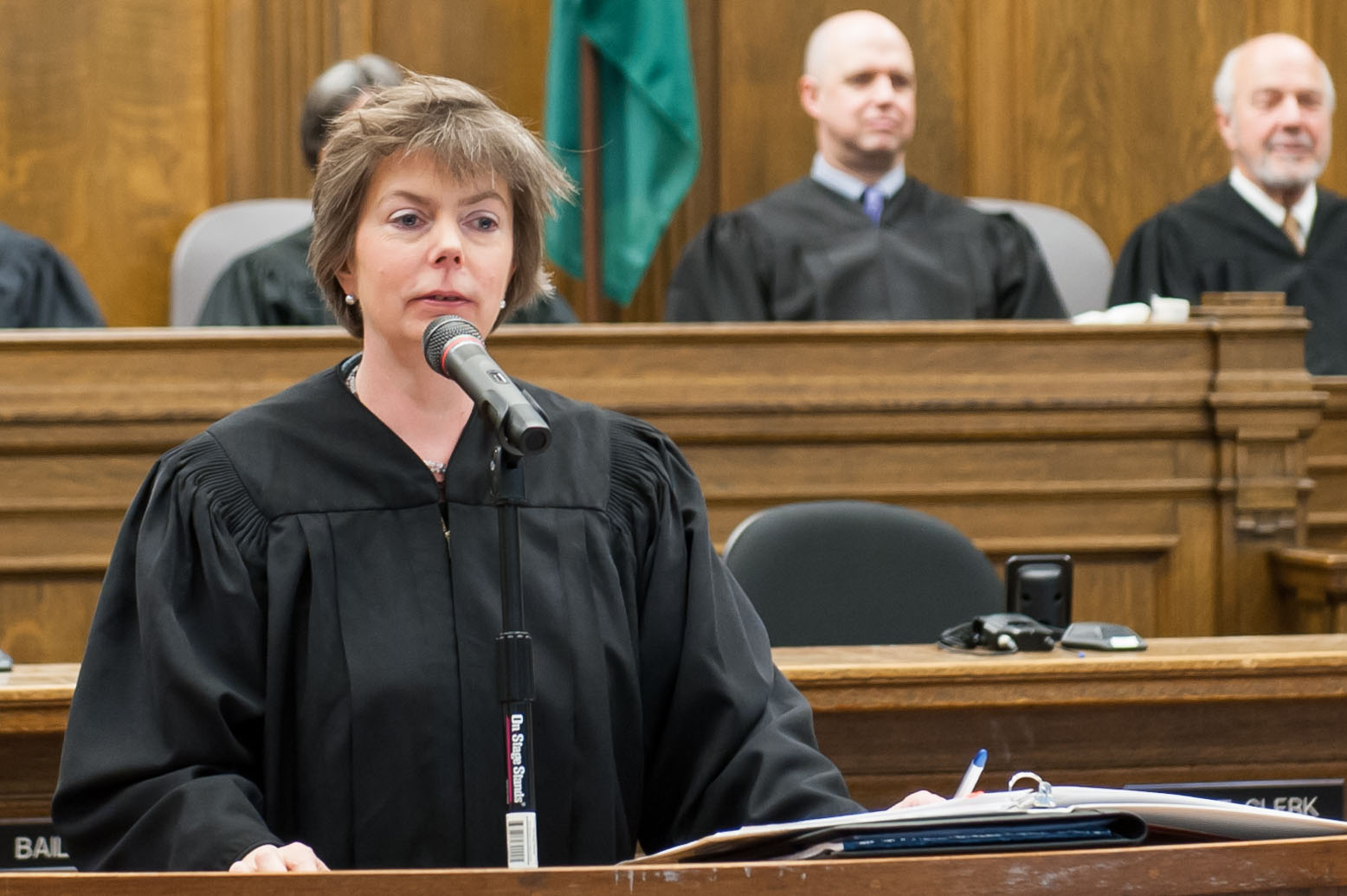
Judge Susan Craighead: The unconscious bias of white privilege
 Crossposted from King County Youth Justice
King County Superior Court Presiding Judge Susan Craighead is one of many Court leaders encouraging the use of implicit bias training and awareness among other criminal justice leaders and their staff. Judge Craighead also serves on the Juvenile Justice Equity Steering Committee, a group collaborating on solutions to end racial disproportionalities in the juvenile justice system.
Recently, I sat next to a businessman from southern Utah on a plane. Like the rest of the country, we found ourselves reflecting on the apparently unjustified shootings of African-American men by police officers in Baton Rouge and Minneapolis. When he found out I was a judge, he was full of questions.
“Do you think police really are biased against African-Americans?” he asked me earnestly. One thing I observed about Utah is its homogeneity – it is full of blonde, blue-eyed families. No wonder this was a mystery to him.
“Well,” I said, “have you ever heard of the Implicit Association Test?”
He had not. I explained that the IAT is a 10 to 15-minute online assessment designed to measure one’s unconscious bias. You can take a test on race, on gender, on sexual orientation, on weight – there are a whole variety. The test involves sorting words and pictures by hitting certain keys on a keyboard. Bias in the test occurs when people are faster at categorizing negative words when they are paired with African-American faces, or faster at sorting positive words when they are paired with white faces – suggesting an uncontrolled mental association between negative things or concepts and African-Americans.
Read more at King County Youth Justice






 Employee News