
Tech Tip: How to Manually Configure Outlook Anywhere

 Read about how to configure a mailbox for Outlook Anywhere. King County devices will be automatically configured for Outlook Anywhere. If you’d like to configure your personally owned device, follow the instructions in the link below on the King County IT Service Center website.
Read more at the KCIT Service Center website
Share this:

CPR classes available this fall for employees

King County employees are welcome to sign up for available CPR classes hosted in the Chinook building September through December. Class dates are as follows:
Basic Heartsaver CPR/AED Training (Open to all King County employees) register with andrew.burns@kingcounty.gov:
- Tuesday, September 13, 2016 – 9 a.m. to noon, Chinook Bldg, Room 126
- Monday, November 14, 2016 – 9 a.m. to noon, Chinook Bldg, Room 126
Refresher Heartsaver CPR/AED Training (Open to all King county employees) register with andrew.burns@kingcounty.gov:
- Tuesday, September 13, 2016 – 1-3 p.m., Chinook Bldg, Room 126
- Tuesday, October 11, 2016 – 1-3 p.m., Chinook Bldg, Room 115
- Monday, November 14, 2016 – 1-3 p.m., Chinook Bldg, Room 126
BLS CPR (Healthcare Provider) Training (Open only to Public Health Certificated staff) register with maryalice.allenbach@kingcounty.gov:
- Tuesday, October 11, 2016 – 9 a.m. to noon, Chinook Bldg, Room 126
- Tuesday, December 8, 2016 – 9 a.m. to noon, Chinook Bldg, Room 126
Share this:

PeopleSoft upgrades and upcoming system outage

This is to inform all County staff that the PeopleSoft system will be unavailable from noon on Friday, August 5 through 6 p.m. on Monday, August 8.
During this planned outage, the PeopleSoft team will be upgrading the system tools and applying vendor-provided updates and maintenance. This work will begin on Friday, August 5 at noon and is scheduled to be completed by 6 p.m. on Monday, August 8.
The system will not be available for access by any County staff during this outage window. There will be a communication sent out to all County staff when the system becomes available.
We realize that this outage impacts PeopleSoft users. We appreciate your understanding and support.
Share this:

Now Recruiting 2016 Ambassadors

 Crossposted from King County Employee Giving Program
The King County Employee Giving Program is recruiting work site Ambassadors for the 2016 Annual Giving Drive.
Ambassadors are the heart and soul of the Annual Giving Drive, the key to reaching each and every one of the 13,500 employees here at King County and providing those they work with transformative moments of meaning in the workplace. All while getting to make a difference around the world. Our goal is to have an Ambassador at every work site.
Read more at King County Employee Giving
Share this:

Executive Constantine signs legislation to invest $87 million in workforce housing around transit stations

 With rents and housing prices out of reach throughout the region, King County Executive Dow Constantine today joined with County Councilmember Dave Upthegrove and housing advocates to sign legislation to invest up to $87 million for creation of more than 1,000 units of affordable workforce housing near new or existing transit stations.
“Today, we celebrate landmark legislation to create vibrant, mixed-income neighborhoods with affordable housing near transit centers,” said Executive Constantine. “It’s an innovative approach to connect more communities across King County to jobs and opportunity.”
Read more in the official press release.
Share this:

Kudos! King County wins recognition for technology practices

 King County Information Technology is a winner in The Center for Digital Government (CDG) and the National Association of Counties (NACo) Digital Counties Survey. The survey identifies the best technology practices among U.S. counties, including initiatives that save tax dollars through newfound efficiencies; boost transparency, cybersecurity and engagement; or innovate through unique and exciting projects.
King County IT has placed in 12 of the last 13 years we’ve completed. King County tied for fourth place with California’s Alameda County and Miami-Dade County. This year’s showing is the best so far for Puget Sound. King County was recognized for innovation, improved transparency and proactively addressing citizen demands and expectations.
“We enjoy this competition and the opportunity to see what other counties are doing right. It is confirmation that we continue to head in the right direction,” said Bill Kehoe, King County Chief Information Officer. “This year, we’re really focusing on open data and empowering residents and county employees to use all the data to make systems and processes work faster and better.”
A big thanks to all the KCIT employees and their collaborators who make these wins possible! We’re shooting for first place in 2017.
Share this:

King County sets national standard in supporting LGBT-owned businesses
 Crossposted from King County DES Express
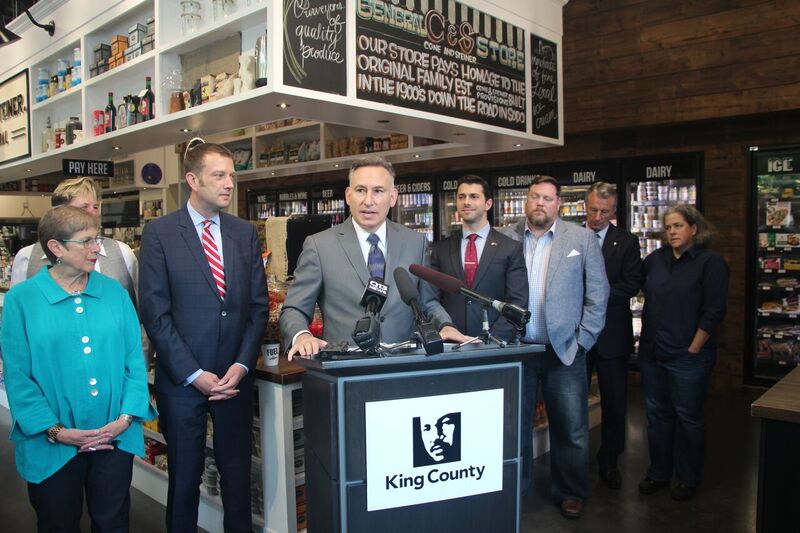
King County will become a national leader in supporting LGBT-owned small businesses under an inclusive policy announced by Executive Dow Constantine.
King County will become the largest county in the United States to track the number of contracts that are awarded to LGBT entrepreneurs, an approach that has dramatically increased the number and value of contracts awarded to local small businesses owned by women, people of color, and people who are disadvantaged during Executive Constantine’s administration.
Share this:

Draft Equity and Social Justice Strategic Plan 2016-2022 available

 We are proud to share with you our draft King County Equity and Social Justice Strategic Plan, 2016-2022. This plan, our first for Equity and Social Justice (ESJ), builds on the good work that we have been doing in ESJ and pushes us to become even more thoughtful, strategic and effective. This Plan also lays out the values that we have co-created with employees and community partners and addresses the need to be inclusive, collaborative, responsive, adaptive and people-focused. Fundamentally, we are moving towards becoming a racially just organization.
Our ESJ strategies as One King County are to invest upstream and where needs are greatest, in employees and in community partnerships. And we will do this with accountable and transparent leadership.
We have also developed a draft preliminary Implementation Plan for this Strategic Plan, which will guide our work through 2018. If you have thoughts and ideas about this plan and its implementation, contact your ESJ Inter-Branch Team representative or the Office of Equity and Social Justice by August 10.
Share this:

Live from Comic-Con: it’s Public Health!


Meredith Li-Vollmer on a panel at San Diego Comic-Con 2016. Meredith is a risk communications specialist at Public Health – Seattle & King County.
Crossposted from Public Health Insider
I’m at a conference, and I just saw a T-Rex wearing a Supergirl backpack trot by. Clearly, I’m not at the CDC (otherwise, Dr. Tom Friedan has a hobby that no one knows about). I’m at San Diego Comic-Con, the premiere comics convention in the world, alongside a projected 130,000 other conference attendees. So what’s a public health professional doing here?
I spoke on a panel called “Comics and health: Saving lives and preventing disease” as part of the Comics Arts academic conference associated with Comic-Con. Our panel shared exciting work that demonstrates the value of the comics medium in conveying health information, part of a growing discipline of “graphic medicine.”
Read more at Public Health Insider
Share this:

Kudos! Lean initiatives win award from National Association of Counties
Crossposted from King County DES Express
King County’s Finance and Business Operations Division (FBOD) has been recognized with a Financial Management Achievement Award from the National Association of Counties (NACo). The awards honor innovative, effective county government programs that enhance services for residents.
NACo honored FBOD’s successful Lean initiatives that have streamlined operations, provided value to our customers, and created a work culture focused on problem solving and respect.
Watch a video about King County winning this award below.






 Employee News