
Supporting the mental health of employees

 Anyone can experience the challenges of mental illness. It does not discriminate based on race, age, gender, ability or identity.
King County and Balanced You support the mental health of employees in many ways. Whether you’re seeking help for yourself or a loved one or trying to learn more, there are many tools available to you. Visit Balanced You’s website or check out this Mental Health Resource Sheet for a list of community resources, counselor directories, benefits information, and more.
Together we can learn more, change the conversation and continue building a stronger, more supportive environment for all.
Share this:

Panel Discussion on Mental Health, Recovery, and Suicide Prevention: Sept. 25, 2019

 September is National Recovery Month and National Suicide Prevention Awareness Month.
Join us Wednesday, September 25, for a panel discussion on actions and resources to support mental well-being and a mentally healthy workplace. The panel will feature representatives from Public Health, Community and Human Services, Metro Transit, and Human Resources, along with King County’s Chief People Officer Whitney Abrams.
Through this discussion, we join others around the nation in celebrating the millions of people who are in recovery from mental health and substance use disorders, reminding us that treatment is effective and people recover. We hope you will come celebrate with us.
Be sure to mark your calendar:
- Wednesday, Sept. 25, 2019 from 9:30 – 11 a.m., King County Administration Building, 5th Floor Training Room
Please Note: This is a County-sponsored event and supervisors are encouraged to permit employees to participate, if possible. Read King County’s HR Bulletin regarding employee attendance at County-sponsored events for more information. Attendance is voluntary, and employees will not be compensated or receive overtime for attending.
Share this:

Benefits and Retirement Fairs Oct. 15 and 16

 Do you want to better understand your King County benefits before Open Enrollment starts on Nov. 1? Do you have questions about your retirement?
King County is hosting benefits fairs where you can meet with benefits and retirement plan vendors. The fairs give you an opportunity to learn more about your options and ask questions—so that you can plan ahead for your and your family’s well-being. There’ll also be raffles, prizes, and giveaways:
- Oct. 15 and 16, 9 a.m. – 3 p.m. King County Elections, Alvine Room, 919 SW Grady Way, Renton
Many of the vendors who provide our employee benefits will be present, including:
- Gallagher VEBA
- Medicare
- Washington State Department of Retirement Systems
- CVS Caremark
- Delta Dental
- The Standard
- Navia Benefit Solutions
- Kaiser Permanente
- Regence BlueShield
- Vision Service Plan (VSP)
- Rowe Price
- HomeStreet Bank
In addition, members of the King County Benefits, Payroll and Retirement Operations team and Balanced You team will be available to answer your questions.
Spouses and partners are welcome. Registration is not required. There will be plenty of free parking. If you have any questions please email Carmen Johnson, King County retirement navigator.
Share this:

Celebrating National Recovery Month this September
 National Recovery Month is celebrated in the U.S. annually each September to promote access to recovery, celebrate those participating in services, and educate communities about how to overcome the barriers of stigma and discrimination. The theme for this year’s Recovery Month is “Join the Voices for Recovery: Together We Are Stronger.”
In solidarity with this national movement, and to recognize recovery wins in our community, each year King County spotlights individuals and hosts activities that spread the message that behavioral health is essential to wellness, that treatment is effective, and that people with substance use and mental health disorders can and do recover.
This year’s Recovery Month activities in King County have been spearheaded by Kathleen Murphy, Behavioral Health Recovery Specialist along with a devoted team of recovery advocates and allies that include: Lisa Floyd, Sherry McCabe, Robert Ewanio, Heather Venegas, Jodie Shreve, John Allen, and Tiffanie Depew. A list of September Recovery Month Activities organized by this team include:
Events:
- Sept. 2-30 – Recovery Bus Ad Campaign
- Sept. 12 – Speak Out for Recovery at Recovery Café, Seattle
- Sept. 21 – King County Peer Network Picnic
- Sept. 27 – Speak Out for Recovery at Recovery High School, Seattle
Traveling resource table:
- Sept. 17 – Seattle City Hall Farmers Market
- Sept. 26 – Queen Anne Farmers Market
Recovery Month Proclamations around King County:
- Bellevue
- Covington
- Enumclaw
- Federal Way
- Issaquah
- Kirkland
- Medina
- North Bend
- Redmond
- Renton
- Sammamish
- SeaTac
- Seattle
- Shoreline
- Tukwila
More information about Recovery Month can be found at http://www.recoverymonth.gov.
Share this:

Drug Court manager shares personal impact of program


Mary Taylor, Drug Court Manager
National Recovery Month is an opportunity to learn more about what King County is doing to support people with services that allow them to rebuild their lives after difficult situations. The internationally renowned King County Drug Court Program, started in 1994 and celebrating its 25th anniversary this October, provides multiple resources for people by combining those from the criminal justice system, substance abuse treatment, and other community services providers.
We sat down with Mary Taylor, Drug Court Manager, to learn more about the steady growth and continued success of this amazing program.
“This is a program within the criminal justice system that allows people charged with specific felonies to access treatment and other services to get their lives back together,” said Mary. “We’re bringing people back who may have lost their way.”
The program is important for a variety of reasons. Each person receives a level of supervision and resources to learn new skills, treat mental health and substance use disorders, receive peer support, and set important personal goals. This comprehensive approach helps each participant, as well as their families and the overall community.
“The program attempts to address participants’ needs. We provide extensive wraparound services,” said Mary, who has been involved with the program since 1998, and started with King County in 1988.
She adds how she has enjoyed helping the program grow over time to include 11 county and 2 contract staff and countless community service providers. Mary admits it is challenging work, but that seeing results encourages her and other staff to continue doing it.
“I grew up with parents who owned a restaurant and were constantly expanding it, and planning the next big thing,” she said. “I guess I bring that experience to this role, asking myself ‘How can we improve, what’s the next step?’.”
“Seeing people at the drug court graduation talking about their path and how they feel whole again are the results that motivate me to keep going.”
This personal connection between the participants and drug court staff is one of the many reasons the program has thrived. Mary explains that relationship building is essential to helping people succeed.
“Court participants can establish a relationship with the judge and talk directly to them,” she said. “Participants form relationships with every staff member, including court staff.”
“We have all bought into this work, and care about the program participant as a person and about their success.”
Further explaining how the program can have a profound impact on each person, Mary says that besides treatment for opioid, heroin, or other drug use, the program attempts to addresses the practical needs of every participant. This includes ORCA cards to help people get to and from appointments, one year of recovery-oriented housing, and working with a resource specialist to develop employment skills and identify other opportunities. Each person receives individualized treatment from professionals they may not have been able to access otherwise. If participants in the program are successful in their treatment, then their criminal charges are dismissed. If not, then they are adjudicated on the original charge. As of August 2019, 2,546 people have graduated from the program.
For the region, the program results in reduced crime and prison use. A December 2018 analysis of Washington State Drug Court participation by Washington State Institute for Public Policy (WSIPP) found crime reductions translated into a net benefit to taxpayers of $9,149 per program participant. Jail bookings were reduced by 49% over the long term for King County Drug Diversion Court (KCDDC) participants, according to the 2018 Mental Illness and Drug Dependency (MIDD) Annual Report.
To learn more about the program, visit the King County Drug Diversion Court webpage. To read a breakdown of the program and its impact, read this blog post on the King County Superior Court blog titled “King County Drug Diversion Court: By the Numbers.”
Pictured: If successful in Drug Court, participants graduate and charges are dismissed. 2,546 people have graduated from King County Drug Court (as of August 2019).


Share this:

Bringing the region together to fight homelessness: Seattle and King County unveil new authority to unify response systems and services

Crafted by Executive Constantine and Mayor Durkan, legislation now before the King County Council and Seattle City Council establishes the King County Regional Homelessness Authority to oversee policy, funding, and services for people experiencing homelessness countywide. The legislation includes a proposed Interlocal Agreement (ILA) and a Charter that authorizes the creation of the new Public Development Authority (PDA) to administer and oversee regional homelessness efforts.
“The new regional authority represents a concerted effort to increase coordination and collaboration of our planning, resources and service delivery countywide to achieve a more efficient and effective response to the needs in our community,” said Executive Constantine. “We are determined to create a service system that seeks solutions to the disproportionality of homelessness among communities of color and listens to the voices of those with lived experience of homelessness as some of our most insightful consultants. Our vision is a homeless response system that is fair and just for all.”
Read more in the official press release.
Share this:

Know how to register to vote

Do you know how to register to vote? In King County, you can register to vote online or by mail until eight to days before an election or in-person through Election Day. Registrations done by mail need to be received, not postmarked, by the eight-day deadline. Learn more.
Share this:

Snow emergencies will now mean free Metro transit

On August 28 the Council approved legislation sponsored by Councilmember Jeanne Kohl-Welles that would waive enforcement of Metro transit fares when Metro activates its Emergency Snow Network to encourage people to use transit and avoid driving during severe snowstorms.
Metro customers will be able to ride without paying the transit fare while the Emergency Snow Network is in effect. The legislation increases accessibility of Metro transit service for those experiencing homelessness in need of shelter and encourages all residents to avoid driving during severe snowstorms.
“Like our policy of free fares on New Year’s Eve, this legislation is about promoting safety,” said Kohl-Welles. “It will encourage people to stay off the roads and get to where they need using a safer mode of transportation – regardless if they have an Orca Card or enough money to pay the fare.”
Read more in the official press release.
Share this:

Life Cycle device replacement milestone

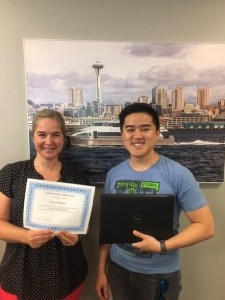 The King County Information Technology (KCIT) Customer Support Services Provisioning team has deployed its 2,000th life cycle device replacement in August. LAN Administrator Daniel Co performed the deployment, bringing replacement equipment to Metro Administer Sara Stefano (pictured). The team is working towards replacing all Windows 7 devices by the end of the year, when Microsoft stops supporting it.
The team has almost doubled its monthly deployment numbers in the past two years, from an average of 235 a month in 2017 to an average of 461 a month in 2019. “The team has greatly matured in the past few years, and they’re making great strides,” says KCIT Enterprise Manager Harry Clark.
The deployment team emphasizes the most important aspect of the process is ensuring users are present at the time of deployment. When users are not present, it slows the process considerably, since the deployment team can’t address any individual needs or issues.
Share this:

Training Spotlight: Defensive Driving

Defensive Driving, multiple dates: Dedicated to enhancing driving skills, reducing collisions and controlling insurance costs, this course focuses on accepting personal responsibility while operating a motor vehicle. Knowing why your vehicle performs the way it does, and understanding key concepts of safety, can reduce your chances of serious injury. A key objective of Defensive Driving training is to influence a person’s driving behavior. This we attempt to achieve through classroom interaction with not just the instructor, but with the other students as well. This certification is valid for 3 years. Register and learn more.
View more training and development opportunities at www.kingcounty.gov/learning.






 Employee News