

Airport fire trucks get cleaned of “forever chemicals”
Crossposted from the DES Express
In a partnership with the Port of Seattle, King County International Airport’s fire engines are being cleaned of PFAS, or per- and polyfluoroakyl substances, found in firefighting foam. These chemicals stick around for a long time, possibly thousands of years, and can build up in the environment and people’s bodies, causing harmful effects. Among the health effects are developmental problems, immune system issues, and links to certain cancers.
PFAS are man-made chemicals used in things like non-stick cookware and fire-retardant materials. The presence of PFAS is pervasive in products we use every day. From food packaging to cosmetics, cookware, upholstery cleaners, rain-resistant clothing, and even firefighting foam, these chemicals find their way into our environment and into our bodies when these products are produced, consumed, and thrown away.
King County is committed to protecting the environment and public health and this means reducing sources of PFAS pollution. King County is addressing PFAS contamination through a comprehensive approach, focusing on upstream interventions to prevent these harmful chemicals from entering waterways and our environment.
“The King County International Airport ARFF unit is excited to be among the first departments in the country to utilize an advanced PFAS cleaning and remediation technology,” said Sgt. Clint Herman with Aircraft Rescue and Fire Fighting (ARFF). “With a common goal and shared vision for health, welfare and safety, the partnership with the Port of Seattle is a true testament that when we work together there are no limits to what we can accomplish.”
The FAA has approved fluorine-free foams (F3) for use and KCIA is planning to convert to the new fluorine-free foams this year. Before converting to the new foams, existing fire engines must be cleaned and decontaminated. Fire engines used by KCIA’s ARFF unit are being cleaned at the Port of Seattle. The cleaning efforts started in August and will be complete this month. See more in a new video from KCTV.
The technology, called PerfluorAd, is used to remove the chemicals from the trucks’ parts. The recovered PFAS are then disposed of off-site, and the rinse water is treated on-site to remove any remaining traces before being recycled or sent to the sanitary sewer.
King County Airport is investing in new organic, biodegradable fluorine-free foams to use in a new plug-in hybrid electric crash rescue truck that will only be used with the PFAS-free firefighting foam. Once existing equipment is cleaned, those trucks will also use the new foam.
KCIA is preparing an investigation plan to determine the presence of PFAS, its extent in identified areas and a remedial/feasibility study to determine alternatives, costs and preferred solutions. The process will take about two years and will be performed in accordance with the Washington State Department of Ecology PFAS Sampling and Remediation Guidance.
The impacts from PFAS can be minimized through collective action to control the sources and limit exposure. Together, we can address PFAS challenges for a healthier, safer future. Get more information about what you can do from the Washington State Department of Health.
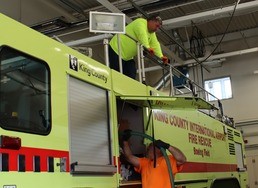
Pictured: Steve Pistoll, Field Service Manager, TRS Group, in orange shirt, works to clean an ARFF engine of PFAS, a man-made chemical in firefighting foam.






 Employee News