
King County launches new safety plan for downtown campus
King County has launched a new plan to create a safe, more welcoming environment around County facilities in downtown Seattle.
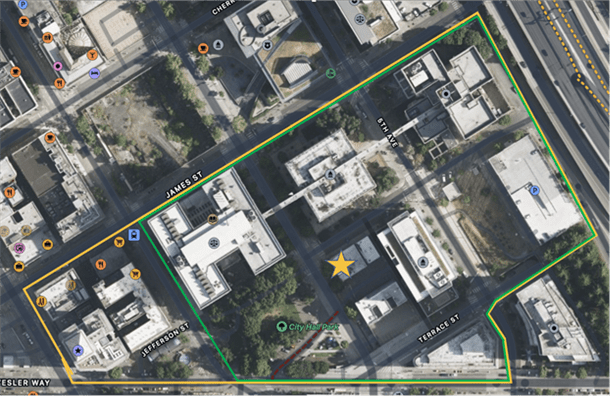
The Civic Campus Safety Plan brings new and augmented resources to King County’s downtown Seattle footprint – bordered by 3rd Avenue, Yesler Terrace, James Street, and Sixth Avenue – with the goal of making the central campus a welcoming space where every person can thrive.
Under the plan, expanded security and custodial services include:
- Additional Sheriff’s Deputies to provide regular patrols on foot and bicycle between 7 a.m. and 5 p.m. Monday to Friday.
- Facilities Management Division (FMD) Security Officers to conduct exterior perimeter patrols of the downtown campus
- Trash and general clean-up will occur each morning, with pressure washing three times per week. Custodial staff will also be on-call during normal hours to respond to cleaning incidents as needed
In addition, a newly formed City Hall Park Neighborhood Outreach Team has been created to support unsheltered people around City Hall Park with access to shelter and housing, as well as helping people in crisis.
People in the community, including King County employees, often don’t know what to do when they see someone who may be in distress or crisis. The Neighborhood Outreach Team is there to help, and employees are encouraged to speak with a neighborhood outreach team member, or call 206-537-3770, if you see someone in crisis within the service area who might need support.
The eight-person team is based out of the Jefferson Building at 4th Avenue and Jefferson Street and is funded through the Behavioral Health and Recovery Division (BHRD) within the Department of Community and Human Services (DCHS). It provides behavioral health services in an area from Yesler Way to James Street and 2nd Ave to 4th Ave.
While not located within the Civic Campus Safety Plan boundary, the County has also expanded resources for the King Street Center (KSC). Three security officers are now assigned to KSC, and exterior clean-up will be conducted daily, with pressure washing three times per week.
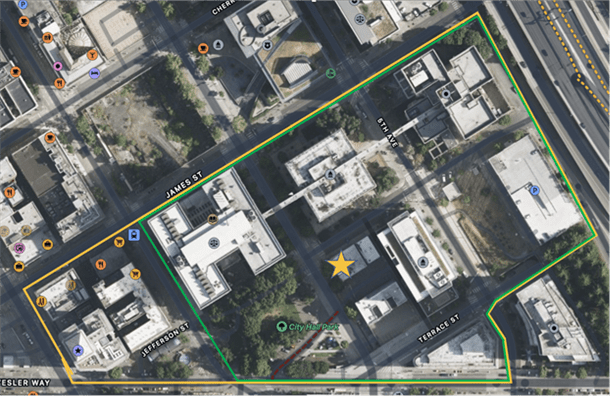
Yellow line: Border for City Hall Park Neighborhood Outreach Team
Yellow Star: Base location for City Hall Park Neighborhood Outreach Team
The County will monitor progress on the plan against a number of measures and make adjustments as needed.
The actions in the Civic Campus Safety Plan are addition to new and enhanced actions the County has already implemented, including:
- Increasing the number of security personnel onsite in the King County courthouse and other county buildings
- Installation of employee card reader locks in Courthouse bathrooms
- Security escort program where, upon request, County employees can request a security escort you for several blocks from downtown buildings to Goat Hill Garage or immediate vicinity bus stops
- A “Walking Bus” pilot program where employees can join their colleagues and a FMD Security Escort each evening walking to the King Street Station and the Colman Dock from the downtown campus.
Share this:

Thank you for participating in the 2022 Employee Engagement Survey

By Whitney Abrams, Chief People Officer

I want to sincerely thank you for participating in the 2022 Employee Engagement Survey. This past year has been challenging, and your feedback is essential in giving us the insights and information we need to be a supportive, inclusive, and respectful workplace.
This year more than 63% of employees spoke up in the survey. Now your feedback, comments, and results are being reviewed and analyzed and we will share more detailed information and next steps with you in May.
We are focused on creating a workplace where every employee is engaged, experiences trust and respect, and has the tools and support to be successful. Your feedback in the 2022 Employee Engagement Survey is vital to help us realize this goal.
Thank you for participating in the survey, and for everything you do to make King County a welcoming community where every person can thrive.
Share this:

New recruits graduate Sheriff’s academy

 Congratulations to Cameron Decker and Kenton Robillard, who were recently sworn in as new deputies by interim Sheriff Patti Cole-Tindall.
Both Decker and Robillard received additional acknowledgement to include The Partner Award, which is decided upon by their classmates and peers, and the Overall Award for the highest scores in academics, including shooting.
The King County Sheriff’s Office continues to recruit officers and staff for a variety of open positions. Click here to view opportunities.
Share this:

Eco-friendly spring cleaning

 The warmer weather and smell of blossoming trees has us in the mood for spring. It’s time to open the windows, clear away the clutter, and start the new season off fresh with a good, deep spring cleaning.
From inside to out, King County’s Department of Natural Resources and Parks wants to help you wipe away the winter dust in a way that’s good for the planet and for you and your family. DNRP is sharing eco-friendly spring-cleaning tips and tricks across all of the department’s social media channels this week, like this one on fresh ways to clean with lemons.
Share this:

Finalists announced for King County Sheriff as recruitment moves into the final phase

Following three rounds of interviews with the hiring committee, three candidates have been selected to move into the final phase of the recruitment process for a new King County Sheriff.
In the final phase of the selection process, the candidates will meet with members of the Public Safety Advisory Committee, King County employees, labor representatives, and contract city representatives and engage with the community in a separate series of public forums prior to a final interview with Executive Constantine. Click here to read the full announcement.
Share this:

Nonprofit application cycle and workshops

For over 30 years, King County employees have been giving to participating nonprofits of their choice through the Employee Giving Program. This past year we pledged nearly $2.4 million!
For nonprofit organizations to benefit from this program, they must apply annually and meet the eligibility requirements — even if they have participated in the past.
Nonprofits are encouraged to join a workshop before applying. Participants in a workshop are more likely to submit error-free, eligible applications.
- Tuesday, April 12 at 9 a.m. Register here.
The application deadline is May 4, 2022. Click here for additional information.
Share this:

Join Commute Seattle’s Earth Day challenge

During the month of April, pledge to “spare the air” by substituting three car trips with climate-friendly travel choices for a chance to win a $100 gift card. You can enter by committing to use one of these earth-friendly options:
- Bike
- Walk
- Bus/Light Rail
- Water Taxi/Ferry
- Carpool/Vanpool
Click here to sign up for the challenge. You’ll be asked for some basic information so we can send a few reminders and resources throughout the month. At the end of April, five winners will be randomly selected to receive $100 gift cards!
If you have any questions about your employee transportation benefits, please visit the Employee Transportation Program (ETP) page or contact the ETP manager, Hossein Barahimi directly.
 Learn more about Commute Seattle’s Earth Day Challenge by visiting their website at https://www.commuteseattle.com/2022-earth-day-challenge.
Share this:

Leadership change at KCIT


Tanya Hannah, King County’s Chief Information Officer (CIO) and Director of our Department of Information Technology, has announced that she is leaving King County.
Executive Constantine appointed Tanya as CIO four years ago, in April 2018, and during that time she has overseen numerous technology projects and improvements at King County to help customers quickly and simply access our information and services. She also helped the County radically change the way it operates and delivers services in response to the COVID-19 pandemic. Along the way the department and Tanya herself received several national awards and recognitions.
Tanya’s last day with King County is May 1.

KCIT will be in good hands in the short term as David Mendel, Director of the Emergency Radio Communications (ERC) Division, has accepted the CIO position on an interim basis. A military veteran with 22 years’ service in the U.S. Navy as an Electronics Technician, David joined King County in 2005 as Regional Communication Services Manager. David is a certified Project Management Professional and has a Bachelor of Science Degree in Business Administration from City University in Seattle and a master’s degree in Business Administration from Columbia College in Columbia, Missouri.
Tanya and David will now begin transition planning to ensure a smooth and seamless leadership change. We will soon begin a nationwide search for a permanent CIO, and we will provide more details on this process soon.
Share this:

April is Records and Information Management Month

Humans have been creating records for over 5,000 years. For most of that time, records have been created in similar ways – by entering data on physical objects, like paper (or clay tablets). The advent of electronic records in the late 20th century pushed many of us into rapid change, adapting to new technologies and processes. Most recently, the COVID-19 pandemic contributed to a quick change in how we work, as many county agencies shifted to electronic processes and made efforts to digitize their physical records and “go paperless”.

The King County Records Management Program is celebrating April as Records and Information Management Month by recognizing the important role that records play in our daily work.
The proper management of records offers many benefits including lowering risk for King County and helping each of us find the information needed to do our jobs. It also aligns with various countywide initiatives and values such as Lean/Continuous Improvement, the True North Value “we are responsible stewards”, as well as Equity and Social Justice by encouraging transparency in the work that we do.
What you can do
There are many ways that employees can contribute to good records management:
- Take Basic Records Management training (15 minutes)
- File inactive electronic records to Content Manager
- Delete transitory records
- Organize/sort records in Outlook or OneDrive
- Review your agency’s records retention schedule
- Review your agency’s standard work documentation (Standard Operating Procedures / SOPs) to ensure that records management steps are captured.
History of Records Management in King County
King County records have existed since the county was formed in 1852. But it was many decades before there was any systematic control over county records. By the late 1960s, the county eventually recognized the need for better control over its records. This corresponded to a general nationwide push towards better records management in the 1970s and the passage of various public disclosure laws, including the Washington State Public Records Act. In 1971, King County Executive Order 1070 called for the creation of a county records management program. Over the next several decades, the purpose of the program was in developing records retention schedules and managing physical records in storage. The first King County records retention schedule was developed in 1972.
The 1980s saw various improvements to the county’s records management processes, including the creation of the King County Records Center and the King County Archives. Throughout this time, focus of the program continued to be the management of paper records. Then after a major lawsuit in 2000 regarding violations of the Public Records Act, King County realized they needed to properly manage electronic records. As a result, the county made efforts to acquire a countywide electronic records management system. The first system, KC ERMS (aka CARM) was in place between 2008 and 2019. In 2019, KC ERMS was retired and replaced by the current system, Content Manager (CM), which went live on October 7, 2019.
As of today, Content Manager is used to house over 17 million electronic records and to inventory over 100,000 boxes in off-site storage.
Share this:

Their mission: Modernize the CFJC’s medical records

As shared from Roll Call: the DAJD newsletter, December 2021 – January 2022 issue
A promising shift could soon deliver more streamlined medical care for youth at the Patricia H. Clark Children & Family Justice Center (CFJC).
“I can’t tell you how excited I am about having an opportunity to switch over to electronic medical records,” Juvenile Division Director Allen Nance said recently.
During the second quarter of 2022, a project team will be migrating CFJC’s paper charts to software developed by Epic, a Wisconsin-based company that’s a leader in the medical records field. The team overseeing the switch toured the CFJC in November. They’re being led by DAJD’s Tricia Diamond (PPM IV, DAJD) and Jason Ortiz (HIT PPM IV) from Public Health.
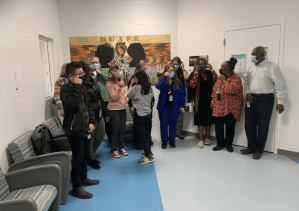
“Epic provides an opportunity to ensure our workflows provide youth with continuity of care based on equitable access while ensuring continuous improvement,” Diamond said.
Epic is a federally certified electronic medical records system that the DAJD and Jail Health Services use at the adult jails. More than 50% of the U.S. population have their medical records in Epic. DAJD will now expand its use to the CFJC.
The move offers advantages for optimizing health care, managing staff time more efficiently, and protecting patient privacy (HIPAA). Nance said that’s particularly important when serving marginalized communities, where access to quality health care may have been spotty.
“A lot of young people come here and get treatment they’ve never received before,” Nance said. “This will be a way for us to advance their medical care in ways we have failed to do in the past. In addition, records of treatment that a youth received at the CFJC will be available to medical providers upon the youth’s return to community.”
The new records system will provide medical staff with information about previous treatment, vaccination history and more. Staff can also look forward to leaving the old system of paper charts behind – and some relief from the task of deciphering doctors’ notoriously illegible scrawl.
“We are excited to bring CFJC onto the Epic system!” said Ortiz, the Public Health project manager who’s helping to lead the migration. “We will bring forward the lessons learned from all the prior implementations to benefit the youth and staff at CFJC.”






 Employee News