
Changes to Temporary COVID-19 Personnel Policy

The Centers for Disease Control (CDC) recently shortened the recommended time for isolation of the public when infected with COVID-19. It is now recommended that people with COVID-19 should isolate for 5 days (instead of 10) if they are asymptomatic. If they continue to be asymptomatic or their symptoms are improving, and they are fever-free for 24 hours without the use of fever-reducing medication, they can come out of isolation after 5 days and return to work.
Additionally, the guidance has changed for those who are exposed to COVID-19 and must quarantine. The state Department of Health and Public Health – Seattle & King County have likewise changed their guidance. The change is motivated by science demonstrating that the majority of transmissions occur early in the course of illness, generally in the 1-2 days prior to onset of symptoms and the 2-3 days after.
Based on the new guidance, the county has updated the Temporary COVID-19 Personnel Policy for Executive branch employees to clarify which employees must be out of the workplace during this time and has reduced the required time away from 10 to 5 days.
What’s changed in the Temporary COVID-19 Personnel Policy
A more concise “close contact” definition.
The addition of people who were “recently pregnant” to the list of people who may be at high risk.
Updates to Which Employees Must be Out of the Workplace During This Time, including:
- Reducing the number of days that an employee must be out of the workplace from a minimum of 10 days to 5 days, when:
- The employee has had symptoms, if the symptoms are improving and they are fever-fee for 24 hours without the use of fever-reducing medication.
- The employee tests positive and is asymptomatic.
- The employee tests positive and has or develops symptoms. This again requires that symptoms are improving, and that they are fever-free for 24 hours without the use of fever-reducing medication.
- The employee is not fully vaccinated, has had close contact with someone with COVID and is asymptomatic (this doesn’t apply to first responders or employees who have had a confirmed case of COVID within the last 90 days).
- No longer requiring employees to be out of the workplace following domestic or international travel.
Updates to the COVID Leave section, including:
- Making clear that COVID Leave can be used for one shift per vaccination (including booster shots) for employees who are unable to work due to side effects; and
- Adding COVID Leave cannot be used to obtain a COVID test. Employees may use sick leave for testing.
Review the updated policy here.
Share this:

Kids in need get a chance to Shop with a Cop

From Woodinville to Covington and locations in between, groups of kids got to experience some holiday cheer thanks to dedicated members of the King County Sheriff’s Office and the support of various community organizations. Shop with a Cop is a program that takes place across the nation during the holidays and locally is an opportunity for law enforcement to connect with the community.

The common perception is that when an officer shows up in a neighborhood or at a business it’s because of a disturbance or a traffic accident, or some other adverse activity that’s taken place. An event like lets the public see law enforcement in a way that creates a positive image and memories for the children.
While the City of Covington office has been hosting Shop with a Cop for many years, it was reinstated in the Skyway community after about 20 years. “I participated in this program in Detroit,” said recent transplant Joshua Storks-Sayles, the Storefront Deputy Sheriff for Skyway. His role as a community liaison is to interact with businesses, schools, and organizations to build positive relationships, from mentoring young people to leading neighborhood projects. They recently held a coat drive and handed out 200 coats, mostly to youth.
“There’s a lot of tension in black and brown communities,” he continued, “Even as a black officer, breaking down barriers starts with kids. These types of events go a long way to building trust,” because they get to see an officer as a normal person who “likes video games, cracking jokes and laughing.”
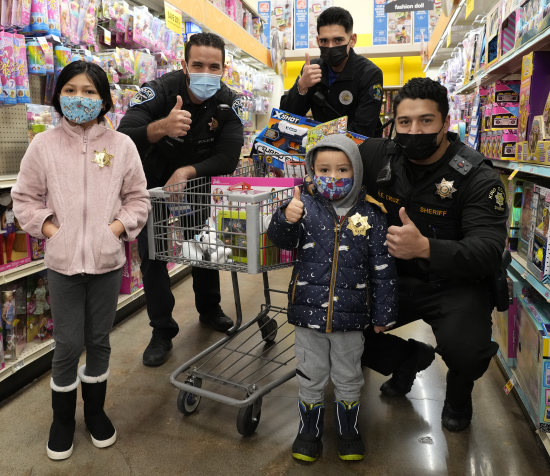
Officer Storks-Sayles worked with Alajawan’s Hands foundation and the Black Equality Committee to secure donations from local residents, busines owners and the Walmart Local Community Grant. With the help of area schools and the Creston Point and Green Tree apartments, they identified about 70 children who were given an opportunity to go shopping with an officer at the Renton Walmart Supercenter.
“Besides the connection with officers, students take away key lessons such as financial literacy and budgeting, decision making, and teamwork while shopping,” Storks-Sayles added. For example, families with multiple children used “critical decision-making to put their budgets together for an item that can be used between them all.”
Bringing back a holiday tradition
Last year, the City of Burien and City of SeaTac officers wanted to implement the Shop with a Cop locally, but because of the pandemic “we settled for a drive-through event,” according to Chad Mulligan, Administrative Sergeant for SeaTac office. “This year we got to host a traditional Shop with a Cop where kids show up with families to the Burien Fred Meyers to meet with an officer, go shopping, and have a photo taken with them.”
Coordinating for those locations are Community Service Officers Michiko Wilson, from the Burien office and Regina Burke out of the SeaTac office. Besides working with the local Rotary for donations, they also arrange for volunteers and solicit recommendations for the participants. The children whose names get submitted are identified by local schools and charities, and sometimes officers themselves who have met the kids while in the line of duty.
There were 25 kids from Burien and 25 from SeaTac, plus another 10 who were displaced because of the Hanover Apartment fire. “Those 60 kids are going to have a memory that is unique to them, getting to shop with an officer,” Wilson said. “I’ve seen officers spend their own money to help people, and they don’t ask for recognition. They’re out there on their days off, before or after their shift helping people.”
“Hopefully the public will recognize they’re doing a lot that is positive in the community,” Wilson added.
Share this:

Spotlight on King County Regional Veterans Court Mentor Program

By Troy Brown, Communication Manager, King County District Court
The King County Regional Veterans Court (RVC) seeks to increase effective cooperation between federal, state and local veterans’ service agencies and the criminal justice system. The RVC’s Mentor Program is a key part of the support available to help veterans successfully complete the RVC requirements.

“Veterans often find it hard to talk to others who are not veterans, or to ask for help,” says Terrell Carrington, RVC Mentor Program Coordinator for King County District Court, and a U.S. Army veteran himself. “The RVC Mentor Program connects participants with someone who can relate to their past experiences. A mentor can help program participants on the road to recovery, whether it is offering encouraging words, showing up for court hearings, or assisting in finding resources, when needed.”
Someone who is there for the vet
“The most important thing a mentor does for RVC participants is just being there,” says Terrell. “They show the veteran that their efforts are not going unnoticed, and continuously support their recovery.”
“One way I think about a veteran mentor is similar to a personal trainer at the gym,” adds Callista Welbaum, Therapeutic Courts Manager for District Court. “When you’re working on your own goals, it’s really helpful to have someone with lived experience who has been there and can be a support – having someone come along side you is incredibly powerful!”
Kate Tramontana, RVC Coordinator for District Court notes, “Most of our participants who have utilized mentors build lasting relationships with them, and that relationship doesn’t end when the participant leaves our program.”
RVC Mentor Coordinator’s role
Terrell Carrington, RVC Mentor Program Coordinator, joined District Court with eight years in the military and a degree in social and human services. “When I realized this position was available, I jumped on it!” he says. “I wanted to be part of the support and to give back to my veteran brothers and sisters.”
Although Terrell’s work focuses on recruiting mentors and connecting RVC participants with a mentor who is well-suited to each person’s background, Callista adds there are additional key aspects to the role: “Beyond his direct support to veterans, in order to get more mentors, Terrell ends up talking a lot about RVC in general to many people. He is like our own RVC ambassador, which helps build support for the court.”
As a veteran himself, Terrell understands the difficulties many vets experience after serving in the military. “I have been on the good side and the bad side,” he says. “I know that trying to adjust from the “dress-right-dress” environment to civilian life is tough. I fought my demons after my military separation and had to do it without support, so I know how difficult it is.”
What people might not know about RVC
When asked about misperceptions the public might have about RVC, Kate mentions several. “One is that all of our RVC participants are males,” she says. “While we do have mostly males in this program, we also serve female veterans.”
Kate also notes that some people might think that participating in a therapeutic court such as RVC is the “easy way out” for defendants to get out of serving jail time. “In reality, participating in a therapeutic court is more difficult than possibly just serving jail time in that it requires participants to do quite a lot as part of their engagement with treatment, probation and other court-imposed requirements. Most folks are on probation for two years, and full compliance for that entire time can be challenging.”
Making a real difference in vet’s lives
The RVC Team often hears from vets how much the program helped them. One example is Mr. Bishop, who served in the U.S. Marine Corps during the Vietnam War. He was diagnosed with cancer in the early 2000s, and his wife of 46 years died in 2015. “I kind of went off the deep end after that,” he said in a 2019 interview with Q13 News. “I was really down and out and got in trouble with the law.” He credited his participation in the court with helping him have “the strength to keep my health up;” He graduated from RVC in early 2021. Watch his story and see more about RVC on Q13: “King County helps eligible veterans in criminal justice system get their lives back on track.”
Click to learn more about Regional Veterans Court.
Share this:

Reminder on measures to reduce spread of COVID-19

With the rapid rise in cases of the Omicron COVID-19 variant, employees are reminded that several measures remain in place to slow the spread of the virus:

- Operations that require employees to be onsite will have KN95 or N95 masks available for all employees. Find out more about using these masks in this Public Health article on improving the quality and fit of your mask.
- Employees who are currently telecommuting should continue to do so where possible and not go into the office unless necessary and approved by their supervisor.
- Non-essential in-person gatherings should be canceled until further notice. Employees should work with supervisors and use good judgment about which meetings should continue to be conducted in person and limit the number of people present where possible. Conduct meetings using Teams, Zoom or teleconferencing where practical.
- In-person customer services that are currently suspended will remain so, except where there is an operational need to shift to in-person service.
- All employees and visitors must continue to wear masks indoors regardless of vaccination status.
Employees are also encouraged to make an appointment for a booster shot as soon as they are eligible. Booster shots have been shown to greatly improve protection against COVID-19, including the Omicron and Delta variants. To schedule a COVID-19 vaccine booster, visit www.kingcounty.gov/vaccine or use the Washington State Department of Health’s vaccine locator to check out your options and get on a waitlist.
With the exercise of reasonable caution, we can help slow the spread of this variant and protect our coworkers whose jobs necessitate they be onsite.
Share this:

Be prepared for cold temperatures, snow, and ice

Updated Tuesday, Dec. 28
Extremely cold temperatures and icy road conditions are forecast for our region this week, so please be prepared for possible commute delays and impacts to business operations.

If you work on site, please be prepared for cold weather. Have a plan for your commute, dress warmly, and let safety be your guide when making commute decisions. If you drive, have an emergency kit in your vehicle, including extra clothing, food, water, and a flashlight. Also, make sure your mobile phone is fully charged. Please remember to wear a mask indoors and follow other precautions and COVID-19 policies. Employees who are currently telecommuting should continue to do so where possible.
Power outages: If you are teleworking and experience a power outage that affects your ability to effectively work remotely, please contact your supervisor to discuss other options for completing work tasks. These may include taking leave or working from your regular King County worksite.
HR Policies: When an agency remains open, but conditions prevent you from reporting to work or from reporting on time, notify your supervisor as soon as possible. You may request leave, subject to approval by your supervisor. If you have no leave accrued, your supervisor may approve leave without pay to cover absences. Sick leave may not be used. Refer to HR Bulletin 2011-0009 County Operations During Emergency Situations and Inclement Weather (Sheriff’s Office employees refer to KCSO Inclement Weather Policy; Superior Court and District Court employees please see check court policies).
Alternative work arrangements: If you are impacted by the weather and adjusting work schedules, working at an alternative location, or taking vacation are options for your job, please discuss these beforehand with your supervisor.
Metro on Emergency Snow Network: Metro’s Emergency Snow Network (ESN) will be effective at 4 a.m. Monday, Dec. 27, until further notice. Metro will reassess daily whether snow clearing efforts have adequately improved road conditions and determine if there is sufficient staffing and buses to restore service and operate the broader all-day transit network. Riders who intend to use Metro’s services Monday, Dec. 27, should visit the Emergency Snow Network webpage to view details about routes in operation and to identify their options.
Resources for travelers
- Metro: Visit MetroWinter.com and Eye on Your Metro Commute, and sign up for Metro Transit Alerts (text, email, tweets via @kcmetrobus, see RSS feed via desktop or mobile RSS reader)
- Roads: Visit Roads’ Snow and Ice resources and sign up for King County Road Alerts (text, email, tweets via @kcroads)
- Sign up for King County Water Taxi Alerts (text, email).
Stay informed: Make sure you’re getting the latest King County information at work and at home in the event of inclement weather.
- Sign up for KCInform, King County’s employee alert and warning system. KCInform is used to reach County employees during an emergency with timely information about infrastructure disruptions, facility impacts, changes in your department’s business operations, and other critical impacts. Your King County desk phone and @kingcounty.gov email are already in the system. It is important to register your County-issued cell phone (if applicable) and personal cell phone and email address to ensure you receive time-sensitive messages. This service is free and your personal contact information is secure and protected. To sign up, please contact kcinform@kingcounty.gov anytime or 206-296-3830 between 8:30 a.m. – 4:30 p.m. Monday – Friday to request your unique registration link. Visit the KCInform website to learn more or watch our short video.
- Call the Employee Hotline—206-205-8600 (save it to your phone now!).
- Check your King County email for information on business operations, delays, and closures. Log on at http://outlook.kingcounty.gov. Some agencies may send additional instructions directly to their staff.
- Contact your supervisor for specific instructions.
Visit the Emergency News page at kcemergency.com for regional impacts.
Share this:

Reduce your risk, sign up for a COVID-19 booster shot

 With the highly infectious Omicron variant now circulating rapidly in our region, it is more important than ever to take steps to reduce your risk – including getting a booster dose if you are eligible. If it has been at least six months since your second dose of the Pfizer or Moderna vaccine, or at least two months since your single dose of the Johnson & Johnson vaccine, you are eligible for a booster shot.
To schedule a COVID-19 vaccine booster, visit www.kingcounty.gov/vaccine or use the Washington State Department of Health’s vaccine locator to check out your options. And to help meet the demand for boosters, the Federal Emergency Management Agency (FEMA) is sending its Mobile Community Vaccination Center to Federal Way and Auburn in December and January. This Community Vaccination Center will be providing free COVID-19 vaccinations and boosters to everyone ages five and older. To get more information and register for an appointment with the Mobile Clinic visit https://bit.ly/kc-comm-vax.
The Centers for Disease Control and Prevention (CDC) recommend everyone currently eligible should get a COVID-19 vaccine booster to maximize protection. CDC recommends the Pfizer or Moderna vaccines over the Johnson & Johnson for both initial and booster vaccinations.
Share this:

N95 masks for employees working onsite

King County is making N95 masks available to employees who are required to be onsite for voluntary use as we continue to monitor the rise of the Omicron variant of COVID-19.
All King County department and division leaders have been provided with information on ordering N95 masks, and these masks will be available soon for onsite employees to request.
If you would like to request a N95 mask for voluntary onsite use, please contact your supervisor.
Before using a N95 mask, please ensure that you read the information below on voluntary use of respirators (N95/KN95).
Information for Employees Who Voluntarily Use Respirators (N95/KN95 masks)
When providing these N95s for voluntary use by on-site employees, each must be provided with the following information:
- Wearing an N95 may put additional stress on your heart and lungs; respirators should be worn with caution, and you might want to get advice from your personal physician or a medical professional prior to wearing one. If you have any trouble breathing or other related symptoms, you should stop wearing this type of respiratory protection and wear a disposable facemask or cloth face covering instead.
- Important information about masks can be found at this Public Health Insider blog post: It’s time to refresh your mask supply (publichealthinsider.com)
- Regardless of the type of mask worn, follow these guidelines:
- To protect yourself, wear face coverings properly.
- Your mask should cover your nose and mouth at all times.
- Always wash your hands with soap and water or use an alcohol-based hand sanitizer before you put on a face covering and after removing it.
- Change your face covering when it gets moist.
- Wash your face covering after each use.
- Snug-fitting masks provide excellent protection.
- Make sure masks fit snugly against your face. Gaps can let air with respiratory droplets leak in and around the edges of the mask.
- Use a cloth mask with multiple layers of fabric, or wear a disposable mask underneath a cloth mask.
- Choose masks with a nose wire or mask fitter
- For visuals of these tips, visit the CDC’s guidance for improved mask use.
- The Washington Administrative Code requires that this table be provided to employees who voluntarily wear respirators, including N95s:

Additional COVID-specific information from the WA Department of Labor & Industries can be found at: Coronavirus/COVID-19 Workplace Safety & Health (wa.gov).
Share this:

Update on in-person operations in January

By Dow Constantine, King County Executive
Many of you have been asking about Future of Work (return-to-office) plans in the new year, and the impacts of the Omicron variant to our timelines. Our Future of Work plans are created to be nimble and responsive to health and safety, operations, and the needs of our employees.
We have not set a firm return-to-office date for those employees who are currently teleworking. At this point, due to the changing environment around the Omicron COVID-19 variant, and the expectation that the spread of the variant will rapidly increase in King County for the next several weeks, teleworking employees will not be asked to return to the office in January. Please continue to hold meetings remotely when possible and do not go into the office unless necessary and approved by your supervisor. With the exercise of reasonable caution, we can help slow the spread of this variant and protect our coworkers whose jobs necessitate they be on-site.
This direction is for King County Executive branch employees, including Assessments, Elections, and Sheriff Office. Employees in other branches of County government may receive additional guidance from their leaders.
While the severity of illness associated with Omicron is not clear at this time, the good news is that most fully vaccinated people – particularly those who have received booster shots – should be protected from severe infection. Thanks to the success of our employee vaccination mandate almost all of our workforce is fully vaccinated. However, we do expect to see many more serious cases in unvaccinated people, as well as many milder breakthrough infections among the vaccinated.
We already have several measures in place to stop the virus and are augmenting these with additional actions where appropriate:
- Operations that require employees to be onsite will have KN95 or N95 masks available for all employees. Find out more about using these masks in this Public Health article on improving the quality and fit of your mask.
- Non-essential in-person gatherings should be canceled until further notice. Please also work with your supervisors and use good judgment about which meetings should continue to be conducted in person and limit the number of people present where possible. Conduct meetings using Teams, Zoom or teleconferencing where practical.
- In-person customer services that are currently suspended will remain so, except where there is an operational need to shift to in-person service.
- All employees and visitors must continue to wear masks indoors regardless of vaccination status.
I also urge you to make an appointment for a booster shot as soon as you are eligible. Booster shots have been shown to greatly improve protection against COVID-19, including the Omicron and Delta variants. To schedule a COVID-19 vaccine booster, visit www.kingcounty.gov/vaccine or use the Washington State Department of Health’s vaccine locator to check out your options and get on a waitlist.
I know that the emergence of this variant is something none of us wanted to see, particularly right before the holidays. As we enter the holiday season, there are many things you can do to protect yourself and your loved ones, including:
- Limit the number and size of gatherings. If possible, get a test before the gathering. Rapid tests are less accurate but still useful
- Gatherings will be safer in well-ventilated spaces. Open windows for fresh air
- Postpone travel where possible
- Now is the time to refresh your mask if needed. Make sure it is well-fitting and high-quality. Everyone ages 5 and older, regardless of vaccination status, are required to wear masks in all indoor public settings and at outdoor events with 500 or more people. Masks are also recommended for everyone in crowded outdoor settings
- Visit Washington DOH’s Vaccine Locator to get a booster appointment
- Take extra precautions for higher risk people in your life, including those who are unable to get vaccinated.
I encourage you to take reasonable precautions this holiday season and do everything you can to stay safe and reduce the impact of this virus on family and friends, on healthcare and other emergency workers, and on our entire King County community.
Share this:

We thank you, our employee audience

Our top stories and videos for 2021
This past year, the twice weekly Employee News newsletter shared employee accomplishments and events, COVID-19 resources and vaccine updates, training and career development information, and other relevant employee news. The Department of Human Resources Employee Communications Team also featured these items on the KC Employee News blog, the King County Employees YouTube channel, the KCEmployees Twitter account, and the King County, WA LinkedIn account.
We would like to thank you, our employee audience, for interacting with this information, sharing it with colleagues, and helping us provide timely news and information that is relevant to your career, your family, and your community.
2021 has been an equally challenging year, and we are grateful to have your support. If you have any story ideas, suggestions, or recommendations, please email us KCEmployees@kingcounty.gov.
The 10 most-clicked Employee News newsletter stories for 2021 were:
10. Walking Bus pilot program launches Nov. 15 – 2,269 clicks
9. How to make sure you are fully vaccinated by Oct. 18 – 2,269 clicks
8. Juneteenth and Indigenous Peoples’ Day to be observed holidays beginning in 2022 – 2,640 clicks
7. King County to require all employees to be fully vaccinated by Oct. 18, 2021 – 3,037 clicks
6. How to get your vaccination status verified – 3,849 clicks
5. Planning for the future of work for employees of King County – 4,138 clicks
4. FAQs and updates to mask requirements for King County employees – 4,494 clicks
3. How to provide verification of vaccine status – 5,255 clicks
2. Want to opt out of Washington’s long-term care program? – 11,536 clicks
1. School-to-Work Transition Fairs go virtual in 2021 – 15,391 clicks
The 10 most-watched videos for 2021 were:
10. Introducing King County eLearning, powered by NEOGOV – 256 views
9. How to navigate King County eLearning – 274 views
8. King County Employee Performance Awards for 2020 – 308 views
7. EAP or MLE: Which program is right for my situation? – 314 views
6. Four Pro-Equity Actions: A Conversation Between the Executive’s Senior Leadership Team. – 322 views
5. DAJD Employee Recognition Video – 363 views
4. King County Vaccine Deadlines for Employees – 373 views
3. KingCare Select Requires County Employees to Choose Their PCP – 471 views
2. Multi-factor Authentication for KC – 643 views
1. King County Employee Engagement Survey – Key Findings – 728 views
Share this:

Is it time to schedule your COVID-19 booster?

If it has been at least six months since your second dose of the Pfizer or Moderna vaccine, or at least two months since your single dose of the Johnson & Johnson vaccine, you are eligible for a booster shot.

The Centers for Disease Control and Prevention (CDC) recommend everyone currently eligible should get a COVID-19 vaccine booster to maximize protection.
To schedule a COVID-19 vaccine booster, visit www.kingcounty.gov/vaccine or use the Washington State Department of Health’s vaccine locator to check out your options and get on a waitlist.
With the Omicron variant now circulating, it is more important than ever to get a booster dose, wear a high-quality and well-fitting face mask, avoid crowded indoor spaces, and get tested if you have symptoms. Thank you for all you are doing to help keep yourself, your family, our workplaces, and our community healthy and safe.






 Employee News