
May is Mental Health Month


Whitney Abrams, Chief People Officer, King County Executive Office
Dear employee,
May is national Mental Health Month, a time to raise awareness about the importance of mental health to our overall health and well-being, and to our community.
Talking about and acknowledging mental health can be difficult and awkward, yet mental health is as important to our well-being as physical health. As the World Health Organization says, “there is no health without mental health.”
Silence and stigma are two of the biggest barriers to people getting the care they need. Employees, family, and friends may struggle in silence, or not know where to turn for help.
Together we can help change this by being compassionate, understanding colleagues, and working to create a culture of hope, inclusion, and support here at King County.
Mental Health Month is a great opportunity for all of us to strengthen our understanding of the importance of mental health and to learn about resources available to us and the people we care about. Balanced You has compiled this webpage with tools to help you recharge, build resilience, and get care for mental health, substance use, and other concerns. You will also find links to learn more about mental health, equip yourself to support people you care about, and inspire you to find your voice.
Whether mental health issues impact us personally, are present with us our whole lives or during a particularly challenging time, or these issues afflict our friends, co-workers, or families, I don’t believe there is any one of us who has not been impacted and suffered hardship. I am not different in this regard, and I strive to be a person who seeks to learn, help, heal, and de-stigmatize something that impacts virtually all of us.
We are stronger as an organization and a community when everyone has the opportunity to thrive, to be at their best, and feel their best. Hope, compassion, and recovery are all around us – in our co-workers, in our families, in ourselves – as are the resources to help one another and ourselves.
As a King County employee, and as the Chief People Officer for this 14,000-employee organization, I am continuously proud of the way we support each other, both on a daily basis and during challenging times. Thank you for continuing to care for and support one another and the people we serve.
Sincerely,

Whitney Abrams,
Chief People Officer
Share this:

May Day events Wednesday, May 1

Dear employee,
Several community groups are planning rallies, marches, and other events for International Workers’ Day this Wednesday, May 1.
We value and respect the peaceful expression of political views and people exercising their First Amendment rights. Employees who are scheduled to work and wish to attend any of the May Day events must follow their department’s appropriate leave policies and take leave with the approval of their supervisor. For more information on your department’s leave policies, please refer to your Human Resources Manager.
May Day activities could affect traffic and transit. Be prepared for these impacts and allow extra time when you travel. Please check with your supervisor for specific information or instructions for your work unit. Any alternate work arrangements must be approved by your supervisor.
Resources for Commuters
- Sign up for Metro Transit Alerts (text, email, tweets via @kcmetrobus, see RSS feed via desktop or mobile RSS reader)
- Sign up for King County Road Alerts (text, email, tweets via @kcroads)
- Sign up for King County Water Taxi Alerts (text, email)
- Visit the King County My Commute page
Visit the Eye on Your Metro Commute (blog during peak weekday commutes).
Share this:

Featured Job: Senior Crime Analyst – Metro Transit Police

Salary: $83,012.80 – $105,227.20 Annually
Location: WA 98108, WA
Job Type: Career Service, Full Time, 40 hrs/week
Department: King County Sheriff’s Office
Job Number: 2019CBM09459
Closing: 5/6/2019 11:59 PM Pacific
The Senior Crime Analyst for King County Sheriff’s Office (KCSO) is a great opportunity for an experienced, data-driven crime analyst to manage all aspects of crime analysis for Metro Transit Police. The Metro Transit Police Department is responsible for providing policing of King County Metro Transit’s bus system and routes across the county, and ensuring safety during Metro’s more than 400,000 daily boardings.
We are seeking candidates with the drive and experience to provide critical tactical and strategic analysis of crime related to Metro Transit operations and services. The successful candidate will demonstrate considerable expertise and creativity to effectively utilize proactive policing tools, incorporate intelligence-led policing techniques, data-driven analysis paradigms, and data collection procedures.
Learn more about this position or view all available positions.
Share this:

Invite your favorite nonprofit today
Crossposted from King County Employee Giving Program
Employee referred nonprofits are our favorite! It is our goal, after all, to connect Employees to the causes they are passionate about. Invite your favorite nonprofit here.
As an Employee Champion, during the Annual Giving Drive you may:
- Share about your favorite nonprofit
- Invite them in or do a special event in their honor
- Pledge
And eligible employees may use up to 3 days of sick leave to volunteer year-round.
Let’s get them in so others can learn about why you think they are so awesome!
Read more from King County Employee Giving Program
Share this:

Training Spotlight: Meeting Mindfulness I and Business Writing Essentials

Meeting Mindfulness I, May 15: This workshop is a day of immersion into mindfulness, stress reduction, body awareness, and inner care. Mindfulness helps us meet challenges with more resilience, and to embrace the joys of life with more appreciation and awareness. Register and learn more.
Business Writing Essentials, June 5: Learn practical tips for producing professional-looking business documents, the importance of writing for a specific audience, and how to make the purpose and call to action clear. Review writing strategies for routine, persuasive, negative news, and personal messages. Includes hands-on exercises that reinforce the 5 C’s of good business writing—being concrete, clear, concise, courteous, and correct. Register and learn more.
View more training and development opportunities at www.kingcounty.gov/learning.
Share this:

Tech Tip: Lock your mobile devices with a pin or passcode


How to access the training:
To start your Cyber Security Awareness Training please login at:
https://sso.securingthehuman.org/kingcounty/
Your account for Securing the Human:
- Username: King County email address
- Password: King County email password
For more information about Cyber Security please visit our Sharepoint site:
https://kc1.sharepoint.com/teams/ITISRC/ISRCPUB
Share this:

They’re not your usual beach combers
Crossposted from Clean Water Stories
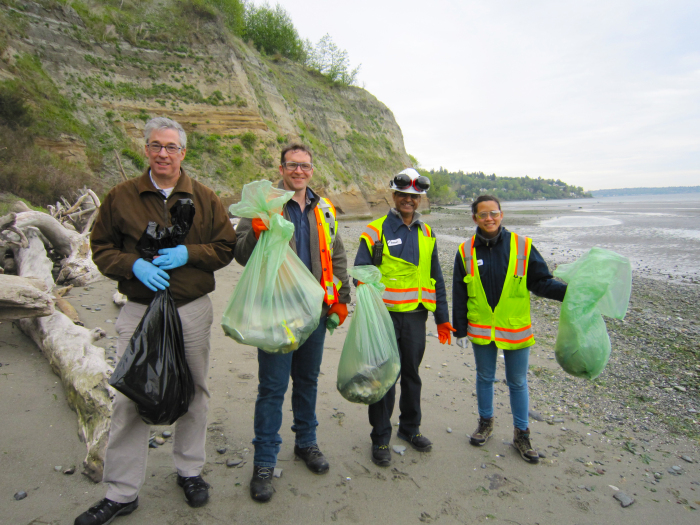
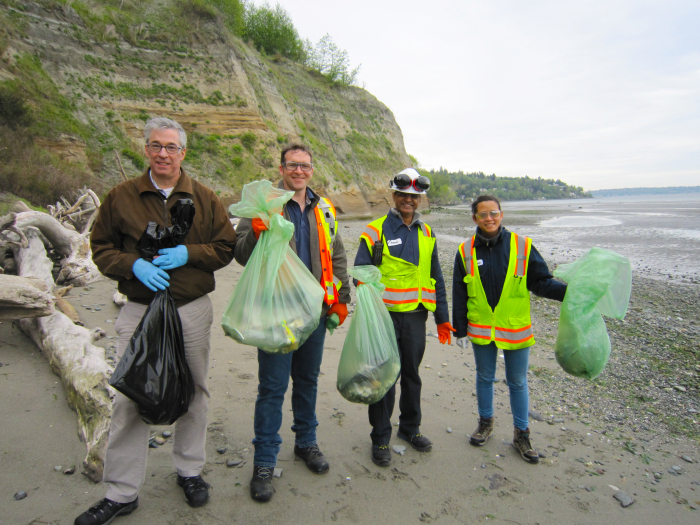 This Earth Day, a determined group of engineers, scientists, lab technicians, technical trainers, managers and more stormed the shore in Discovery Park picking up litter and debris.
The staff at West Point Wastewater Treatment Plant take their stewardship of the park around the treatment facility seriously, and can often be seen toting trash off the beach and trails.
Read more from Clean Water Stories
Share this:

Former Seattle Police Chief John Diaz to oversee detention at King County

 Bringing in a leader with strong management skills, a background in law enforcement and community policing, and more than three decades of public service, Executive Constantine named John Diaz as interim director of the Department of Adult and Juvenile Detention.
Diaz was Seattle police chief from 2010-2013. He began his career at the Seattle Police Department as a patrol officer in 1980 and held many leadership positions before being named Chief of Police. Diaz was Deputy Chief of Administration, then Deputy Chief of Operations, for nearly ten years, where he oversaw administration of the department, including management of 1,900 employees and a $250 million dollar budget.
Read more in the official press release.
Share this:

Learn how to boost your retirement savings

 You and your spouse or significant other are invited to learn more about saving for retirement with the King County Deferred Compensation Plan.
Several in-person sessions are coming up April 30, May 1, and May 2. See details and registration. Other education sessions are offered throughout the year.
For more information about Deferred Compensation Plan education—including webinars—go to the Deferred Compensation web page.
If you have any questions, please contact KC Deferred Comp.
Share this:

Pet of the Week: Bella

 Bella is a 1 year-old, female, Pit Bull mix (A575315). Her personality color is GREEN, meaning she is an adaptable dog who loves to go with the flow! Bella has lived in a foster home with another large dog and children and she got along well with them.






 Employee News