
Pet of the week: Pearl

Crossposted from Tails from RASKC
 We have a real gem for Pet of the Week: meet Pearl!
This young pittie was brought to RASKC by a good Samaritan. When she first arrived, Pearl was very nervous. She has since come out of her shell to show her shining personality – which we call “Rambunctious Red. Read more
Share this:

Featured Job: GIS Analyst

Salary: $77,320.88 – $98,008.77 Annually
Location: Seattle, WA
Job Type: Special Duty Assignment or Term Limited Temp (TLT)
Department: King County Department of Information Technology
Job Number: 2018-08504
Closing: 10/23/2018 11:59 PM Pacific
*This opportunity is open to both internal and external applicants. It is being offered as both a TLT (Term Limited Temporary) OR a Special Duty assignment. (Only internal, Career Service employees are eligible for Special Duty assignments. It is important to note that you must get approval from your current supervisor/manager to accept a Special Duty assignment)
Perform a full range of GIS development and application tasks, including web applications, spatial analysis, and map design/production, in support of high-priority GIS projects and services for a large, diverse community of clients. Perform all aspects of data development and maintenance for spatial and tabular data related to urban and regional planning, land use/land cover, zoning, and real property. Develop and nurture effective working relationships with all project clients. Lead project teams and act as a mentor for other staff where appropriate, in alignment with project management and technical requirements.
Learn more about this position or all available positions.
Share this:

Get to know 2018 Giving Drive nonprofits – Spotlight on organizations serving people with a disability
Each year King County employees help hundreds of nonprofit organizations do vital work in our community and around the world by donating through the Employee Giving Program, and this year’s Annual Giving Drive is now underway.
As we recognize Disability Awareness Month this October, here are four participating nonprofits whose work helps people with disabilities in our community:
- The Arc of King County(9233) – Serving individuals and families with intellectual and developmental disabilities through case management, peer support, leadership training, and advocacy.
- Alpha Supported Living Service(9033) – Providing 24/7 support for people with developmental and intellectual disabilities to reach their full potential as individuals and community members.
- Northwest’s Child Inc. (9561) – Serving the day to day, year round needs of children, youth & young adults with moderate/severe developmental/physical disabilities in a community-based, integrated, day setting
- Provail(9870) – Supporting people with disabilities to fulfill their life choices in the Greater Seattle area.
Find out how to make a pledge here, or contact your Employee Giving Program Ambassador, visit www.kingcounty.gov/giving, email EmployeeGiving@KingCounty.gov or call 206-263-9405 for more information.
Share this:

New Seattle Symphony discounts

King County employees can receive 15 percent off most Seattle Symphony concerts this year by using Discount Code CONDUCTOR19.
- October 23: A tribute to David Bowie called the Life Aquatic featuring Seu Jorge.
- October 26 and 27: Baroque & Wine season begins with Handel Music for The Royal Fireworks. Your promo code will give you 15 percent off these concerts.
To order tickets visit www.seattlesymphony.org and enter the promo code CONDUCTOR19 prior to selecting seats, order by phone at 206-215-4747 or 1-866-833-4747 and give the operator the promo code or purchase tickets in person at the Benaroya Hall Box Office located at the corner of Third Avenue and Union Street, Monday – Friday 10 a.m. – 6 p.m., Saturday 1 – 6 p.m.
See all available discounts on the Employee Discount webpage.
Share this:

School-to-Work Program changes lives

 If you ask what students with developmental disabilities need in order to achieve employment before leaving high school, what you will hear most often is “high expectations” and “work experience.” Ask what it takes for a program to make this happen for students countywide, and what you will hear is “collaboration.” But if you ask students what it takes, it might be about supporting them to reach for their dreams. Working with Washington State’s Division of Vocational Rehabilitation, Developmental Disabilities Administration, school districts, consultants, employment service providers, businesses, families, and over 1,500 students over 14 years, collaboration and support is exactly what the King County School-to-Work Program is all about.
Perhaps one of the most remarkable examples of collaboration and supporting a student’s dream is Devon’s story, a graduate of Seattle public schools who participated in the 2017-2018 cohort of the King County School-to-Work Program. Devon’s journey began with her family and their commitment to developing a strong school experience. Active and involved, Devon attended both special and general education classes in high school, was a cheerleader, and also an athlete on the unified soccer team. But all the while, she and her family were looking beyond high school. Her mother Sue explains “she expected to go to college at the end of high school, just like her parents and siblings.”
Like most students with developmental disabilities, Devon could participate in high school transition services through age 21, yet what is possible during and after high school transition is complicated at best. Sue understood that learning as much as possible about transition and adult services were keys to success. She attended King County Transition Resource Fairs (a big part of King County School-to-Work’s outreach) as well as school gatherings. She connected with teachers, adult service professionals, and other families. With these efforts, Devon met her college goal by attending Highline College’s ACHIEVE Program as part of her high school transition plan. Passing science classes such as oceanography and climate science, and becoming a great public speaker, Devon earned her ACHIEVE Certificate on campus, alongside other students with and without disabilities.
However, Devon and her family wanted more. For her final year of transition, Devon applied and was accepted into Seattle Children’s Project SEARCH program. Project SEARCH is an international model for transition services; students receive both classroom-based learning and work internships within a host business. These opportunities are provided in concert with employment services designed to support students to fulfill their employment needs and those of the business. In King County, the employment services most students receive at Seattle Children’s are funded by the School-to-Work Program and provided by the employment agency Vadis. Devon shared, “My Vadis experience was amazing… A job coach is someone who helps you get a job that you are passionate about.” The goal of the School-to-Work Program is to help all students obtain employment by the time school ends and School-to-Work consistently exceeds national employment averages for young adults with developmental disabilities.
While at the hospital, Sue explained that Devon “worked in the cafeteria, and in the neurology department, stocking, filing, office tasks and cleaning. She landed a weekly greeter position at a local rotary, learning valuable public relation and hospitality skills.” The position was part of the Partners for Work program, a Rotary District 5030 priority project created in 2008. Partners for Work is designed to assist employers in gaining access to the talented, untapped workforce of people with developmental disabilities. Devon recalls, “My coworkers helped me to understand the process of setting up tables and setting up the badges. Being a greeter was my favorite part of the experience because I got to meet some amazing people like the Governor.” King County has supported Partners for Work by contracting with Wise, a local nonprofit, to coordinate internships and develop the program with Rotary clubs countywide. Debbie Moore of Wise says that Partners for Work has grown to “32 of 45 King County Rotary Clubs” and has “led to 113 employment opportunities.”
Devon’s next big move came when the Rotary member organization Universal Cells announced a new position. Devon applied. “Universal Cells, it is a biotech company that’s doing stem cell science. Which is perfect for my skills and my passion for science” says Devon. “After the interview was over I went home and waited. When my job coach called me that next morning she said ‘I have exciting news!’ I remembered that when she told me that I got the job, and I burst into tears. I was so completely happy that my childhood dream came true.”
Devon ended her high school transition program with success, working 16 hours per week as a lab aide and she has since received a raise and additional work hours. “It has been 9 months and I’m enjoying more every day. Working as a lab aide and helping with cleaning, organizing, labeling, and the list goes on. My boss is super supportive of me as an employee and as a person. My co-workers are absolutely stunning to work with because they help me to achieve my goals.”
Congratulations to Devon and thank you to all King County School-to-Work partners and the many community members who create opportunities for students with developmental disabilities to succeed!
Share this:

Get ready to ShakeOut on Thursday, Oct. 18

Though our region hasn’t felt a major earthquake in more than 15 years, we all need to be prepared for the next time the ground moves. That’s why King County encourages everyone to take part in the Great Washington ShakeOut on Thursday, October 18.
At 10:18 a.m., or another time convenient to you, practice what you would do in an earthquake:
- DROP to the floor
- Take COVER under a desk, table, or other sturdy furniture and protect your head
- HOLD ON until the shaking stops.
FMD will announce the earthquake drill in many King County buildings, and we encourage you to hold your own drill at home after work.
This is also a good time to make sure you’re signed up to receive alerts. To register for KCInform, our internal alert system, email kcinform@kingcounty.gov or call 206-296-3830 to request a unique registration link. To sign up for ALERT King County, our public warning system, visit kingcounty.gov/alert.
The data you provide for these systems is secure and protected and will only be used to contact you in the event of an emergency or system test.
You should also take this opportunity to look at your emergency kit(s) to make sure you have everything you need, and to replace anything that is expired, damaged, or spoiled.
For more preparedness tips and information, visit kingcounty.gov/prepare.
Share this:

Exec drops by to congratulate new Department of Human Resources
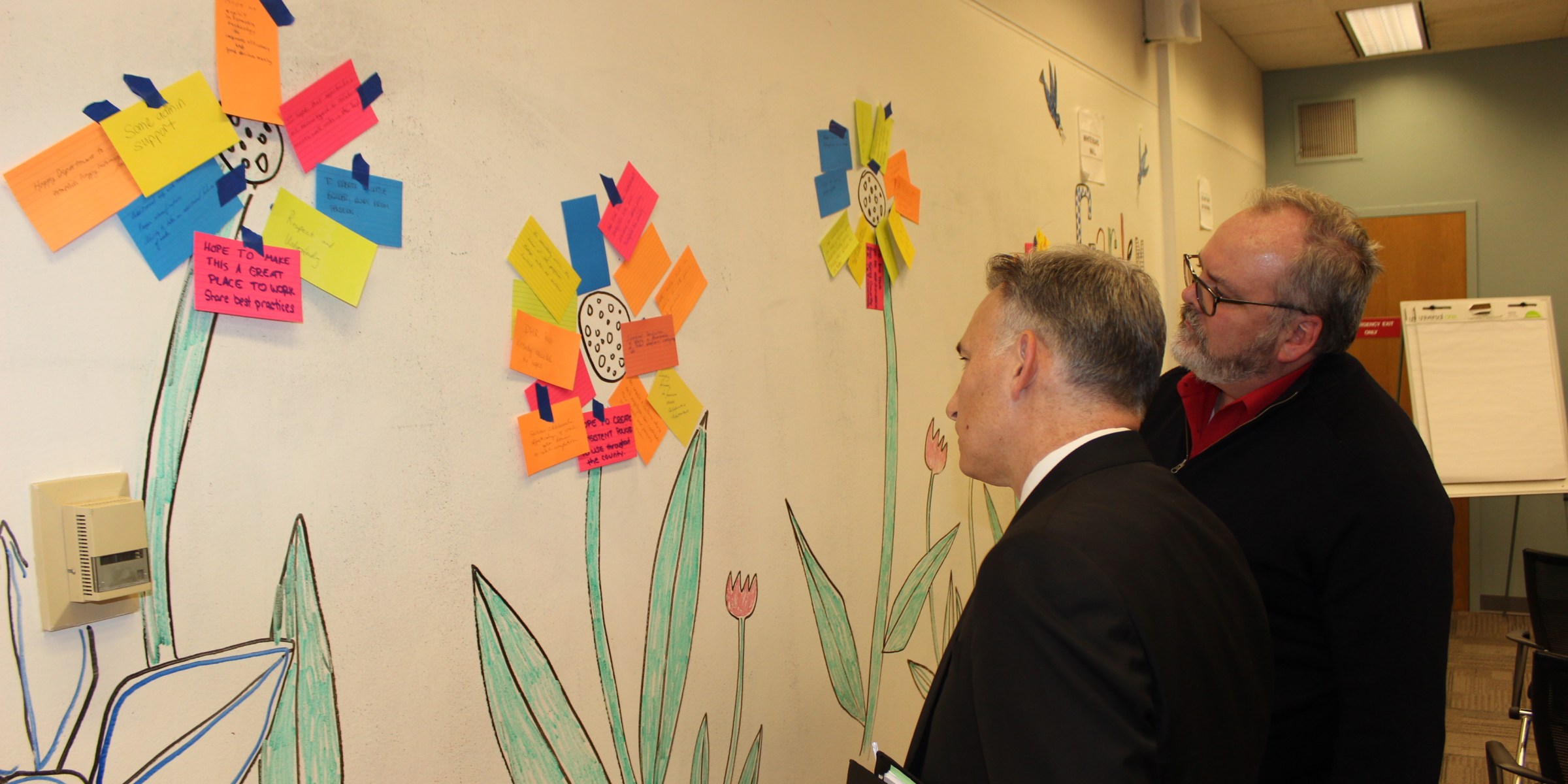
King County Executive Dow Constantine dropped by the Human Resources Division All Hands meeting last week to congratulate employees on being members of the newest King County department: the Department of Human Resources (DHR).
The County Council recently approved the Executive’s proposal for the new department, and on October 8, confirmed Jay Osborne (pictured below with the Executive reviewing DHR’s “Garden of Hopes”) as the department’s first director. The Department of Human Resources brings together the Human Resources Division, The Office of Alternative Dispute Resolution, and selected staff from Benefits, Payroll, Retirement Operations (BPROS), to deliver on the Executive’s Investing in YOU strategy of building a workplace where every employee has the tools and support to innovate, achieve their career goals and do their best work.
King County Executive and newly confirmed Director Jay Osborne view the DHR “Garden of Hopes.”
“As we embark on building this department and bring together all of our employee-facing work into one place, we can and will make this a better employer and a place that is recognized outside of our walls as being the best place to work,” the Executive said to staff. “Having all of our employee-facing services working together means that we will be able to provide greater clarity and better service to our employees, to elevate problems and solve them. And it says that you are important, that we have an entire department that is devoted to you, the nearly 15,000 people who are delivering services for the people of King County.”
Share this:

Pet of the week: William
Crossposted from Tails from RASKC
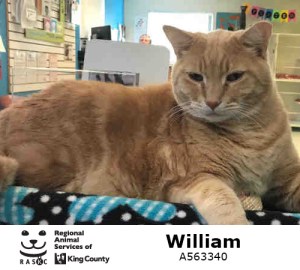
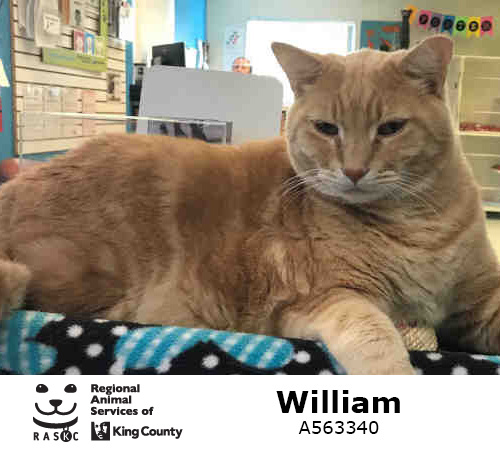
This is one cool cat – meet William, our Pet of the Week!
This affectionate lovebug can be a little shy at first, but he just needs some time to warm up. Once he gets used to you, William would love to cuddle with you.
Read more at Tails from RASKC
Share this:

Upcoming Lunch and Learn opportunities: Balanced You and your benefits

You’ve heard about Balanced You, you get emails from Balanced You, but you’d like to learn more. We’ve got you covered. Get to know Balanced You and become part of the movement!
In addition, with Open Enrollment just around the corner, the Benefits team will provide an overview of 2019 benefit changes and updates.
Choose the most convenient session and join us!
Read more at Balanced You
Share this:

Training Spotlight: Advanced PeopleSoft Query, Developing Your Leadership Style and PeopleSoft for Agency Human Resource Professionals

Advanced PeopleSoft Query, Oct. 17: It is open to experienced PeopleSoft Query users who have completed the Intermediate PeopleSoft Query training. Topics covered will include subqueries (Exist/Not Exist, In List/Not In List, other condition types), the Case statement (If-Then-Else logic), union queries and outer joins, case studies (the “movement” queries and more) and aggregates (create and Q/C aggregate queries). Learn more and register at Eventbrite.
Developing Your Leadership Style, Oct. 18: Learn how to capitalize on your personal leadership style to achieve workplace goals. In this course you will: Identify your leadership style through personal assessment; learn the difference between leadership and management; recognize the “being” and “doing” of leadership; and develop the innate motivating techniques that transform employee attitudes and enhance cooperation and teamwork. Learn more and register at Eventbrite.
PeopleSoft for Agency Human Resource Professionals Oct. 25 and ongoing: This course is designed for agency Human Resource professionals new to the PeopleSoft HR role. Human Resource professionals will learn the basics of creating a new position, position change requests, using action/reason codes, special duty effective dating and how to correct errors. Learn more and register on Eventbrite.






 Employee News