
GPS locators coming to fleet vehicles

This fall, King County is installing Global Positioning System (GPS) equipment, also known as the Automatic Vehicle Location (AVL) System, in most County vehicles. KCIT is overseeing implementation of this technology.
AVL is designed to enhance internal services and public service delivery, as well as advance the Executive’s Best Run Government and Combating Climate Change initiatives. The AVL System will automate and expand data collection to drive decisions on issues such as right-sizing our fleet, minimizing fuel consumption and greenhouse gas emissions, and helping us better manage field operations. Implementing this technology will help County agencies optimize routing and dispatch, improve response times, facilitate data-driven capital and operating decisions, and expedite sharing of accurate real time service information (such as snow plowing) with the public.
The system will be implemented in phases throughout the remainder of 2018 and into 2019/2020. Employees will receive more information from their department leadership when their phase is coming up.
An executive policy is being developed to establish standards for uses of the AVL System. The policy will also provide users with guidelines regarding their authority and responsibilities for the data collected and the records generated by the system. When the policy is finalized, it will be available here.
AVL will be installed on most vehicles managed by the Fleet Administration Division. The system will not be installed on revenue-generating vehicles such as buses, vanpools, or Access vans. You can find more information about the AVL Project here.
Share this:

Discount available for Seattle Symphony performances, Sept. 12, 13 and 15

King County employees are welcome to take advantage of an available discount for upcoming Seattle Symphony performances tonight, tomorrow and Saturday.
Sept. 12 and 13 – For Distant Worlds: Final Fantasy the music will be performed by the Seattle Symphony while the video game plays on the giant screen above. Buy tickets to Final Fantasy and the symphony will waive the handling fee when promo code FANTASY19 is entered. Purchase tickets here.
Saturday, Sept. 15 – The Opening Night concert will kickoff music director Ludovic Morlot’s final season and feature pianist Jean-Yves Thibaudet performing. Buy tickets and receive 20% off using promo code LUDO20. Purchase tickets here.
See all available discounts on the Employee Discount webpage.
Share this:

City Hall Park line up

Food trucks will be in City Hall Park from 11 a.m. – 2 p.m. between 3rd and 4th Avenues, just south of the Courthouse Building.
- Today, Wednesday, Fish Basket NW. More info here.
- Tomorrow, Thursday, Plum Bistro Mobile. More info here.
- Friday, Kukree. More info here.
Every weekday a park concierge will be on-site from 10 a.m. – 4 p.m. There will be games, outdoor seating and buskers from noon to 4 p.m. View the upcoming schedule here.
Share this:

First Untold Story performance to be held Sept. 20 in Renton
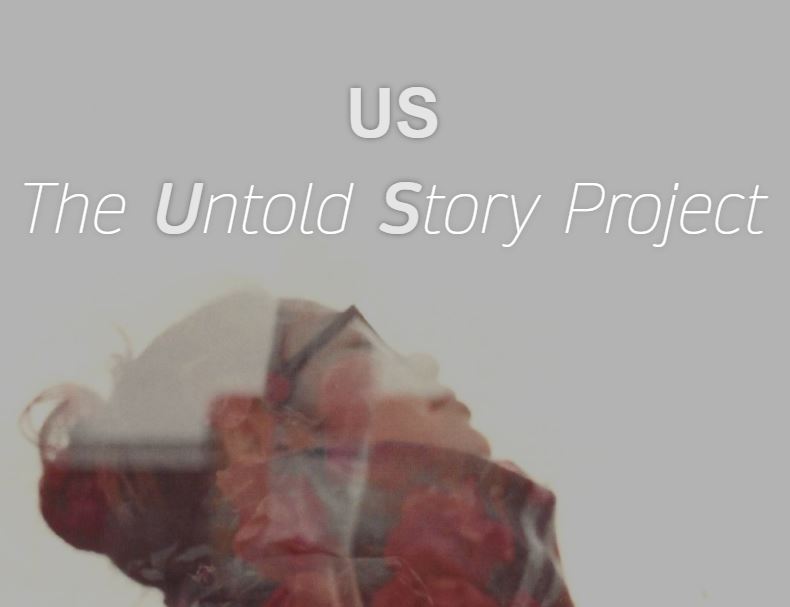
The first of three performances for US – The Untold Story will be held Thursday, September 20 at the Department of Elections in Renton. It will be from 1:30-3:30 p.m. in the Alvine Room.
Each of the performances will feature stories submitted by King County employees of color who responded to the question, “What’s your untold story of racism?” These stories are available to read on the Untold Story Project blog.
Local poets and actors will perform the readings under the direction of Seattle actor and storyteller Jekeva Phillips. The discussion to follow will be facilitated by conceptual artist and community-builder Natasha Marin.
- Sign up for the September 20 performance at the Elections Office in Renton here.
- Registration for the October 9 performance at King Street Center is full.
- Sign up for the November 13 performance at the Wing Luke Theatre in the International District here.
The ESJ Literary Project is a joint effort of the Solid Waste and Wastewater divisions. Contact Donna Miscolta or Julia Yen for more information.
Share this:

Employee Survey coming spring 2019
Dear fellow King County employee,
King County Executive Dow Constantine
Through our Investing in YOU work we’re continuing to build a workplace where you have the tools, support, and opportunity to do your best work.
For the past three years we’ve used the annual Employee Engagement Survey to hear from you about how can we make King County a better place to work, and how we can provide services more effectively to our residents.
Using what we’ve learned on our engagement journey and in response to your feedback, we’re making improvements to the engagement survey process.
First, based on your feedback, we are switching administration of the annual employee engagement survey from fall to spring. We heard that fall is a very busy time for you and that spring would offer more time for digesting the results and creating action plans. So, the next survey will be administered in spring of 2019 and will continue on an annual basis.
Second, beginning in 2019 you’ll see some exciting changes: a shorter survey, the ability to check in more frequently to see how things are going, and more robust information about the relationship between engagement and how our organization performs. But we’ll continue to provide the pieces that we heard matter to you, such as the ability to track data trends over time, reports that help you figure out where to focus your efforts strategically, and the ability to look at data through an Equity and Social Justice lens.
In the meantime, we remain focused on acting on 2017 results. In the past year workteams, divisions and departments have created 285 action plans to address issues like career advancement, work life balance and how we work together as teams. I asked my Cabinet and members of my Senior Leadership Team to create action plans of their own to address your feedback through the survey about their visibility, communicating openly and honestly and modeling expected behavior. I also have my own action plan and have been enjoying getting out to your worksites to learn more about what you do and hosting listening sessions in my office with groups of employees.
I look forward to sharing more information with you as we get closer to the launch of the next survey. Thank you again for everything you do for our residents and our region.
Sincerely,

Dow Constantine
King County Executive
Share this:

Featured Job: Registered Nurse – Juvenile

Closing: 09/30/18 11:59 PM (GMT -8:00)
Salary: $35.36 – $49.51 Hourly $73,548.80 – $102,980.80 Annually
Location: King County Youth Service Center – 1211 East Alder Ave, Seattle
Job Type: Career Service, Full Time, 40 hrs/week
Department: Adult & Juvenile Detention
Job Number: 2018CB08318
Department of Adult and Juvenile Detention, in partnership with Public Health – Seattle & King County, is recruiting for Registered Nurses who have a strong interest in working with our community’s justice-involved youth. As Public Health nurses, we strive to provide the highest quality of care through a trauma-informed lens. If this type of practice speaks to your passion, we encourage you to apply!
For more information, contact HR Analyst Caroll Budny at 206-477-6464 or Caroll.Budny@KingCounty.gov .
Learn more about this position or all available jobs.
Share this:

Employee workgroup takes on equity challenges

This article is by Corinne Easter, Administrative Specialist with the King County Office of Risk Management Services
When thinking about Equity and Social Justice (ESJ), most people immediately think about age, ethnicity, and gender. Fewer people look deeper and realize that job classification can also be an ESJ issue. Shawn Abernethy, Human Resources Manager for the Department of Executive Services (DES) has been leading a group focused on just that: equity within workgroups.
Shawn summarizes their 2018 action items by saying, “In 2018, we have been focused on three main goals. We are building an equitable and inclusive workplace culture, building a more racially diverse and culturally responsive workforce at all levels, and creating equitable employee development and access to opportunities.”
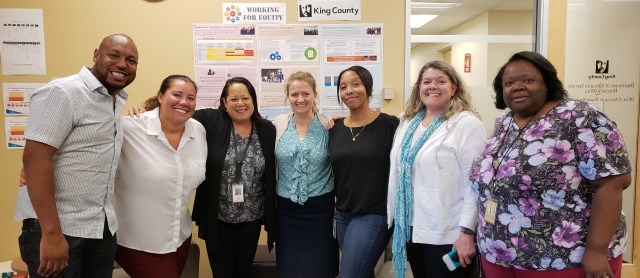
Pictured: Left to right are Robert James, Jennifer Irwin, Shawn Abernethy, Christina Davidson, Miesha Vaughn, Sandy Treibel and Cecelia Hayes.
From the team, Supported Employment Program Manager Christina Davidson, Senior Human Resources Analyst Robert James and Claims Investigator, Miesha Vaughn have taken the lead on these three goals. Christina and Miesha created several focus groups to engage employees in classifications that have limited access to training due to alternative work schedules, all day fieldwork or continuous customer-facing positions. A second group, led by Miesha, evaluated the effectiveness of mentorship programs as an avenue to work towards career goals. The third group, led by Robert, worked with DES human resources staff and individuals from the Human Resources Division to help visualize workforce demographics, recruitment data, and identify disparities in diverse hires.
Why is it important to focus on workforce equity? Miesha answered this by saying, “Everyone should have equal access to learning and development. We have a lot of untapped talent out there and people deserve the opportunity to develop it.” Three members of the focus group committee also answered this question. Jeff Steuby, Lead Transit Custodian, said, “It’s important to be a voice for front-line employees, and give them permission to be proactive about their careers.”
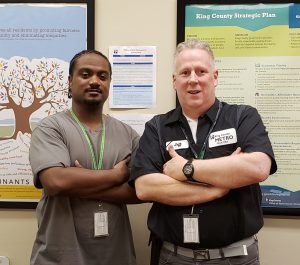
Pictured: From left to right are Saybre Locke and Jeff Steuby.
Saybre Locke, Custodian for the Facilities and Management Division, added, “By telling our own stories at the focus groups, we created a ‘safe space’ for employees to engage in honest dialogue.”
Michael Rheubottom, Rail Station Custodian, continued, “We were in the field talking to real people. What surprised me was that the different positions and trades didn’t matter, we were all experiencing the same issues.”
Caroline Whalen, Director of the Department of Executive Services, reflects on her team’s work by saying, “I’ve learned a lot from reading Stephen Covey’s books on management and leadership and he said, ‘Strength lies in differences, not in similarities.’ King County’s goal to have county management reflect our community demographics aligns with this management principle.”
“DES has a remarkable Workforce team helping us to reach this goal, she continued. “I appreciate their approach that began by listening to employees who have jobs in the lower salary ranges to get their ideas and creating development plans that help those employees achieve their career goals.”
With about half of these projects completed, Miesha and Christina plan on publishing their focus group findings in the next few weeks, while the mentorship pilot that ended in July will have participant data analyzed for relevant information and themes. Similarly, Robert’s group is still collecting data, and he will see what can be done with it to help different groups advance into management positions.
The positive feedback and reception of this group’s work re-enforces the importance of King County’s Equity and Social Justice Strategic Plan. Providing employees with equitable work groups and a supportive environment is necessary for career development. This workgroup will continue its work through 2022.
Share this:

Pet of the Week: Lila Rose

Crossposted from Tails from RASKC
Lila Rose is a 3 ½ year-old, black, longhair female cat (#A555163). This beautiful girl is an affectionate love bug once she warms up to you. She loves hanging out with her favorite people, and once she get comfortable she can talk up a storm! Lila Rose’s personality color is RED, meaning she is a spirited and fun-loving girl who likes to get attention on her own terms. She can get a bit overstimulated with petting, so it’s best to keep an eye out for signs she may need a break. This sweet girl may take some time to get comfortable in her surroundings, so she would probably do best in a low-traffic home without young kids. Lila Rose is litter box trained, spayed, current on vaccinations and microchipped. Her $30 adoption fee also includes a free visit to the veterinarian of your choice, and 30 days of opt-in pet insurance through Trupanion.
Share this:

Training Spotlight: Introduction to Organizational Performance Measurement

If you have a desire to improve your skills and knowledge of organizational performance measurement, this course is for you. This introductory course is for participants who want to gain a practical understanding of organizational performance measurement. No prerequisites are required. Participants should come curious, ready to engage in exercises, and experiment with new concepts and ideas. Learn more and register on Eventbrite.
Visit www.kingcounty.gov/learning to learn more about trainings and other opportunities to invest in YOU!
Share this:

Green space for all: King County moves to speed up open space investments and improve access

Crossposted from Keeping King County Green
Across the street from a grassy private lot fenced off with razor wire, kids play tag in a gray concrete Tukwila parking lot, sometimes dodging honking cars and making the apartment manager nervous about his liability. The closest park playground is a hot 20-minute summer walk from the apartment building along busy arterials.


These kids are among a half million King County residents without easy access to green space, parks or trails (within a 10-minute walk). It’s a stunning truth in a county renowned for its astounding outdoor possibilities – the Cascade Mountains, lush forestlands, fertile farmlands, salmon-bearing streams and rivers, a world-class trail system, lakes both large and small, and the iconic Puget Sound.
The City of Tukwila would like to purchase the vacant lot – easily distinguished within the low-income neighborhood because it has mature trees and green grass – and turn it into a community park. But, with other priorities in a financially-strapped local government, Tukwila hasn’t had the matching money it needs to qualify for King County’s open space funding program – funding that could make a park happen.
Giving more kids, and more King County residents, the ability to experience the health and quality of life benefits of green space is why the King County Council overwhelmingly approved legislation aimed at conserving the last, best places in King County, and making sure every community has easy access to green space.
The legislation bolsters a new Land Conservation Initiative launched earlier this year, designed to improve access to green spaces in underserved communities and preserve 65,000 acres of remaining vital and at-risk farmlands, forestlands, river corridors, open space lands and trail corridors throughout King County within a generation (30 years).
The Initiative is the culmination of two years of work between the County and multiple partners, including 39 cities within King County and conservation partners such as: The Mountains to Sound Greenway Trust, The Trust for Public Land, Forterra, The Wilderness Society, and The Nature Conservancy.
Proposed in May by King County Executive Dow Constantine, the legislation does not increase property taxes, but instead enables the County to borrow more against future revenues from an existing funding stream – as much as $148 million over the next four years – to accelerate protection of open and green space.
What’s more, the ordinance removes the financial match requirements for acquiring new open space in communities where open space investments have been lacking, and which have missed out on the health, quality of life, economic and environmental benefits associated with nearby green spaces.
“Many communities have experienced – and still experience – a history of unequal and limited investment in parks, open space and trail access, which limits the ability of people to lead healthy lives,” said De’Sean Quinn, Tukwila City Councilmember and co-chair of King County’s Open Space Equity Cabinet. “The local match requirement has been a barrier for cash-strapped communities to access CFT funds to make open space investments. Removing the match means these communities can now seek CFT funds for green space investments in neighborhoods with the greatest needs.”
It can’t come too soon for those kids playing tag in Tukwila, and some 500,000 other King County residents.
- Land Conservation Initiative website






 Employee News