
Her passion now: Preparing nurses to build resilience in our community

Crossposted from Public Health Insider
This article was originally posted on campaignforaction.org.
As the chief nursing officer at Public Health Seattle-King County, Washington, Dorene Hersh, MSN, RN, is responsible for clinical practice oversight for over 350 public health nurses employed in management, supervisory, advanced practice, field nursing, ambulatory care, and correctional health roles. She is a Robert Wood Johnson Foundation Public Health Nurse Leader and Culture of Health Breakthrough Leader in Nursing.
Why did you decide to become a nurse?
I became a nurse by accident, literally. In the summer of my junior year of high school, I was working at a restaurant. There was a large roast beef-carving stand and I was slicing meat for customers. The knife slipped, and a customer said, “You should get that taken care of.” I looked down and saw that I had cut myself quite deeply. While in the emergency department, I admired the way the nurses cared for the patients, triaging and balancing the needs of everyone present, including the providers. This experience inspired me to pursue nursing.
I also grew up in a very small town in Michigan and wanted to travel. The flexibility of nursing would allow me to attain employment no matter where I decided to live.
Can you describe your philosophical evolution from making that decision to where you are today?
Nursing is probably the only field where you can have a “do over” any time you desire. Though my graduate degree was as a pediatric nurse practitioner, I never worked a day as a PNP after discovering great gratification working in public health care.
I began as a bedside nurse in a neonatal intensive care unit. Since my original degree was a diploma RN, I pursued my bachelor’s degree while working full time—12-hour nights. After I graduated with my BSN, I began working per diem in home care, caring for the graduated preemies from the hospital. I eventually moved into home care full time, moving into leadership positions until I became a chief of nursing for a pediatric center for medically fragile children.
I had moved from Michigan, to New York, to California, then to Washington State, where I currently reside. My graduate degree was as a pediatric nurse practitioner (PNP). I had cared for medically fragile children for the first 20 years of my career, working with populations that were impacted by social determinants of health (although it wasn’t called that at the time). I had realized that caring for well children didn’t hold the same degree of satisfaction as I had previously enjoyed.
I graduated, passed my boards, and entered the field of public health leadership, where I could put my passion into upstream strategies to change the trajectory of health.
Of all that you have accomplished, what are you most proud of?
I am proud of all that I have accomplished. Each milestone seems the most important at the time.
I cherish my time as a Robert Wood Johnson Foundation Public Health Nurse Leader. The training, coaching, and support has exponentially moved me forward onto state and national stages, which I never thought would have been possible before that experience.
As of July 1, my team was awarded a multimillion dollar [Health Resources and Services Administration] HRSA grant that will train future generations of ambulatory care nurses to care for medically underserved populations. The funds will support training nurses in our unique clinical experiences, including primary care, mobile medical vans, Refugee Screening—a nurse-run clinic that serves all newly arrived refugees providing culturally sensitive care for those who might have been through trauma—and Buprenorphine Pathway clinics to prepare nurses in the delivery of trauma-informed care. All of this is part of preparing nurses to build resilience in our community—that is my new passion.
If you could change the profession in any one way, what would you change and why?
Excellent question! If I had a magic wand, I would establish parity in nursing practice across our nation. We as a country are missing a great opportunity utilizing nurse practitioners to the fullest extent of their licensure. This is an important strategy in providing care in underserved areas. The nursing and provider shortages are growing as the Baby Boomers age. I think this strategy is attainable.
What is the most important action that nurses can take to lead the way to improve health and health care in America?
If each nurse found one thing in their community, where they work, where they worship or where they play, to model for others, it would be a great start.
I work with inspiring, talented, and dedicated nurses who make a difference every single day. Not only at work, but after hours, dedicating their time to running for office, raising money for charities, participating in marches, volunteering for community clinics, the list goes on. If we could engage every nurse across our nation to do one thing, think the impact would be great. A ripple in the pool of health in America.
Nurses are the largest sector of the health care workforce and the most trusted profession. We are essential to improving health and achieving health equity. Solving the health care crisis will be a multifaceted approach, with no one answer.
What role do you see for yourself in building a healthier America?
In Washington State, our Action Coalition is working on this very thing. We have three goals:
- We are striving to create meaningful leadership opportunities for nurses, with a key focus on statewide efforts to advance health equity and population health.
- We are educating nurses in various practice settings on the impact of the social determinants of health through a variety of strategies.
- We are striving to transform nursing practice by incorporating social determinants of health into plans of nursing care in all care settings.
We are fortunate to have three statewide initiatives to leverage in achieving our goals, Healthier Washington, which is our state health improvement plan; Action Now!, which is a group of nursing leadership across the state joining together to address the nursing shortage; and the American Hospital Association’s 123forEquity Campaign to eliminate health care disparities.
Volunteering my time and effort to co-lead our Action Coalition has been very rewarding by mentoring the next generation of nurse leaders, and by engaging nurses to help move the needle to improve the health of our communities.
Share this:

Stop Noxious Weeds, by Land and by Seeds!

Crossposted from Noxious Weeds Blog

Many noxious weed seeds stick onto boots, pant legs, car tires, and other objects to spread to new sites. Don’t let them use you—brush them off!
Noxious weeds are sneaky. Each one has its trick for taking over: many spread by seed, while others use stem and root fragments, underground rhizomes, or aboveground runners. Anytime you’re out around a noxious weed, make sure you know how it reproduces, and don’t let it use you to invade!
One of the main methods of weed dispersal is via seeds and other propagules that latch onto boots, pant legs, pet fur, tires, and other moving objects. Some, like the infamous garlic mustard (Alliaria petiolata), are really hard to see once they’re mixed in with mud and dirt. When you’re working around these plants, always use a boot brush to clean seeds and soil off of you, your pet, and your friends before leaving the site.


When it comes to many weeds that spread by stem and root fragments (and those going to seed), don’t toss them in your backyard compost pile. They can re-root and grow right out of it. Instead, put them in your city-provided yard waste bin or in the trash, depending on the species. For disposal tips and other information on a specific noxious weed, visit our website.
Many of King County’s noxious weeds are going to seed right now, so it’s crunch time to control them. Good luck out there—drink water, wear sunscreen, and don’t forget to brush your boots!
Share this:

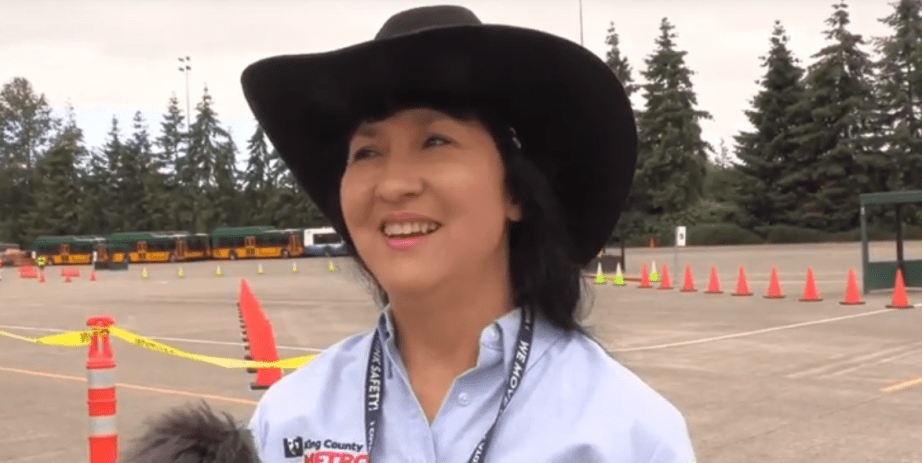
Meet Tammy Klein, 7-time champion of the ‘Metroadeo’
Crossposted from Metro Matters
By Scott Gutierrez
Ask Tammy Klein what she enjoys most about her job at King County Metro and she lists three things: her customers, her coworkers, and getting to drive a bus.
This veteran driver can sure handle a 40-foot coach. She’s a seven-time champion of the “Metroadeo,” the annual transit Olympics for some of Metro’s most skilled drivers.
Klein is the first and only woman to win the competition, and in June, claimed her third consecutive title in three years. She will represent Metro at the Washington State Public Transportation Roadeo on August 19 in Kennewick, and then at the International Bus Roadeo next year in Lexington, Kentucky.
“Participating in the roadeo does make you a better-focused driver,” said Klein, a 23-year veteran who drives a variety of routes every week as a board operator out of Metro’s Ryerson Base in Sodo. “It is about safety and (avoiding) collisions and pedestrian accidents. It’s very rewarding. I think it’s something that every new driver should consider. “

There were 37 competitors in this year’s event at Metro’s training yard in Tukwila. It consists of 11 obstacles testing drivers’ abilities to maneuver the bus forward, backward and around tight turns, as well as precision braking, judging distance and how evenly they can pull up to the bus stop. Drivers have seven minutes to complete the obstacles while trying to avoid hitting any of 150 red traffic cones set up throughout the course.
“The hardest part is just getting over the nerves because it is your one shot you’ve worked all year for,” Klein said. “You do have to practice.”
There also is a inspection test in which drivers have to find a variety of operational defects on the bus within 8 minutes. Usually that includes one “security issue,” such as a suspicious package hidden from view.
Klein didn’t hit any cones during the driving test and scored a total of 682 points out of 700. The second-place score was 612 points.
Klein now has her sights on the state competition, where Metro will be one of 20 agencies participating from Washington and Oregon. And she’s looking forward to another chance at beating her personal best of 8th place at the International Bus Roadeo in 2019.
Share this:

Map literacy and the 2016 presidential election
Crossposted from GIS & You
Here’s some food for thought about elections-related maps, how they can be used and abused and what they can teach us about effective and valid cartographic design.
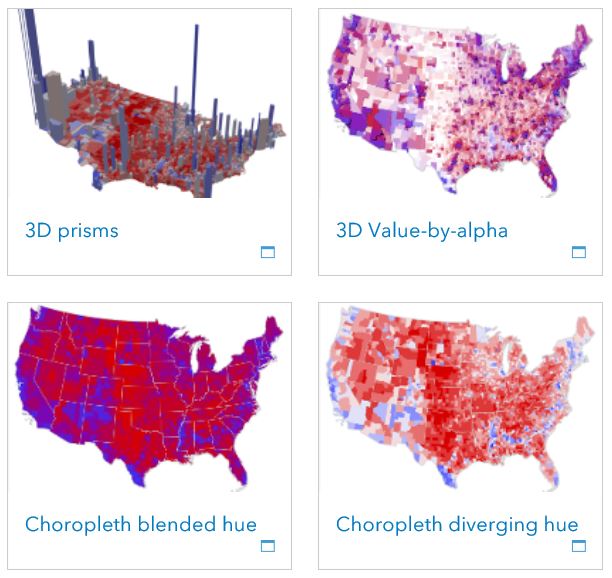
Among the fundamental skills required to be map literate, that is, to be able to read and comprehend maps, are an understanding of scale, the recognition of spatial orientation (north-south-east-west, up-down, etc.), and an appreciation of map projections (by which a three-dimensional surface is represented in two dimensions). A higher-level, overarching principle of map literacy is that a single map can seldom tell a whole story, which is a point well made by Dr. Kenneth Field, Esri senior cartographic product engineer, in a recent article in Wired.
In “Is the US Leaning Red or Blue? It All Depends on Your Map,” Field discusses a number of dramatically different maps that display voting data from the 2016 United States presidential election. Field avoids branding certain maps right or wrong (assuming the data in the maps are valid). Instead he explains how certain types of maps can emphasize a particular story, or how they can obscure or reveal specific aspects of the data they portray.
Understanding how maps can do these things is a necessary skill in being able to judge the validity of particular maps. A collection of various maps of the 2016 election could function as a wonderful laboratory for learning and exercising map literacy. As noted in the Wired article, Dr. Field has provided just such a learning laboratory with his interactive map gallery, “Thematic maps of the 2016 Presidential election (lower 48 states).” Perusing 32 different maps of the election results and their explanations should help anyone better understand any one map of election results, past or future.
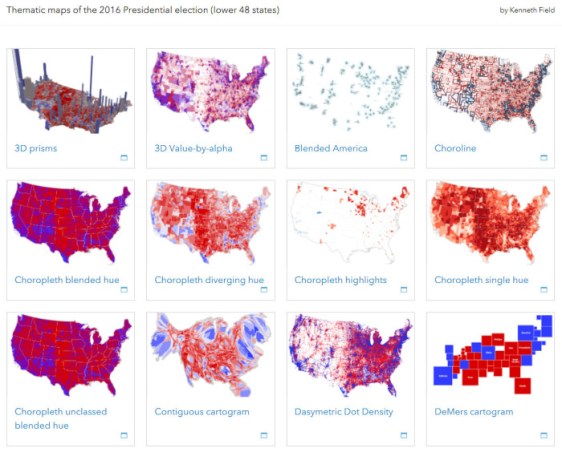
Some of the maps in the gallery “Thematic maps of the 2016 Presidential election (lower 48 states)” by Kenneth Field.
Dr. Field goes by the Esri username “cartogeek,” but he also blogs under his own “cartonerd” label. On the same day the Wired article was published, Field drilled down in his blog on yet another 2016 election map which appeared recently in the New York Times. The result is a highly acerbic and instructive case study in map literacy. We would all do well to use examples like these, and the insights of professional cartographers like Kenneth Field, to heighten our awareness of how maps can represent, and misrepresent, data. When it comes to elections data, that can’t help but make us more informed and better citizens.
Patrick Jankanish is Senior Cartographer in the King County GIS Center and is a member of its Client Services group.
Share this:

Featured Job: Public Health Nurse – Immunization PHN

Closing: 08/24/18 5:00 PM
Salary: $33.61 – $45.92 Hourly; $69,908.80 – $95,513.60 Annually
Location: Chinook Building, Seattle
Job Type: Special Duty Assignment or Term-Limited Temporary
Department: Public Health – Seattle and King County
Job Number: 2018-08434
This position works in close collaboration with members of the Healthcare for the Homeless Program, Emergency Preparedness Program, and other members of the CD-Imms Program. Major areas of responsibility include coordinating and leading community vaccination clinics, supervising Medical Reserve Corps volunteers, providing technical assistance regarding recommendations for vaccine administration to health care providers and the public, representing PHSKC at internal and external meetings and events, and participating in the Section’s response during vaccine preventable disease outbreaks. While this position is based in the Chinook Building in Downtown Seattle, the incumbent will oversee vaccination clinics in non-traditional settings such as homeless villages and shelters throughout King County. The position reports to the Immunization Program Manager in the Communicable Disease Epidemiology & Immunization Section of the Prevention Division.
For more information, contact Nursing Talent Acquisition Specialist Amy Curtis at 206-263-8358 or Amy.Curtis@KingCounty.gov.
Learn more about this position or all available jobs.
Share this:

Social Media Spotlight: GIS & You on WordPress

GIS & You is introducing a new monthly contest called “Where in King County?”
Each month, GIS & You will present a portion of a map either published on the King County website or produced from a King County GIS web mapping application. Each contest will also spotlight some of the features available from the web-mapping applications and some cartographic concepts that can help make you a more effective map user.
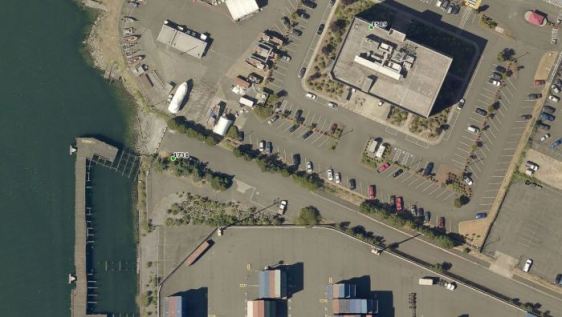
How does the contest work? Simply study the map presented and perhaps find other clues in the text. You may have to do some detective work to solve the question. Then answer the question in the comments section of the post on the GIS & You blog. The first correct answer received wins.
The winning answer to the first challenge was Jack Perry Park; congratulations to Kristina!
Follow GIS & You on WordPress today.
Share this:

Pet of the Week: Slinky
Crossposted from Tails from RASKC
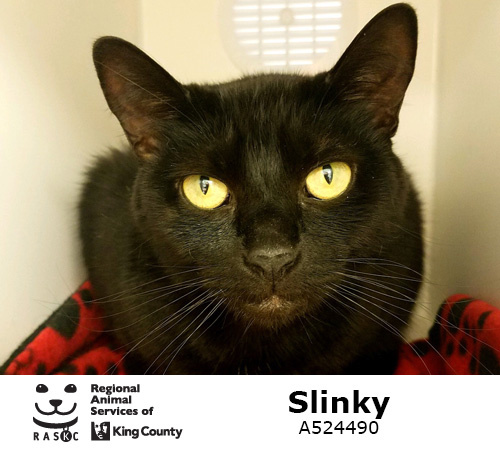
She’s fun for a girl or a boy – she’s Slinky, our Pet of the Week!
This young black cat is spirited, with a fun-loving personality – so she’s one of our “Rambunctious Red” personalities. Slinky is friendly and, though she’s shy, she can be vocal! Slinky can get a little overstimulated with petting, but she is affectionate and loves getting attention. Because of her shy nature and sensitivity to handling, a quiet, low-traffic home with a cat-savvy family would be ideal. Slinky would thrive as the only pet in her new home.
She has been diagnosed with an inflammatory condition that is currently being managed. The staff and volunteers at RASKC will be happy to answer any questions when you come to visit her. Slinky is litter box trained, spayed, current on vaccinations, and microchipped. Her adoption fee includes a certificate for a free veterinary exam and the option of 30 days of free pet insurance through Trupanion.
You can learn more about Slinky on our website, kingcounty.gov/AdoptAPet, or visit her at the Pet Adoption Center in Kent.
Share this:

Movies@Marymoor adds ‘The Lion King’ to summer movie schedule, Aug. 15

The BECU Outdoor Movies@Marymoor has made a change to their 2018 movie schedule. The Aug. 15 planned screening of Ferdinand has been replaced by Disney favorite The Lion King. The rest of the schedule remains the same with all events offering entertainment, trivia, food trucks and vendors.

All events are “bring your own seating,” dog friendly and smoke free. Admission is $5 per person cash or $6 credit, with kids age 5 and under free. Seating opens at 6:30 p.m., and movies begin at dusk. Parking is $5 per vehicle.
For more information, visit the DNRP Newsroom or facebook.com/moviesatmarymoor.
Share this:

KCIT testing Cherwell IT service management tool


Last month, we announced KCIT’s project in KCIT Help Desk to transition from email tickets to online portal.
They are now finishing the portal design, have completed revising the Service Catalog, and are mapping the new portal to Cherwell.
Administrator and analyst training will begin this month, and sessions to determine if the new design resonates with end users are in the works.
Specific launch details will be shared here as they become available. Departmental IT staff can email Amy Hitchcock with questions.
Share this:

Training Spotlight: Basic Data Visualization
 Basic Data Visualization: Our ability to gather and collect data has steadily increased over the past decade. But data alone is not information and does not easily convey a compelling story. This half-day introductory course will allow participants to:
- Understand why data visualization is important
- Explore ways to tell a story with data
- Mock up data visualizations in whiteboard exercises, using tips explored in class
Participants have the option of bringing their own measures to the training to review in small teams. Examples throughout the class will focus on performance measurement, although the data visualization tips are more broadly applicable.
What this training is NOT:
- A technical training on building visualizations in Excel, Tableau, Power BI, or Oracle BI Insights
- An advanced business Intelligence or dashboard tools training
- A training on how to build a tier board or round at a tier board
- An infographics training
The training takes place Tuesday, Aug. 14, 8:30 a.m. to noon at the King County Administration Building. Click on the above link to learn more and register before the sessions fill up, and visit Learning and Development on KingCounty.gov to learn more about trainings and other opportunities to invest in YOU!






 Employee News