Community Owned Data series

Crossposted from Best Starts for Kids

During the month of June, we will be running a “community owned data” blog series. This is our kick off post! Every other year, Best Starts collects community data that helps guide our funding strategies. To ensure that we are truly partnering with communities and sharing data ownership, Best Starts partnered with specific communities to have conversations about the data and help us understand it. We learned a lot from this process and want to share our learnings with our larger community here. 

Best Starts for Kids Approach to Data

To measure impact and ensure accountability for public funds, Best Starts for Kids allocates 5 percent of all levy money towards data and evaluation.  All Best Starts strategies strive to answer the question, “Is anyone better off?”

Best Starts’ data efforts are guided by three principles:

  • Accessibility
  • Partnerships
  • Collaboration

Accessibility

Best Starts for Kids inspires innovation and actively contributes to an evidence base that will equip King County and its partners to improve equity in outcomes for King County residents. In 2017, Best Starts made data available on the Best Starts website. The 45 data indicators help to answer the question of “is anyone better off” by assessing the well-being of children, youth, families and communities throughout King County with interactive maps, graphs, and trends. This is the portion of the website that we encourage funding applicants to draw upon when developing their Best Starts funding applications.

Making the data available is only one part of achieving accessibility. We must also help people find the data and ask for feedback so that we know the data makes sense to others.

Partnerships

Best Starts for Kids values multiple kinds of data so applicants are strongly encouraged to draw upon not only quantitative data but also share qualitative stories to demonstrate how they propose to affect change. Data collection is a partnership between Best Starts staff and partners to show results.

The Best Starts for Kids Health Survey is the product of many partners contributing. Initially conducted between September 2016 and January 2017, the survey provides baseline data and informs Best Starts activities. The survey produced valuable new information, including data on diverse communities rarely represented in data collection.

The groundbreaking new methods we used in the Best Starts Health Survey lead the nation in ensuring our data reflects the strengths and needs of all King County kids and families. A nation-wide panel of epidemiologists selected the Best Starts for Kids Health Survey for the Robert Wood Johnson Foundation (RWJF) National Award for Outstanding Epidemiology Practice in Addressing Racial and Ethnic Disparities.

However, as the Best Starts data team began analyzing the data, we knew that we needed to develop feedback loops with the communities the data represented in order to be truly equitable in our process.

Collaboration & Communal Learning

A shout out to Fakequity as this blog post on weaponizing data came out right around the time we were thinking of how best to analyze and share our Best Starts for Kids Health Survey data. As government, we knew we had to be proactive to avoid unintentionally using data to harm communities. We also heard this message clearly from members of the Best Starts Children, Youth, and Advisory Board. And so our series of “Data Dives” were born.

39097784660_9d21766e42_o

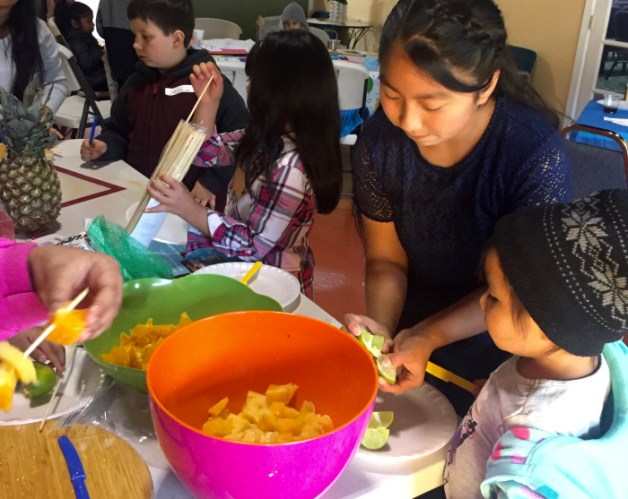
Data Dive participants of all ages contributing.

Alongside community partners including Community Café CollaborativeUnited Indians of All Tribes FoundationOpen Doors for Multicultural Families, and local grassroots leaders, Best Starts hosted a series of participatory community meetings, coined “Data Dives,” to facilitate joint learning and interpretation with specific cultural and linguistic communities. These collaborative meetings took place between November 2017-April 2018 and built trust, relationships, and shared ownership of the findings. The specific communities included: Latino/a, Black/African-American, Somali, Vietnamese, Chinese, Samoan, American Indian/Alaska Native, and Lesbian, Gay, Bisexual, Transgender, Queer/ Questioning, and Two Spirit families.

In spaces tailored for specific languages and food preferences, participants “dove into data,” sharing unique community perspectives on Best Starts data. Parents and caregivers asked questions about the data, discussed how it related to their lived experiences, and shared their viewpoint on survey results. Children of all ages were welcomed and led through a separate play-based discussion.

Children participating in a Data Dive

Children participating in a Data Dive.

The King County Equity and Social Justice Fund provided a $7,500 grant to partially fund the Data Dives. The overarching themes we heard reaffirmed Best Starts strategies and will inform continued implementation.

Takeaways

We are so grateful for all the participants who contributed to our Data Dives. We will be sharing what we learned over the next few weeks and want to continue learning with you all. Data Dive participants requested that the two-way dialogue continue, and we are excited to continue learning together. You can expect us to cover the following topics over the next few weeks:

  • Methodology we used to help interpret the data
  • What specific communities said about the data
  • Feedback on messages and words used

Stay tuned!

Parks crew’s Lean pilot drives tangible results

In Lean thinking, “Going to Gemba” refers to the process of going where the actual work happens to observe and learn from those doing the work, and that’s exactly what three members of Executive Constantine’s Senior Leadership Team recently did at Marymoor Park in Redmond.

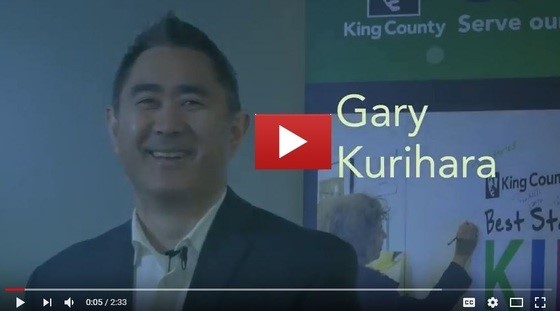
Chief Performance Officer Gary Kurihara, Chief People Officer Whitney Abrams and Chief Operating Officer Casey Sixkiller met with employees from King County Parks’ North Utility Trail Crew in their maintenance shop to learn more about their pilot of a Lean Daily Management System.

LEAN (1 of 23)

Members of Executive Constantine’s Senior Leadership Team meet with employees from King County Parks’ North Utility Trail Crew.

“We went with the purpose to learn about how their Daily Management pilot was working and how they have applied Lean in making improvements,” Kurihara said. “Within their Daily Management pilot they share how they have applied process and improvement measure in a visual management system to engage the team in daily huddles to review performance, communicate issues, share feedback and plan for the day.”

The North Utility Trail Crew maintains regional trails north of Interstate 90, also working on projects like fencing, playground installations, fabrication work and small equipment repair. They began piloting a Daily Management System in April to plan and manage their workdays, communicate to address problems and track their progress.

The North Utility Trail Crew has been an early adopter of Lean at Parks and has helped used it to not only identify process efficiencies but to build a better workplace.

“It’s been a process of learning and trying, learning something about Lean, sharing it with my crew, and trying it out,” Mabry said. “We have found some efficiencies and saved some money, just by trying it out.”

LEAN (2 of 23)

Chief Performance Officer Gary Kurihara with employees from King County Parks’ North Utility Trail Crew discussing their pilot of a Lean Daily Management System.

Mabry also said that they had been able to establish a healthier work culture by “getting together, communicating what our standards will be, all of us agreeing on it, and moving ahead.”

The North Utility Trail Crew is a prime example of how Lean can drive tangible performance results by creating powerful employee engagement through the application of lean principles and tools within a system of work.

“It was inspiring to see the excitement and ownership of the individual team members,” Kurihara said. “It didn’t matter whether it was their most tenured team member or a summer temp. Their humility, team orientation, and community focus show me they were learning and applying ‘real’ Lean to their work.”

It’s also a model for how Lean can be effectively leveraged at Parks.

“They’re a model district for us, implementing Lean tools, communicating regularly and addressing problems in a collaborative effort, and they all participate in the improvements around their shop and on their trails,” Andy Boland, Continuous Improvement Supervisor with Parks, said. “I really wish you could bottle that culture up and pass it around because everyone acknowledges one another, supports one another, and they take learning and growth really seriously there.”

Superior Court block party to celebrate Juneteenth Tuesday, June 19

King Cty Super Crt Juneteenth 2018 Flyer.jpgIn case you missed it, King County Superior Court is observing Juneteenth by hosting a Juneteenth – A Day of Remembrance block party celebration Tuesday, June 19 from 11:30 a.m. to 2 p.m.

From its Galveston, Texas origin in 1865, Juneteenth today commemorates African-American freedom and emphasizes education and achievement. It is the oldest nationally celebrated commemoration of the ending of slavery in the United States.

The event is free and open to the King County work community. Join the Superior Court for exhibits, live entertainment and food on Spruce Street between 12th and 14th Avenues!

Cine en el Parque outreach opportunities

The Department of Natural Resources and Parks invites King County departments and agencies to participate in the County’s Cine en el Parque Movie at the Park event Saturday, Aug. 4 at Dick Thurnau Memorial Park in White Center.

Cine_El_Parque_Poster_2018 800sizedCine en el Parque, featuring the screening of Coco in Spanish with English subtitles, is a terrific summertime outreach opportunity for County teams to reach our Latino community and connect residents with programs and agencies. Departments and agencies are invited to participate and promote their community programs and services, particularly if you have materials or campaigns designed to engage King County’s Spanish-language residents.

This is the fourth year DNRP is hosting Cine en el Parque.

Signing up for an outreach table at the event includes:

  • Arriving on site by 5:30 p.m.
  • Having one or two volunteers (proficieny in Spanish is preferred) to work the table from 6:30 p.m. until the movie begins at dusk (9 p.m.).
  • Bringing a 10×10 tent, if desired.

If you wish, stay and watch the movie with your family and friends!

Cine en el Parque attendeesDuring the two hours prior to showtime, you will have the opportunity to reach movie goers and share information about your great King County programs and services – and you are more than welcome to stay and watch the movie with your family and friends!

To sign up, contact DNRP Online Public Engagement Specialist Marie Tweedy at 206-477-3717 or Marie.Tweedy@KingCounty.gov. Please share this with appropriate outreach staff in your department.

Metro managers who #RideTransit: Diane Carlson

Shared from Employee Transportation Program

In observance of Ride Transit Month, the Employee Transportation Program is chatting with four Metro managers about their transit commutes, and sharing any advice they’d like to pass along to new riders.

First up is Diane Carlson, who became Metro’s Director of Capital Projects in February. Carlson lives along the SR-520 corridor, about three quarters of a mile from the Yarrow Point freeway bus stop.

“I’m lucky,” says Carlson. “I can get on any bus. I can catch a bus to the train at the University of Washington, or I’ll ride any bus that’s coming from the Eastside through downtown Seattle.”

Carlson adds that, with traffic problems increasing for buses on SR-520, on I-5, and downtown, she finds the bus-train connection at the UW to be more consistent than an all-bus trip.

Asked how she decides which option to take on a given day, she says she takes the first one that comes by after she gets to the bus stop, “Unless the traffic looks really bad. Then I’ll wait for a bus that’s going to the UW.”

What does Carlson like most about her transit commute? “I like the walk to the bus, and then I like being able to get work done,” she said. “Or, if I’m really lucky, I get to read something for fun!”

Her best advice for new riders is to use an app that provides real-time arrival information, adding, “I use One Bus Away all the time.”

June is Ride Transit Month ride and win.pngYou can enter to win prizes all month long if you do any combination of the following:

To learn more about all your employee transportation benefits, visit the Employee Transportation Program website and watch ETP’s video.

Michael Jacobson receives national Excellence in Government Leadership Award

Michael Jacobson, Deputy Director of Performance, Strategy and Budget, has been recognized by the Association of Government Accountants with their 2018 Excellence in Government Leadership Award. This nationally recognized award is given to professionals who exemplify and promote excellence in government financial management, outstanding leadership, and innovative management procedures. It recognizes the cumulative achievements of state or local government professionals who have served as a role model and consistently exhibited the highest personal and professional standards.

“This award represents cumulative career achievements, all of which were available to me due to the strong support of county leadership to pursue innovation and excellence in our organizational performance management work,” said Jacobson. “I have also been encouraged to assist other organizations, which allows us to be seen as leaders, which – in turn – brings awareness to the county and our efforts to be the Best Run Government.”

During Jacobson’s tenure at King County, he has led the development of key elements of the County’s award winning performance management system, including King County’s first countywide strategic plan, public performance reporting, Executive performance review sessions (KingStat), and employee and community surveys.

MJ award (002) cropped

Michael Jacobson and members of the Performance, Strategy and Budget team. Pictured from left to right: Tricia Davis, Van Badzik, Sondra McCaw, Vince Vu, Michael Jacobson, Dan Farmer, Jeannie Macnab and Abby Beatty.

Each year since 1990, the AGA has recognized individuals through its national leadership awards. AGA CEO Ann Ebberts said the honorees exemplify the role-model behavior and servant leadership that defines excellence. “We are proud to recognize the government-wide impact of their work, their focus on supporting the development of others, and most importantly, their commitment to improving mission and service delivery to citizens,” said Ebberts.

For more information about Michael Jacobson and his team’s work, visit the Performance & Strategy website.

Tech Tip: Leveraging Skype for Business at King County

Skype for Business

Over the past year, KCIT and Employee News have shared a range of great Skype for Business articles.

Here’s a rollup, in case you missed any!

Tech Tip: Skype for Business: How to Skype with external customersThe Skype for Business (Lync/UC) account on your computer is a simple and effective way to have meaningful (remote) meetings with clients, partners and customers even if your client, partner or customer doesn’t have a Skype for Business account.

Tech Tip: Skype Bite – How to Use Instant MessagingWant to get in touch with someone fast? Skype for Business is perfect for that. Whether it’s an instant message, call, or a cute (work-related) emoji, Skype should be your first, fast option.

Tech Tip: Skype Bite: How to invite an external person to a Skype meetingMany of us do business with outside customers and need those outside customers to use the King County Lync/Skype for Business system. It’s easy for those customers to download the web app. Here’s how.

Tech Tip: Skype 4 Business: Ordering King County Skype phones, headsets or speakersGo shopping at the King County Skype store then contact your telecom rep and let them know what you want.

Tech Tip: Skype for Business (S4B): How to set up and add people to a groupS4B groups are like email groups – only better. With S4B, you can Instant Message, make a quick call, or set up skype meetings for the future – just to that group.

Tech Tip: Skype Bites: How to forward your phone using Skype for BusinessNo one can be at their desk 24/7/365. Skype for Business allows you to forward your calls to many places including your personal cell, an individual or an entire call group.

Tech Tip: Skype Bites: How to get Skype for Business into your Outlook and Calendar RibbonPeople say, “I can’t even get Skype on my computer! Your Skype bites are of no use to me!” Here’s how to do it in 30 seconds … well … 39 seconds.

Tech Tip: Skype Bite: Virtual meeting toolsSkype is a powerful tool. You can hold virtual meetings with anyone inside and outside King County providing they have Skype for Business.

Tech Tip: Create a Skype meetingThis one minute video shows you how to turn a regular meeting into a Skype meeting for guests unable to attend in person.

Tech Tip: Skype for Business: Switching handset to headsetDo you want to switch from your desk phone to a headset in the middle of a call? It’s no problem with Skype for Business!

Tech Tip: Skype for Business Desktop SharingStep-by-step directions on how to share your desktop with Skype for Business.

Stormwater mapping: A glimpse into the world of tracking where the rain goes
Crossposted from The Downstream Blog

Aeronautical engineers, consultants, graphic designers, and Geographic Information System (GIS) professionals formed an unlikely, but unstoppable, team at King County’s Water and Land Resources Division last year. The project team’s short-term goal was to map the stormwater drainage system within parts of unincorporated King County, an assignment that allowed them to test their field skills and environmental passion. To help accomplish this, a team was brought together as part of an ongoing effort to map stormwater drainage system that had not been inventoried, as required by King County’s Phase 1 Municipal Stormwater Permit. Team members were hired for their knowledge of stormwater management and GIS, as well as a love of the environment. Their diverse backgrounds helped them each bring different skills to this project.
“This was a great opportunity to get a foot in the door at King County,” said Anna Lucero, one of the first mappers hired onto the team.

A team of about a dozen people was hired to locate, map, and inspect stormwater structures along nearly 800 of the 1,400 miles of roadways in unincorporated King County. The team started their days dispersing across the county to map and inspect nearly 65,000 stormwater structures and mechanisms, including pipes, ditches, catch basins, manholes, and other drainage features. The team would verify that these structures were not full of debris, cracked, or otherwise deficient, allowing water to continue to move smoothly throughout the stormwater system and help reduce flooding. To give a sense of magnitude of the stormwater infrastructure within King County, King County Roads Division estimates there are more than 5,000,000 linear feet of ditches, more than 25,000 catch basins, and more than 2,000,000 linear feet of pipe.

“The data needed a lot of work,” said Joe Espinosa, the project lead. “(It) hadn’t been updated in more than 15 years.”

downstreamblog-post-1_-image-1

Mapper Chris Meder enters data into a tablet during a ditch and culvert inspection.

A day in the life of the temporary mappers would start with the team strategizing their game plan for the day and making computer updates to the mapping work from the previous days. They would review the updated maps, determine what areas still needed to be mapped or reviewed, and would venture out with a teammate in a truck, traveling to their designated area to spend the day.  “Having a partner in the field built great comradery among the team,” said Chris Meder.

Within their designated area, the mapping team would inspect each catch basin, measuring its dimensions, and assess if there were any large cracks or deficiencies in the structure. Using mirrors on sticks, they inspected the pipes coming in and out of each catch basin.

“I put a mirror down into a pipe one day and saw a skunk tail pointing at me,” said Jeff Tarshis. “Needless to say I wrapped up that inspection pretty quickly.”

Culverts were also a common stormwater conveyance structure that the team inspected. A culvert is a pipe or concrete box structure that drains to an open channel, swale, or ditch under a roadway or embankment. It is important that these culverts are not clogged with debris and do not have any breaks in the pipe or structure so water can move smoothly and quickly through the structure, therefore reducing flooding.

downstreamblog-post-1_image-2

Mapper Emily Davis encounters a kitten while inspecting a concrete pipe in unincorporated King County.

“One of my best field memories was when I inspected a culvert and saw two kittens in there,” said Emily Davis. “The kittens did not appear hurt but were quite playful and keen on diverting our attention.”

The team explored the widespread geographical areas of King County, the 13th largest county in the United States, which included summer field work on Vashon Island, winter trips to Enumclaw in the snow, and foggy fall trips to Duvall. Over the course of the short-term project the crew of 16 assessed nearly 27,000 stormwater structures and, of those, more than 5,000 structures were flagged for further investigation.

downstreamblog-post-1_image-3

An example of a catch basin that is plugged with sediment and needs cleaning.

One surprise on the job was how interesting stormwater is within our environment.

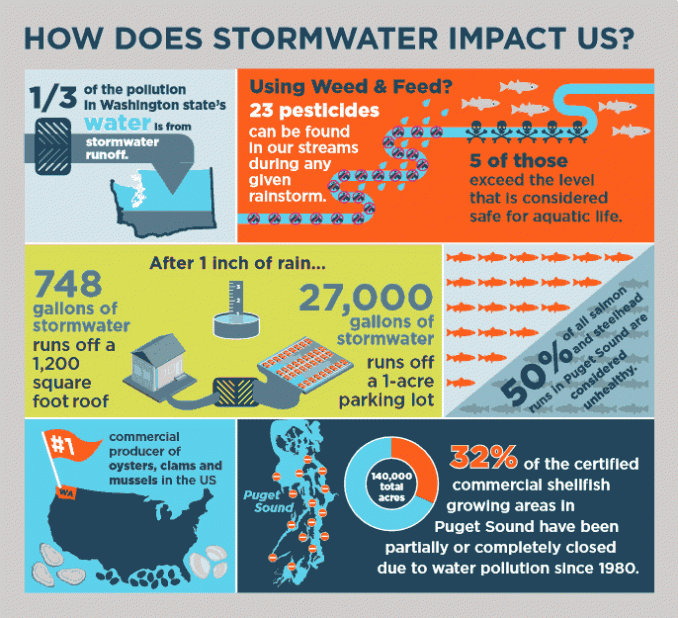
“I came into the job wanting to expand my GIS skills,” says Chris Meder. “I came out stoked about stormwater management.” This short-term project provided the team with a boots-on-the-ground understanding of how rainwater flows through our communities and how extensive the stormwater infrastructure is in King County. The field work provided the mappers with real-world experience in understanding how stormwater pollutes our local waterways — an invaluable lesson since stormwater is the predominant source of pollution threatening the health of Puget Sound.

Getting out of the office and having this field component was a draw for many on the team.

“I love field work,” said Emily Davis. “It was satisfying to go out and get a lot of work done, regardless of weather.” Physically, the project gave the team experience in dealing with challenges of weather because they were out in the field mapping each week, rain or shine.

“I learned to always wear rain pants when it is raining,” said Taylor Rulien, “because just wearing a rain jacket doesn’t always keep you dry in our rainy season.”

This job also helped the team field test their knowledge of water systems in the real world, which requires an engaging mind to appreciate and understand.

“My educational background in engineering and my inquisitive mind for water systems helped me in this job,” said Melissa Dahl.

downstreamblog-post-1_image-4

Mapper Andrea Wong inspecting a catch basin alongside a road.

In addition to field and GIS skills, the project also provided numerous non-technical skills, including how to work together in a team setting, transferring outdoor data collection into online data tools, and building community relation skills.

“The public was so supportive of this project,” said Anna Lucero. “Everyone was very understanding and interested to learn that the rain does not go into the same pipes as their sewage. Everyone cared.”

This stormwater mapping project helps King County save time and money by minimizing emergency responses and road or property damage. Mapping and inventorying these structures provides data to make better decisions on stormwater infrastructure investments for a county of more than two million residents. And, with more knowledge about where the stormwater runoff goes and how it gets there, we can continue to clean up our lakes, rivers, and streams by looking upstream at potential sources of pollution.

Many of the team members were uncertain about applying for the project’s positions because of the short-term nature, but they were all glad they did it.

“I knew it was risky going from a full time consulting job to this, but it was exciting to jump into the unknown,” said Emily Davis. “This short term position pushed us to learn more and not be sedentary in a career.”

“This is the first job I have ever been sad to leave,” said Kasim Salahuddin.

“This job has helped shape my future,” said Melissa Dahl. “King County gave all of us a great opportunity and we are so appreciative.”

Keep an eye out for future internships, short term jobs or sign up for alerts at Careers at King County.

downstreamblog-post-1_image-5

The stormwater mapping team (*permanent data support staff). Back row, from left: Nick Hetrick*, Matthew Goad*, Kasim Salahuddin, Emily Davis, Melissa Dahl, Mark Preszler*. Middle row, from left: Jeff Tarshis, Kyle Korbines, Taylor Rulien, Edward McFarlin*, Lusha Zhou*. Front row, from left: Chris Meder, Ana Lucero, Andrea Wong, Jeannie Pride*, Joe Espinosa*.

All Home: Count Us In 2018 Report

CountUsInInfographicCaptureThe 2018 Count Us In report found 12,112 people experiencing homelessness across the region on January 26, 2018, including 5,792 people sheltered in emergency shelters, safe havens and transitional housing and 6,320 people on the streets, in vehicles or staying in tents or encampments (both sanctioned and unsanctioned). The count includes a 15 percent increase in unsheltered people and a four percent increase overall, the smallest increases in homelessness in the region in the past four years.

The biggest improvement was a 31 percent reduction in veteran homelessness, the result of increased investments and strong collaboration across federal, state, county and local governments and local non-profit agencies.

“Count Us In was a community effort and reflects the manner in which we must address this growing crisis,” said Kira Zylstra, Acting Director of All Home. “Though the overall count increased, the pace is slowing and there is tremendous progress in reducing veteran homelessness. Now is the time to double down on our efforts to ensure the same progress for the 12,112 people without housing today and the thousands more who experience homeless over the course of the year.”

Read the News Release and the full 2018 report.

Winning – it’s what we do!

Crossposted from Election Connection

We’re proud to share that we recently won several awards, three for our voter access programs and two for videos we created last year.

naco-awards-transparentNACo awards-transparentFirst things first, we received three awards from the National Association of Counties (NACo) for the great way we’re improving voter access for residents here in King County. NACo’s annual Achievement Awards recognize programs that are innovative and enhance services for residents.

We won the 2018 Achievement Award from NACo in two different categories. We will be formally recognized for these awards at the 2018 Annual Conference held in July:

If that wasn’t amazing enough, the great videos we created last year also each won several awards.

pollie-award-logoEvery year the American Association of Political Consultants (AAPC) recognizes media that is outstanding within the field of political and public affairs. AAPC awarded our videos three 2018 Pollie Awards honors, receiving gold, silver and bronze.

  • The overall 2017 King County Elections campaign won the Gold Pollie Award in the category for Best Digital or Internet Campaign.
  • Our video, Your vote is your voice, also called “The Struggle” won the Silver Pollie Award in the category for Best Statewide/Local Public Affairs/Issue Advocacy Television Spot.
  • Our video, What would happen if everyone voted?, also called the “Multiplier Effect” won Bronze in the category for Best Statewide Public Affairs/Issue Advocacy Web Video.

reed-awards-finalistThese videos also won two Reed Awards from Campaign and Elections, an online magazine about political consulting. The Reed Awards were created to recognize the best campaigns of the political industry.

These awards were won in the categories for Best Use of Digital Advertising for the overall King County Elections campaign, and the Best Use of Voice-Over Talent in a TV Ad for the video What would happen if everyone voted?

all3

Pictured: From left to right, the Gold, Silver and Bronze Pollie Awards.