
Employee receives workplace support, creates amazing video project


Pictured: Paul Israel, Parks Specialist
Valuing King County employees means listening to their concerns and providing opportunities. When employees are interested in advancing their careers, it’s important to be attentive to their needs and together discover a way to address them. The Investing In YOU initiative helps identify the tools and support employees’ needs to innovate, achieve their career goals and ultimately do their best work.
One such employee is Paul Israel, a Parks Specialist with the Department of Natural Resources and Parks (DNRP). Working outside, Paul’s usual duties involve everything from playground installation and culvert replacement, to standard maintenance such as resurfacing regional trails and removing hazardous trees. Recently though, he proposed a video project to Kevin Brown, Parks’ Division Director, and received the full support and resources needed to get it done, creating four successful videos.
“These videos are a valuable source of information,” Paul said. “They present information in a simple, concise way.”
The videos cover topics including an introduction to King County Parks, mower maintenance, volunteering and marketing efforts. The videos will be used to educate employees about their role within Parks Division, as well as help educate the public on the impact Parks has on the overall community.
“We want to provide safe places for the public to recreate, and educate them on the services we provide,” said Paul. “Parks is full of talented employees who stretch taxpayer dollars and contribute to the larger goals we have here at King County, like improving equity and social justice practices and preserving the environment.”
Paul has been with the county full-time for three years. His work takes him all over the county addressing Parks’ needs, and allows him to feel challenged in a positive way. He recently held a Special Duty position as a Communications Specialist within the Wastewater Treatment Division (WTD), where he contributed to articles on the WTD blog and helped to document the restoration efforts at West Point Treatment Plant. After returning to Parks, the video project became an opportunity for Paul to further challenge himself, drawing from his experiences in the Special Duty role and utilizing his background in writing and photography.
“I like to call my job ‘construction in the woods’,” he said. “Every day is different. I’m always picking up new skills that are relevant to my job with the County, and also improve my life outside of work.”

Pictured: From left to right the Project Team: Bing Subelbia, Project Manager, Paul Israel and Andy Boland, Supervisor
“My education and background push me to solve problems through a communications lens,” he added. “Strong visual content can last for years, be emotionally impactful and serve purposes like training, recruitment, marketing, and motivation.”
As part of the DNRP goal to support employee growth, Bing Subelbia, a Project Manager for Parks, helped guide the project and support Paul by acting as a mentor. Bing oversees the business and programmatic needs of the Operations Section within Parks. Bing notes how well Paul managed everything from start to finish, from research and developing the video scripts, to overseeing production and polishing the finished product.
“Paul’s work on this project was impressive. It was easy to see his dedication in achieving an excellent end product.”
“This project was such a success, it has become the motivation for the creation of a training and resource library for audiences inside and outside of Parks,” said Bing. “Additionally, the resource library will help the division’s Lean efforts by providing employees with access to consistent and supplemental training that we hope will help staff in performing their jobs more easily and improving their work.”
The Division is already planning next steps for 2018. It is working on a communications plan to share these videos and also use multimedia to better engage employees and the general public. It also recognizes that developing employees, like Paul, and allowing them to realize their full potential greatly benefits both the county and the individual.
“I believe this opportunity for Paul really inspired him to do his best and to thrive for an outstanding outcome,” Bing said. “We saw his passion for this type of work, his talent as a writer and his potential to do much more.”


Pictured: Filming the video project
Paul is grateful for the support and trust his supervisors and colleagues placed in him to accomplish this project.
“This experience not only allowed me to use existing skills in a professional environment, but provided a platform for career growth,“ he said.
He appreciates being given the opportunity to use his personal skills to highlight the amazing work Parks performs for the county and the community.
“Our Parks system is unique. It covers a very large geographical area, with numerous programs and work units,” Paul said. “I hope these videos can help employees see how their work impacts their co-workers, the agency, and the public as a whole.”
View the final full-length video titled ‘Introduction to King County Parks,’ below:
View the final video titled ‘Volunteer with King County Parks’ below:
Share this:

Featured Job: E911 Program Manager

Closing Date/Time: Wed. 02/21/18 12:00 AM Pacific Time
Salary: $112,070.40 – $142,064.00 Annually
Job Type: Career Service, Full Time, 40 hrs/week
Location: E911 Program Office, 20811 84th AVE S Kent, WA 98032, Washington
Department: King County Department of Information Technology
Description: King County’s Information Technology Department (KCIT) is seeking an E-911 Program Manager who is responsible for leading and managing the strategic direction of the E-911 and Radio programs for King County. Building collaborative relationships with regional Public Safety Access Points (PSAP) partners and Radio System Managers will be critical to regional success. This position also represents the E-911 and Radio programs with outside vendors, governmental leaders and the public.
This role involves daily interaction with senior-level management, multiple business units and inter-local jurisdictions. This position is also responsible for collaboratively supervising a team of professional staff to complete this work. We are looking for a self-starter who is an excellent communicator, a collaborator who can successfully engage with all levels of the organization and the PSAP/Radio partners, and has strong technology, strategic planning, relationship management and project management skills.
Contact: For information contact Shannon McCourt at 206-263-6957 or SMcCourt@kingcounty.gov.
Learn more about this position, or view all available jobs.
Share this:

Social Media Spotlight: Office of the King County Exec Instagram

 King County is a great place to live, work and play. This is the official account of the Office of Executive Dow Constantine and his staff.bit.ly/2oZSJ9d
Follow the Office of the King County Exec on Instagram today.
Click here to view all King County social media pages.
Share this:

Tech Tip: New online request form for King County Archives

The Archives just rolled out a new form on its home page to facilitate efficient response to requests for King County recordings held in the collection. Not only is the form easy to use, but it is designed to ensure that requestors provide sufficient information required to locate needed documents. The new form, combined with a recently implemented online-payment option, greatly improves customer service by streamlining transactions and by allowing clients to conduct business with the Archives from any location and at any time of day.
Thanks to Derek Sheppard and the KC Web Team for their excellent support and customer service on this project.
Share this:

Kudos! Welcome to the new King County Sheriff, Mitzi Johanknecht

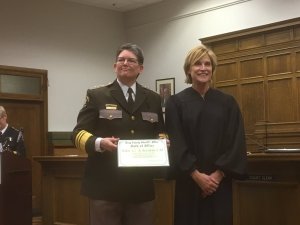 Pictured here is new King County Sheriff Mitzi Johanknecht, with Judge Laura Inveen, being sworn in Tuesday morning at the King County Courthouse.
It’s official! Please join us in welcoming Mitzi Johanknecht as our King County Sheriff!
Share this:

2017 brings a bond rating boost, lower costs for vital infrastructure

Crossposted from Clean Water Stories
 Operating a regional wastewater utility requires more than a dedicated workforce and highly specialized equipment. It also takes money, especially when it comes to funding new facilities to make sure our system keeps pace with population growth.
Just like you might borrow money to invest in a new home, or remodel a kitchen, we borrow money to build new facilities, or to upgrade or expand our system, by issuing bonds.
Read more at Clean Water Stories
Share this:

Visualizing King County: Timber cruise reports from 1907-08

Crossposted from Bytes and Boxes
New online! The King County Archives recently completed a project to image and rehouse 45 volumes of Assessor’s timber cruise reports dating from 1907-08. Valued by researchers for their detail and accuracy, the reports are a unique resource for this time period in King County. We are thrilled to make high-quality copies of these records easily accessible through our public search site.
The imaged reports document natural topography like ridges, swamps, and waterways; vegetation and soil types; human impacts such as areas that have been burned or logged; and the built environment, including trails, houses, farms, roads, mines, mills, and railroads.
Read more at Bytes and Boxes
Share this:

Sing-a-long: “These are a few of our public health things”

Crossposted from Public Health Insider
 Smileys on restaurants and signage on clinics
Saying “you’re welcome” to all who come in it
Kicking off Best Starts with com-mun-ities
These are a few 2017 things!
Spray parks and hygiene and tales made of doodles
Noro in oysters
And phthalates in noodles
Wild bats that fly and may carry rabies
These are a few 2017 things!
Read more at Public Health Insider
Share this:

Happy New Year from King County Employee Health & Well-Being

Crossposted from Healthy Incentives
As announced last month, there are exciting changes coming to the Employee Health & Well-Being Program, and happy days are ahead for King County employees! In case you missed it, visit the New Health & Well-Being Program site or check out this short video regarding the upcoming changes.
The Employee Health & Well-Being team is excited to get the New Year going. As we prepare to introduce the new program, here are ways to remain involved:
Stay engaged
Many of the programs and activities you enjoy are still available so stay engaged! See the list here.
Read more at Healthy Incentives
Share this:

Chief deputy of King County Sheriff’s Office featured in national magazine

 Chief deputy Jim Pugel is featured in a recent article by the Pew Charitable Trusts entitled Law Enforcement Veteran Offers New Perspective on Policing.
“I was taught to catch the bad guys and put them in jail and then go out and do it all over again.”
The article discusses criminal justice reform, recidivism rates, the LEAD program here in King County and how real-world consequences changed Jim’s thinking about crime and punishment.
Read more at the Pew Charitable Trusts.






 Employee News